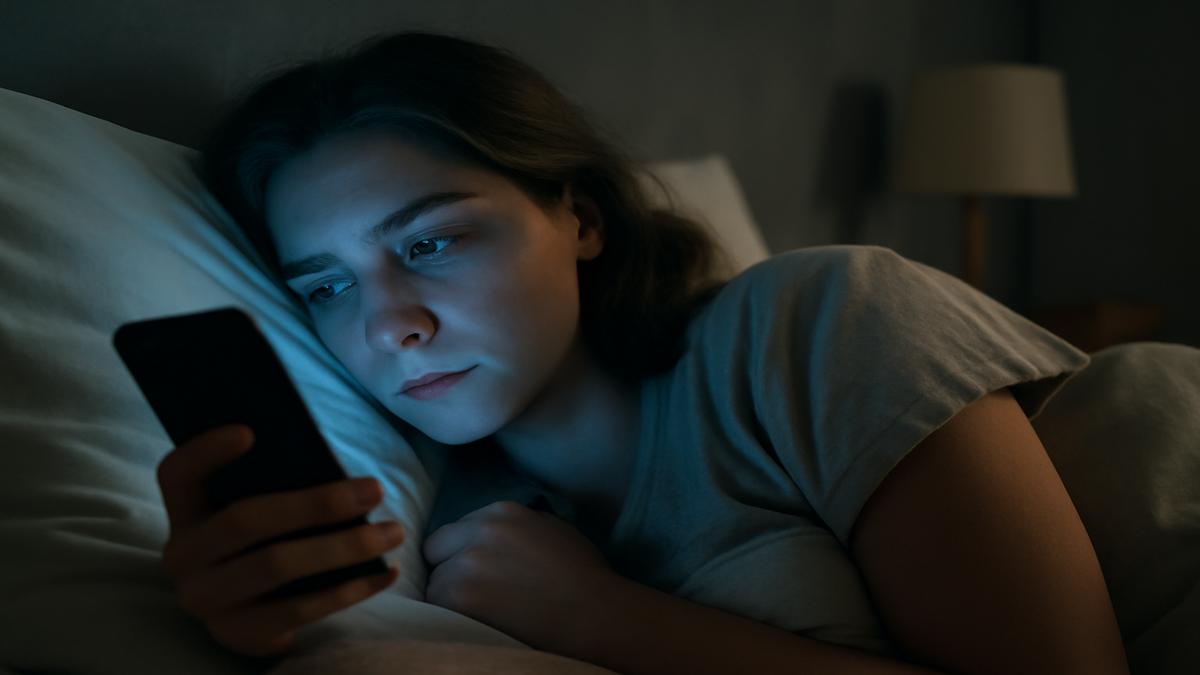
You’re lying in bed, thumb scrolling on autopilot, wrapped in the soft glow of your phone’s “Night Mode.” The screen has turned a cozy amber; the harsh blue glare is gone. Your eyelids feel heavy. You yawn, tell yourself, “It’s fine. I’ve turned on the blue light filter—I’m safe,” and you sink deeper into the screen’s warm light like it’s a digital campfire.
Then an hour vanishes. Your mind is somehow more awake than before. You set the phone down, turn off the lamp, and close your eyes. And suddenly it’s as if a projector has switched on behind your forehead—thoughts spinning, fragments of videos replaying, some random conversation from three days ago looping as though your brain is afraid to miss anything.
What if that comforting amber glow has been lying to you the whole time?
The soft lie of “Night Mode”
When your phone announced its blue light filter update a few years ago, it sounded like salvation. Turn the screen warm and you’d protect your melatonin, guard your circadian rhythm, and drift off like a baby deer in a meadow at dusk. The marketing felt strangely tender, like your device suddenly cared about your sleep.
The idea is simple enough: blue light—especially around the 460–480 nm wavelength—signals daytime to your brain via receptors in your eyes that talk to your internal clock, your suprachiasmatic nucleus. Block the blue, save the sleep. Easy.
Only, it isn’t that simple.
In dim rooms across the world, millions of us have been staring into warm-tinted versions of the same bright, stimulating content, believing we’re “protected” because the light looks less harsh. But your brain isn’t fooled by color alone. It cares about brightness, timing, and what you’re doing with that light far more than the gentle sepia wash your screen uses to reassure you.
Blue light filters aren’t completely useless—but they’re a bit like wearing sunglasses while staring directly into a bonfire at midnight and then wondering why your body still thinks it’s party time.
The real villain isn’t just color — it’s timing, brightness, and stimulation
Imagine walking outside into a forest just after sunset. The sky is bruised purple, tree trunks darkening into silhouettes. Colors drain from the leaves; everything flattens into shades of gray-blue. Your body reads all of this as “time to wind down.” Your pupils dilate, melatonin creeps upward, and the world grows softer.
Now imagine that quiet scene shattered by a floodlight.
Your phone, even in its warmest “Night Shift” or “Eye Comfort” mode, is still a tiny floodlight inches from your face—especially in a dark bedroom. Your eyes, and the clock deep in your brain, notice brightness first. The melanopsin-sensitive cells that regulate your circadian rhythm aren’t obsessed with the idea of “blue” as a color; they’re tuned to short-wavelength, high-energy light and to intensity. A bright, high-contrast, captivating screen—warm-tinted or not—still shouts “wake up” into that fragile nighttime system.
Then there’s the content itself. A tense work email. A comment you can’t stop thinking about. A news alert. The endless thumb-jerking novelty of short-form video. These aren’t passive experiences; they’re stimulation grenades. Your nervous system is built to respond: heart rate up, cortisol up, mental gears spinning. A warm-filtered video of someone yelling into a camera at 11:47 p.m. is still a jolt to your brain, no matter how golden your pixels look.
So while night modes may nudge you in a slightly better direction than full blast blue-white, they often produce something more dangerous: a false sense of security. You stay on your device longer, closer to bedtime, with just as much mental arousal—and then lie there, confused, wondering why sleep now feels like a distant animal that only visits other people’s houses.
The way your body reads light (and why screens break the spell)
Long before there were alarm clocks, blackout curtains, or phones buzzing on the nightstand, your ancestors used the sky as their only clock. Daylight, twilight, firelight, darkness: this daily choreography wrote itself into your biology. You are still built for that rhythm, even if your schedule lives inside a rectangle now.
Your body uses a few simple signals to decide whether it’s time to be alert or to drift toward sleep:
- Light intensity: Bright light, especially from above, screams “daytime” to your brain. Dim light tells it that the sun is low, evening is coming.
- Light spectrum: That crisp blue of a clear midday sky has a strong impact on your circadian clock. Warmer, fire-like tones suggest late evening. But again, it’s not
about color. - Timing: Light in the morning anchors your internal clock; light at night shifts it later, like dragging sunset down the timeline.
When you’re staring into your phone at 10, 11, 12 p.m., you’re feeding your eyes a high-contrast, near-field blast of artificial “day” at the exact moment your system expects dimness and gentle darkness. That timing alone—regardless of screen color temperature—can delay melatonin production, fragment sleep, and make it harder to feel sleepy at the right hour the next night.
You can test this on yourself without tracking apps or gadgets. Spend an evening camping or staying somewhere rural with minimal electric light. Let the sky do what it does. Let darkness be actual darkness. You may notice you feel drowsy earlier, your thoughts quiet faster, and your sleep feels heavier. Your biology hasn’t changed; you’ve simply stopped arguing with it.
So if the blue light setting is fake comfort… what actually helps?
Phones aren’t going away. Neither are laptops, tablets, or lit-up e-readers. The goal isn’t to retreat to a cabin and live by candlelight (unless you want to). The goal is to make your modern night feel just a little more like the natural evenings your body expects.
Think of it as rewilding your sleep—not with rigidity or shame, but with a series of small, practical shifts that gently nudge your nervous system toward rest instead of buzzing, backlit vigilance.
1. Treat “Night Mode” as background, not a shield
By all means, keep the warm filter on. It’s slightly better than harsh blue-white, especially if you work under screens all day. But stop treating it like armor. It’s seasoning, not the meal.
The key adjustment is mental: stay aware that a warm screen is still waking light. If you wouldn’t shine a bright desk lamp into your face at 11 p.m., your phone doesn’t deserve a free pass just because it looks like candlelight.
2. Turn brightness way down—and change your surroundings
Brightness is your first dial to reach for. Any time after sunset, start gradually ratcheting your screen brightness down. Not just one tiny notch—really down, to the edge of what’s still readable without strain.
Then look around your room. Overhead lighting dumps a false noon from the ceiling straight into your circadian wiring. Swap it for small, warm, low-positioned lamps. Better yet, use a single table lamp or a string of soft fairy lights. When light comes from below eye level and stays dim, your brain reads it more like firelight than like daybreak.
3. Create a digital “sunset” time
Most people think of bedtime as a fixed point: 11 p.m., lights out. Your body doesn’t work like a switch; it works like a gradient. It needs a dusk, not a cliff.
Pick a “digital sunset”—a time when you stop using phones, laptops, and tablets for anything stimulating. Make it 60–90 minutes before you want to be asleep. If you wake at 7 and want around eight hours, that might mean screens off by 10 p.m. at the latest, winding down toward 11:30.
You do not have to be perfect. Even one or two nights a week of honoring this digital dusk can recalibrate your internal sense of night. The key is consistency more than intensity. Your body loves patterns.
4. Swap doom-scrolling for analog rituals
There’s a small, sacred window between the day’s noise and sleep’s quiet. Most of us fill it by cramming more noise into a smaller space.
Try experimenting with analog replacements during that time. Instead of “one more” scroll:
- Read a paper book or a non-backlit e-reader.
- Journal or brain-dump worries onto a page so they’re not clanging around when the lights go out.
- Stretch lazily on the floor in a pool of lamplight—hip circles, shoulder rolls, whatever feels animal and unhurried.
- Listen to an audio story or gentle podcast with your eyes closed, screen facedown or across the room.
None of this needs to look like a wellness influencer’s curated night routine. Think “pleasant friction” between you and your phone: make sleep easier to fall into than your feed.
5. Guard your mornings if your nights are messy
Some seasons of life simply won’t let you have perfect evenings: newborns, shift work, late-night deadlines, long-distance calls with someone in another time zone. If nights are chaotic, put your energy into protecting your mornings.
Morning light is a powerful reset button. Within an hour of waking, go outside or to a window and let natural light hit your eyes (no sunglasses, if it’s safe and comfortable). Even on overcast days, this dose of daylight is much stronger and cleaner as a signal than your phone’s glare at midnight. It helps anchor your clock, which can soften the blow of the late-night light you couldn’t avoid.
And consider this quiet equation: the more your mornings feel grounded, the less desperate you’ll be to steal stimulation from the end of the day.
A simple sleep-friendly screen plan
Here’s a compact way to think about balancing your digital life with the way your body is wired for sleep. You don’t have to do it all at once; even one or two moves can shift your nights noticeably.
| Time of Day | What to Do with Screens | Why It Helps |
|---|---|---|
| Morning (first 1–2 hours) | Keep brightness normal or high if needed, but balance with 5–15 minutes of real outdoor light. | Strong morning light anchors your circadian clock and can make it easier to fall asleep at night. |
| Afternoon | Use screens as needed; no special rules, but take short breaks from continuous exposure. | You avoid eye strain and mental fatigue that build into nighttime restlessness. |
| Evening (2–3 hours before bed) | Turn on warm filters, start lowering brightness, and reduce emotionally charged content (arguments, work, news). | Gentler light and less stimulation allow your nervous system to downshift gradually. |
| Digital “Sunset” (60–90 minutes before bed) | Ideally, no phones or tablets. If needed, use only for calm, short tasks, with very low brightness and at arm’s length. | This window is when melatonin should rise; bright and engaging screens push it later. |
| In Bed | Keep the phone off the mattress and, ideally, outside arm’s reach. Use an alarm clock instead of your phone if possible. | Removing the “just one more scroll” temptation lets your brain associate bed with sleep, not stimulation. |
The quiet rebellion of protecting your night
There is a particular feeling when you walk away from your phone at night before you’re exhausted—when you turn off the lamp and your eyes are not ringing with afterimages of a glowing rectangle. The dark feels less like an empty void to fill and more like a soft, heavy blanket that’s been waiting all day to be pulled up around your senses.
This is not about purity or perfection. There will be nights when you fall asleep with the phone still in your hand, face bathed in amber light, mind chewing on someone’s hot take. There will be seasons when the glow is your only lifeline to people or work you care about.
But between those nights and seasons, there is room for tiny rebellions: dropping your screen brightness three more notches than feels comfortable at first. Leaving your phone on the kitchen counter after 10 p.m. and walking to bed with empty hands. Letting the outside sky, not your notifications, tell you what time it is.
Your phone’s blue light setting is not evil; it’s just a prop in a much bigger story your body is trying to tell about light and dark, day and night, effort and rest. When you stop mistaking the prop for protection, you can begin to choreograph something truer—and far kinder—to the animal that lives inside your human schedule.
Imagine one future night. You stand in a dim room, lights low, the hum of the day settling. You tap your phone dark earlier than you used to, not out of discipline, but because you’ve started to crave what comes next more than one more scroll. You feel your brain loosen its grip. You lie down. The dark is deep, uncomplicated. Somewhere inside, your clock nods in approval.
That’s not something any display setting can give you. That’s you, reclaiming the rhythm that was always yours.
FAQ
Does blue light really affect sleep, or is it overhyped?
Blue light itself does have a measurable impact on your circadian rhythm and melatonin production, especially in the evening. But the impact people feel most in daily life usually comes from a combination of factors: bright light at night (of any color), mentally stimulating content, and using screens right up until the moment they try to sleep. So blue light isn’t a myth—but it’s only one piece of a bigger puzzle.
Are blue light–blocking glasses worth it?
They can help somewhat, especially if you use screens heavily in the evening and can’t avoid them for work. However, they shouldn’t be your only strategy. Glasses don’t change brightness, timing, or the emotional stimulation of what you’re watching or reading. They are a supplement to good habits, not a replacement for them.
Is reading on my phone at night really that bad if I use dark mode?
Dark mode and warm filters are better than stark white backgrounds, but the screen is still a bright, close light source, and the device itself is loaded with distractions. If you like reading at night, a paper book or a non-backlit e-reader in dim, warm light is gentler on both your eyes and your sleep system.
What if I need my phone as an alarm?
If you must use your phone as an alarm, try keeping it on a dresser or table away from your bed instead of under your pillow or in your hand. That distance reduces the temptation to scroll in bed and still lets you hear the alarm. Long term, a simple, inexpensive alarm clock is often the easiest, most sleep-friendly fix.
How long before bed should I stop using screens for the best sleep?
Most people do best when they avoid bright, stimulating screens for at least 60–90 minutes before their intended sleep time. Even 30 minutes helps, but a longer “digital dusk” gives your brain more time to wind down, melatonin to rise, and your body to shift into sleep mode more naturally.

Hello, I’m Mathew, and I write articles about useful Home Tricks: simple solutions, saving time and useful for every day.