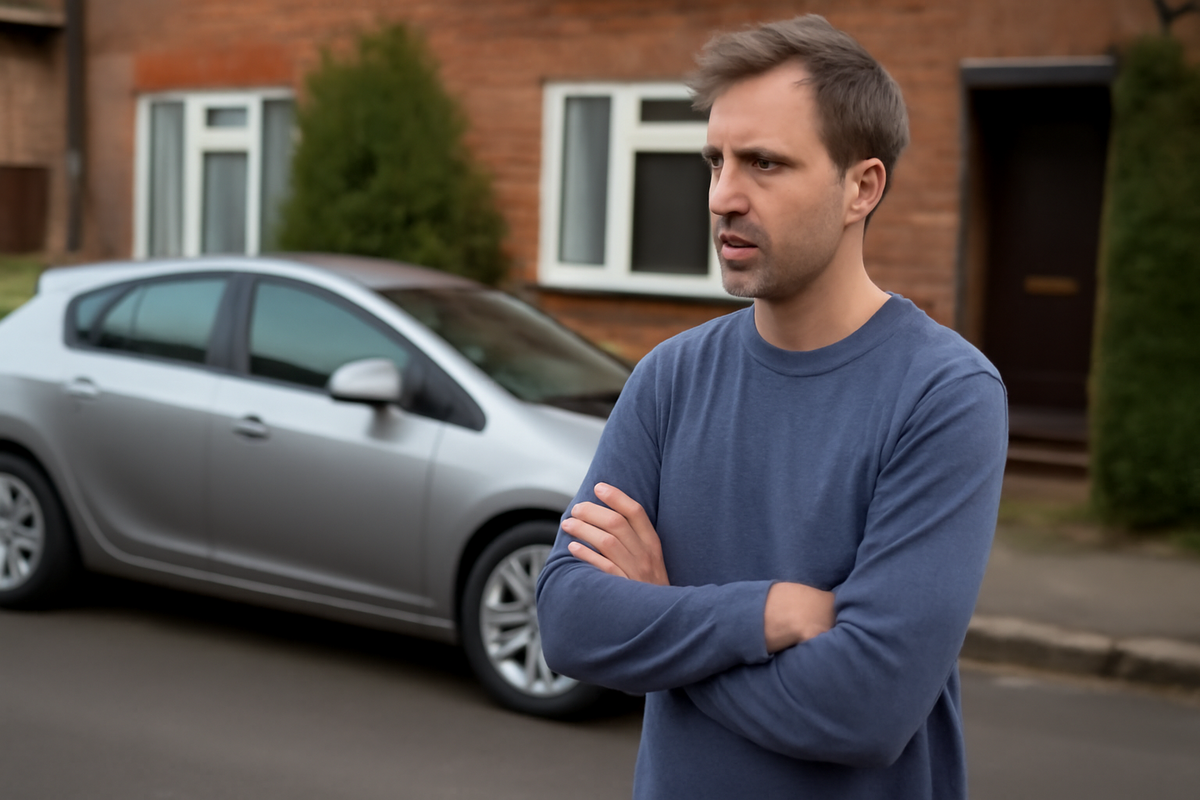
The first time you hear an unfamiliar engine idle outside your window for just a little too long, a strange tension moves into the room with you. It might be evening, dishes still drying on the rack, or early morning when the kettle is beginning to sing. You pause, listening. That car isn’t yours. It isn’t your neighbor’s either. You pull back the curtain, peering through that tiny gap you’ve used a hundred times before just to check the weather or watch the birds. And there it is, a vehicle you don’t recognize, sitting directly in front of your house like it owns the patch of curb you quietly think of as “yours.”
You feel it then—that flicker of irritation mixed with doubt. Are they allowed to park there? For how long? Is it rude, or is it illegal? You remember something about public streets and rights-of-way, about “no parking” signs and fire hydrants and driveways that should never be blocked. But none of that feels especially helpful while you stand at the window in your socks, staring at a stranger’s bumper. You wonder how long they can stay before they cross some invisible line from mildly annoying to plainly unlawful.
The Quiet Myth of “My” Curb
There’s a kind of unspoken story we tell ourselves about the land just beyond our front steps. The lawn, the front tree, the mailbox: clearly ours. The sidewalk feels shared, but it’s still part of the world that belongs to our home. But the curb? That’s where the story gets blurry. We instinctively think of the curb in front of our house as an extension of our property—our unofficial driveway overflow, our guests’ landing zone, the space where moving trucks and deliveries should intuitively belong to us by proximity alone.
Legally, though, that quiet belief usually doesn’t hold up. In most places, the street and the curb are public property, managed by the city, town, or county. That means anyone with a properly registered vehicle, following posted rules, can usually park along that stretch, whether they live three doors down or three neighborhoods away. It’s a bit like discovering that the sunny chair by your favorite café window, the one you always sit in, isn’t actually “your” chair—just a spot you’ve become emotionally attached to.
Still, your emotional claim is no small thing. You watch over that space. You shovel snow off it in winter. You pick up leaves and trash. You feel protective, and that matters in how conflicts start—or don’t. The law might call it public right-of-way, but your heart calls it home turf. The challenge is learning how those two realities coexist without turning every parked car into a personal affront.
What the Law Usually Says About Street Parking
If you could float above your neighborhood, watching the grid of roads like a living map, you’d see patterns of rules woven quietly into the asphalt. Painted curbs. Posted signs. Fire hydrants. Driveways. Crosswalks. Each one is a word in the legal language of parking, telling you where a car may rest and where it must stay away.
Most communities follow a similar baseline: if a street is public, not posted with special restrictions, and your vehicle is legal and not blocking anything important, you’re generally allowed to park. That logic applies in front of your house, your neighbor’s house, and even the one with the perfect shade tree everyone secretly covets.
Of course, there are limits. They tend to show up in city ordinances and traffic codes that few people read until they’re fuming at the window or staring at a parking ticket. Typical rules might include:
- No blocking driveways, even partially.
- No parking within a certain distance of fire hydrants, intersections, or crosswalks.
- No overstaying posted time limits (like “2-hour parking”).
- No leaving inoperable or unregistered vehicles on the street.
- No parking too close to stop signs, bus stops, or loading zones.
These rules don’t care who lives where. Your address doesn’t give you special ownership of the curb any more than your favorite park bench becomes deeded land. In legal terms, the right to use the curb usually belongs to everyone under the same set of conditions.
So, How Long Can Someone Park There?
That uncomfortable question—how long can they stay?—rarely has one universal answer. It usually depends on three main factors: local time limits, long-term storage rules, and any special designations on your specific block.
Time limits, if they exist, are often posted: one-hour parking, two-hour parking, or “no parking between 2–5 a.m.” If you don’t see a sign, your town might still have a general rule buried in its municipal code, like “no vehicle may remain parked in the same spot on a public street for more than 24 or 72 hours.” These kinds of rules are designed to keep public streets from turning into long-term storage lots for unused vehicles.
There’s another layer, too: some neighborhoods have residential permit zones or visitor restrictions, especially near busy downtowns, campuses, or train stations. In those areas, how long someone can park isn’t just about time—it’s about who they are on paper. A car without the right permit might be allowed only for a short daytime window, or not at all during certain hours.
All of this means that the car in front of your house might be legally fine for an entire weekend—or only for a couple of hours—depending entirely on your local rules. The tension comes when your sense of fairness bumps against a stranger’s quiet compliance with the law.
Property Lines, Feelings, and That Invisible Wall
Step outside and stand at the edge of your driveway. If you could see your property line glowing on the ground like a beam of light, you might be surprised where it actually ends. In many places, the land up to and sometimes beyond the sidewalk is technically part of a public right-of-way, even if you mow the grass and shovel the snow. You’re caring for it, but you don’t fully own it in the way you own the living room couch.
The curb is almost always on the public side of that invisible border. From a legal perspective, that’s where your control fades into something more communal. Yet it doesn’t feel communal when the same unfamiliar truck shows up day after day, sitting in front of your picture window while its owner lives a street over—or doesn’t live anywhere nearby at all.
That’s when the human part kicks in. You start asking different questions, the ones you can’t find in a statute book: Is this considerate? Is it neighborly? Is it safe? You might notice how hard it becomes for your elderly parent to be dropped off, or how your kids have to navigate around a larger vehicle every morning. You might feel a small but persistent pressure every time you park around the corner and carry groceries farther than you’d like.
The law lays out where your rights end, but courtesy decides where your relationships begin. That’s the invisible wall many people run into long before they ever think of calling the police or city hall.
Common Legal Limits on Long-Term Parking
Even if a street is public and fair game, most communities still want a certain amount of movement. A car that never leaves its spot becomes part of the landscape in a way the law doesn’t usually allow. This is where abandoned vehicle and long-term parking rules sneak in, slowly but surely.
You might find local rules that say things like:
- No vehicle may be parked in the same location on a public street for more than 24, 48, or 72 hours.
- Any vehicle that appears inoperable (flat tires, broken windows, missing plates) may be tagged and towed after notice.
- Overnight parking may be restricted on certain streets or citywide during winter for snow removal.
If that unfamiliar car has become a fixture in front of your house for days on end, and you’re certain it hasn’t moved, these are the kinds of laws that might apply. The trick is proving it. Often, enforcement involves a chalk mark on a tire, a note of the license plate, and a countdown before a warning or ticket appears.
It’s not usually about the discomfort you feel when you see the same car each day; it’s about keeping streets usable, clear, and safe for everyone. The law tends to move slowly here, but it does move—especially when safety or abandoned vehicle concerns are involved.
When Is It Actually Illegal to Park in Front of Your House?
You might stand at your front window and feel a deep sense of injustice, but feelings alone don’t write tickets. To cross from annoyance into illegality, certain conditions almost always have to be met—conditions that are much less emotional and much more technical than most of us like.
Parking in front of your house is usually illegal only if it breaks a specific rule. Those rules often include:
- Blocking your driveway or garage access.
- Parking too close to a fire hydrant or intersection.
- Ignoring visible “no parking” or time-limit signs.
- Violating a residential permit requirement.
- Leaving a vehicle long enough to trigger abandoned-vehicle or maximum-time laws.
If a car is simply sitting legally along the curb—registered, positioned properly, not blocking anything—it often doesn’t matter that it’s in “your” usual spot. The law rarely recognizes emotional inconvenience as a violation.
Still, there’s one more layer: harassment or targeted behavior. If someone is deliberately using street parking to intimidate or stalk you, the issue may shift from traffic law into the realm of harassment or nuisance. That’s a more complex story involving patterns, evidence, and sometimes restraining orders, but it does exist. The same curb that is usually a neutral zone can become a focal point in larger disputes.
A Simple Glance at Typical Local Rules
Every community writes its rules in its own voice, but many share a similar backbone. Here’s a simplified comparison that might resemble what you’d see if you quietly combed through a few different towns’ codes one evening, tea in hand, trying to make sense of your curbside frustration.
| Topic | Common Rule in Many Areas |
|---|---|
| Who owns the street? | Usually the city, town, or county; it’s public right-of-way. |
| Can others park in front of my house? | Yes, if they follow all parking rules and signs. |
| Typical time limit without signs | Often 24–72 hours in the same spot, but highly local. |
| Driveway access | Blocking any driveway is usually prohibited and ticketable. |
| Special zones (permits, time limits) | May restrict who can park and for how long, especially in busy areas. |
Emotions, Neighbors, and the Art of the Knock on the Door
Law can be cold. It lives in thick books and dry web pages, in sections and subsections and line after line of exacting language. But life on your street is warm and messy and small enough that you can smell the neighbor’s cooking when the windows are open. Somewhere between the black-and-white rules and your very real frustration lives the thin, fragile space of human interaction.
Sometimes the car parked in front of your house belongs to someone visiting a neighbor who never thought to ask whether you’d mind. Other times it’s a delivery driver, a caregiver, a home health aide, a plumber, or a teacher picking up a child. On many of those days, the solution isn’t in the legal code—it’s in a calm conversation.
That might mean stepping outside and, in a voice as neutral as you can manage, saying something like, “Hey, just so you know, it’s really tough for us when this area is blocked for long stretches. Is there any chance you could use the other side of the street when you can?” It’s not a demand, because you may not have the legal right to make one. It’s a request for courtesy, which lives in a different universe altogether.
Of course, not every neighbor will respond with warmth or understanding. Some might bristle, some may shrug, and a few might dig in, defending their own sense of entitlement to public space. That’s when it’s worth remembering that not every curbside conflict needs to become a war. With a clearer view of what the law actually allows, you can choose your battles more carefully—and sometimes decide that while a situation is irritating, it’s not worth escalating.
When to Involve the City or Police
There are times when the hum of an idling engine outside your home shifts from mildly irritating to genuinely concerning. A car might block your driveway when you need to get to work. A vehicle may sit abandoned-looking for weeks, collecting leaves and dust. Or someone might deliberately park in front of your home in a way that feels targeted and hostile.
In those moments, the question becomes less “Is this considerate?” and more “Is this allowed, and who enforces it?” That’s when contacting non-emergency police lines or local parking enforcement becomes reasonable. Before you call, though, it helps to gather details: license plate, make and model, how long it’s been there, whether it’s blocking anything, whether you’ve noticed it move.
When you do reach out, the answer may not be what you hope. An officer or clerk might tell you, firmly but politely, that a legally parked car on a public street is beyond their power to move just because it’s in front of your house. On the other hand, if the vehicle is clearly blocking a driveway, covering a hydrant, or violating a time-limit or abandoned-vehicle rule, they might tag it, ticket it, or eventually tow it.
It’s strange, learning the difference between “this feels wrong” and “this is actually against the rules.” But once you do, something softens. You know when to breathe and let it go, when to knock and ask for cooperation, and when to take a more formal step.
Learning to Share What Was Never Truly Yours
Standing at your window, you may still feel the sting when a stranger settles in along the curb you cleared of snow last winter. You might always wish there were some invisible shield around your home, a respectful buffer that everyone just understood. But on most streets, the law was never written to grant that private bubble of space. It was written to weave everyone into the same shared web of pavement and parking and movement.
Once you accept that the curb in front of your house is not fully “yours,” something else can grow in that space: perspective. You become the person who knows the difference between legal and illegal, between annoying and actionable. You may still grumble under your breath, but you also learn to pick your moments—to ask kindly, to call when it truly matters, and to remember that you, too, park in front of places that someone else quietly calls home.
The street, after all, is the great leveler. Your neighbor’s guests, the visiting nurse, the delivery driver, the friend who only finds one open spot on the block—they’re all part of the same ongoing story written in tire tracks and tail lights. Knowing the rules doesn’t make the irritation vanish overnight, but it does give you the one thing that’s always more powerful than a passing car: the calm certainty of where you stand.
FAQ: Parking in Front of My House
Do I legally own the curb in front of my house?
In most places, no. The curb and street are public right-of-way owned or controlled by the city, town, or county, even if they’re directly in front of your property.
Can I stop someone from parking in front of my home?
Usually only if they’re breaking a specific law—like blocking your driveway, a hydrant, or violating posted restrictions. You generally can’t stop someone from using legal on-street parking just because it’s near your home.
Is it legal for a neighbor to park in front of my house every day?
Often yes, as long as they follow all parking rules and any time limits. Emotional frustration doesn’t automatically make their parking illegal, though it can certainly affect neighborly relations.
What if a car hasn’t moved from in front of my house for days?
Your local rules might treat that as long-term or abandoned parking, often with limits like 24–72 hours in the same spot. You can usually report it to parking enforcement or a non-emergency police line to check.
Can I put cones or signs to reserve the space in front of my house?
Generally no. Placing objects in the public right-of-way to reserve parking is often prohibited, and in some areas those objects can be removed or you can be fined.
What should I do if someone is blocking my driveway?
Blocking driveways is commonly illegal. You can usually contact local parking enforcement or the non-emergency police line, providing details so they can ticket or tow if allowed by local law.
How can I find out the exact parking rules for my street?
The most reliable way is to check your city or county’s parking or traffic ordinances or contact local parking enforcement. They can clarify time limits, permit zones, and any seasonal or special restrictions that apply to your block.

Hello, I’m Mathew, and I write articles about useful Home Tricks: simple solutions, saving time and useful for every day.