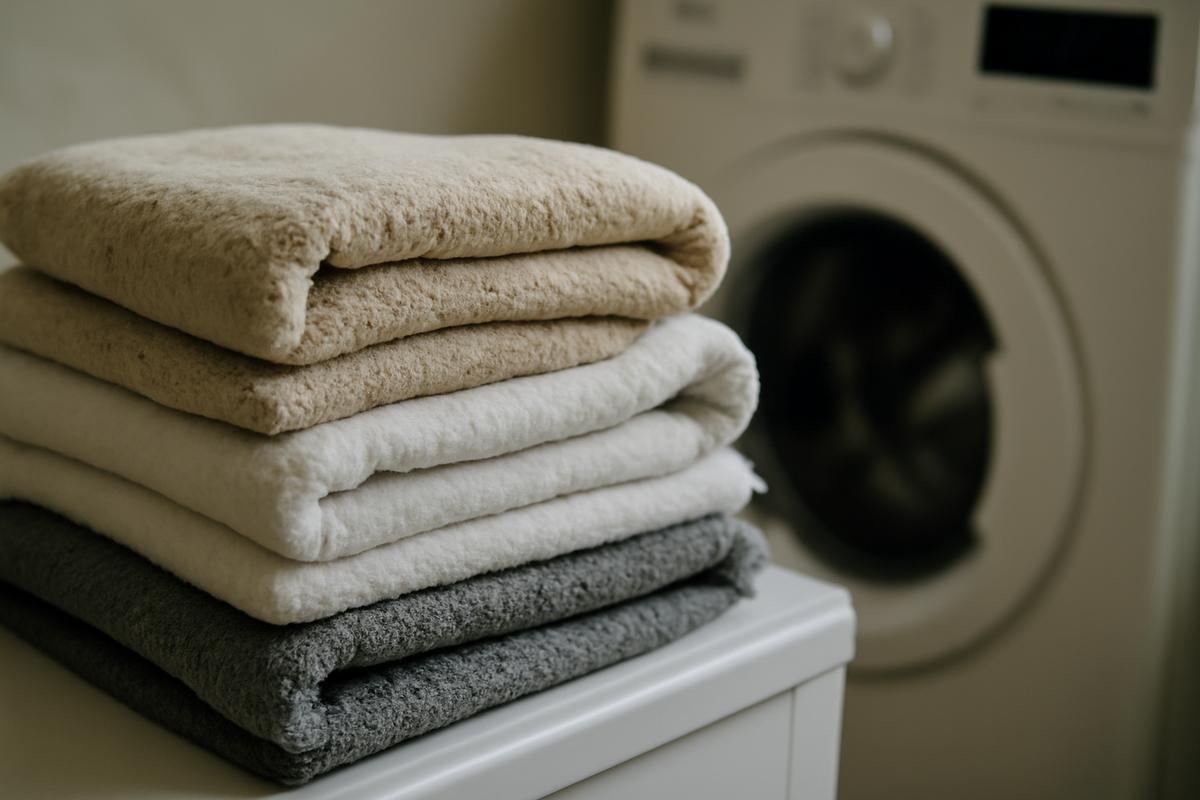
The towel looks innocent enough at first. Folded on the bathroom shelf, it’s plush in memory, soft in your imagination. But then comes the moment of truth: you step out of the shower, steam curling around you, water beading on your skin. You reach for that towel, press it to your shoulders… and instead of that cloud-like hug you were expecting, you get something closer to a sun-dried doormat. Stiff. Scratchy. Almost resentful.
It’s confusing, isn’t it? You wash them, you dry them, you buy the “good” ones, maybe even splurge on fancy fabric softener—and still, they end up feeling like cardboard. It feels a bit like a small domestic betrayal, a tiny mystery hiding in the laundry basket. But like most mysteries, there’s a story behind it—a quiet, everyday tale written in minerals, detergents, fibers, and the way we live with water and cloth.
The Hidden Life of a Towel
Every towel has a secret life you rarely see. When it wraps around you in the morning, it’s not just drying you off; it’s collecting the salt from your skin, traces of soap, tiny flakes of skin, oils, and whatever minerals are dissolved in your tap water. Day after day, shower after shower, it absorbs not just water—but your life in miniature.
The first few washes are a honeymoon phase. The loops of cotton, fresh from the factory, are open and fluffy. They drink in water greedily and spring back like fresh grass after rain. You hang them, fold them, stack them. Nothing squeaks or scratches.
But time makes collectors of everything, including towels. Those soft loops begin to pick up what your water leaves behind: calcium and magnesium from hard water; leftover detergent that never quite rinses out; traces of fabric softener that coat instead of soften. The towel doesn’t change all at once. It’s gradual. The loops start to mat down, tiny crystals and residues crust around the fibers, and the once-flexible threads grow rigid.
And so one day, you step out of the shower, and the story has changed. The towel still looks fine—at a glance—but the touch has turned from meadow to scrubland.
The Quiet Culprit: Hard Water and Hidden Minerals
Most people blame the washer, or the brand, or the dryer setting. But often, the real villain is something you can’t even see: the water itself. If you’ve ever noticed chalky spots on your shower door, clinging scale on the kettle, or a faint film on glassware, you’ve already met the quiet sculptor that’s hardening your towels—hard water.
Hard water is full of dissolved minerals, especially calcium and magnesium. While these minerals aren’t harmful to drink, they build invisible layers on fabric over time. Imagine each towel fiber as a tiny strand of grass. Now imagine dust slowly settling, day after day, and turning to microscopic stone around each blade. That’s what hard water does. It leaves mineral deposits that wrap around those cotton loops, making them stiff, rough, and reluctant to absorb.
Inside your washing machine, the dance is even more complex. Detergent is busy trying to break up oils and grime, but hard water barges in, binding with the detergent molecules. That means your soap has to work double-time just to do the basics. Some of it can’t rinse out properly, and instead, it clings to the towel, mixing with minerals and forming a residue that feels a bit like finishing powder on fabric. Layer after layer, wash after wash.
The result? Even a freshly washed towel can feel like it’s already been around the block. It’s not really “dirty,” but it’s not free either. It’s weighed down with invisible echoes of every previous wash cycle.
When Softener Makes Things Harder
There’s another twist in the story, one that feels especially unfair: the hero product you bought to fix the problem might actually be deepening it. Fabric softener, for all its pleasant scents and silky promises, doesn’t make fibers softer in the way you might think. Instead, it coats them with a thin, waxy, lubricating layer.
For some fabrics—like certain synthetics, sheets, or light clothing—that’s not disastrous. But towels are different. Their whole job is to absorb water. Those thirsty loops of cotton need space, texture, and contact. When fabric softener coats them, it fills in the gaps, flattens the loops, and reduces their ability to grab onto water. It’s like smearing lotion on a sponge and expecting it to soak up a spill.
Over time, this coating doesn’t just affect absorbency—it adds to the stiffness. The waxy layer can combine with detergent residue and hard water minerals, like building up varnish on already-tired wood. You might notice that your towels smell nice, but feel wrong. Or they take longer to soak up water, almost repelling it at first touch.
Then there are dryer sheets, those crackling little squares that promise cloud-like softness. They work on the same principle: coated fibers, less static, more slip. But on towels, that slip is exactly what you don’t want. Towels need a bit of friction to feel plush and to function well. The silky glide of a dryer sheet might make clothing feel pleasant, but on a towel, it turns into waxy drag and stiffness.
The Slow Build-Up You Can’t See (But Definitely Feel)
It’s tempting to imagine that towels “go bad” suddenly, that they simply reach a certain age and then collapse into scratchiness. But mostly, stiff towels are a story of quiet accumulation. Little by little, layer by layer, residues build up until softness is muffled under everything left behind.
Picture the path of a single towel over a year. It’s used, hung on a hook where it doesn’t quite fully dry. Maybe you live in a humid climate, where dampness lingers. Between washes, it sits slightly moist, a gentle incubator for smells and invisible films. Then it’s thrown into the hamper with a mix of other fabrics, skin oils, hair, the faint dust of daily life. Into the machine it goes, with a generous scoop of detergent—maybe more than it really needs, because more soap must mean more clean, right?
The machine fills with water that’s a little too cool to dissolve all that soap completely. Some of the detergent never really lets go; it clings instead. The rinse cycle tries its best, but the load is heavy, the water hard, the drum crowded. Out come the towels, cleaner but slightly more encased than before.
In the dryer, high heat does another kind of work. The loops of cotton tighten and contract a bit under the heat, especially if they’re being over-dried. Any remaining residues bake in more firmly. If you’ve added dryer sheets, a new layer of coating joins the party. The towel emerges fluffy-looking, thanks to tumbling air, but touch tells a different story—crisp, rigid, almost squeaky.
This is why your newer towels sometimes feel amazing at first, then slowly lose their charm. It’s rarely about the quality alone; it’s the slow, quiet build-up of everything they’ve been asked to carry. A towel isn’t failing. It’s simply saturated with tiny leftovers.
How Everyday Habits Shape Your Towels
Your towels are little mirrors of your laundry habits—and the environment they live in. Many of the small routines that feel harmless actually shape the texture of those loops over time.
Think about detergent, for instance. Those bright caps and scoops practically invite overuse. Yet most towels don’t need as much detergent as you think—especially if they’re only being used to dry off clean skin. Extra detergent doesn’t equal extra clean; it often equals extra residue. Each wash, a fine invisible layer clings to the fibers like dust on a bookshelf.
Water temperature adds another note to the story. Very hot water can be harsh on fibers, especially over many cycles, weakening threads and causing them to lose their spring. Very cold water can fail to dissolve certain detergents fully, encouraging buildup. Somewhere in the middle—warm, not scalding—usually gives towels the best balance between cleaning and kindness.
Load size also plays a quiet but crucial role. When the machine is overly full, towels can’t move freely, rub, and rinse properly. Detergent gets trapped between layers, and the rinse water never quite sweeps everything away. Too tight a crowding inside the drum, and you get a wash that looks busy but accomplishes less than you think.
Then there’s how often—and how—you dry. High, prolonged heat in the dryer can leave towels brittle, especially when they’re already coated with residues and minerals. Line drying under a hot sun can create its own version of stiffness, as fibers dry rigidly without the tumbling motion that softens them. None of these are wrong; they just shape texture in quiet ways.
Simple Rituals to Coax Back the Softness
The good news is that stiff towels are not always a final verdict. In many homes, they’re more like a call to adjust the ritual. With a few small shifts, you can slowly strip away the residues, unbind the fibers, and invite your towels back into something closer to their original kindness.
One of the simplest allies in this work is something already in many kitchen cupboards: white vinegar. Not the perfumed kind, not mixed with anything fancy—just plain, distilled white vinegar. Used occasionally in place of fabric softener, it acts as a gentle dissolver of mineral scale and detergent residue. It doesn’t leave its scent behind when used in moderation; instead, it leaves less coating on the fibers and more breath in the loops.
Baking soda can also be a quiet helper. Added to the wash, it can help neutralize odors and loosen some of the build-up clinging to the fabric. These ingredients don’t create softness by coating; they create it by subtraction, by taking away what doesn’t belong.
Another shift is simply using less: less detergent, fewer products, less heat. Trusting that a smaller amount of soap, properly rinsed, is kinder than an overflowing cap. Choosing warm water instead of very hot for most towel loads. Letting the dryer run on a medium setting and removing towels while they still hold a hint of warmth and flexibility, rather than waiting until they’re bone-dry and brittle.
If hard water is your constant companion, you may find that your towels will always lean a little toward the stiff side unless you change the water itself, with a softening system. But even without that, careful washing habits can slow the mineral buildup and keep towels more inviting for longer.
A Quick Glance Guide: Why Towels Turn Stiff
Here’s a compact view of what might be happening to your towels—and what you can try instead.
| What’s Going Wrong | What It Does to Towels | Gentler Alternative |
|---|---|---|
| Hard water with high mineral content | Leaves mineral deposits that stiffen fibers | Occasional rinse with white vinegar; consider a water softener if possible |
| Too much detergent in each load | Causes soapy buildup, waxy feel, less absorbency | Use smaller doses; run an extra rinse if needed |
| Regular use of fabric softener or dryer sheets | Coats fibers, flattens loops, reduces softness | Skip softeners; tumble dry with air only or dryer balls |
| Overloading the washing machine | Poor rinsing, trapped detergent and minerals | Wash fewer towels at a time for better movement and rinsing |
| Over-drying on high heat | Makes fibers brittle, bakes in residue | Use medium heat; remove while slightly warm and fold |
Letting Towels Breathe Like They Once Did
Somewhere in your home, there might be a towel that still remembers what it felt like to be new. Maybe it’s a guest towel, seldom used. Maybe it’s the one you reserve for visitors, the one that never gets tossed into a crowded load with jeans and hoodies. Touch it, and you’ll feel how open its loops are, how quietly it drinks in water, how it drapes rather than creaks.
That memory is a kind of compass. It reminds you that towels aren’t meant to be eternal; they wear, they age, and sometimes they simply reach the end of their comfortable life. But it also reminds you what’s possible when fibers are cared for with a little more patience and a little less product.
Letting towels “breathe” means giving them space in the machine, space on the line, space in the dryer. It means trusting that soft doesn’t always come from a bottle, but often from absence—less residue, fewer coatings, gentler heat, more thorough rinsing. It’s a kind of minimalism for laundry, a quiet step back from the idea that more is always better.
Even if your water is stubbornly hard, even if your towels have been stiff for as long as you can remember, small shifts can still make a difference. A few washes with no softener, a little less detergent, a splash of vinegar once in a while, a break from overdrying—bit by bit, you may feel the loops loosen their shoulders again.
And the next time you step out of the shower, steam soft on your face, you might notice a small but important change. The towel that greets you will still be the same old towel, the same color, the same familiar weight. But as you draw it around your shoulders, it won’t resist. It will bend. It will drape. It will remember how to be kind to your skin again.
FAQs About Stiff Towels
Why do my towels feel stiff even with fabric softener?
Fabric softener coats the fibers instead of cleaning them. On towels, that coating builds up, trapping detergent and minerals and making the loops less flexible and less absorbent. Over time, this can make them feel even stiffer.
How can I make my stiff towels soft again?
Try washing them without fabric softener, using less detergent, and adding a cup of white vinegar to the rinse cycle. You can also run an occasional wash with baking soda. Dry on medium heat and avoid over-drying.
Does hard water really affect towel softness?
Yes. Hard water leaves mineral deposits on towel fibers. These deposits make the fabric feel rough and can also trap detergent residue. If you have hard water, you may notice stiffness more quickly and more persistently.
Should I stop using fabric softener on towels completely?
For most towels, it’s best to skip fabric softener and dryer sheets. If you like a fragrance, use it sparingly and only occasionally, and rely more on good rinsing and proper drying for everyday softness.
How often should I replace my towels?
With regular use, many towels last two to five years before they lose much of their softness and absorbency. If you’ve tried deep-cleaning and the fibers still feel thin, scratchy, or non-absorbent, it may simply be time to retire them.
Is line-drying bad for towels?
Not at all—but line-dried towels can feel a bit crisp, especially in strong sun or wind. You can soften them by giving them a short tumble in the dryer afterward on a low or air setting to loosen the fibers.
Why do my towels feel soft but don’t absorb water well?
That often means they’re coated with fabric softener or residue. They may feel smooth to the touch but resist soaking up water. Stripping that buildup with vinegar and baking soda washes can help restore their absorbency.

Hello, I’m Mathew, and I write articles about useful Home Tricks: simple solutions, saving time and useful for every day.