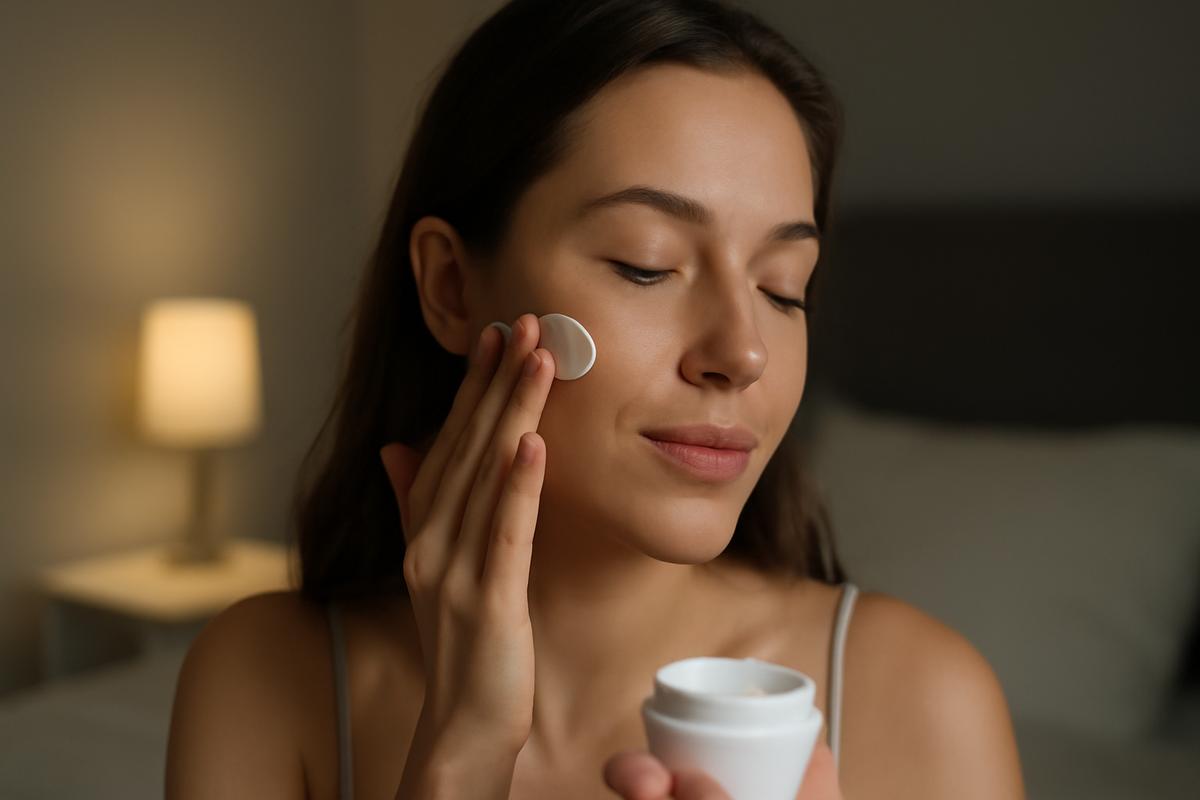
The first time you notice it is almost accidental. You’re standing in the bathroom, end of a long day, bare feet on cool tile, the mirror still holding the last of the shower’s steam. You scoop a familiar cream from its jar. It feels the same as it did this morning—silky, faintly fragrant, a small luxury you’ve repeated countless times. But tonight, it seems to sink into your skin as if your face has been waiting for it. The usual tacky film doesn’t linger. Instead, the cream disappears quickly, almost greedily, leaving your skin soft, supple, calmer. You blink at your reflection. Same product. Same hands. Same face. Different time of day. And yet, something is obviously different.
The Secret Night Life of Your Skin
Your skin lives a double life, and it doesn’t bother to hide it. By day, it is a soldier—armor against sunlight, pollution, temperature swings, the slight sting of wind and the quiet insult of city air. Its mission from dawn to dusk is clear: defend, deflect, endure.
By night, though, your skin changes roles. It moves from defense to repair, from “keep out” to “let in.” If you could watch your skin at a microscopic level, it would look almost like a shift change in a factory. Day workers clock out; the night crew takes over. Barriers loosen, blood flow shifts, cell activity hums with different instructions.
This is why that evening cream seems to melt more easily, why a serum at night can feel almost too strong compared to the same one in the morning. Your skin isn’t playing tricks on you—it’s following an ancient rhythm written into your cells, guided by the same internal clock that tells you when to sleep, when to wake, when to feel hungry, when to feel tired.
Deep in your brain, the suprachiasmatic nucleus—your master clock—keeps time with light and darkness, sending subtle signals to every organ, including your skin. As the light fades, your body shifts gears: hormones change, temperature dips, and your skin quietly gets to work. In this low-light phase, your cream isn’t just a surface layer; it’s an invited guest.
The Daytime Fortress vs. the Nighttime Gateway
To understand why your skin absorbs cream better at night, imagine it as a house whose windows and doors behave differently depending on the hour. During the day, the windows are tightly shut. At night, they crack open just enough to let fresh air and good things in.
In scientific terms, that house is your skin’s barrier function, especially the outermost layer: the stratum corneum. In daylight hours, this layer tightens up to shield you from UV rays, environmental toxins, and microscopic strangers. Your skin’s surface tends to be slightly more rigid, a bit more selective. Hydration levels are often lower by afternoon, but paradoxically, your skin is also better at blocking entry—like a thirsty person still insisting on keeping the door locked.
Come nightfall, that changes. Research has shown that your skin’s permeability—the ease with which substances can pass through—increases in the evening and at night. It’s not a dramatic swinging open of the gates, but a subtle, measurable softening. Lipids shuffle, micro-gaps widen slightly, and the skin becomes more receptive. Your night cream slips through that softened armor with a little less resistance.
At the same time, trans-epidermal water loss (TEWL) tends to increase during the night. In simple terms, your skin loses more water after dark. That might sound like bad news, but it’s actually an invitation: when you apply a cream, especially one rich in occlusive and humectant ingredients, it can trap moisture more effectively right when your skin is naturally letting it go. The timing is almost poetic—your skin opens up, and your cream arrives like a timely rain.
When Your Cells Clock In for the Night Shift
There’s a moment, usually a few hours after you fall asleep, when your skin is at its busiest. Invisible to you, entire neighborhoods of cells are awake and working overtime. Some are cleaning up the day’s damage. Others are building new proteins, stitching together tiny breaks in your skin’s structure, and restocking antioxidants to face tomorrow’s light.
These nightly repair rituals are driven by your circadian rhythm. During the day, your skin’s priority is to fend off environmental insults, so it leans on antioxidant systems, melanin production, and structural defenses. At night, the balance tips: DNA repair ramps up, cell turnover increases, and enzymes that rebuild collagen and elastin have more bandwidth to operate. Blood flow to the skin also rises, bringing along oxygen and nutrients like tiny care packages.
Now place your night cream into this scene. It’s not just resting on top of your skin while this work unfolds—it’s participating. Ingredients like niacinamide, peptides, ceramides, and retinoids can synchronize with this internal timetable, offering building blocks and signals exactly when your skin is most primed to use them. Think of your night cream as both a meal and a toolkit placed on the workbench just as the craftspeople begin their shift.
That’s part of why you might wake up some mornings surprised at how different your skin looks compared to when you went to bed: a little plumper, a little brighter, a little calmer. It isn’t magic. It’s maintenance—well-timed, deeply biological maintenance.
Why Nighttime Feels Different on Your Face
Beyond your skin’s internal rhythms, the world around you changes at night, and your skin responds to that change too. The bathroom is quieter. The hum of daytime stress has softened. Your shoulders drop an inch lower when you stand at the sink. All of that affects your skin, even if subtly.
Cortisol, your main stress hormone, tends to decline later in the day and into the night. Lower cortisol levels can ease inflammatory responses, giving irritated or sensitized skin a small window to breathe. You’re usually not squinting into harsh sunlight or battling city air or touching your face absentmindedly with hands that have been everywhere. You’re not sweating under layers or rushing between tasks. Instead, there’s a slow, unhurried ritual—cleanse, pat dry, apply, exhale.
This calmer environment also means you’re less likely to rub your face immediately after applying cream, less likely to interfere while it settles. You’re not layering makeup on top, not rushing into the outside world. The cream has the luxury of time, uninterrupted hours in which to meld with your skin, join its night work, and settle into the upper layers in a way that just doesn’t happen between a quick morning application and a fast commute.
You might notice differences in texture too. Formulators often design night creams to be slightly richer, sometimes with slower-absorbing lipids that form a soft veil over your skin. That veil acts almost like a duvet for your face, keeping warmth and moisture close by while enhancing absorption of active ingredients beneath. It’s a small, tactile reminder that this is a different kind of care, meant for a different moment in your day.
How Night Changes the Math of Moisture and Absorption
Underneath the sensory experience—the coolness of cream on warm skin, the faint scent rising with each soft stroke—there’s a quiet shift in numbers and processes your body doesn’t bother to tell you about. Temperature edges up slightly as you fall asleep. Vessels near the skin surface dilate. These two things alone can change how ingredients behave on your skin.
Warmer skin can soften the lipids in your outer layer, making that layer more flexible and penetrable. It’s similar to how butter spreads more easily on warm toast than on cold. That doesn’t mean your barrier is weak; it means it’s more dynamic, more ready to exchange. When you apply cream at night, its oils and actives can integrate more smoothly with this softened surface, finding micro-pathways they couldn’t fully access under the harsher, drier, cooler conditions of a rushed morning routine.
Meanwhile, as that natural nighttime water loss increases, humectants in your cream—ingredients like glycerin, hyaluronic acid, sorbitol, or aloe—reach up and hold onto moisture like tiny hands catching dew. Occlusives, such as certain plant oils, shea butter, or petrolatum, lay down a thin, invisible film to keep that moisture from drifting off into the air as you sleep.
Below is a simple overview of how your skin’s behavior shifts from day to night and how that changes your cream’s journey:
| Skin Factor | Daytime | Nighttime |
|---|---|---|
| Main job | Defense and protection | Repair and regeneration |
| Barrier tightness | Stronger, less permeable | Slightly relaxed, more permeable |
| Water loss (TEWL) | Lower to moderate | Higher, especially during sleep |
| Cell activity | More focused on protection and antioxidant defense | More focused on repair, DNA fix, and renewal |
| Absorption of cream | Good but limited by barrier | Enhanced; creams often sink in more fully |
This is the quiet arithmetic of the night: more permeability plus more water loss plus more repair equals a moment when your skin not only allows in more but uses more of what you give it. It’s not simply that your skin is a better sponge at night; it’s that it’s a busier, more purposeful one.
Rituals that Help Your Skin Drink in the Night
Once you understand how your skin behaves after dark, the small choices you make around your night cream start to feel less like routine and more like collaboration. You’re not forcing your skin to do anything unnatural; you’re giving it what it’s already asking for.
Start with cleansing—not the harsh, squeaky kind that strips your face until it feels tight, but a gentle, thorough wash that lifts away sunscreen, makeup, and the grit of your day. When your face is clean, your night cream doesn’t have to fight through leftover film. It can meet your skin directly, layer onto a surface that’s ready to work, not still carrying the ghosts of foundation and city dust.
Pat your skin dry, leaving it just a little damp; that lingering moisture is like a handshake for your cream’s humectants. Then apply with intention. Tiny upward strokes, soft pressure along your cheeks, gentle taps around the eyes. You don’t have to choreograph it; simply slowing down is enough. The warmth from your fingers helps soften both the cream and your skin’s surface, nudging absorption along.
Listen, too. If your skin is sensitive or reactive, it may prefer simpler formulas at night—fewer fragrances, fewer potential irritants, more straightforward nourishment. If it’s dull or thickened, it might welcome ingredients that support cell turnover. But in either case, the goal is the same: to work with your skin’s natural night agenda, not bulldoze over it.
The most underrated tool of all, though, is consistency. Your skin’s circadian rhythm is a pattern, not a one-off event. Giving it nourishment once in a while is nice. Offering that care every night, at roughly the same time, is a conversation—a slow-building trust between what your body already knows to do and what you choose to add with that small, cool scoop from the jar.
Why This Matters More Than a Trend
There’s a certain comfort in knowing that your skin absorbs cream better at night not because of a marketing slogan, but because of something older and deeper: biology that evolved to survive a world of light and dark. Long before jars and serums and ingredient lists, your skin was already doing this—tightening up to face the sun, softening to repair in the dark.
When you lean into that rhythm, you shift the story of skincare from “fixing flaws” to “supporting cycles.” That shift may seem subtle, but it changes how you feel standing at the sink at the end of the day. No longer is nighttime application just a final task between you and the pillow. It becomes an act of alignment—your intention catching up with your body’s own quiet wisdom.
Next time you smooth cream over your face under the dim bathroom light, pause for a moment. Feel the cool slip against your warm skin. Notice how quickly it seems to vanish, how your fingertips glide then catch slightly as the product sinks in. Your skin is not just passively receiving. It is opening, drinking, repairing.
Behind the mirror’s flat reflection, a choreography unfolds: cells repairing what the sun frayed, micro-barriers rebuilding, moisture settling back into places it slipped away from. Your cream is part of that dance, not the star but a valued partner. The night makes room for it; your routine invites it in.
And when you wake—when the first gray-blue of morning climbs through the window and you see your face again in fresher light—you’re not just seeing the aftermath of sleep. You’re seeing the work of the night shift, the traces of a quiet collaboration between biology and ritual, between the rhythm of your cells and that simple, repeated act of care. Your skin absorbed more because you chose to meet it at the right time, in the right way. The rest is just nature, doing what it does best when the lights go down.
FAQ
Does skin really absorb products better at night?
Yes. At night, your skin barrier becomes slightly more permeable and trans-epidermal water loss increases. This combination makes the skin more receptive to creams and active ingredients, allowing them to penetrate more effectively and support natural repair processes.
Should I use a different cream at night than in the morning?
Often, yes. Day creams are usually lighter and designed to work with sunscreen or makeup, focusing on protection. Night creams tend to be richer, with ingredients that support repair and renewal, taking advantage of the skin’s increased nighttime absorption and regeneration.
What time is best to apply night cream?
Aim to apply your night cream 30 minutes to an hour before you go to sleep. This gives your skin time to begin absorbing the product before your face meets the pillow, reducing friction and product transfer to your bedding.
Can I overdo it with active ingredients at night?
Yes. Because your skin is more receptive at night, strong actives like retinoids or acids can be more potent. Introduce them slowly, watch for redness or irritation, and balance them with soothing, hydrating ingredients so your skin’s repair doesn’t turn into a struggle.
What if I have very sensitive skin—should I still rely on night creams?
You can, but choose gentle, fragrance-free formulas focused on barrier support, such as creams with ceramides, glycerin, and calming plant extracts. Nighttime is still when your skin repairs itself; a calm, supportive cream can help that process without overwhelming sensitive skin.

Hello, I’m Mathew, and I write articles about useful Home Tricks: simple solutions, saving time and useful for every day.