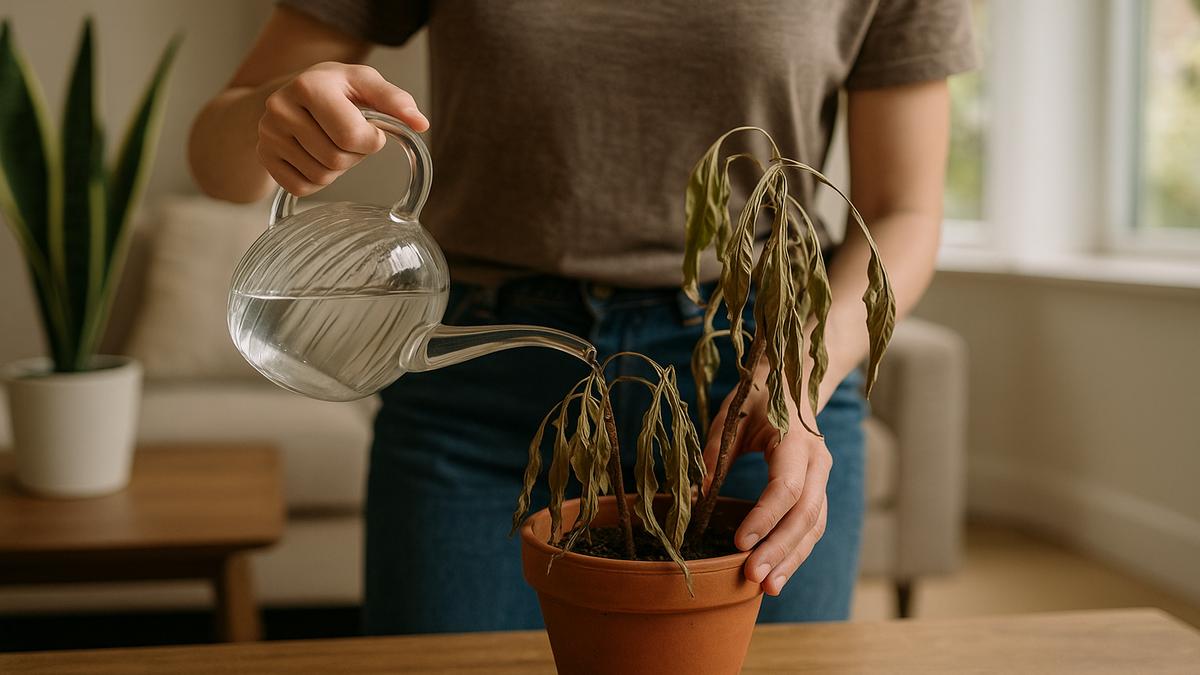
The first thing you notice is the silence. Your living room jungle, once bright and lush and visibly growing toward the light, is still now—too still. The calathea’s edges are crisping to a sorrowful brown, the jade plant has dropped another leaf, and the fern that used to explode with new fronds looks like hair left in the drain. You stare at them with the same baffled helplessness we reserve for blinking car dashboards and tax forms. “But I water you,” you say out loud, feeling half-ridiculous and half-accused. Deep down, though, a suspicion has already taken root: somehow, your kindness—your watering—might be what’s slowly killing them.
The quiet myth living under your watering can
There’s a story most of us carry without knowing it, a quiet myth that sneaks under our watering cans: plants are fragile, thirsty creatures that die because we forget to water them. It’s in every cartoon windowsill geranium, every sitcom joke about “Oops, I killed the office plant,” every well-meaning reminder app pinging on your phone.
So when you finally bring home your own plants, you act accordingly. You buy a cute watering can. You set a schedule. Every two days, or every Sunday morning, or whenever your phone dings, you dutifully pour water into each pot. You’re trying your best. You keep the promise.
And then they start to go yellow. Or brown. Or soft. Leaves curl like old parchment. New growth stalls. You turn to the internet and see a phrase repeated so often it sounds like a meme: “Most plant problems are caused by overwatering.” You stare at the sickly thing on your shelf and feel a weird combination of guilt and rebellion. How can that be? You barely see them drink.
Here’s the twist that flips everything: what kills most houseplants isn’t a lack of water. It’s a lack of oxygen in their roots caused by water that never really leaves. In other words, it’s not that you water too much in one moment; it’s that you water again before the plant has had the chance to breathe.
The schedule that almost everyone gets backwards
We tend to water like we live: by the calendar. Monday is leg day. Thursday is laundry. Sunday is plants. It’s simple, predictable, and totally wrong for something that doesn’t own a clock.
Plants don’t run on dates; they run on conditions: light, temperature, humidity, root density, soil texture. If you fix watering to time instead of to need, you accidentally turn your pot into a swamp half the year and a desert the other half.
Think about it: in winter, with short days and low light, your plant is barely photosynthesizing. It’s not “drinking” very fast. But your calendar doesn’t care; it just keeps saying “Water day!” You pour more water into soil that’s still damp from last week. Oxygen gets pushed out of the tiny spaces between soil particles. Roots suffocate, rot sets in, and suddenly your plant looks dry—not because it lacks water, but because its roots are damaged and can’t move water up to the leaves. You see crispy edges and think, “It must be thirsty,” and the cycle tightens like a noose.
In summer, with bright light and open windows, the same plant might be guzzling water. The soil dries out in two or three days. But your weekly alarm is still six days away. Now the plant really is thirsty; by the time you water again, it’s been quietly stressed for days. In one season, your schedule drowns it; in another, it starves it.
The schedule 99% of people get backwards is this: they fix when to water and guess at how much. The one that actually works is the opposite: you fix how to water, and you let the plant tell you when.
Water deep, then wait: the rhythm your plants actually want
There’s a moment, the first time you water this way, where it feels like a small act of rebellion. Instead of a polite little sprinkle over the top, you bring your plant to the sink and drench it—slowly. You watch the water soak through the soil, feel the weight of the pot become heavy and grounded in your hands. You wait until water flows from the drainage holes at the bottom, then let it drain completely. No half measures, no “just a splash.” This is a full drink.
And then you walk away.
You don’t schedule the next watering. You don’t promise your plant a date. You promise something else: “I’ll listen.”
Listening, in plant terms, looks and feels delightfully analog. You press a finger into the soil, not just brushing the surface but sinking to the second knuckle. Cool and moist? Leave it alone. Dry and crumbly? Time to water. You lift the pot and feel its weight: heavy usually means wet, feather-light means dry. Some people keep a spare empty pot of the same size nearby just to compare. Others use a wooden chopstick, poking it into the soil and checking for damp, dark stains on the wood when they pull it out.
Suddenly, watering is no longer a chore line on a to-do list. It becomes a conversation of textures and weights and subtle signals. Each plant has its own tempo. A thirsty monstera in bright light might drum a quick rhythm: “Water me every 4–5 days.” A slow-growing snake plant in a shady corner might murmur: “Every three weeks is fine, thanks.”
You’re not guessing anymore. You’re checking. You’re letting the soil, not the clock, decide.
| Plant Type | How Dry Before Watering? | Typical Rhythm (Bright Indoor Light) |
|---|---|---|
| Succulents & Cacti | Let 90–100% of the soil dry out completely | Every 2–4 weeks |
| Tropical Foliage (Pothos, Monstera) | Top 50–75% of soil should feel dry | Every 5–10 days |
| Ferns & Calatheas | Top 25–40% dry; never bone-dry all the way | Every 3–7 days |
| Snake Plants, ZZ Plants | Let 75–100% dry between waterings | Every 2–4 weeks |
These are rhythms, not rules. The real power is that you’re checking the soil first, not blindly following the numbers.
The hidden world at the bottom of the pot
The crime scene of most plant deaths is not visible from above. It’s happening in the tangle of roots you rarely see.
Imagine you’re a root. Your job is to grow into little pockets of soil, searching for moisture and nutrients. You need oxygen between soil particles to stay alive, like tiny lungs scattered underground. When you water deeply and then wait, water flows through, wets everything, and then slowly drains and evaporates, leaving behind a balance: enough moisture for drinking, enough air for breathing.
But if water never really leaves—if the pot has no drainage hole, if it sits in a decorative outer pot filled with runoff, if you’re watering again before the soil has exhaled—those tiny air spaces stay filled with water. You can’t breathe. Parts of you start to die and decay. The soil becomes sour, smells faintly swampy. Fungi and bacteria that love soggy conditions move in, and “root rot” begins.
From above, it’s deeply confusing. The plant may wilt, the leaves may droop, and your brain, trained by dry lawns and thirsty hikers, shouts: “It needs water!” So you give it more of the very thing drowning it.
Breaking that loop means paying attention to three surprisingly physical things:
- Drainage holes: Non‑negotiable for most houseplants. If water can’t escape, the plant can’t breathe.
- Saucers and cachepots: Empty them. Leaving roots soaking in runoff is like making them sleep with their head underwater.
- Soil type: Heavy garden soil or cheap, dense mixes cling to water too long. A good potting mix feels loose, airy, crumbly. For succulents, it should drain almost frighteningly fast.
When you flip a struggling plant out of its pot and see mushy brown roots instead of firm white ones, you’re not looking at “mystery plant failure.” You’re looking at the long, quiet effect of a schedule that never let the soil fully breathe.
Why “thirsty” leaves lie to you
Plants talk with their leaves, but like any language, it’s easy to misread the accent. Crisp, brown edges on a peace lily? Could be underwatering. Could also be overwatering that has damaged the roots so badly they can’t keep up. Yellow leaves on a pothos? Maybe too much water. Or not enough. Or not enough light. Or old age.
If you only look at the leaves, you end up in a loop of guesswork and anxiety. That’s how you get people nervously pouring a little bit of water every day “just in case,” trying to adjust to every crunch and curl, while the roots below either drown or dry out in slow motion.
The way out is strangely simple: stop asking the leaves only. Ask the soil too. It’s the one thing that never lies about water.
Here’s a tiny ritual that can change the way you relate to your plants: every time you see a leaf looking off—pale, crispy, limp—pause. Don’t grab the watering can. Instead:
- Press your finger into the soil, down at least 2–3 cm (about your second knuckle).
- Notice the temperature and texture. Cool and damp? It has water. Warm and bone‑dry? It doesn’t.
- Lift the pot gently. Is it heavy like a wet sponge or light like an empty cup?
Now interpret the leaves in the context of the soil. Droopy leaves + soaking wet soil = too much water or poor drainage. Droopy leaves + dusty dry soil = actually thirsty. Yellow leaves + constantly damp mix = slow suffocation. Yellow leaves + well‑draining soil that dries between waterings might just be natural aging or low light.
You aren’t reacting based on fear anymore. You’re responding based on evidence, and your watering becomes less about emergency fixing and more about steady, quiet care.
Light, seasons, and the “moving target” of thirst
Watering would be simple if your home were a lab: same light, same temperature, same humidity all year, same plant in the same spot. But the real world is a slow kaleidoscope, and your plants feel every turn.
In summer, longer days and brighter light mean faster photosynthesis. More energy use, more water movement, faster drying soil. That fern by your east window might drink every four days in July. By December, when the same window gets pale, slanting light, the soil may stay moist for two weeks.
Heating and air conditioning change things too. A radiator under a windowsill turns a cozy plant corner into a stealth desert every winter, wicking moisture from leaves and soil alike. Air conditioning in summer can dry the air, while also cooling the room and slowing growth. And then there’s humidity: bathrooms and kitchens tend to be kinder to tropical plants because the air there simply holds more water.
This is why a single piece of advice like “Water once a week” is almost always wrong. It might sometimes be accidentally right, the way you might sometimes land on the right radio station by spinning the dial with your eyes closed. But the target keeps moving with light and season, and your best bet isn’t memorizing numbers—it’s building a habit of checking.
A gentle way to start: choose three plants in different spots. For two weeks, quickly check their soil every other day. Don’t water unless they’re actually dry at the depth they prefer. Just notice the pattern: “Wow, the one near the big south window dries out in 3 days, but the one in the hallway takes 9.” You’re learning their individual thirst languages, not trying to force them into the same accent.
Rewriting the story: from plant killer to quiet observer
There’s a particular feeling that comes the first time one of your plants pushes out a new leaf after months of barely holding on. You notice it one morning: a tight, glossy coil on your pothos, or a new spear of green emerging from your snake plant like a secret handshake. It’s not dramatic to anyone else, but to you, it’s a small miracle—and a verdict.
Something you’re doing is finally right.
Ironically, that “something” usually isn’t a special fertilizer, a rare soil, or an expensive humidity gadget. It’s patience. It’s restraint. It’s the courage to stop watering on autopilot and start letting the plant show you when it’s ready.
The story shifts: you’re no longer the over‑eager caretaker who keeps refilling a glass that’s still half full. You become the quiet observer, the person who fingers the soil before lifting the watering can, who respects that roots need air as much as they need moisture, who understands that plants don’t follow your schedule—you follow theirs.
And suddenly, the living room doesn’t feel so silent anymore. There’s a hush of growth you can almost hear: the soft stretch of roots exploring fresh pockets of air and moisture, the slow unfurling of leaves untouched by panic watering, the subtle rearranging of green as each plant settles into its own rhythm. You aren’t trying to rescue them every week. You’re just keeping time while they dance to a song older than calendars.
Frequently Asked Questions
How do I know for sure if I’m overwatering or underwatering?
Check both leaves and soil. Limp or yellowing leaves with consistently wet, heavy soil usually mean overwatering or poor drainage. Crispy, curling leaves with very dry, dusty soil usually point to underwatering. If in doubt, gently slide the plant from its pot: mushy, brown roots signal overwatering; dry, brittle roots suggest underwatering.
Is using a moisture meter better than using my finger?
Moisture meters can help, but they’re not perfect and can misread in very coarse or very fine soils. Your finger, a wooden chopstick, and the weight of the pot are often just as accurate. If you use a meter, treat it as a second opinion, not the only voice.
Can I keep plants in pots without drainage holes?
It’s risky. Without drainage, excess water has nowhere to go and root rot becomes much more likely. If you love a pot without holes, use it as a decorative outer “cachepot.” Keep your plant in a plastic nursery pot with drainage inside it, and always empty any collected water after watering.
What’s the best way to water: from the top or from the bottom?
Top watering is usually best for most plants because it helps flush out salts and ensures the whole root ball gets moisture. Bottom watering—letting the pot sit in a shallow tray of water until the soil wicks it up—can help rehydrate very dry, water‑repellent soil. Whichever you choose, drain thoroughly afterward and avoid letting the pot sit in standing water.
Why does my plant still look bad even after I fixed my watering?
Roots and leaves recover at different speeds. Once roots have been damaged by overwatering or long‑term drought, they take time to regrow. Old, yellow, or crispy leaves often won’t turn green again, but new growth should start to look healthier. Give it several weeks of consistent, appropriate watering and stable light before deciding a plant is truly failing.

Hello, I’m Mathew, and I write articles about useful Home Tricks: simple solutions, saving time and useful for every day.