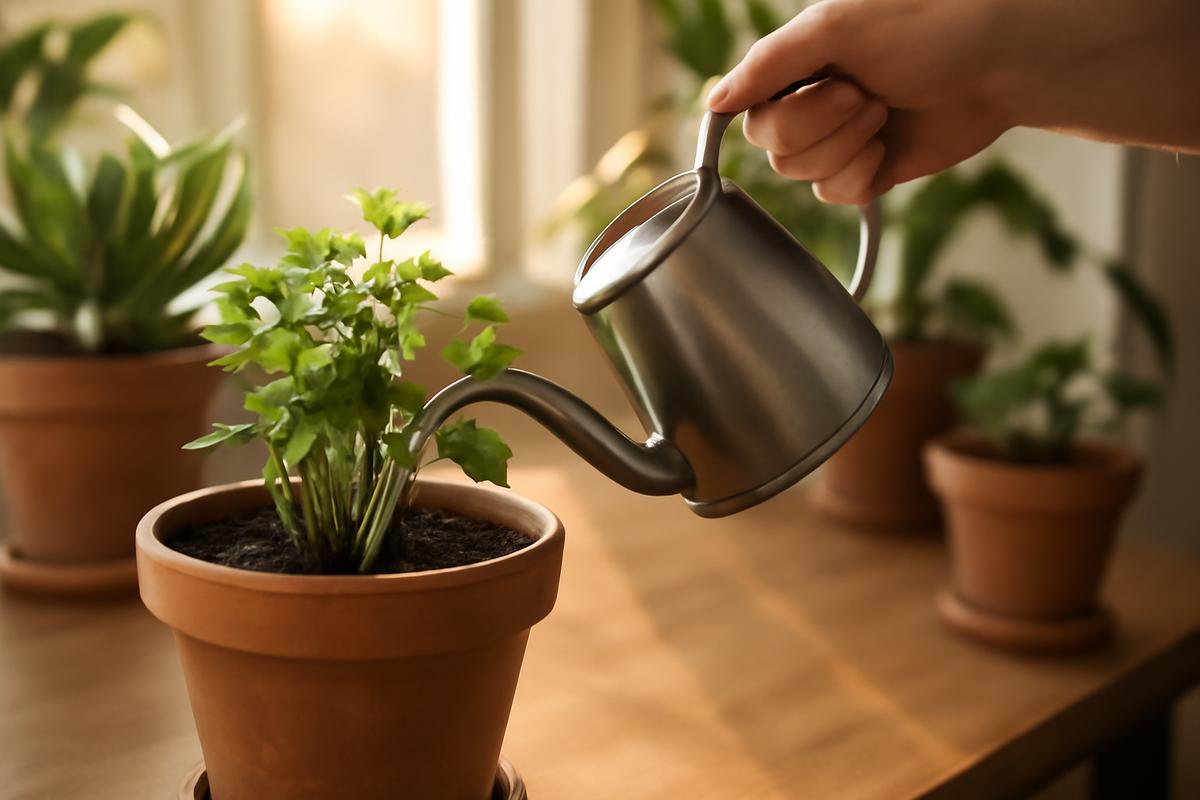
The first thing you notice is the sound. Before the sun has properly climbed over the rooftops, before the city has rubbed the sleep out of its eyes, there’s only the hush of the hose and the soft patter of water on soil. The air is cool enough that your breath hangs faintly in front of you. Leaves glisten, catching the faintest hint of gold as dawn starts to push its way into the garden. In that dim, blue-tinged half-light, you water your plants—and they seem to breathe. Tomorrow, and the day after that, you swear they look taller, greener, more alive. It starts to feel like a secret pact between you and them: meet me here, at this hour, and I’ll grow for you.
The quiet hour your plants have been waiting for
There is a very particular moment in the day when plants seem almost to lean toward the watering can, when every drop you pour feels somehow more effective. Gardeners talk about it like myth: “Water in the morning,” they say, “and your plants will reward you.” But there’s a more precise truth hiding inside that advice—an “exact time” when nature and physics and plant biology align.
Slip outside about an hour after sunrise. The light is still soft, the air not yet heavy or hot. You might notice birds still deep in their first wave of songs, shadows long and blue across the ground. This early window—roughly between sunrise and mid-morning—is when water becomes more than just a drink. It becomes strategy.
At this hour, the soil is cool, but not cold from the night. The plant’s internal systems are just waking up, ready to start the busy work of photosynthesis. The world has not yet turned harsh. It’s here, in this quiet, that your watering can has almost magical leverage.
Why “right now” matters more than “how much”
Plants don’t live their days as one long, smooth line of activity. They live in pulses and cycles. They open and close microscopic pores, shift water and nutrients up and down their stems, and adjust their inner chemistry in response to light, temperature, and humidity—minute by minute.
In the early morning, those tiny leaf pores, called stomata, are just beginning to open. Think of stomata as the plant’s breathing holes: they take in carbon dioxide, release oxygen, and allow water vapor to escape. Later in the day, as temperatures climb, plants begin to close some of these pores to prevent too much water loss. But first thing in the morning, the plant is optimistic. Conditions are gentle, and it’s gearing up for a full day of sugar-making.
Watering at this precise time feeds directly into that process. The water you pour seeps down into the root zone just as the plant prepares to draw deeply from the soil. With the sun still low, evaporation is minimal. Each droplet has a better chance at doing actual work—traveling up stems, plumping leaves, and fueling growth—instead of disappearing into the air as soon as it lands.
This is why two gardens, receiving the same total amount of water, can look utterly different if one is watered at midday and the other at dawn. It’s not just generosity that matters. It’s timing, alignment, and how thoroughly your water can soak in before the world gets hot and impatient.
The invisible race between roots and the rising sun
Think of every morning as a race: roots versus the sun. Your plants know that as soon as daylight strengthens, they’ll be asked to perform. Leaves will heat up. Transpiration—water vapor leaving those tiny stomata—will increase. If there isn’t enough moisture deep in the soil, the plant will be forced into survival mode instead of growth mode.
By watering an hour or two after sunrise, you’re handing your plants a head start. The water has time to infiltrate deeper layers of soil before the surface dries out. Roots can sip and send that moisture upward, filling stems and leaves like tiny hydraulic pumps. When the real heat arrives, your plants are already armed with internal water reserves, like having eaten a slow, nourishing breakfast before a long hike.
Miss this window, and the story changes. Watering in midday heat often leads to shallow wetting—water spreads across the hot, dry surface and evaporates fast. Your plants might look refreshed for a short while, droplets hanging from their leaves like jewels, but much of that water never reaches where it counts. Roots stay thirsty, and plants remain stressed, quietly trimming back their ambitions to simply get through the afternoon.
The science of a “golden hour” for watering
This ideal early-morning window isn’t just poetic; it’s rooted in a handful of physical truths that play out every day in your yard, your balcony pots, or your windowsill herb garden.
| Factor | Early Morning | Midday |
|---|---|---|
| Air Temperature | Cool to mild | Hot |
| Evaporation Rate | Low | High |
| Plant Stress Level | Lowest | Highest |
| Soil Surface Temperature | Cool | Very warm/hot |
| Water Efficiency | Maximum | Reduced |
In early morning, the air can hold less moisture than later in the day when it’s warmer, which means water evaporates more slowly from soil and leaf surfaces. The difference is often invisible in the moment but obvious over time in plant health and water bills.
Soil particles, still cool from the night, welcome water in instead of repelling it. On a hot afternoon, especially in compacted or sandy soils, water can bead up and run off before it has a chance to penetrate. In morning conditions, it’s more likely to sink and spread downward, forming a deeper, more stable reservoir where roots can roam.
There’s also the matter of disease. Many common plant fungi and leaf diseases thrive in environments where foliage stays wet into the night. When you water just before dark, droplets linger on leaves and stems in the cooling air, creating a perfect playground for spores. When you water shortly after sunrise, any stray moisture on foliage has the entire day ahead to dry out. You give your plants hydration and a better chance at staying healthy.
Morning watering and the plant’s internal clock
Plants don’t wear watches, but they do keep time. Their internal clock—a circadian rhythm not unlike our own—tells them when to ramp up growth, when to conserve, when to open and close stomata. Many species anticipate sunrise and begin shifting their biochemistry an hour or two before light actually arrives.
When you water in those first hours of light, you’re syncing with that rhythm. The plant’s hormonal signals for growth, root development, and photosynthesis are already turning up the volume. Delivering moisture at that moment is like showing up to a meeting exactly when everyone is most alert and ready, instead of knocking on the door when the room is half asleep or already packing up for the day.
This synchronization is subtle, but it’s why consistent morning watering often leads to sturdier stems, fuller foliage, and faster recovery from transplant shock or pruning. You’re not just preventing thirst—you’re fueling momentum.
The exact time, fine-tuned to your world
“Early morning” sounds charmingly vague, but plants respond to something more precise: the relationship between light, temperature, and humidity where you live. In practice, the magic window for most gardens falls between one hour after sunrise and about 9 a.m.
If you garden in a hot, dry climate where summer days soar, aim closer to sunrise. The sooner you can get water into the ground before the heat begins, the better. In milder or coastal climates with more moderate temperatures, you have a slightly wider runway, and watering between 7 and 9 a.m. will still hit that sweet spot.
Indoor plants follow a similar pattern, even if they’re shielded from weather. They feel the shift in light coming through your windows, the change in room temperature as your home wakes up. Watering them soon after that first wave of light—rather than late at night when the house is cooling and dark—helps them align water uptake with their most active hours.
The “exact” time, then, isn’t a fixed clock number for everyone. It’s a consistent idea: give your plants deep hydration after the night’s rest, before the day’s challenges. As long as you’re watering within that morning envelope, you’re harnessing the same advantage.
What happens when you water at night?
Night watering has its quiet appeal—the air is calm, the day’s tasks are done, and it can feel like a calming ritual, especially in summer. But for plants, night is more about repair and recalibration than aggressive growth.
When you soak the soil in the evening, the water does reach roots, but the cooler, darker conditions slow the plant’s metabolism. Uptake is sluggish. Moisture sits longer around stems and leaves. If your garden has ever developed mysterious spots on foliage, gray molds, or mildewy patches seemingly overnight, evening watering might be a silent accomplice.
In some very hot, arid regions, careful night watering can still be better than hot midday watering, because at least evaporation is reduced. But where disease pressure is high—humid climates, crowded plantings, or dense foliage—morning wins almost every time.
How this one change makes plants “grow faster”
“My plants just started taking off.” Gardeners often say this when they shift to a morning watering habit. Growth seems to accelerate: leaves unfurl faster, new buds appear more reliably, and the whole garden carries a certain upright confidence. What you’re really seeing is not magic, but the removal of repeated, invisible stress.
A plant that goes into the heat of the day with dry soil and partially filled cells is like a person starting a marathon dehydrated. It might still finish, but not with much grace, and certainly not at top speed. Day after day of this subtle struggle slows everything down—root exploration, leaf expansion, flower and fruit production.
When your watering aligns with that early morning window, the plant spends less time merely surviving and more time investing. Roots push deeper, hunting for even more moisture and nutrients. Shoots stretch with less fear of midday collapse. Flowers and fruits, especially in vegetables and ornamentals, mature more fully and consistently.
Even houseplants show the difference. A pothos or monstera watered in the morning will often perk up by noon, leaves glossy and full, while a plant watered at night might stay slightly droopy through the next day, taking its time to distribute that moisture.
Consistency: the secret partner of timing
Timing is powerful, but timing plus consistency is transformative. Plants love patterns. When you water around the same early hour every few days (or as their soil dryness dictates), they settle into a stable rhythm of uptake and release.
Roots become braver, venturing deeper rather than clustering anxiously near the surface in search of unpredictable puddles. That deeper root system is one of the biggest contributors to a plant’s ability to “grow faster”—because with more roots come more nutrients, more structural support, and more resilience during dry spells.
So while that first week of early watering might give you small, encouraging signs—a leaf that doesn’t wilt by afternoon, soil that feels cooler and more crumbly—over a few weeks, the change compounds. Height, branching, flowering: they all gain a few percentage points of momentum. You’ve given your plants better working hours, and they repay you in growth.
Designing your own dawn ritual
There’s also something distinctly human that happens when you start meeting your plants at this specific time of day. You begin to notice small things you missed when watering was just another chore squeezed between emails or errands.
You see which leaves turned glossy overnight, which bud is just shy of opening, which spider has strung a web across the tomatoes. You hear the low hum of waking insects, feel the cool edges of stones under your bare feet, smell the mineral tang as water hits dry earth. The garden becomes not just a destination but a daily story you step into before the rest of the world demands your attention.
Setting up this ritual doesn’t need to be elaborate. For some, it’s a watering can and five minutes of quiet, moving slowly from pot to pot on a balcony. For others, it’s a hose snaking through garden beds, or a drip irrigation system set on a timer to begin just after sunrise while you watch from the kitchen window with your first cup of coffee.
What matters is the regularity—and the awareness that this sliver of time is when your effort has the most impact. You’re not just pouring water; you’re choosing when that water can do its best work.
Small adjustments, big rewards
If early mornings are difficult for your schedule, start small. Move watering thirty minutes earlier than you usually do. Notice how the soil looks and feels by late afternoon. Watch for minor shifts in leaf posture and color over a couple of weeks.
For indoor plants, simply watering them first thing when you wake—rather than right before bed—can synchronize them more closely with the daily light cycle of your home. Place the watering can somewhere you’ll see it in the morning, like by the sink or near the balcony door, so that the ritual practically invites you.
With time, the “exact time” will feel less like a rule and more like a natural appointment. You may even find that the garden is gentler company at daybreak than any social feed or inbox. And while you’re quietly unwinding, your plants are, quite literally, gearing up to grow faster.
Frequently Asked Questions
What is the best exact time to water my plants?
The most effective window is typically between one hour after sunrise and around 9 a.m. This allows water to soak in deeply before heat and evaporation increase, while syncing with the plant’s natural daily rhythm.
Is it really bad to water at midday?
Midday watering isn’t instantly harmful, but it is less efficient. More water evaporates, soil can repel water when very hot, and plants are already under heat stress. If it’s your only option, water deeply at the soil level and avoid wetting leaves.
Can I water my plants at night?
You can, but it increases the chance of fungal diseases, especially in humid climates or tightly planted gardens. Water sitting on cool leaves and stems overnight creates conditions that many pathogens love. Morning is usually safer.
Does this timing rule apply to indoor plants too?
Yes. Indoor plants also benefit when watering is aligned with their active light period. Watering in the morning, as the room brightens, helps them use moisture during their busiest hours of photosynthesis and growth.
How often should I water if I’m watering in the morning?
Frequency depends on plant type, pot size, soil, and climate. Instead of a strict schedule, use the top 2–5 cm (about an inch or two) of soil as your guide—water when it’s dry at that depth, always aiming for that early morning window.

Hello, I’m Mathew, and I write articles about useful Home Tricks: simple solutions, saving time and useful for every day.