The first thing you notice is the silence. It’s the kind of winter hush that seems to swallow sound, leaving only the soft crunch of frost underfoot and the faint creak of the laundry line as it sags beneath a row of damp clothes. Somewhere a kettle whistles behind a misted window, but out here, it’s just you, your breath hanging in little ghostly clouds, and a family of clothes that simply refuse to dry.
The Strange Magic of “Drying” in the Cold
There’s something oddly mesmerizing about watching laundry in winter. Shirts stiffen into boards, socks freeze into shapes that vaguely remember feet, and jeans turn into icy armor. You take them in hours later, convinced they must be dry by now, only to discover a dampness that clings stubbornly to the fabric, as if the cold has stitched moisture into every thread.
It doesn’t feel fair. Summer laundry is easy—slap it on the line in the morning, and by lunchtime, it’s sun-warmed and soft, smelling faintly of clouds and wild air. In winter, you can hang the same load for what feels like forever, and still be greeted by clammy seams and pockets that feel like tiny, cold swamps.
But the winter line has its own theater. Steam rises faintly from a freshly hung sheet, white on white against a pale sky. The air smells of wet fabric, woodsmoke, and far-off chimney soot. Woven into that small domestic ritual is a quiet lesson in physics, patience, and the nature of cold air itself.
Cold Air, Warm Breath: What’s Really Going On?
Take a breath outside on a cold morning. See that pale puff? That’s water vapor, made visible as your warm, moist breath hits cold, dry air. Now imagine your laundry as one long, slow exhale. Every shirt, towel, and pair of pyjamas is trying to do the same thing: release water into the air around them.
The catch is that cold air, no matter how crisp and clean it feels, isn’t very good at holding moisture. Warm air can hold a lot of water vapor; cold air can’t. So each water molecule leaving your laundry has fewer places to go, fewer gaps to squeeze into. It’s like trying to empty a crowded theater through a narrow doorway instead of a wide one.
Drying doesn’t just depend on temperature, of course. Wind plays a big role. Humidity does too. But temperature is the quiet boss in the background, shaping how quickly your laundry can let go of its water. In summer, both warmth and wind conspire in your favor. In winter, the cold pulls everything tight and slow.
Evaporation: The Invisible Journey
When your clothes are wet, water is clinging to the fibers, nestling into every twist and weave. For your laundry to “dry,” that water has to escape into the air as vapor. That’s evaporation. It’s an energy-hungry process: water molecules need enough energy to break free from the surface of the fabric and drift away.
Warm temperatures give those molecules a boost—they wriggle and bounce with more vigor, escaping more easily into the air. Cold temperatures drain that energy, slowing everything down. It’s a bit like trying to dance in a heavy coat versus a loose shirt; motion becomes harder, slower.
In winter, evaporation doesn’t stop—it just happens at a glacial pace. And as it slows, you see the consequences in your stubbornly damp towels and those jeans that still feel vaguely swampy after a full day on the line.
The Two Clocks of Winter Laundry
When we say “winter laundry takes twice as long to dry,” it’s not pure exaggeration. In many climates, it’s a realistic rule of thumb. There are two clocks ticking whenever you hang clothes out in the cold: the temperature clock and the moisture clock.
The temperature clock slows everything. As the air gets colder, evaporation rates drop. Your shirt doesn’t know what the weather forecast says; it only knows how much thermal energy is around it. Less heat equals less motion. Less motion equals less evaporation.
The moisture clock is sneakier. Even if it’s cold, if the air is dry and there’s a decent breeze, water will eventually be pulled away from your clothes as the wind continually replaces the air around them. But when the air is both cold and humid—think heavy clouds, fog, or a still winter afternoon—it’s like asking your laundry to dry in slow motion.
When Clothes Freeze—and Still “Dry”
Here’s where winter reveals one of its strangest tricks: clothes can freeze and still gradually become dryer. On very cold, dry days, shirts sometimes turn rigid on the line, sleeves hard as planks. It feels as if time itself has stopped in the fabric. But look closer, and something delicate is unfolding.
The water in the fabric freezes, yes, but the dry air still steals away moisture through a process called sublimation—where ice turns directly into water vapor without becoming liquid first. It’s the same quiet process that shrinks snowbanks over time, even on days too cold for melting.
You might bring those frozen jeans inside and watch them slowly soften, realizing that somewhere during their time on the line, they lost more water than you expected. Winter drying isn’t as clean and simple as summer’s quick sun-bake, but it’s no less real. It’s just working on winter’s terms.
The Everyday Science Behind Your Laundry Basket
Back indoors, you probably don’t think in terms of relative humidity or heat transfer; you just think, “Why is this pile never going away?” Radiators hum, the heating kicks on, and suddenly your house becomes a microclimate in its own right. Hang clothes indoors and you begin a small, quiet negotiation with the air inside your walls.
Every damp shirt you drape over a chair, every towel on a rack is whispering its moisture into the room. Your windows fog a little. The air feels slightly thicker, softer. The more water your laundry shares with the room, the slower the rest can evaporate. If the air near the clothes becomes too moist, it’s like trying to dry in a cloud.
That’s why the same load of washing that might dry in a breezy summer afternoon can linger overnight, or longer, in winter—even indoors. Your heating may make the air warmer, but closed windows, poor ventilation, or already humid rooms can turn that warmth into a damp embrace instead of a drying wind.
Why a Tumble Dryer Feels Like Cheating
Turn on a tumble dryer on a bleak winter evening, and you’re essentially creating a miniature weather system built solely for your laundry: high heat, forced air, and rapid movement. The drum lifts and drops the clothes, constantly exposing new damp surfaces to moving, warm air that’s quickly whisked away and vented outside or through a condenser.
Compared with a still, cold backyard or a cramped, humid room, the dryer is a kind of artificial summer in a steel box. The difference is dramatic. But it’s also energy-hungry, noisy, and a little bit at odds with that quieter, slower world just outside the window—where shirts and socks are still frozen in their patient vigil on the line.
How Winter Slows Drying: A Simple Comparison
If you could shrink down and stand among your laundry fibers, winter versus summer would feel like stepping into two different planets. The following simple table sums up how a typical load behaves in different drying worlds. Think of it not as rigid science, but as a sketch of what you probably already feel in your bones.
| Condition | Summer Afternoon | Winter Day |
|---|---|---|
| Air Temperature | 25–30°C (77–86°F) | 0–8°C (32–46°F) |
| Average Outside Drying Time | 2–4 hours | 6–10+ hours |
| Main Drying Helpers | Heat, sun, light breeze | Dry air, wind (on good days) |
| Typical Fabric Feel | Soft, warm, airy | Cool, sometimes stiff or partly damp |
| Main Limiting Factor | Occasional humidity or still air | Low temperature, high humidity, weak air movement |
Even if your local weather doesn’t match those exact numbers, the pattern likely will: winter shifts your laundry into a slower gear, turning what feels like a simple chore into a longer, more delicate dance with the elements.
Working With Winter Instead of Fighting It
There’s a quiet kind of satisfaction in learning to dry clothes well in winter. It’s part craft, part patience, and part paying attention. Once you understand what the cold air is doing, you start to adjust in small ways—like turning the dial on an invisible machine.
You might time your washing to the best slice of daylight, so your laundry can grab whatever thin warmth and brightness the sun offers. Instead of hanging clothes in cramped corners, you give them as much space as your home can spare, so air can weave between them. You crack a window for ten minutes, even on a frosty day, to let moist indoor air drift out and drier air slip in.
Over time, you learn your house’s microclimates—the warm patch above a radiator, the drafty spot by the back door, the room that never quite dries anything properly. You learn which fabrics will stubbornly cling to moisture and which surrender it quickly. Towels become your slowest pupils; thin cotton shirts, your star performers.
Little Tweaks That Change Everything
Most of the ways to speed up winter drying are simple, almost humble. Spin clothes on a higher setting, and you start with less water in the fabric in the first place. Hang heavier items at the edges of a rack, where air can move more freely. Turn thick garments inside out halfway through drying, exposing the still-damp inner layers.
Ventilation—fresh, moving air—is the unsung hero. A small fan in a corner, barely humming, can transform a sluggish indoor drying day into something much more efficient. Not a gale, just a gentle nudge that keeps water vapor from lingering around your clothes like breath on a windowpane.
None of these tricks make winter behave like summer, of course. But they nudge the odds back in your favor. They help you work with the physics of cold instead of pushing blindly against it.
The Quiet Intimacy of Winter Chores
Winter laundry, for all its inconvenience, has a way of tethering you to the season. It asks you to look up at the sky before you load the machine: Are the clouds moving? Will there be a breeze? It nudges you to notice where the weakest sunlight falls in your yard, how your breath curls when you step outside with a basket on your hip.
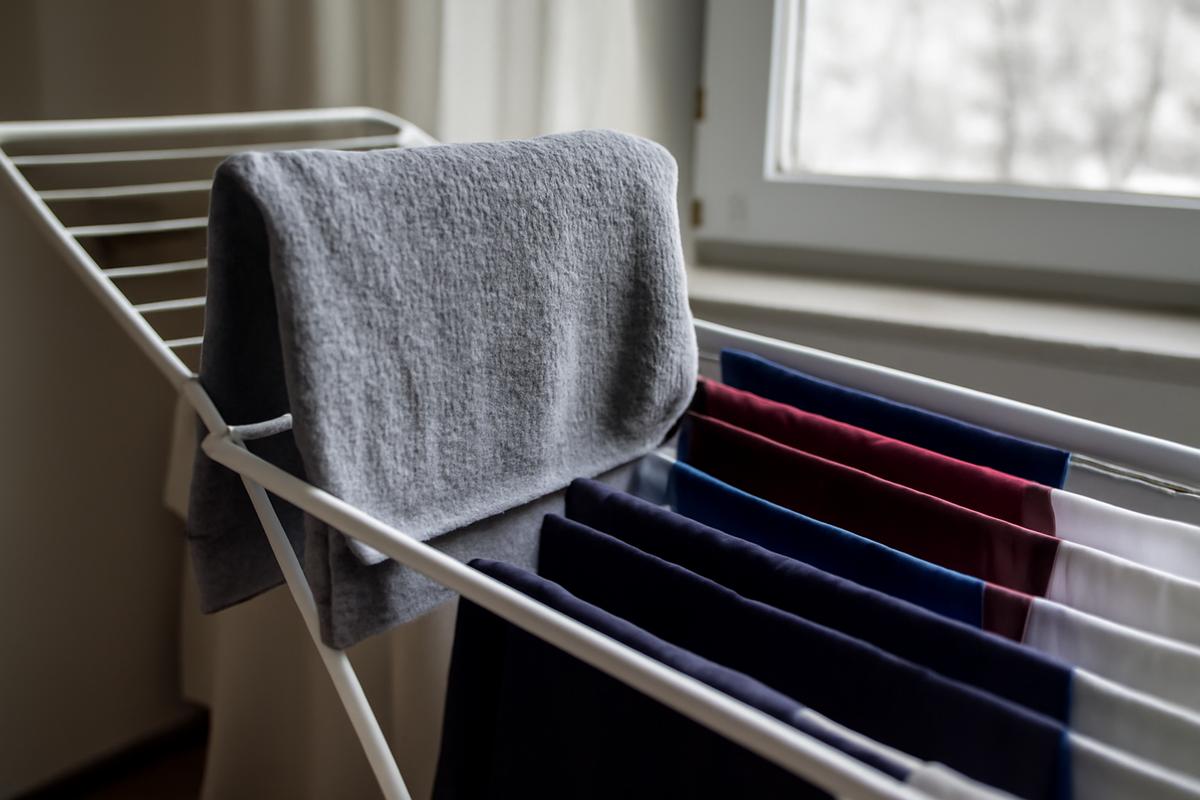
Inside, draped clothes become makeshift curtains, soft sculptures of daily life. A sweater over the banister, socks near the heater, shirts lined up by a window. They are small flags of domestic weather, marking the passage of days even when the world outdoors seems frozen in place.
You begin to see the rhythm. The way dampness in the house rises and falls with each load. The way a sudden gust on a cold, bright day can dry a sheet faster than a gray, half-warm afternoon. The way folding still-cool shirts at night brings a faint scent of winter air back into the living room, as if the outside world had followed you indoors and curled up quietly on your lap.
Why It Matters That Laundry Takes Longer
On the surface, the fact that winter laundry takes twice as long to dry is mostly a nuisance. It means careful planning, extra patience, sometimes a resigned relationship with the tumble dryer. But it also mirrors something larger about how we live with the seasons.
The cold slows things down—not just water molecules but routines, expectations, the pace at which we expect our lives to run. In summer, we demand speed: fast drying, quick chores, everything done between the first cup of coffee and the late-afternoon sun. In winter, the world answers with a gentle, unyielding “not so fast.”
Allowing for that extra time can feel like a form of surrender, but it’s also a form of attention. It’s noticing that the air has limits, that warmth is not an endless resource, that even our most ordinary tasks are shaped by forces we can’t command, only collaborate with.
Somewhere between the science of evaporation and the art of getting socks to dry on a bleak Tuesday, there’s a quiet wisdom: that life, like laundry, will always move differently in the cold. That taking twice as long doesn’t always mean wasting time; sometimes it means moving in step with a slower, older rhythm than our electrified world remembers.
FAQs
Why do my clothes feel cold even when they’re dry in winter?
In winter, fabrics often sit in cooler air, so they don’t pick up the cozy warmth you feel in summer. Even when fully dry, clothes can feel cold to the touch because they’re closer to the room or outdoor temperature, not warmed by direct sun or high ambient heat.
Can clothes really dry outside when it’s below freezing?
Yes, they can. When it’s cold and dry, ice in the fabric can slowly turn directly into water vapor—a process called sublimation. Drying is slower than in warm weather, but given enough time and some air movement, frozen clothes will still lose moisture.
Is it bad to dry clothes indoors in winter?
Not necessarily, but it can raise indoor humidity. That extra moisture can lead to condensation on windows and, in poorly ventilated spaces, create conditions for mold. Balancing indoor drying with short bursts of ventilation and spacing clothes well usually keeps things healthier.
Does using a higher spin speed really help in winter?
Very much so. A higher spin removes more water before you even start drying, which is crucial when evaporation is slow. Less water in the fabric means less time hanging and fewer problems with dampness lingering in your living space.
What fabric types dry fastest in winter?
Lightweight synthetic blends and thin cottons generally dry fastest because they hold less water and release it more easily. Thick towels, heavy denim, and dense knits dry the slowest, especially in cool, still air.

Hello, I’m Mathew, and I write articles about useful Home Tricks: simple solutions, saving time and useful for every day.