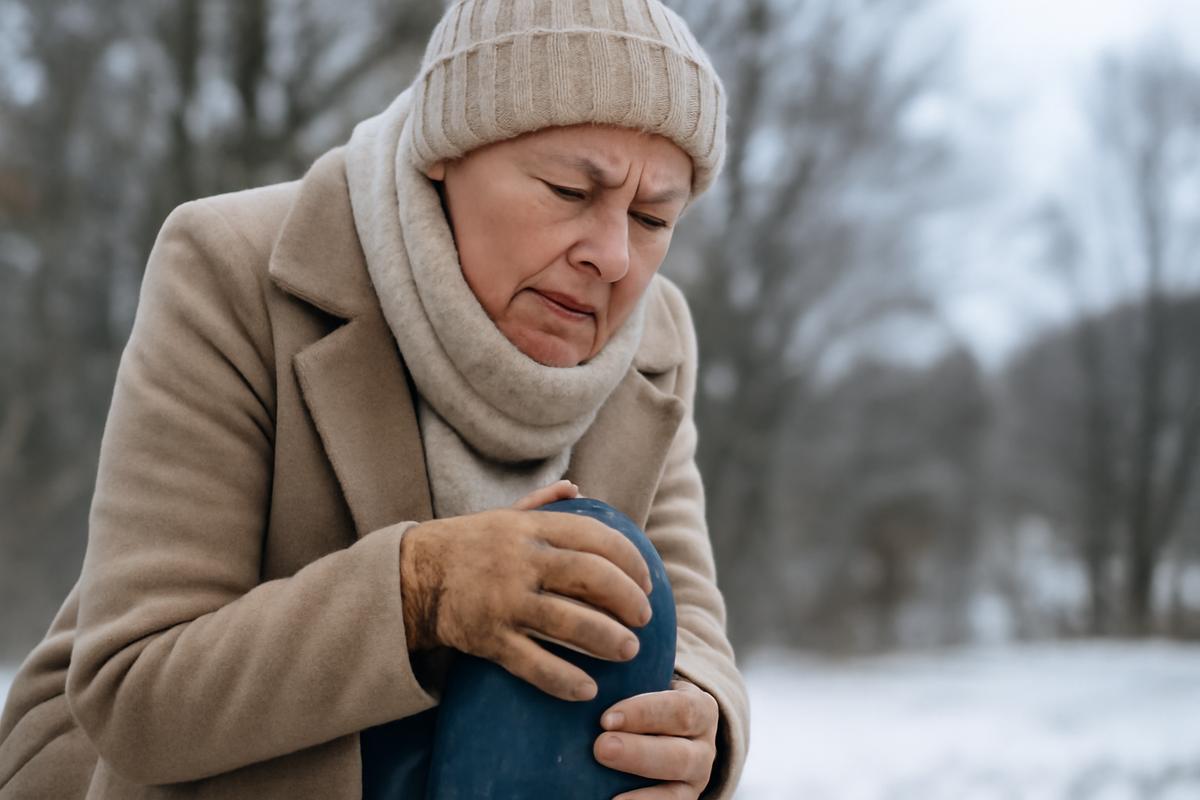
The first sting of the season always arrives at night. Maybe you notice it when you’re sitting on the couch, half-watching a movie, half-scrolling your phone. A dull ache curls into your knees, a slow twist settles in your fingers, and your shoulders feel like they’ve quietly turned to stone. Outside, the winter wind moves like a whisper through bare branches, and inside your joints begin their own kind of weather report. “Storm’s coming,” your body seems to say, even if the forecast has already told you the same thing. You flex your fingers, roll your ankles, and wonder—again—why the cold, dry winter air has this uncanny way of waking up old aches and stirring up new ones.
When the Weather Moves Into Your Bones
Ask around at any gathering where winter coats pile up near the door, and you’ll hear variations of the same story. “My knees know when snow is on the way.” “My hip starts nagging the minute the temperature drops.” “My fingers are like tiny barometers.” There’s an almost folklore quality to it, as though our bodies are quietly tuned to continental weather systems. But beneath those shared stories is something quite real: winter changes the way your joints feel, move, and respond.
Imagine your joints as carefully engineered little ecosystems—bone, cartilage, synovial fluid, ligaments, and tendons all working together in contained harmony. That harmony is sensitive, not just to what you do with your body, but to the world moving around it. When the air cools, pressure shifts, humidity falls, and we retreat indoors to drier, heated spaces, that ecosystem responds. Sometimes loudly.
It’s easy to dismiss it as “just getting older” or “weather superstition,” but modern science has nudged closer to explanations that sound a lot less like myth and more like mechanics: tiny pressure changes pushing on swollen tissues, cool air tightening muscles, nerves firing differently in the cold, and your brain translating all of that into the familiar language of ache and stiffness.
The Science of Aching in the Cold
Winter doesn’t exactly sneak into your joints; it presses on them, pulls at them, and quietly changes how they function. To understand why your knees complain on icy mornings or why your fingers feel clumsy and reluctant, we have to follow the path of cold air and falling pressure right down into those joint capsules.
Barometric Pressure: Invisible Hands on Your Joints
Barometric pressure is the weight of the air around you. You can’t see it, but you’re always moving through a sea of it. When a winter storm rolls in, barometric pressure often drops. That drop may give swollen or sensitive joints just a bit more room to expand, like easing the lid on a jar. Inside a joint already inflamed by arthritis or old injury, that tiny shift can feel surprisingly large.
Picture a balloon filled almost to its limit. If you reduce the pressure outside that balloon, it subtly swells. Your joints aren’t balloons, but the tissue inside them can react similarly. Synovial fluid and soft tissues may push outward ever so slightly, stretching the nerve-rich capsule around the joint. Your nerves notice. They send messages. Your brain reads them as pain, stiffness, or a flare-up of something you thought you’d already adapted to.
Cold Muscles, Tight Tendons, Stiff Joints
Cold doesn’t just wrap itself around your skin—it moves inward. Muscles cool and tighten, tendons feel shorter, and circulation slows a little at the surface of your body as blood retreats inward to protect your core temperature. When the tissues around your joints stiffen, every movement asks more effort from the system.
Think of trying to bend a half-frozen garden hose. It doesn’t flow. It resists. Your joints can feel that way in winter: less supple, more reluctant. Tight muscles pull more on the points where they attach to bone. Stiff tendons drag a bit more against their anchor points. Over time—even just over a long, cold afternoon—this can translate into a persistent, nagging ache.
Dry Winter Air and the Quiet Thirst of Your Joints
Winter isn’t only about cold. It’s also about dryness—the kind you can feel in your lips and throat, but also the kind you can’t see, in the subtle dehydration creeping into your tissues. Heated indoor air pulls moisture from your skin and, more quietly, from the fluid balance inside your body.
Synovial fluid—the slick, viscous liquid inside your joints—is one of your body’s best lubricants. It cushions your steps, lets your fingers glide, and keeps bones from crashing directly against one another. This fluid, like the rest of you, depends on good hydration and a stable internal environment. Dry air and low-level dehydration can leave those internal mechanics feeling less slippery, more resistant.
The result is rarely dramatic. It shows up instead as small frictions: a grinding sense in the knees when you get up from a chair, an extra stiffness in your hands when you try to turn a doorknob, that feeling of needing to “warm up” joints that used to obey instantly. For people already living with osteoarthritis, rheumatoid arthritis, or lingering injury, this seasonal dryness can mean stepping straight into a winter of amplified discomfort.
| Winter Factor | What Changes in Your Body | How It Feels in Your Joints |
|---|---|---|
| Cold Temperature | Muscles tighten, circulation shifts inward, tissues become less elastic. | Stiffness, slower movement, more effort to bend or straighten. |
| Low Barometric Pressure | Inflamed tissues may expand slightly inside joint capsules. | Increased sensitivity, dull or throbbing pain, “storm warning” sensations. |
| Dry Indoor Air | Mild dehydration, less-than-ideal joint lubrication. | Grinding, crackling, or more noticeable joint “catching.” |
| Less Movement | Muscles weaken, supporting structures lose flexibility. | Worsening stiffness, pain after sitting, slower recovery. |
The Mind-Body Weather Channel
Not all winter joint pain is purely mechanical. Part of the story unfolds in the quieter, more mysterious corridors of the nervous system. Your brain doesn’t simply record pain; it interprets it, colors it with memory, mood, and expectation. And winter brings its own heavy palette.
Shorter days, weaker sunlight, and long nights can nudge your mood downward. For some people, seasonal affective changes slip into the edges of their lives: a little less energy, a softer motivation to move, a creeping sense of heaviness. Pain lives in this emotional landscape. When you feel low, aches feel louder, more insistent.
Chronic pain, especially from conditions like arthritis, also has a learned component. Your brain remembers. If every winter has meant an uptick in pain, your nervous system may start preparing early, heightening its awareness even before the worst of the cold arrives. That anticipation can amplify the message coming from your joints. It’s not imagined; it’s a conversation between tissue and brain that grows more fluent each year.
This doesn’t mean your pain is “just in your head.” It means your body and mind are continuously co-authoring your experience of winter, layering biology, sensation, and memory into the story your joints tell when the temperature plummets.
Why Some Joints Complain More Than Others
If winter air were purely democratic, every joint would ache equally. But the body is not so orderly, and the cold has favorites. Old injuries flare first. Joints that have known surgery or fracture seem to remember. Areas bearing the weight of your life—knees, hips, lower back—often protest the loudest.
In osteoarthritis, the cartilage cushioning the bone wears thin, and the underlying bone remodels itself, sometimes leaving rough edges and bony outgrowths. Winter exposes these fragile mechanics. With less lubrication, tighter support structures, and the squeeze of barometric changes, those altered surfaces talk back. Knees may signal with a sharp jab on stairs. Hips might whisper with a long fatigue that settles after a walk on frozen sidewalks.
People with inflammatory conditions—rheumatoid arthritis, psoriatic arthritis, lupus—often feel winter not just in single joints, but in the whole map of their bodies. Inflammation can be unpredictable, but cold and stress are frequent triggers. Fingers swell, wrists complain, ankles rebel. Even without obvious swelling, the nerves running through those joints can become more reactive in low temperatures, sending more urgent messages from the same level of physical disturbance.
There’s also the reality of how we move in winter: more shuffling on icy ground, more guarding against falls, more tension in the shoulders as we hunch against wind. That constant subtle bracing adds to the load on certain joints—ankles, knees, hips, spine. Over weeks and months, these adjustments become part of the pain story too.
Movement: The Gentle Antidote to Winter Stiffness
When your joints ache, the instinct is to curl inward and go still. Couch, blanket, warm drink—retreat. For a while, that can feel like relief. But stillness is sneaky. The less you move, the more your muscles shorten and weaken, and the more work your joints must do without their usual muscular support.
In winter, movement becomes not just exercise but medicine. Gentle, regular motion brings warm blood back to your joints, lubricates the moving parts, and reminds your nervous system that not every signal is a threat. Slow morning stretches, a short indoor walking routine, a few minutes of yoga on a mat in a patch of sunlight—these small rituals can loosen the ice that seems to creep into your knees and fingers.
Imagine your joints not as broken parts, but as instruments that need regular tuning. Each bend and stretch is a subtle recalibration, a way of whispering to your body, “You are still capable of movement, even in this cold.” Over time, those whispers add up. Pain may not vanish, but it can soften around the edges, becoming more of a companion you understand than an enemy that ambushes you.
Creating a Kinder Microclimate for Your Joints
You can’t negotiate with the jet stream or talk a snowstorm into postponing itself. But you can create small, intentional pockets of warmth and moisture where your joints live. The winter outside may be harsh; the winter inside your home, your daily routine, and your body can be softened.
Start with warmth that truly reaches the places that hurt. Layered clothing that protects knees and hips, warm socks that insulate ankles, gloves that hold in the heat around fragile finger joints—all of these help reduce the muscular tightening that feeds pain. Heating pads or warm baths can be like short visits to another season, one where your joints remember what it feels like to move without resistance.
Hydration is another quiet ally. In winter, thirst signals fade. You might go hours with only a small cup of coffee or tea, not realizing your cells, including those in your joints, are quietly drying out. Keeping a glass of water within reach, adding broths or herbal teas, and consciously sipping throughout the day helps maintain the fluid balance that keeps your internal hinges gliding more smoothly.
Even the air in your home can be tuned to your joints’ liking. A small humidifier can soften the desert-dry radiated heat that steals moisture from skin and sinuses. That added humidity can make breathing easier—and while it won’t cure arthritis, it can help your body feel less under siege.
And then there is rest. Not the collapse-on-the-couch kind, but the intentional kind that cycles between effort and recovery. Listening when your joints say, “enough for today,” but not believing them when they suggest, “let’s never move again.” Finding that balance is deeply personal, and no chart or app can find it for you. It’s a kind of winter wisdom you grow into, year after year.
Body, Weather, and the Stories We Tell
When we talk about winter aches, we’re really talking about a relationship: between your body and the place you live. Between the turning of the seasons and the joint that still remembers the time you twisted it on a trail or broke it on a slippery patch of ice. Between your nervous system and the long, dark months when daylight feels scarce.
There is science beneath all of this: pressure gradients, temperature shifts, inflammatory pathways, nerve sensitization. But there’s also the lived reality—how it feels at 6 a.m. when the alarm goes off and your hands hesitate on the edge of the blankets, already anticipating the cold air. How it feels walking the dog as your knees complain with each step on the hard, frozen ground. How it feels when a friend says, “My joints are killing me this week,” and you both quietly understand.
Why does winter air make joints ache more? Because we are not separate from our environment; we are porous to it. We respond to the tilt of the earth, the angle of the sun, the passing of a storm. Our joints, especially the ones that have carried us through injury, illness, and age, are simply among the most eloquent places where that response is felt.
And yet, within that sensitivity lies a kind of resilience. Each winter offers a new chance to learn what eases your body: the temperature at which your hands feel loose, the stretches that help your hips trust the day, the rituals that make your home a gentler climate than the one raging beyond your windows. The air will turn cold again. The pressure will fall. Snow will come and go. But so will your capacity to adapt, to listen, and to care for the small, complex weather systems living inside your joints.
FAQ: Winter Air and Aching Joints
Does cold weather actually cause arthritis?
No, cold weather doesn’t cause arthritis. Conditions like osteoarthritis or rheumatoid arthritis develop from wear and tear, autoimmune processes, genetics, injuries, and other factors. However, winter weather can make existing joint problems feel worse or more noticeable.
Why do my joints hurt before a storm?
Before a storm, barometric pressure often drops. This change in pressure may allow inflamed tissues in your joints to expand slightly, stretching sensitive nerve endings and making pain feel more intense. People with arthritis or old injuries are often more sensitive to these changes.
Can staying warm really reduce joint pain in winter?
Yes. Warmth helps relax muscles, improves blood flow, and reduces stiffness around joints. Warm clothing, heating pads, warm baths, and staying active indoors can all help soften winter-related joint discomfort.
Is it better to rest or move when my joints ache in cold weather?
Gentle, regular movement is usually better than complete rest. Too much inactivity can increase stiffness and weaken the muscles that support your joints. Slow stretching, light walking, or low-impact exercises like swimming or indoor cycling can help, as long as you respect your pain limits.
Does drinking more water really help my joints in winter?
Staying well hydrated supports overall tissue health, including cartilage and synovial fluid in your joints. While water alone won’t cure joint pain, mild dehydration and very dry air can contribute to a sense of stiffness and discomfort, so regular fluid intake is beneficial.
Should I be worried if my joint pain always gets worse in winter?
Seasonal increases in joint pain are common, especially in people with arthritis. However, if your pain becomes severe, limits your daily activities, comes with swelling, redness, or fever, or feels very different from your usual pattern, it’s wise to speak with a healthcare professional.
Will moving to a warmer climate make my joint pain disappear?
Some people do feel better in consistently warmer, more stable climates, especially if their joints are sensitive to cold and pressure changes. However, climate alone rarely makes joint disease vanish. Many people still experience some pain in warm regions, though they may have fewer or milder flare-ups.

Hello, I’m Mathew, and I write articles about useful Home Tricks: simple solutions, saving time and useful for every day.