Why socks matter more than blankets for warmth
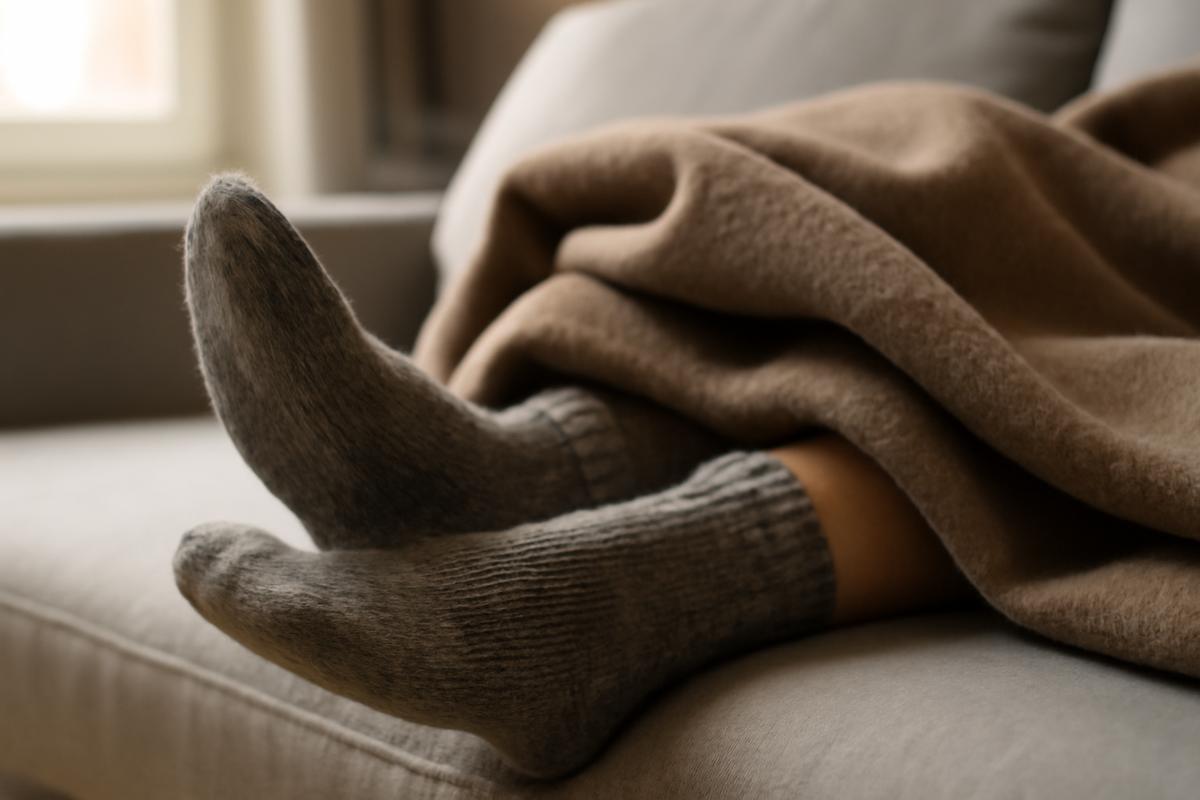
You notice it first in your toes. The rest of you feels reasonably fine – your sweater is thick, the blanket pulled up to your chin is satisfyingly heavy – but your feet are small, icy moons at the far edge of your body. You curl them up. You tuck them under your calves. You try to pretend they don’t exist. But the cold creeps upward, a quiet invasion, and suddenly no number of blankets feels like enough.
At some point, you do what every shivering human eventually does: you get up, rummage through a drawer, and pull on a pair of socks. Not fancy ones. Just socks. Cotton, maybe a little worn at the heel. But five minutes later, the world changes. The air is still the same temperature; the blanket hasn’t grown any thicker. Yet warmth begins to pool around your ankles and radiate through your body like a rising tide. You sigh, soften, and think, in that private way we have with small miracles: Oh. This is better.
The Quiet Power of Warm Feet
We grow up believing blankets are the champions of warmth. They’re what we pull from closets during winter and pile on beds like layers of soft armor. Blankets are visible warmth – they make a statement. But warmth, the real kind that seeps deep into you, begins at the edges of your body. And few edges are more important than your feet.
Your feet are a crossroads. Dozens of tiny bones, dense networks of blood vessels, and nerve endings all crowd into that small space. When you’re cold, your body makes a ruthless calculation: protect the vital organs at the core, even if it means sacrificing comfort at the extremities. Blood flow to your hands and feet slows. Your toes become scouts in a frozen outpost, reporting back: We’re losing heat out here.
Pulling a blanket to your shoulders doesn’t change that fundamental choice your body has already made. But slipping on socks – especially warm, well-fitted ones – quietly changes the rules of the game. By adding insulation where heat is bleeding out fastest, you encourage your body to keep sending warm blood to your extremities. In return, your core no longer feels the same urgent need to hoard heat. The system relaxes. Your whole body starts to feel warmer, not because the air changed, but because your circulation did.
There’s something intimate about this exchange. Socks don’t just lie over you like blankets do; they hold you. They cling to the arch of your foot, follow the slope of each toe, wrap the vulnerable places where skin meets cold floorboard. They move with you, an invisible layer of quiet protection that stays put long after the blanket has slipped or the comforter has sagged to one side in your sleep.
Why Socks Beat Blankets in the Heat Game
Surface Area, Edges, and the Places Heat Escapes
Imagine your body as a little house in winter. The blanket acts like adding a thicker roof – wonderful, yes, but if the windows and doors are wide open, you’re still going to lose warmth quickly. Your feet are those drafty windows. They have a relatively large surface area and sit far from your core, where blood has cooled slightly on its journey outward. Bare or poorly covered feet are like glass panes in a blizzard.
Socks are insulation at those windows, like snug storm shutters. They reduce how much warmth radiates out through the skin of your feet and help trap the thin layer of air that naturally sits between your skin and fabric. That tiny buffer of captured air is one of the secrets of staying warm: your body heats that air, and the fabric helps keep it from escaping.
Blankets help with this too, of course, but they mostly cover your midsection – the torso and thighs – where heat loss is significant but not as emotionally noticeable. The human nervous system is especially sensitive to cold in the extremities. That means when your toes are freezing, your brain throws its hands up and declares: We are freezing. Even if, technically, you’re not.
Cover the feet well, and suddenly the story changes. Your brain receives new signals – comfort instead of alarm – and it relaxes its perception of cold. You might still be in a drafty cabin, wind rattling the windowpanes, but with warm socks, your body believes in the possibility of safety again.
The Difference Between Trapped Heat and Shared Heat
Blankets work best by trapping the heat that’s already there. They’re like a lid on a pot: useful, but passive. If you’re truly chilled to your bones, simply stacking blanket upon blanket can feel like stacking lids on a pot that’s barely simmering. You’re containing almost nothing.
Socks, by comparison, are more like gently stoking the smallest, most vulnerable flames. By keeping your feet warm, you improve circulation, which helps your body distribute heat more evenly. To put it another way: blankets preserve what warmth your core already has, but socks help convince your body to spend that warmth more generously, sending it out to the edges rather than barricading it in the center.
This is why, on a cold night when you’re struggling to get warm, it often makes more sense to add a pair of good socks than to grab yet another thick blanket. You don’t need a heavier lid; you need your internal fire to burn steadier and more evenly.
The Feel of Fabric: Not All Socks Are Equal
When Fibers Decide Your Night
Think of the most blissful pair of socks you’ve ever worn: maybe thick and woolly, or buttery-soft and smooth, or that perfect midweight pair that felt like a hug but never made your feet sweat. Texture is a quiet storyteller here. Run your finger along a merino wool sock: there’s a spring to it, a resilient softness. Cotton, in comparison, feels cool at first contact, simple, familiar – but in deep winter, that coolness can betray you.
Some fabrics hold warmth even when your feet sweat; some cling to moisture and turn clammy. Here’s a quick look at how different materials behave when the night turns cold and your toes are negotiating a truce with the air:
| Sock Material | Warmth | Moisture Handling | Best For |
|---|---|---|---|
| Merino wool | High | Excellent; stays warm when damp | Cold nights, camping, chilly homes |
| Thick cotton | Moderate at first | Poor; holds moisture, can feel clammy | Short wear in mild cold |
| Synthetic blends | Moderate to high | Good; wicks moisture | Active use, hiking, variable temps |
| Cashmere & luxury fibers | High | Good; soft and insulating | Lounging, sleeping, relaxed comfort |
Merino wool is the quiet hero in this lineup. Unlike the scratchy sweaters of childhood memory, high-quality merino is incredibly soft, stretchy, and forgiving. It insulates even when damp, which means if your feet sweat a little under the covers, you’re not suddenly plunged back into chill. Synthetic blends also earn their place: they manage moisture, dry quickly, and often come in designs that hug the foot without drifting or bunching.
Cotton, though beloved and easy to find, is a bit of a fair-weather friend in deep cold. It feels inviting when you first slip it on, but if you wear cotton socks in a chilly room, your feet may sweat slightly in the effort to warm up. That moisture clings to the fibers, cools, and before long, your toes are swimming in little puddles of cold. It’s not your imagination when you feel colder after a while in cotton socks – your feet are working harder and getting less in return.
The Fit That Makes or Breaks the Warmth
Beyond fabric, there’s the question of fit. A sock too tight strangles circulation, undermining the very warmth you’re hoping to build. A sock too loose lets air escape and bunches up in your boots or under the heel, leaving some parts of your foot exposed and others smothered.
The sweet spot is a sock that feels like a gentle handshake: firm enough to stay in place, soft enough that you forget it’s there. When you slide it on before bed, you don’t want to feel squeezed. You want a sense of quiet containment, like being carefully wrapped without pressure. This is the kind of fit that works with your body’s circulation rather than against it.
Nighttime Rituals: How Socks Transform Sleep
The Way Warm Feet Invite You into Rest
There’s a small, nearly magical shift that happens the moment your feet truly warm up under the covers. Your shoulders unclench. Your breath drops a little deeper into your body. The space between waking and sleep softens. It’s not just comfort; it’s biology. When your extremities are warm, your blood vessels dilate – a process called vasodilation – which helps your core temperature gently drop. That drop in core temperature is one of the body’s natural signals that it’s time to sleep.
So socks don’t just make you feel warmer; they can actually help your body slide into sleep more easily by supporting this natural temperature regulation. It’s a quiet kind of partnership: you give your feet a little external warmth, and in return, your body lets its guard down internally.
Imagine slipping into bed after a long winter day. The air above the sheets is a touch sharp. Instead of piling on extra blankets, you take a moment to pull on a soft pair of sleep socks – not the ones you wore all day, but fresh, dry, and inviting. As you stretch your feet out, they meet not the shock of cold sheets, but a gentle buffer. The bed feels less like a test to be endured and more like a place you’re allowed to surrender to.
This is why some people swear that one pair of good socks is the difference between restless, fidgeting nights and deep, uninterrupted sleep. Your body isn’t wasting subtle bursts of energy constantly trying to warm your feet, which means more of you is free to drift, to heal, to reset.
When the Outdoors Proves the Point
Blankets Don’t Hike; Socks Do
Step outside the bedroom and the lesson becomes even clearer. Spend one night in a cold tent, and you’ll learn that you can wrap yourself in the thickest sleeping bag on earth and still be miserably cold if your socks are wrong. In the wilderness, warmth is not a decorative choice; it’s survival strategy. And out there, the hierarchy becomes unmistakable.
Hikers and mountaineers carry fancy insulated jackets, yes, but they also carry spare socks with near-religious devotion. Dry, warm socks are non-negotiable. When you’ve trekked all day through slush or across frosted ground, there is no greater luxury than stripping off damp socks and pulling on a thick, dry pair as night falls. No extra blanket can replicate that feeling. It’s not a layer on top of you; it’s a layer with you, right at the boundary where skin meets air.
On long trails, people will sacrifice all sorts of seemingly important items to lighten their packs: extra clothing, a redundant gadget, that second book they optimistically packed. But spare socks? They stay. They’re insurance against blisters, against frostbite, against the kind of bone-deep cold that makes you question your choices and your sanity. The same priorities hold in our more ordinary landscapes: drafty apartments, underheated offices, early mornings in kitchens with cold tile floors.
In all these places, blankets remain essentially stationary comforts. They guard spaces – couches, beds, lounge chairs – but they don’t travel with you. Socks, though, follow you from room to room, from chair to window, from desk to kettle. They’re warmth that walks.
Choosing Warmth Intentionally
Building from the Feet Up
If you start thinking of warmth as something you build from the edges inward, your rituals begin to change. You stop asking, “Do I need another blanket?” and instead ask, “Are my feet actually warm?” When the answer is no, that’s where you begin.
You might assemble a small “winter drawer” with intention: a few pairs of merino or other wool socks for truly biting nights, a couple of synthetic-blend pairs that manage moisture well if you run warmer, maybe one outrageously soft pair kept just for bedtime or quiet evenings reading by the window. You come to learn that weight isn’t everything; a dense, well-made thin wool sock can outperform a thick, sloppy cotton one in almost every real-world situation.
Over time, you notice patterns: how your mood dips more quickly when your feet are cold, how your patience shortens, how the world feels smaller and more hostile. And on the nights when you remember to prioritize your feet – to give them room, softness, and protection – the rest of you follows. There’s a subtle but real sense of being taken care of, even when you live alone, even when the house is quiet and the weather presses against the windows.
Blankets still have their place, of course. They’re comfort writ large, the visible symbol of being off-duty. But they do their best work when they’re part of a system that starts with socks, not one that tries to compensate for their absence.
Frequently Asked Questions
Do socks really make you warmer than adding another blanket?
In many situations, yes. If your feet are cold, your body restricts blood flow to the extremities, which can leave you feeling chilled overall. Warming your feet with good socks can improve circulation and help your entire body feel warmer, often more effectively than simply adding another blanket on top.
Is it safe to sleep with socks on?
For most people, it’s perfectly safe and can even improve sleep quality by helping the body regulate temperature. The key is to choose socks that are not too tight, breathable, and made from materials like wool or soft synthetics that don’t trap excess moisture.
What kind of socks are best for warmth at night?
Merino wool socks are often the best choice: they’re warm, breathable, and stay comfortable even if your feet sweat a little. Soft synthetic blends designed for cold weather can also be excellent. Avoid very tight socks or those with tight elastic bands that may restrict blood flow.
Why do my feet still feel cold in thick socks?
Several things could be happening: the socks might be too tight and reducing circulation; the material (like cotton) might be holding moisture and cooling your feet; or the rest of your body may be so cold that your body is still limiting blood flow to the extremities. Switching to looser, moisture-wicking socks and warming your core can help.
Should I focus on socks or blankets if my house is very cold?
Ideally, both matter, but start with socks. Warm, well-fitted socks tackle one of the biggest sources of heat loss and discomfort. Once your feet are comfortably warm, you can adjust blankets as needed instead of relying solely on piling more layers on top of your body.

Hello, I’m Mathew, and I write articles about useful Home Tricks: simple solutions, saving time and useful for every day.