Why shoes feel tighter in the evening
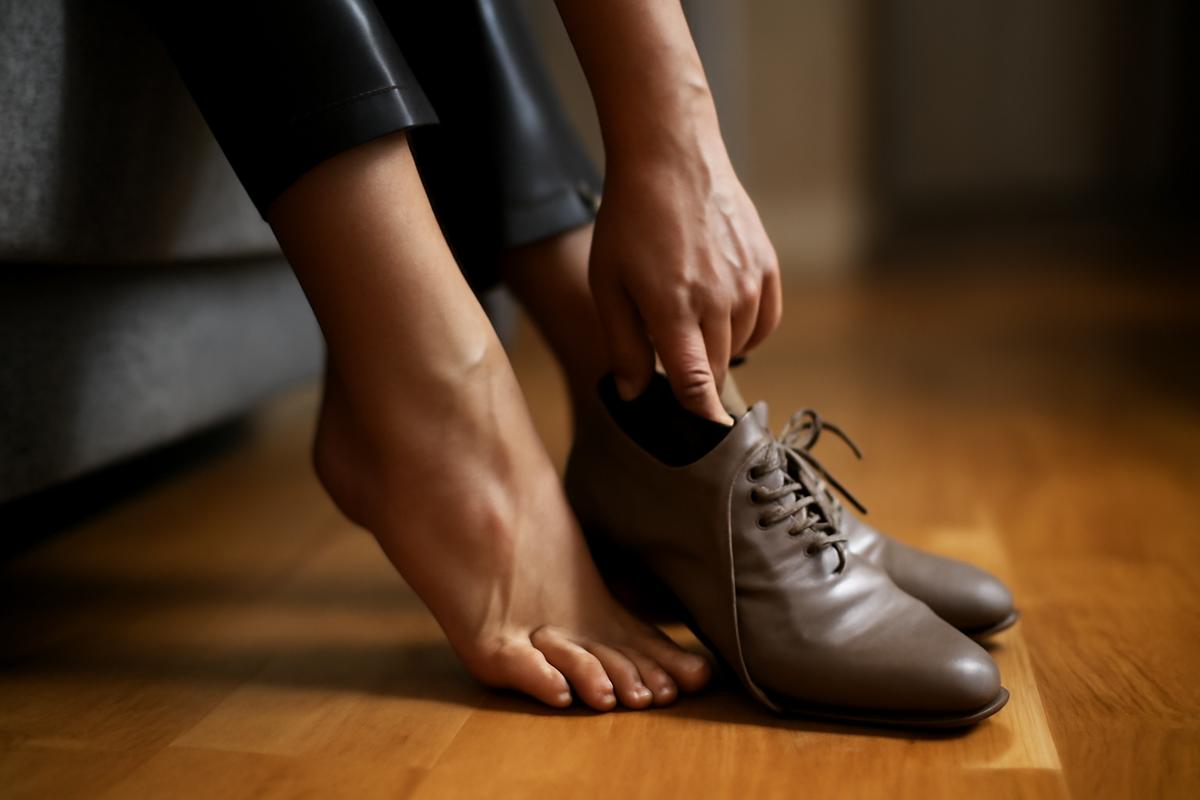
By the time the sun leans low and the sky turns the color of ripe peaches, there is a small, stubborn truth waiting for you at the front door: the same shoes that slipped on like a dream this morning now resist you with quiet defiance. You tug at the heel, wiggle your toes, maybe unlace and re-lace in the hallway light, wondering if your feet somehow aged ten years between breakfast and dinner. The leather pinches, the strap bites, and suddenly every step home feels like you’re negotiating a truce between your body and your wardrobe.
It’s a tiny daily mystery. We don’t write poems about it, and yet it carves its presence into your ankles with red lines. Why do shoes feel tighter in the evening, as if the day itself has swelled inside them? The answer is part science, part story—a subtle choreography of blood, gravity, movement, and material. And once you start paying attention, you may never see your own feet the same way again.
The Evening Swell: How Your Feet Whisper the Story of Your Day
Think of your feet as the quiet archivists of your waking hours. They have been with you for every step, bearing your weight, absorbing shock, adjusting to cobblestones and office carpets, train platforms and kitchen tiles. By the time evening rolls in, they are no longer the same feet that slid into your shoes at sunrise.
Inside your body, blood and fluid are always on the move. When you stand or sit for long stretches, gravity tugs that fluid downward, pulling it into the lower parts of your body—especially your feet and ankles. The tiny blood vessels and lymphatic channels there can only move fluid back up so fast. Over hours, a little extra stays behind, like guests who linger after the party is supposed to be over.
The result is mild swelling—so common that most people don’t notice it until their shoes turn into storytellers. That gentle pressure across your toes, the snugness over the bridge of your foot, the way your pinky toe presses just a little too firmly against the side of the shoe: it’s all the language of evening feet. Morning feet are leaner, drier, well-rested; evening feet are soft-edged, a bit puffed, rich with the weight of every step you took.
It’s not dramatic, usually. A few millimeters of change, maybe half a shoe size on a long, hot day. Yet when your shoes are cut with no extra mercy—no stretch, no forgiveness—that tiny swell becomes a sharp conversation. A blister here, a rubbed toenail there, a strap that indents the skin like a pressed leaf.
Gravity, Blood, and the Slow River Under Your Skin
If you could watch your circulation across a single day, it would look like a slow river negotiating a long, gentle hill. In the morning, when you first swing your legs out of bed, your body’s fluids have had all night to redistribute. Lying flat, you’re like a quiet lake: there’s no “downhill” for gravity to pull toward, so your feet start the day with less fluid pooled in them.
Stand up, though, and the landscape changes. Now your heart must pump blood upward, fighting gravity from your toes to your chest and beyond. Your veins and lymphatic system act like an uphill pipeline, using tiny valves and muscle action to keep everything moving back toward your heart. Every time you flex your calf or shift your weight, you help that system along, squeezing the vessels and pushing fluid up.
But modern life doesn’t always cooperate. Long hours at a desk, commuting in cars, standing behind counters, lining up at checkouts—these all invite stillness. Muscles don’t work as often as they could, the upward push slows, and gravity wins small, repeated battles. By late afternoon, those small victories show up in your shoes.
On hot days, the effect amplifies. Heat coaxes blood vessels to expand, a cooling strategy your body uses to help shed warmth. Those wider vessels allow more fluid to seep into surrounding tissues. Your feet, already the far edge of the map, suddenly become a quiet floodplain. So when that late-summer bus ride home has your sandals leaving faint impressions in your skin, it’s not your imagination. It’s physics and physiology, humming together beneath your tan lines.
The Shape-Shifters: How Shoes Change While You’re Changing
We tend to think of shoes as fixed objects—the same at dawn and dusk, loyal and unchanging. But they, too, are slowly transforming as the clock turns. Leather softens with warmth and movement, stretching here, compressing there. Foam insoles compact under your weight, losing some of their initial plushness. Even synthetic materials, though more rigid, respond to temperature and pressure.
Imagine a brand-new pair of leather shoes in the morning. The leather is still firm, unacquainted with the contours of your bones and arches. As you walk, warmth from your skin and friction from each step makes the material slightly more pliable. It molds, yes—but sometimes not in the direction you would hope. The edges might curl in, the heel cup might hug tighter, or seams may press more pointedly into sensitive areas.
Combine that with the subtle swelling in your feet, and you have a converging story: your feet are expanding while your shoes are losing their early-day generosity. The cushioning flattens, offering less buffer; the upper gently grips more tightly as the shape of your foot presses outward. The numbers on the box—size, width, style—cannot capture this evolving relationship.
By evening, those cute boots or minimal sneakers may feel like they’ve turned on you. But in truth, both you and your shoes have simply evolved over the course of the day, meeting again at dusk as slightly different versions of yourselves.
Little Differences That Turn Into Big Pinches
Not all shoes react the same way, and not all feet either. Some people glide through the day in the same pair of shoes with barely a moment’s discomfort, while others begin to dread their evening walk home by lunchtime. Often, the difference lies in tiny details—a half size here, a width there, a style choice made for aesthetics more than anatomy.
High heels, for example, shift your body weight forward, pressing your toes into the narrowing front of the shoe. As your feet swell over the day, there is nowhere for that extra volume to go but into friction and compression. Similarly, pointed-toe styles corral your toes into a shared corner, demanding harmony from bones that evolved to spread out and grip earth, not crowd into a polished triangle.
Even athletic shoes can conspire against comfort if they prioritize fashion over fit. Narrow toe boxes, stiff overlays, or shallow insteps may feel “snug but fine” at 8 a.m., then morph into cramped territories by late afternoon. The difference between a shoe that cooperates with evening feet and one that protests can be as delicate as a few extra millimeters of width or a slightly roomier upper.
| Time of Day | What Happens to Your Feet | How Shoes Tend to Feel |
|---|---|---|
| Early Morning | Less fluid in feet, cooler temperature, minimal swelling. | Shoes feel roomier, easy to slip on, fewer pressure points. |
| Late Morning | Gradual increase in fluid from standing or sitting. | Fit feels “just right” or snug; cushioning still fresh. |
| Afternoon | Noticeable swelling, especially in warm weather or long periods of stillness. | Shoes feel tighter; straps and seams more noticeable. |
| Evening | Peak swelling of the day; feet slightly larger and warmer. | Shoes can feel cramped, stiff, or painful; red marks and fatigue appear. |
When Your Body Speaks: Beyond “Just Tight Shoes”
Most of the time, that evening tightness is harmless—a whisper of the day’s journey. But sometimes, your feet are saying more. Persistent or severe swelling can be a quiet messenger of other things happening deeper inside your body.
For some, salt-heavy meals lead to more fluid retention. Your body, trying to keep the balance of salt and water just right, holds onto a little extra water. The farthest places—your feet and ankles—become the storage shelves. You may notice your socks leaving deeper imprints, sandals feeling snug, or the skin on your feet looking slightly shiny by the end of the day.
Other times, hormones join the conversation. Many women notice their shoes feeling tighter in the days leading up to their period, as hormonal shifts encourage the body to hold more fluid. Pregnancy, too, brings a distinctive swelling, the body’s circulation re-routing and expanding to support two lives at once.
And there are moments when persistent swelling is worth more attention: issues with veins, heart, kidneys, or lymphatic flow can all appear first at ground level, in the swelling of feet that don’t quite fit their shoes anymore. When one foot is much more swollen than the other, or when swelling is paired with pain, shortness of breath, or sudden weight gain, it stops being about tight shoes and starts being a message that deserves a doctor’s eye.
The Silent Work of Muscles and Movement
There’s a simple, often overlooked ally in the battle against evening shoe tightness: your own muscles. Every time you flex your foot, point your toes, rise onto your tiptoes, or roll your ankles, you’re helping to push fluid back toward your heart. Your calves, especially, are like a second heart for your lower legs, pumping with each step.
When a day involves only small movements—desk to coffee machine, car seat to sofa—those muscles don’t get much of a workout. Fluid lingers, feet puff, and shoes slowly transform from silent companions into low-grade tormentors. A few deliberate choices can change that: taking the stairs, standing up every hour, walking a block further than necessary, pausing to circle your ankles under the table during a long meeting.
Even small rituals at home can help. Kicking off your shoes for a few minutes, elevating your feet on a cushion, gently flexing your toes as you scroll through messages in the evening haze—these acts are as much for your circulation as they are for your comfort. They invite gravity to loosen its grip, to let the river of your blood run a bit more freely uphill.
Choosing for Dusk, Not Just for Dawn
Most shoe choices are made in the morning, when feet are at their smallest and the day still feels full of possibility. The leather is smooth, the colors crisp, the mirror kind. It’s easy to prioritize how shoes look at 8 a.m. over how they will feel at 6 p.m.—but your feet remember the entire script, not just the opening scene.
Sizing with the evening in mind can be quietly revolutionary. Trying on shoes later in the day gives you a more honest sense of their true relationship with your body. Leaving a thumb’s width of space between your longest toe and the front of the shoe, choosing a width that doesn’t demand your foot compress to fit, favoring designs with softer, more forgiving uppers—all of these small decisions are forms of care.
Materials matter, too. Natural leathers and fabrics tend to breathe better, reducing the heat that encourages swelling. Shoes with adjustable features—laces, buckles, straps—can adapt with you as your feet change over the day. Roomy toe boxes respect the natural spread of your toes, especially when fatigue makes them crave space.
There is a certain kindness in owning more than one pair of “everyday” shoes and alternating them. The foam and fabric recover between uses; the pressure points rotate; your feet experience different patterns of support. Even minimalist or barefoot-style shoes, which ask your muscles to work a bit harder, can feel more forgiving if sized and introduced thoughtfully.
A Small Evening Ritual of Release
There’s a moment, perhaps one of the simplest pleasures of the day, when you finally step out of your shoes in the evening. The release is almost audible, like a sigh escaping through your soles. Your toes unfurl, the arch relaxes, and your feet spread into their oldest, most natural shape—a little wider, a little wilder than the outlines traced on shoe store floors.
You might not think of that moment as anything more than relief, but it can also be a quiet act of listening. How long do your feet take to feel normal again? Where do you see the red marks, the pressure lines, the tiny callouses? These are not just signs of wear and tear; they’re feedback, a body-language note passed discreetly to your future self: next time, choose a little more room here, a softer edge there, a lower heel.
In a life that often asks us to move faster, stand longer, and ignore small discomforts, paying attention to why shoes feel tighter in the evening is a way of honoring limits. It’s listening not just to facts about veins and gravity, but to the lived experience of the body that carries you through every crowded train, every long hallway, every quiet walk at dusk.
So tomorrow morning, when you reach for your favorite pair, you might pause. You might remember the version of yourself who will come home in the amber light, feet a little swollen with the story of the day. And maybe, for that person, you choose the pair that will still feel like a companion when the sun is going down.
Frequently Asked Questions
Why do my shoes feel fine in the morning but tight in the evening?
Your feet naturally swell during the day as gravity pulls blood and fluid downward into your lower legs. Long periods of standing or sitting slow the return of this fluid to your heart, causing mild swelling. By evening, your feet can be slightly larger, so shoes that felt comfortable in the morning may feel snug or tight.
Is it normal for feet to swell every day?
Mild, symmetrical swelling in both feet and ankles by the end of the day is common, especially if you’re on your feet a lot, sit for long periods, or it’s hot outside. However, sudden, painful, or one-sided swelling, or swelling accompanied by symptoms like shortness of breath or chest pain, is not normal and should be evaluated by a medical professional.
Can my shoe size really change over the course of a day?
Yes. While your official shoe size doesn’t change from morning to night, the volume of your feet does. Swelling can effectively make your feet behave as if they’re up to half a size larger in the afternoon or evening, especially after long, active, or hot days.
What kind of shoes are best to reduce evening tightness?
Shoes with a roomy toe box, soft or breathable uppers, adequate cushioning, and adjustable features like laces or straps tend to handle evening swelling better. Choosing low to moderate heels and trying on shoes later in the day can also help ensure a more comfortable fit from dawn to dusk.
How can I prevent my shoes from feeling so tight later in the day?
Several small habits can help: choose shoes with a little extra space, avoid very narrow or pointed styles for all-day wear, move regularly to keep your calf muscles active, elevate your feet when you can, stay hydrated, and be mindful of very salty meals. Rotating between different pairs of shoes also gives materials and cushioning time to recover.
When should I be worried about swelling in my feet?
Seek medical advice if swelling is severe, appears suddenly, affects only one foot or leg, or comes with pain, redness, warmth, shortness of breath, chest pain, or rapid weight gain. These can signal more serious issues, such as blood clots, heart or kidney problems, or infections.
Should I buy my shoes in the evening instead of the morning?
Yes, it’s often recommended. Buying shoes in the late afternoon or evening lets you size them to your feet at their largest point in the day. This reduces the chances that they’ll feel uncomfortably tight after hours of wear, and helps you choose pairs that stay kind to your feet from first light to the last steps home.

Hello, I’m Mathew, and I write articles about useful Home Tricks: simple solutions, saving time and useful for every day.