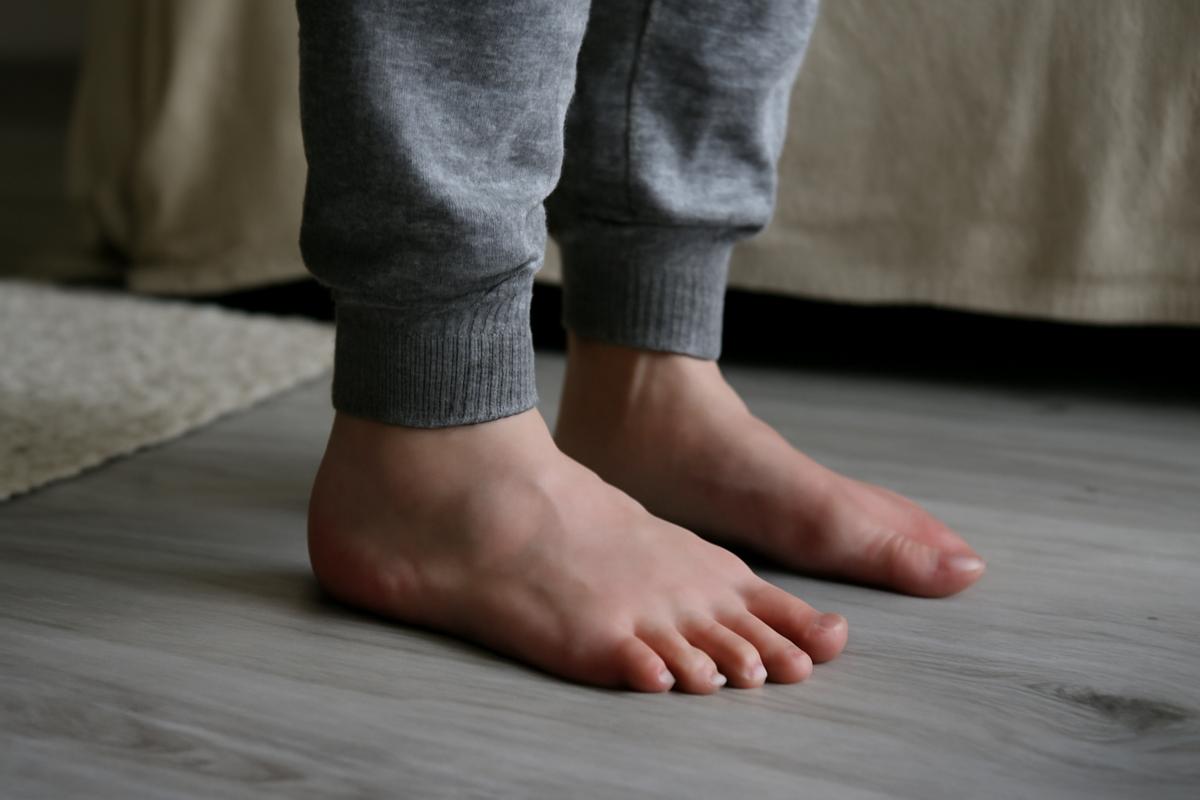
You notice it first on winter mornings. The alarm goes off, you swing your legs out of bed, and your feet land on the floor with a soft thud. The air is still warm under the blanket, but the ground beneath you is not. It is cold. Not politely cool, but sharp, like the chill of an unopened refrigerator. You wince, curl your toes, and for a moment you just stand there, gathering the courage to take the next step. You tell yourself it’s nothing, just a minor discomfort, a small price for getting on with the day. But your body is paying closer attention than you are. Beneath the skin, your blood vessels are reacting, tightening, clenching. Your heart gives a subtle push against a newly resistant landscape. And slowly, quietly, that cold floor begins a conversation with your circulation.
The Hidden Conversation Between Your Feet and Your Heart
Most of us think of cold floors as an inconvenience, the kind of thing solved with thicker socks, a pair of slippers, or a carpet runner. But the body sees cold not as a nuisance, but as a signal. When your bare feet meet a chilly tile or wooden surface, your nervous system reads it as a potential threat: loss of heat, risk of damage, time to protect.
The skin on your feet is dotted with tiny temperature sensors called thermoreceptors. They’re silent most of the time, humming along as you go about your life, but the moment they feel a drop in temperature, they start sending rapid-fire messages up the nerves to your spinal cord and brain. In response, your body flips a switch you don’t consciously control: blood vessels in your feet and lower legs begin to constrict.
This tightening—vasoconstriction—is your body’s instinctive way of reducing heat loss. By narrowing the pipes, it sends less warm blood to the surface where it might be cooled, and redirects more toward your core, where your vital organs are kept safe and warm. Evolutionarily, it’s brilliant. But in the ease and comfort of modern life, it can have consequences people rarely connect to the sensation of a cold floor.
If your feet meet that chill only occasionally, your body manages it well: constrict, adjust, relax, move on. The problem comes when the exposure is frequent, daily, and long term—when you regularly walk barefoot over icy tiles or stand for long stretches in a cold kitchen, bathroom, or studio. Over time, the reflexive tightening of blood vessels stops being an occasional protective response and starts becoming a pattern, a habit learned by your circulation system.
How Cold Floors Turn Small Vessels into Tight Funnels
Imagine your circulation like a landscape of rivers and streams. Your arteries are the wide rivers, carrying strong currents from the heart; your veins are slower, winding channels returning blood home. But it’s the tiny capillaries, the narrowest streams, that do the delicate work—delivering oxygen and nutrients, picking up waste, sharing warmth with your tissues.
Now picture those tiny streams narrowing whenever your feet touch a cold surface. The capillaries and small arteries in your toes, soles, and ankles compress like someone gently pinching a drinking straw. Blood still flows, but the passage is tighter, the pressure different, the journey slower and less generous.
Over time, repeated constriction can mean your tissues get less of what they need. Nerve endings that crave oxygen and warmth become irritable. Muscles tire sooner. Skin grows cool, sometimes pale or bluish. You might notice your toes take longer to warm up after a shower, or that your feet sting when you finally slip under a blanket. That’s your circulation negotiating with a smaller and smaller margin of comfort.
It’s not just about comfort. That constant start-stop pattern—tighten with cold, relax with warmth, tighten again—can aggravate underlying circulation problems you might not even know you have. People with Raynaud’s phenomenon, diabetes, or peripheral artery disease often feel this acutely, but even those with no formal diagnosis can feel the slow erosion of resilience. The feet, already at the farthest edge of the circulatory system, are like a distant village at the end of a narrow, winding road. Any extra obstacle along the way makes the trip just that much harder.
| Effect of Cold Floors | What Happens in Your Body | How You Might Feel |
|---|---|---|
| Vasoconstriction | Small blood vessels narrow to conserve heat | Cold, pale, or bluish toes and soles |
| Reduced microcirculation | Less blood reaches skin, nerves, and muscles | Numbness, tingling, “pins and needles” |
| Increased blood pressure load | Heart pushes against more resistance in narrowed vessels | Fatigue, heaviness in legs, sometimes headaches |
| Slower venous return | Cool, tense muscles and vessels hinder blood returning to the heart | Swelling, achy calves after standing |
Hidden in this quiet reshaping is a simple truth: the relationship between your feet and your heart is more intimate than it feels. Every time your bare skin meets a cold floor, your entire circulatory system is invited into a negotiation it did not plan to have.
Why the Cold Seems to “Climb” Up Your Legs
There is a particular kind of discomfort people describe after spending time on a cold floor: it starts in the feet, then slowly creeps upward, like water wicking through a cloth. The toes go numb first, then the balls of the feet, then the arches. After a while, the ankles feel stiff, the calves tense, and a faint heaviness settles in the legs. This isn’t your imagination; it’s the body’s response radiating outward from a small but insistent stimulus.
When your feet are chilled, your calf muscles often respond by tightening. Partly, this is reflex—cold muscles naturally contract more and are less elastic. But the calves are more than just support columns holding you up: they’re sometimes called your “second heart.” With every step, the squeezing and releasing of these muscles help pump blood back toward your chest, working against gravity. If the muscles are cold and stiff, they’re less efficient at this mechanical pumping.
Combine constricted blood vessels in the feet with underperforming calf muscles, and you get a sort of traffic jam in your lower limbs. Blood takes more effort to move upward; fluids can pool; that mild swelling at the end of the day becomes more common. Resting might help, elevating your legs might help, but if you step again onto that same cold floor, the story resets.
Circulation is never purely local. When one part of the system feels a strain, the rest compensates. Your heart may beat a little harder to push blood through those narrowed vessels. Your nervous system whispers quiet commands to tighten here, release there, in an effort to keep pressure and temperature within a safe range. Over the years, this constant balancing act, triggered by something as simple as a chilly tile, becomes part of the background load your body carries.
Cold Floors, Chronic Habits, and Slow-Burning Consequences
The harm of cold floors rarely makes headlines because it doesn’t announce itself dramatically. There’s no single dramatic moment when everything changes. Instead, it’s a story written in many small chapters: the daily rush from warm bed to bathroom tiles, the quick barefoot trip to let the dog out on a frigid porch, the long hour cooking dinner in a kitchen whose floor never seems to lose its chill.
Each moment is brief. But habits are made from brief moments repeated.
At first, the effects might be subtle: your toes get cold faster than they used to, or you find yourself rubbing your feet together under the desk to keep them alive and awake. You get more frequent “pins and needles” when you sit too long, or an odd, electric buzzing in your feet at night. You chalk it up to age, stress, shoes, anything but the ground itself.
Yet the science of thermoregulation and vascular health tells a consistent story. Long-term exposure to cold, especially on the extremities, can:
- Reinforce patterns of excessive vasoconstriction, training vessels to overreact to even modest drops in temperature.
- Aggravate symptoms in people with existing circulation issues, amplifying numbness, pain, and sensitivity.
- Contribute to higher average blood pressure as the body continuously nudges the system to push blood through narrowed passages.
- Slow tissue repair where circulation is chronically compromised, potentially affecting skin integrity and nerve health.
This doesn’t mean cold floors will inevitably lead to severe disease; biology is not so simple, and many factors shape your vascular story. But they do represent a steady, often overlooked source of strain on a system that depends on warmth, elasticity, and easy movement.
Think about the difference between walking across a sun-warmed wooden deck and a stone floor in mid-January. On the warm deck, your shoulders drop, your step is relaxed, you don’t rush. On the cold stone, your body pulls inward: shoulders hunch, steps shorten, breath catches. Without words, your entire posture reveals what your circulation already knows—this is not a friendly surface.
Listening to Your Feet: Early Warnings from the Ground Up
One of the simplest, most accessible ways to assess your circulation is to pay attention to how your feet behave in everyday life. The signals are often soft at first, easily ignored amid louder dramas of work, family, and fatigue. But they are there, like small flags planted at the edge of your awareness.
You might notice that your feet:
- Stay cold long after the rest of your body warms up.
- Turn blotchy, pale, or bluish when exposed to cold floors or air.
- Feel numb, tingly, or painful after standing barefoot on a chilly surface for only a short time.
- Take longer to recover normal sensation after you slip them into warm socks or under a blanket.
- Feel heavy, as if each step is just a bit thicker than it should be.
Each of these sensations is a small story written by your blood vessels and nerves. They are not always signs of disease, but they are signs of a system under stress, of a delicate balance being pushed just a bit too often. Cold floors are not the only culprit, of course—sitting for long periods, tight shoes, smoking, and certain medical conditions all carve their own paths into your circulation. But the ground beneath you is one of the few variables you can change immediately, daily, and with relatively little effort.
There is an emotional component, too. When your feet are cold, your whole body often feels less at ease. You move less, you curl in, you hesitate. Movement is one of the best allies of circulation; hesitation, its quiet enemy. In this way, cold floors do more than narrow vessels—they change behavior, turning you a little more sedentary, a little less inclined to pace, stretch, or wander.
Simple Shifts: Turning the Floor from Foe to Ally
The good news is that the same daily pattern that can slowly strain your circulation can just as easily be reshaped into a gentler, more supportive one. You don’t need to rebuild your house or install underfloor heating to change the relationship between your feet and the ground. You need only to create a barrier, introduce warmth, and invite movement.
Think of your feet as sensitive ambassadors. Their job is to gather information from the world and send it to the rest of you. When they constantly report “cold, cold, cold,” your vessels shrink back in self-defense. When they report “warm, cushioned, safe,” those same vessels soften, expand, allow flow.
Soft, insulating rugs in places where you stand the most—by the bed, in front of the sink, near the stove—act like quiet negotiators. They buffer the shock of the cold beneath, giving your thermoreceptors a more moderate story to tell. A pair of comfortable, non-restrictive house socks or slippers transforms every step into a more neutral experience, where your body doesn’t have to brace itself before your heel even lands.
Warmth alone isn’t enough, though. Movement matters. Gentle foot and ankle exercises while you sit or stand—rolling your ankles, flexing and pointing your toes, spreading your toes wide, lifting your heels—wake up the calf muscles and encourage blood to travel more freely. Short, frequent walks through your home do more for your circulation than one long, heroic effort. The goal isn’t athletic performance; it’s rhythm. Circulation loves rhythm.
Even small rituals help. Placing a warm cloth over your feet in the evening, massaging lotion into your soles and toes, or soaking your feet in warm (not hot) water for a few minutes can become daily invitations to your blood vessels to relax and expand. These are not indulgences; they are quiet forms of maintenance, like oiling the hinges on a well-used door.
Reframing Comfort as Circulatory Care
In a culture that often glorifies endurance—toughening up, walking barefoot on cold floors as if it were a badge of resilience—it can feel strange to prioritize something as simple as keeping your feet warm. But resilience is not only about what you can tolerate; it is also about what you choose not to tolerate every day.
By tending to your environment, by softening the sharp edge of that first step out of bed, you are not pampering yourself in some trivial way. You are reducing a small but constant demand on your cardiovascular system. You are choosing better conditions for your blood vessels, your nerves, your heart.
Over months and years, these choices accumulate. Feet that are regularly warm and gently stimulated carry richer blood, more often. Calves that move frequently become better pumps. A body that doesn’t have to defend itself against tiny daily assaults of cold can spend that energy on resilience where it truly matters.
FAQs: Cold Floors and Circulation
Do cold floors really affect overall circulation, or just make my feet uncomfortable?
Cold floors do both. Locally, they cause the blood vessels in your feet and lower legs to constrict, reducing blood flow and making your feet feel cold, numb, or tingly. Systemically, frequent or prolonged exposure can increase the resistance your heart works against and subtly influence blood pressure and circulatory patterns over time.
Is brief contact with a cold floor harmful?
Short, occasional contact is usually not harmful for a healthy person. The body can quickly constrict and then relax the blood vessels without lasting issues. Concerns grow when exposure is repeated many times a day, or you stand on cold surfaces for long periods, especially if you already have circulation problems.
Why do my feet hurt when they start to warm up after being very cold?
When cold-constricted blood vessels begin to reopen, blood rushes back into tissues and nerve endings that have been partly deprived. That sudden return can cause aching, burning, or stinging sensations as the nerves react to the change in temperature and blood flow.
Can cold floors worsen conditions like Raynaud’s or diabetes-related circulation issues?
Yes. For people with Raynaud’s phenomenon, even mild cold can trigger intense vessel constriction and color changes in the toes. Those with diabetes or peripheral artery disease already have vulnerable blood vessels and nerves; repeated cold exposure can aggravate numbness, pain, and slow healing in the feet.
What practical steps can I take at home to protect my circulation from cold floors?
Use warm, cushioned rugs in key areas, wear soft socks or slippers, avoid long periods of barefoot standing on cold surfaces, and add daily foot and calf movement—simple flexing, ankle circles, and short walks. Gentle warmth, like a warm foot bath or a heated cloth, can also encourage better blood flow.
Are there signs that my circulation is being affected beyond normal “cold feet”?
Warning signs include persistent numbness or tingling, frequent color changes in the toes (white, blue, or very dark red), slow warming even after covering your feet, swelling in the ankles or lower legs, and pain when walking that eases with rest. If you notice these, especially alongside cold-floor exposure, it’s wise to speak with a healthcare professional.
Does strengthening my legs help counteract the effects of cold floors?
Yes. Strong, active calf and foot muscles act as powerful pumps that help return blood to the heart. Regular walking, gentle calf raises, and foot exercises improve circulation and make your legs more resilient to brief cold exposure—though they don’t replace the benefit of simply keeping your feet warm.

Hello, I’m Mathew, and I write articles about useful Home Tricks: simple solutions, saving time and useful for every day.