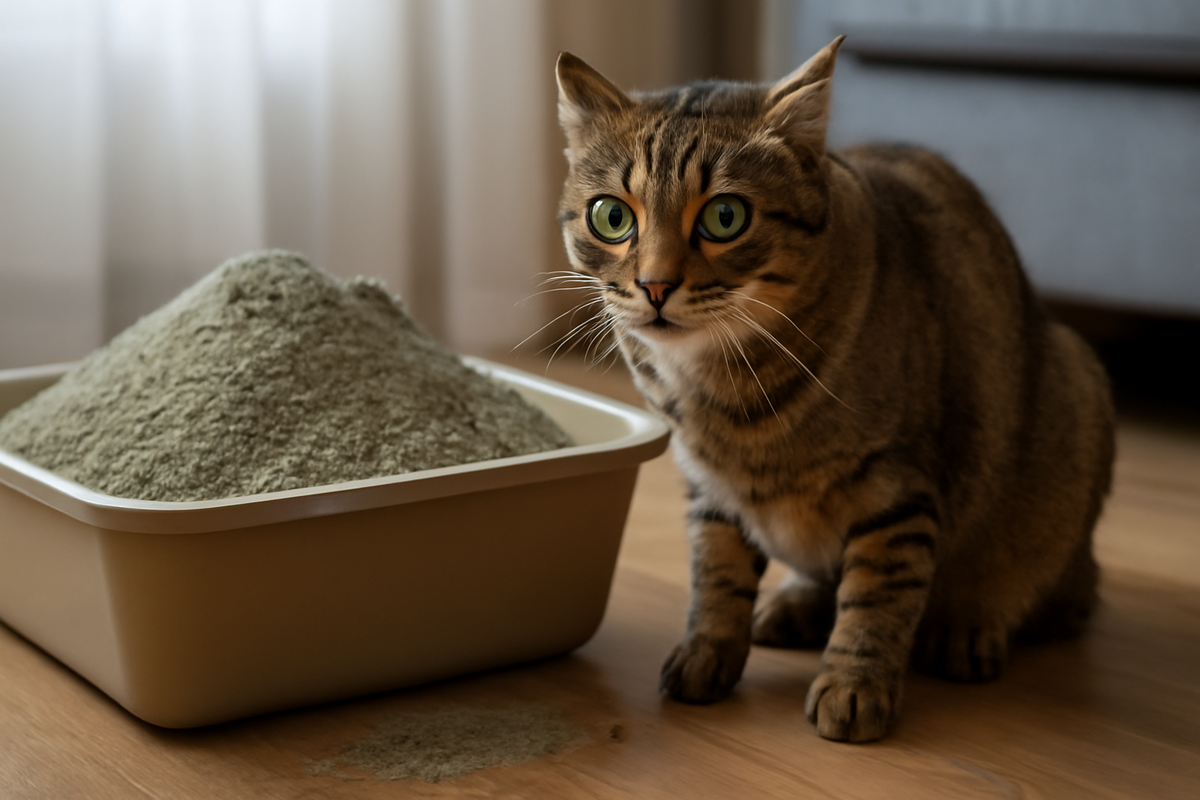
The first sign was the sound she made when she thought no one was listening. A low, breathy whine floated out from the bathroom — barely a sound at all, more like a sigh of frustration wrapped in fur. When Mia followed it, barefoot and half-distracted, she found Oliver the tabby frozen in his litter box, standing rigid on the plastic edge like the floor had turned to lava. His tail flicked once, twice. Then he jumped out without doing anything, bolted under the bed, and left a faint, sour smell that said everything his small body was trying to hide.
The Mistake Hiding in Plain Sight
Mia did what most of us would do: she googled “cat peeing outside litter box,” convinced it was a medical emergency or a sign of rebellion. Was he angry? Was he sick? Was this payback for the new sofa? She booked a vet appointment, braced her wallet, and started preemptively apologizing to her carpets.
At the clinic, under the soft hum of fluorescent lights, her vet asked the usual questions — food, water, any changes at home — then paused.
“Tell me about his litter box,” the vet said.
Mia blinked. “His… box?”
The vet nodded. “Type of litter? How many boxes? Where are they? How deep is the litter? How often do you clean it?”
The questions tumbled out, plain and practical, but underneath them was a quiet truth more and more veterinarians are trying to get cat guardians to see: the single biggest source of silent, needless stress for indoor cats is often not the food, the toys, or even the other animals — it’s the litter box. Or more precisely, the very normal, very human way we set it up.
Because for a cat, a litter box is not a trash can. It is a landscape. A territory. A place of vulnerability and instinct, where wild ancestry bumps into tiled floors and scented clumping clay. And one simple, common mistake — the wrong kind of box, the wrong setup, the wrong assumptions — is quietly stressing out countless cats, every single day.
The One-Box, One-Corner Problem
Most of us, without thinking, make the same choice Mia did: we buy a single box, tuck it into a bathroom corner or laundry room, maybe slap a lid or flap door on it to “keep the smell in,” and call it done. It’s neat, tidy, visually out of the way — perfect for humans.
For cats, it’s often a nightmare.
“If I could wave a magic wand and change one thing in cat homes,” one vet behaviorist likes to say, “I’d change litter box setups.” The core mistake? Treating the litter box like a household object instead of what it is for a cat: a survival zone.
The classic human setup — one box for a multi-cat home, covered, shoved in a corner near a noisy washer, filled with strongly scented litter and cleaned “when we remember” — quietly breaks almost every rule of feline comfort. The stress that follows can masquerade as picky behavior, spite, or random accidents, when in reality it’s a cat trying to cope with a bathroom that feels, to them, unsafe.
What Your Cat Sees When You See a Box
Imagine you’re trying to use a public restroom. There’s only one stall, the door is half-jammed, the floor is sticky, someone’s running a loud machine right outside, and the air reeks of artificial perfume trying to smother something worse. Also, there’s a decent chance that when you’re mid-squat, someone might burst in and corner you with no way out.
That’s what many cats experience several times a day.
Cats are both predator and prey in their evolutionary story. When they eliminate, they’re in a moment of deep vulnerability — they want to see their surroundings, hear what’s coming, and know they can escape if startled. A covered box limits sightlines, traps smell, and funnels all exits to one hole. A box in a tight corner or behind a door can feel like a trap. Sharing one box with another cat? That can feel like trying to share one bathroom with your least favorite coworker during a plumbing emergency.
Vets see the results in exam rooms everywhere: urinary tract issues, constipation, stress grooming, “inappropriate elimination” (a term that quietly blames the cat for a very appropriate protest), and anxious behavior that looks mysterious until you zoom out and ask the same question Mia’s vet did: “Tell me about the box.”
What Vets Say a “Good” Litter Setup Actually Looks Like
Once Mia finished describing her system — one covered box, pine-scented litter, once-a-week full clean, tucked in the dark corner of a small bathroom — her vet didn’t scold. She simply nodded and pulled out a notepad.
“Okay,” she said, turning the pad around. “Let’s build Oliver a bathroom he actually feels safe in.”
Across clinics and behavior practices, the advice is strikingly consistent. While every cat is an individual, most thrive when a few core principles are met.
1. The Magic Formula: Number of Boxes
The rule that surprises people most is this one:
Number of litter boxes = number of cats + one.
So if you have one cat, you should ideally have two boxes. Two cats? Three boxes. It sounds excessive until you see what it does to stress levels. Multiple boxes do three things:
- Offer choice — a vital stress buffer for animals who can’t say, “I don’t like that spot, can we move it?”
- Reduce crowding and territorial tension between cats.
- Provide backup options if one box is temporarily dirty, scary, or blocked.
For Oliver, that meant going from one lonely plastic cave in the bathroom to two open, inviting trays in different parts of the home.
2. Open, Not Covered
Most vets and behaviorists now recommend uncovered boxes. While humans love lids for aesthetic and odor reasons, cats often feel cornered inside them. Smells build up, sound is muffled (which means surprises feel more sudden), and there’s only one visible way in or out.
Open boxes let a cat:
- See the room and anyone approaching.
- Hear normally and anticipate movement.
- Escape easily if startled.
Some cats will tolerate a covered box. A few even seem to prefer it. But if you’re seeing stress signs, peeing just outside the box, or hesitation at the entrance, removing the lid is often the simplest, fastest fix.
3. Size and Shape: Bigger Than You Think
A “standard” litter box from the pet aisle is usually too small. Picture your cat stepping in, turning in a full circle, squatting, and then burying their waste — without any part of their body hanging over the edge. If that mental video doesn’t work in your current box, it’s too tight.
Many vets now suggest using large, shallow plastic storage bins (with low sides or a cut-out entrance) as litter boxes. They’re inexpensive, spacious, and far more comfortable for bigger cats or seniors with stiff joints.
As a loose guide: the box should be at least 1.5 times the length of your cat, from nose to base of tail.
4. Quiet, Accessible Locations (Not Just One)
Location is where human convenience often trumps cat comfort. Laundry rooms, utility closets, or cramped bathrooms seem perfect to us — out of sight, out of mind. But for a cat, these spaces come with slamming doors, rumbling machines, strange vibrations, and tight corners.
Better locations are:
- Quiet but not isolated.
- Away from food and water bowls.
- Easy to reach without navigating stairs if you have a senior or arthritic cat.
- Placed so there’s more than one way to approach or leave the box.
In a multi-level home, vets strongly recommend at least one box on each floor. No cat should have to race up a staircase when they suddenly need to go.
5. Litter Depth and Texture: Think Soft Sand, Not Gravel Pit
We often forget: litter is a surface they have to stand in, dig through, and scrape. Rough, sharp, or perfumed litters can feel like walking barefoot on scented gravel. Most cats prefer a fine, soft, unscented clumping litter poured to a depth of about 5–8 cm (2–3 inches).
Too shallow, and they can’t dig or bury properly. Too deep, and they sink or feel unstable. Heavier, large-grain litters may be comfortable for some cats, but if you see your cat shaking their paws, standing on the very edge, or bolting in and out, the texture might be the quiet culprit.
6. Cleanliness: Scoop Like It’s a Habit, Not a Chore
The most loving person can still make the most common mistake of all: not scooping often enough. Vets recommend scooping at least once a day, ideally twice for multi-cat households, and doing a full dump-and-wash of the litter and box regularly (often every 1–4 weeks, depending on how many cats and boxes you have).
For a cat, a box that smells strongly of old waste says, “Someone else lives here. This is not fully yours.” It also feels — and literally is — unclean. Their noses are much sharper than ours; what smells faintly musty to us can be overwhelming to them.
A Simple Table for Quick Fixes
Below is a quick, mobile-friendly reference for common litter box mistakes and their cat-friendly fixes:
| Common Human Habit | How It Stresses Cats | Vet-Recommended Fix |
|---|---|---|
| One litter box for multiple cats | Territorial tension, crowding, avoidance | Provide boxes = cats + 1, spread around the home |
| Covered box with small entrance | Feels trapped, can’t see or hear threats well | Use open boxes; remove lids or flaps |
| Box in noisy laundry room or tight corner | Startles, no escape routes, avoidance | Place boxes in quiet, open, accessible spots |
| Strongly scented or rough litter | Paw discomfort, overpowering smell | Use soft, fine, unscented litter; 2–3 inches deep |
| Infrequent scooping | Dirty, smelly surface, signals “not your space” | Scoop daily (or more); wash box regularly |
How Changing the Box Changes the Cat
Back at home, Mia stood in the pet aisle staring at a wall of litter boxes, suddenly seeing them as landscapes instead of plastic bins. She chose two big, open storage tubs with low sides, a bag of unscented fine clumping litter, and left the covered box in the cart for returns.
She placed one box in a quiet corner of the living room, far from Oliver’s food and water but still in the flow of daily life. The second went in the hallway upstairs, where sunlight stretched in the afternoon and there was no door to suddenly swing open. She filled each with a soft, even layer of litter and waited.
Oliver didn’t transform overnight into a blissfully calm cat, but the shift was small and clear. He approached the new box cautiously, sniffed, then stepped in with all four paws, not just the front two. He turned in a full circle, scratched, and made an unhurried deposit. No rapid-fire digging. No panicked exit. Just… normal cat business done in peace.
Over the next weeks, the small signs of tension began to fade. Fewer “accidents” outside the box. Less hiding. No more strange, breathy whine from the bathroom. The fix had not been a fancy fountain, a new toy, or a calming diffuser — it was the mundane, quiet revolution of giving a cat the kind of bathroom a cat would choose, if only they had thumbs and a say.
Medical vs. Behavioral: Why Vets Always Say “Check First”
None of this means that every litter box issue is caused by setup alone. Vets are careful to stress this: if your cat is suddenly peeing outside the box, straining, crying, visiting the box over and over, or you notice blood in their urine, that’s an emergency, not a design critique. Urinary tract infections, crystals, blockages (especially in male cats), kidney disease, and diabetes can all show up first as “bathroom problems.”
The safest order of operations is:
- See a vet to rule out medical causes, particularly if the behavior is new or dramatically changed.
- Fix the environment — box number, placement, litter type, cleanliness — even if there is a medical issue. A more comfortable setup supports healing and prevents layering stress on top of illness.
- Observe quietly. Cats are subtle; you’ll often notice their entire body language soften as their environment starts to make sense to them again.
The Quiet Power of Respecting Instinct
When we invite cats into our homes, we often love the idea of their wildness — the stealthy paws, the hunting gaze watching a speck of dust in the sunlight. But we quietly ask that wildness to squeeze itself into human routines and aesthetics. Eat here, sleep here, use this small plastic rectangle in the laundry room and don’t complain.
The litter-box mistake vets keep warning about isn’t a moral failing. It’s a mismatch of species needs. We want neatness, containment, and invisibility for something that, for them, is about safety, territory, and ease. The fix is not expensive or particularly glamorous. It is, in a way, an act of humility: rearranging our space to admit that our small house tiger is still, inside, an animal who scans for escape routes when they poop.
And when we get it right, the reward is subtle but profound — a cat who steps into their box without hesitation, who leaves without bolting, who trusts the ground beneath their paws and, by extension, the hands that filled it.
So if you live with a cat, you might try this small experiment today. Sit on the floor at their eye level. Look at their litter box not as furniture, but as habitat. Is there more than one? Is there room to move, to see, to breathe? Does it smell like harsh perfume or like nothing at all?
The change you make next might be as simple as removing a lid, moving a box out of a closet, or adding a second tray in a quieter room. To you, it may feel minor. To the animal who shares your home, it might feel like this: finally, a door unlocked; finally, a place where the wild part of them can let go and not look over their shoulder.
FAQ
How many litter boxes do I really need?
Most vets recommend one box per cat, plus one extra. So one cat = two boxes, two cats = three boxes. This gives each cat options and reduces crowding and territorial stress.
Are covered litter boxes always bad?
Not always, but many cats find them stressful because they limit visibility, trap odors, and provide only one exit. If your cat is hesitant, anxious, or eliminating outside the box, switching to an open box is often helpful.
What kind of litter do cats usually prefer?
Most cats do best with soft, fine-grain, unscented clumping litter at a depth of about 2–3 inches. Strongly scented or very coarse litters can be uncomfortable or overwhelming.
How often should I scoop and clean the litter box?
Scoop at least once a day, and more often in multi-cat homes. Fully change the litter and wash the box regularly — from weekly to monthly depending on how many cats and boxes you have and how sensitive your cat is.
My cat suddenly started peeing outside the box. Is it just a litter-box issue?
Not necessarily. Sudden changes in bathroom habits can signal medical problems like urinary infections, blockages, or kidney disease. Always see a vet first to rule out health issues, then address litter box setup and location.
Where should I place litter boxes in my home?
Choose quiet, low-traffic spots that are easy for your cat to reach, away from food and water. Avoid tight corners, loud appliances, and spaces where doors can suddenly close and trap your cat.
Can changing the litter box setup really reduce my cat’s stress?
Yes. Vets and behaviorists routinely see improvements in anxiety, inappropriate elimination, and even some health issues when cats are given more, better-placed, open, and clean litter boxes that respect their natural instincts.

Hello, I’m Mathew, and I write articles about useful Home Tricks: simple solutions, saving time and useful for every day.