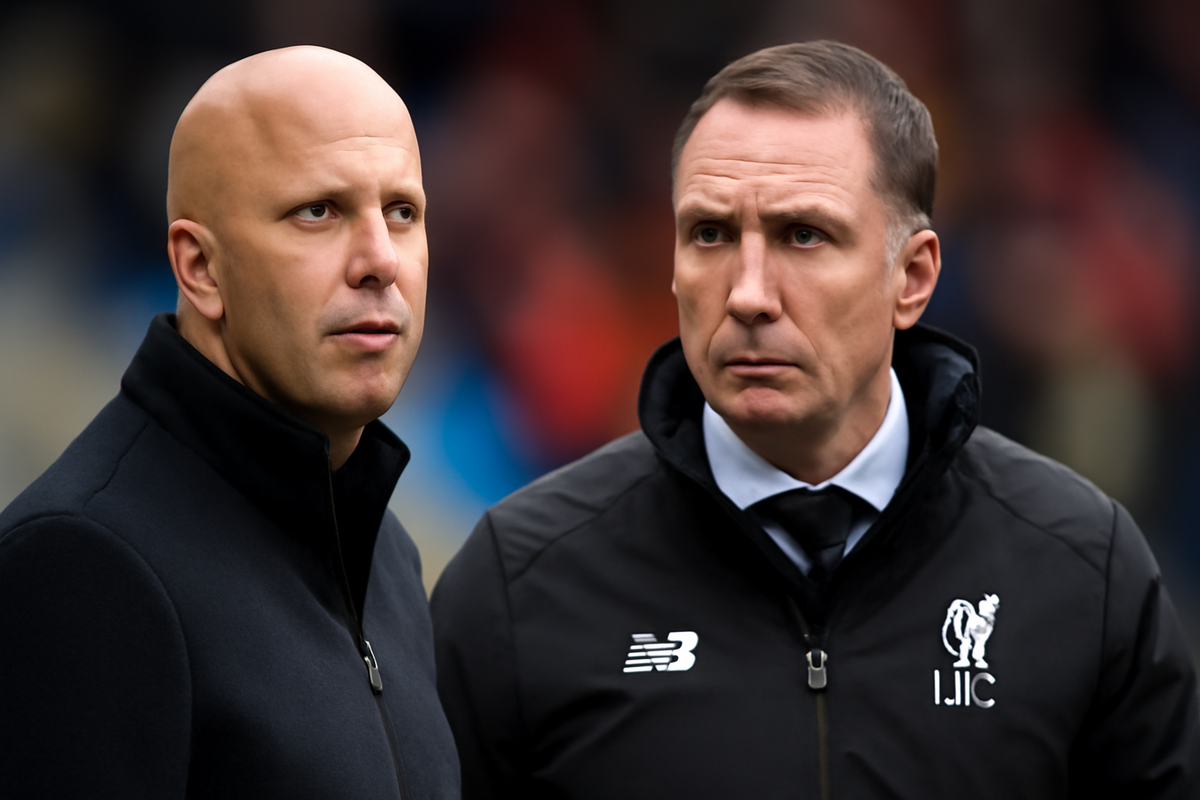
The sky above Anfield had that particular shade of Liverpool grey – somewhere between steel and saltwater – when the first murmur passed through the crowd. You could feel it more than hear it. Not anger, not yet. Not even frustration. Just that uneasy question that creeps in at the edges of a fanbase that has known both ecstasy and implosion: What exactly are we becoming?
Arne Slot’s Liverpool is still a work in progress, the paint fresh, the lines not quite defined. But in the pubs along Walton Breck Road, on late‑night fan channels, and in the restless middle of the Kop, something familiar is being whispered with increasing frequency: this looks uncomfortably like the early Brendan Rodgers years again. Not the blistering, dream‑like 2013–14 title charge; the other bit. The brittle bit. The bit where transfer gambles missed, where an attacking idea lost its sharpness, and where philosophy began to sound like excuse.
Anfield’s New Era, Old Echoes
Walk up the steps to the Main Stand, past the polished glass and the polished smiles, and you see it immediately: Liverpool have been built around an idea of intensity for nearly a decade. Under Jürgen Klopp, everything pulsed with purpose. Even the mistakes were made at full throttle. Now, things feel…different. Not bad, not yet catastrophic. Just different in a way that makes people suspicious.
Arne Slot stepped into one of the most difficult jobs in modern football: replacing a beloved architect who left behind not ruins, but a cathedral. And Slot didn’t stroll in quietly. He brought his own identity – a preference for control over chaos, for structure over storms; positional play instead of instinctive heavy metal football.
The issue, critics say, is not that he wants to play a different tune. It’s that the club’s transfer decisions, combined with his tactical demands, are starting to rhyme with an era nobody wanted to revisit. The term some fans now mutter, almost superstitiously, is “Brendan‑bad” – that stretch where ambition and confusion danced an awkward waltz, and Liverpool slipped from title talks into post‑Suárez drift.
The Brendan Shadow
Brendan Rodgers, like Slot, arrived as the progressive thinker, the man with a project, the apostle of “philosophy.” When it worked, it felt revolutionary. But when the spine of his best team left or aged and the signings didn’t match the rhetoric, the whole thing sagged. Possession without punch. Ideas without anchoring personalities. Transfer committees producing players who never quite fit the jigsaw they were bought for.
Now, with Klopp gone, that old anxiety is resurfacing. This time the face on the touchline is different, the accent different, the pedigree Dutch rather than Northern Irish, but the questions feel eerily familiar: Are Liverpool signing players for a clear, coherent system? Or are they once again trying to bolt shiny additions onto a car that’s already changing engines mid‑race?
Transfer Decisions: A Squad in Half-Light
On paper, some of Liverpool’s recent transfer moves are justifiable. They look good in data dashboards and highlight reels. Young, technically comfortable players. Tactical versatility. Resale value. The usual buzzwords. But football is not played on paper or in spreadsheets; it is lived on grass, judged in split‑second decisions when the Kop sucks the ball toward the net or groans in disbelief.
Under Slot, the club has leaned into profiles that suit a more patient, possession‑heavy approach. Ball‑playing defenders. Midfielders who drift between the lines rather than launch themselves through them. Wingers comfortable coming inside and sliding passes instead of just tearing down the flanks like unleashed greyhounds. The intention is clear: more control, more manipulation of space, more chess, less pinball.
The problem, critics argue, lies in the balance. The departures – whether by age, contract expiry, or strategic pruning – have slowly stripped the squad of a certain viciousness. The snarling, second‑ball hunters. The players who turn a messy 50/50 into a 70/30 just by desire. In their place, there is a sleeker, shinier profile. But not necessarily a better one for the Premier League’s relentless grind.
Numbers That Tell a Nervous Story
Even early in Slot’s tenure, you don’t need to be a data analyst to feel the shift. You can see it in the way Liverpool now build from the back, sometimes slowly, sometimes beautifully, sometimes dangerously. You can sense it in the crowd when the ball cycles laterally once too often, when promising breaks lose their altitude, when teams that used to be smothered now find oxygen in Anfield’s half.
Imagine looking at a snapshot like this – not definitive, but suggestive:
| Metric (League Only) | Late Klopp Era | Early Slot Era |
|---|---|---|
| Average Possession | 59–61% | 63–66% |
| Shots per Game | 17–19 | 13–15 |
| High Turnovers per Game | 9–11 | 5–7 |
| Goals from Pressing Situations | Among league best | Mid‑table range |
| Passes per Defensive Action (PPDA) | Aggressive pressing, low PPDA | Less aggressive, higher PPDA |
More of the ball, fewer shots, less chaos in the opponent’s third. That is not inherently a disaster; it’s a philosophical trade‑off. But in the Premier League, where even relegation candidates are stocked with sprinters and street‑smart technicians, controlling the ball is only half the battle. If the transfer policy tips too far toward delicacy over brutality, a team can drift into sterility.
And that, precisely, is the warning label critics are now slapping on this Liverpool side: the risk of harmless dominance. Possession that looks impressive on television graphics but does little to terrify anyone in real life.
Arne Slot’s Football: Beautiful Patterns, Blunt Edges?
If you watch Slot’s Liverpool from the upper tiers, it can look like choreography. The back line spreads, the pivot drops, full‑backs inch inside, wingers pinch in toward the half‑spaces. Triangles bloom and fade across the pitch. The plan is easy to trace with your finger in the air: pull opponents one way, exploit the gaps they leave behind.
The tension lies in implementation. Klopp’s sides were built for vertical violence – sucker punches launched from turnovers, surging red waves crashing into ragged defenses. Slot, by contrast, wants to ask opponents a thousand questions in possession, to move them slowly until the right pass appears. When it works, it is elegant. When it doesn’t, it is ponderous.
This is where the transfer strategy becomes far more than just a list of ins and outs. To play Slot’s version of modern positional football at the pace and intensity the Premier League demands, a squad needs hyper‑specific profiles. Centre‑backs who can defend acres of space but also thread line‑breaking passes. Midfielders who can both receive under pressure and chase lost causes relentlessly. Wide forwards who are as happy to combine in tight spaces as they are to finish moves with minimum touches.
The Wrong Kind of Comfort
Critics argue that too many of Liverpool’s recent reinforcements lean toward one half of that equation. Technically neat, press‑resistant players – yes. Wild‑eyed physical monsters who treat every duel like a personal insult – fewer and fewer. The squad feels increasingly optimised for a training‑ground rondo rather than a December night away at a snarling mid‑table ground where the grass is long and the welcome is short.
This is where the “Brendan‑bad” echoes get louder. Under Rodgers, Liverpool sometimes felt like a concept album – clever, tactical, cerebral – but dangerously reliant on one or two individual stars to add the raw chaos that turned theory into points. When those stars left or dipped, the aesthetic remained, but the edge vanished.
Slot’s system, according to his defenders, can bake that edge into the structure itself over time. Yet his detractors counter that structure without the right personalities is just geometry. You can set the team up perfectly, but when a second ball drops loose in midfield, when a cross flashes through the six‑yard box, you still need the kind of player who thinks with their teeth, not their feet.
The Dressing Room Temperature
Football tactics live or die not on a whiteboard but in the expressions of players when the ball goes out for a throw‑in in the 88th minute. At Liverpool, there is no open mutiny, no visible revolt. But there is adjustment, and with adjustment always comes friction.
Senior players groomed for years on Klopp’s “run through the wall, then ask why” ethos now find themselves in a new landscape of finely measured runs and rehearsed patterns. For some, it’s a refreshing tactical challenge. For others, it feels like being asked to write poetry after a lifetime of shouting battle cries.
Slot needs buy‑in from two different generations at once: the veterans whose legs carry memories of Madrid and Istanbul‑chasing nights, and the new signings who only know Liverpool as a post‑Klopp project, not a miracle in progress. The risk, as always in transitional eras, is that the squad fractures into those who believe the plan just needs more time and those who quietly suspect the plan itself may be flawed.
Leaders in Search of a Map
Under Rodgers, the leadership vacuum post‑Gerrard was painfully evident. A team that once followed one man’s gravity discovered it had to manufacture new constellations. Some stepped up; most did not. The wrong players were given the wrong responsibilities at the wrong moments. The dressing room began to feel like a collection of separate careers rather than a single shared mission.
Slot is navigating a similar knife‑edge. Virgil van Dijk and a handful of others still anchor the emotional core, but time is not a neutral bystander. As contracts, trajectories, and transfer whispers swirl around them, these veterans must decide whether this new version of Liverpool is a destination or just a last stop before farewell.
The transfer policy, once again, feeds directly into the mood. Sign too many “projects” and the senior pros can feel outnumbered by players learning on the job. Skew too heavily toward youth and promise, and you risk repeating the mistake of those Rodgers‑era windows where potential was stockpiled but authority was neglected.
Are Liverpool Really Sliding Toward “Brendan‑Bad” Levels?
It’s tempting, maybe even comforting, to see history repeating itself in clean, predictable loops. But the situation is more shaded than a simple then‑and‑now comparison.
On one hand, Liverpool under Slot have deeper institutional stability than during much of Rodgers’ time. The club is more grown‑up now: a clearer sporting structure, better use of data, a more defined wage hierarchy. The training ground, the stadium expansion, the global presence – these are foundations Rodgers never fully enjoyed.
On the other, there are a few unmistakable warning flares:
- Big games drifting by without Liverpool exerting their old chokehold.
- Transfer windows that feel more like clever tinkering than bold, targeted surgery.
- Home performances where the crowd sings as loudly as ever, but the players seem to be playing a different, quieter sport.
“Brendan‑bad,” at its core, was not about one man’s name. It was about a sensation: that the club’s ideas and its recruitment were out of sync with the brutal reality of the league. That decisions were being driven by hope rather than ruthless clarity. That Liverpool were closer to being an elegant nearly‑team than an inevitable winning machine.
Critics warn that Slot’s current trajectory – more technical, less feral; more patient, less punishing – risks steering the club back toward that uneasy middle ground. Not a collapse, not a crisis in flames. Something more insidious: the slow normalisation of being “just another good side,” rather than the team nobody wants to face.
And that, for a fanbase that has tasted the sharpness of European finals and title parades, might be harder to live with than outright failure.
What Has to Change to Avoid the Slide?
The solution is not as simple as sacking a manager or splurging on a single superstar. Liverpool’s challenge under Slot is more delicate: to align transfer policy with tactical reality while maintaining the club’s long‑term discipline.
First, recruitment needs to dual‑track philosophy and ferocity. If Slot wants technical mastery and positional rotations, fine – but those players must also arrive with the physical and mental steel to handle the league’s ugliest afternoons. Every signing should be asked two questions: Can they execute the patterns? And can they survive the storm?
Second, the squad requires a re‑anchoring of leaders who are not just vocal but transformational. Players who bend games toward their will when structures crack. For all the analytics and tactical drills, football remains a sport where individuals can grab a match by the throat for five minutes and change a season.
Third, Slot himself will need to prove he can adapt. The Premier League punishes ideological purity. The best managers – Klopp, Guardiola, even peak Ferguson – all evolved. Slot’s early blueprint is clear; what is not yet proven is whether he can blend his Ajax‑inflected neatness with the kind of raw, direct menace that has always defined the best Liverpool sides.
Finally, the club must retain a certain ruthlessness in judging their own decisions. If a transfer profile isn’t working, if a tactical avenue turns into a cul‑de‑sac, the response must be swift and unsentimental. Brendan‑bad Liverpool clung too long to ideas that weren’t delivering. This version cannot afford the same luxury.
On nights when the mist rolls in off the Mersey and Anfield lights glow like a ship’s lanterns, it’s easy to believe that the stadium itself will prevent any real decline, that history is a kind of armour. But history, like atmosphere, is only ever a starting point. The rest is choices – who you sign, how you play, what you tolerate, when you act.
Right now, Liverpool under Arne Slot stand at a fork in the road. Down one path lies a bumpy but ultimately successful evolution into a new kind of dominant side, one that wins differently but just as often. Down the other, a slow slide into aesthetic respectability and competitive irrelevance: lots of nice football, not enough unforgettable nights.
The critics are not predicting doom so much as sounding an alarm. Not every possession‑based coach is destined to become Brendan Rodgers; not every transition era must echo an old disappointment. But the signs are there, in the transfer market, in the tactics, in the mood drifting around the ground like cigarette smoke after full time.
In the coming seasons, Liverpool will decide – consciously or otherwise – which echoes they want to amplify. The roar of a club that re‑invented itself and stayed at the top, or the uneasy murmur of a fanbase realising, too late, that the past they’d buried was quietly returning.
FAQ
Is Arne Slot’s style really that different from Jürgen Klopp’s?
Yes. Klopp’s football relied heavily on high pressing, vertical transitions, and emotional intensity. Slot’s approach is more focused on controlled possession, structured build‑up, and positional play. The tempo and rhythm of matches feel noticeably different, even if both managers like their teams to be proactive.
Why are critics comparing this period to the Brendan Rodgers era?
The comparison isn’t just about tactics; it’s about mood and direction. Under Rodgers, Liverpool often looked stylish but fragile, with transfer decisions that didn’t always fit a coherent long‑term plan. Critics see similar warning signs now: lots of possession, less cutting edge, and transfers that may prioritise technical neatness over physical and mental edge.
Are the recent transfer decisions really that bad?
They aren’t disastrous in isolation. Many of the signings are talented and suit a more possession‑focused style. The concern is about balance: too many similar profiles, not enough aggressive, tone‑setting players who can handle the most demanding Premier League battles. The risk is a squad that looks good statistically but struggles in high‑stakes moments.
Could Slot’s approach still succeed in the Premier League?
It can, if it evolves. Possession‑based football works at the highest level, but it has to be paired with intensity, direct threat, and physicality. If Slot can blend his structured approach with a bit more chaos and vertical aggression – and if the club recruits accordingly – his Liverpool could still become a formidable force.
What should Liverpool prioritize in upcoming transfer windows?
They need players who combine technical quality with power and mentality: aggressive ball‑winners, leaders in key positions, and forwards who can turn half‑chances into goals. The focus should be on restoring the team’s ability to dominate both the ball and the fight, avoiding the trap of becoming a neat but toothless side.

Hello, I’m Mathew, and I write articles about useful Home Tricks: simple solutions, saving time and useful for every day.