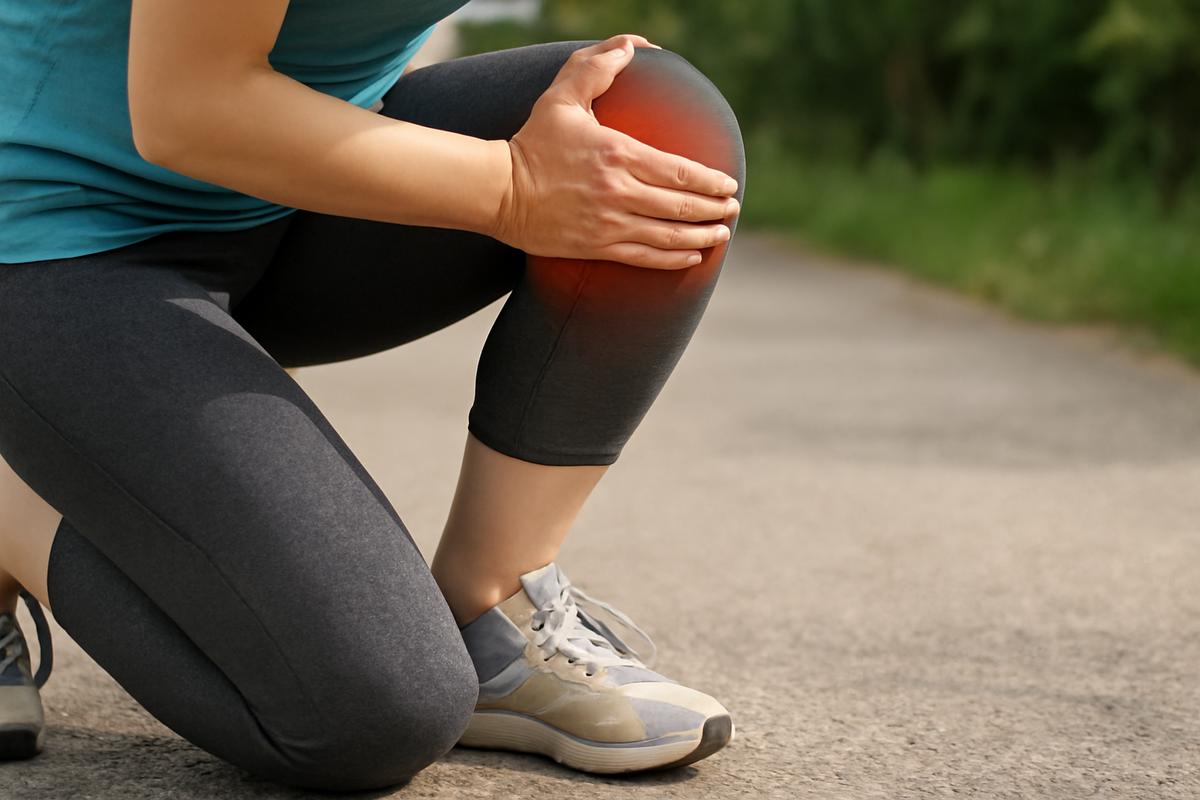
The first time I noticed it was on a trail that smelled like fall. The air had that cold bite, the maples were dropping leaves in damp, papery layers, and somewhere a dog barked in the distance. My knees ached—not in the sharp, dramatic way of an injury, but in a slow, nagging whisper. Every downhill step felt like a quiet argument between my joints and gravity. I wasn’t old, not injured, not out of shape. But something was clearly off. It wasn’t until I sank onto a mossy log to rub my knees that I glanced down and saw the real culprit: my shoes, their heels worn into a crooked, lopsided slope, like the roof of an old barn about to collapse.
The Quiet Saboteur Hiding at the End of Your Legs
If knees could talk, they’d probably sound exasperated most of the time. Day after day, step after step, they carry the awkward negotiations between your feet and your hips, handling all the impact, twists, and turns in between. Yet when our knees start to hurt, we tend to blame our age, our weight, our workouts, even the weather. We almost never look down and say, “You know what, maybe it’s the shoes.”
But very often, it is.
There is a particular shoe mistake that quietly sabotages knees everywhere: wearing shoes that don’t match what your body, your gait, and your daily life actually need. It’s not just about old shoes, or flat shoes, or high heels. It’s about the mismatch—between the way your body moves and the surface you walk on, and the type of support (or lack of it) you’ve strapped to your feet.
Pause for a second and notice your feet right now. Are they squeezed into something stiff and narrow? Propped up on a hard, rigid wedge of foam? Maybe soft and pillowy but collapsing inward at the arch? Your knees feel all of that. They feel every millimeter of tilt, twist, and wobble that your shoe either corrects—or quietly allows.
The One Mistake: Ignoring What Your Shoes Are Really Doing to You
The core mistake is deceptively simple: ignoring how your shoes are changing the way your legs line up and move.
We think of shoes as accessories, style choices, or activity gear. But your shoes are more like moving floorboards strapped to your feet. Every step is you landing on those mini platforms. If those platforms are too high, too worn, too soft, too rigid, or entirely wrong for your foot shape, your knees are the ones absorbing the compensation.
Here’s what usually happens: you put on a shoe that feels “fine” in the store. Maybe it looks good, or it’s on sale, or a friend swears by the brand. It feels cushioned, maybe even bouncy. But inside the structure of that shoe—its heel height, arch shape, torsion stiffness, toe-box width—your body is making small adjustments. Maybe your ankles roll in a little more. Maybe your heel tilts. Maybe your toes splay and fight against the narrow front. Those changes might feel subtle, but your knees are now bending and rotating in slightly new patterns, thousands of times a day.
Do that for weeks, months, years, and then one day on a staircase or a trail or a grocery store aisle, your knees start complaining. Not because they suddenly failed you—but because they’ve been quietly overworked by the wrong shoes.
How a Few Millimeters Can Twist Your Knees
Imagine standing on a gentle ramp instead of a flat surface. If the heel of that ramp is just a little higher, your weight shifts forward. Your calves tighten, your quads have to work a bit harder, and your knees feel more pressure at the front. That’s what a raised heel—even a small one—can do all day long.
Now imagine that same ramp is also tilted slightly inward. Maybe the inside edge is lower than the outside. That’s what happens when your shoe is worn down unevenly, or when it doesn’t match your natural foot mechanics. Your foot rolls inward or outward, your shin follows, and your knee joint gets twisted in the middle, tasked with managing an angle it was never meant to hold for so many hours.
We tend to think of obvious culprits like stilettos. But the truth is, knee-aggravating shoes hide in plain sight: everyday trainers with thick, squishy soles that collapse on one side; minimalist flats with no cushioning worn on concrete all day; heavy boots with zero flex that force your joints to over-bend; running shoes long past their expiration date, their invisible support eroded like a shoreline.
Listening to Your Shoes Before Your Knees Start Shouting
The story of knee pain often begins in a quiet place: in the tiny frictions, the subtle imbalances, the unnoticed compromises your body makes all day long. Most of us don’t stop to check unless something hurts enough to interrupt us, like the first creakiness on the stairs or that ache when getting up from the floor.
But your shoes have been talking the whole time—you just haven’t learned their language yet.
Take them off and flip them over. Run your fingers along the outsole, feel for irregular wear. Is the heel worn down more on one side? Are the edges rough and slanted, like a small cliff on one corner? Does the sole feel soft and mushy instead of springy and firm? When you place the shoes on a flat table, do they rock or tilt?
All of those little signs are hints of how your foot has been striking the ground, and how your knee has been forced to follow.
| Shoe Sign | What It Often Means | Possible Knee Effect |
|---|---|---|
| Heel worn on inner edge | Foot rolling inward (overpronation) | Increased stress on inside of knee |
| Heel worn on outer edge | Foot rolling outward (supination) | Strain on outer knee and IT band |
| Sole feels very soft or “squishy” | Cushioning has broken down | Poor shock absorption, more impact on knees |
| Shoes tilt when placed on table | Uneven wear or distorted structure | Knee alignment altered with every step |
| Tight, narrow toe-box | Toes can’t spread to stabilize | Knees work harder to control balance |
None of this is about perfection. No foot is perfectly neutral, and no shoe can magically fix your entire body. But the mistake that causes so much avoidable knee pain is pretending the shoe doesn’t matter—keeping pairs in rotation long after their structure has collapsed, choosing style over function on the days we’re on our feet the most, assuming that if it doesn’t hurt immediately, it can’t be doing harm.
The Daily Scenes Where Your Knees Pay the Price
Picture a few ordinary moments:
You’re standing in line at a coffee shop, weight shifting from one foot to the other in sleek boots with stiff soles and a subtle heel rise. Your knees stay slightly bent to keep you balanced, your quads quietly burning, your kneecaps pressed a little harder into the joint with each minute you stand.
You’re walking across a city in soft, floppy sneakers you’ve owned for years. The pavement is unforgiving; your shoes, once supportive, now bend and twist without control. Your ankles wobble, your arches collapse with each step, and your knees play the hero, stabilizing what the shoes no longer do.
You’re at a wedding in perfectly polished dress shoes or pumps, the kind that feel fine for that first hour of standing, until your knees begin to protest each trip back and forth across the dance floor. The narrow front squashes your toes, which should be your natural tripod of balance. With that base compromised, your knees again are called in to manage the chaos.
We like to pretend that our joints operate as isolated systems: my knee hurts, so something must be “wrong” with my knee. The truth is far less tidy. Knees live in the messy middle, between whatever your feet are doing below and whatever your hips and core are doing above. Change the story at one end, and the plot shifts in the middle.
Comfort Is Not Always the Hero You Think It Is
There’s another twist in the story: comfort can lie. A shoe can feel soft and cozy and still strain your knees, especially if it’s too squishy or lacks structure. Pillow-like cushioning can lure you into longer walks or runs while your joints are quietly absorbing more rotation and tilt than they should.
On the other hand, a firmer shoe with the right shape, flex, and support might not feel heavenly at first—because your body has to adjust from the pattern it’s used to. The key is to distinguish between “breaking in the shoe” and “the shoe breaking you.” Mild adaptation? Acceptable. Increasing knee ache that gets worse the more you wear them? That’s your signal.
Look for how your knees feel a few hours after wearing a particular pair, and especially the next morning. Shoes write their stories not just in the moment, but in the echoes your body feels later.
Finding Shoes That Let Your Knees Breathe Easier
So what do shoes that are kinder to your knees actually look and feel like? They won’t be the same for everyone, but there are patterns your body tends to appreciate.
Your knees usually prefer shoes that allow your feet to be stable but not locked, supported but not caged. Think of a good shoe like good earth beneath you: firm enough that you don’t sink and wobble, forgiving enough to absorb some impact, and level enough that your joints aren’t constantly fighting a slope.
A few principles, translated from clinical language into body-sense:
- Moderate heel height. A small, gentle lift can be okay, but big differences between heel and forefoot turn every step into a mini downhill, loading the front of your knees.
- Enough room for toes to spread. When your toes can fan out and press into the ground, your knees don’t have to work as hard to keep you balanced.
- Support that matches, not fights, your arch. Too much arch support can feel like a rock under your foot; too little can let your foot collapse. You’re looking for “guided” rather than forced alignment.
- Structure with flexibility. A shoe should bend where your foot bends (around the ball) and resist twisting like a dishcloth. Total stiffness or total floppiness are both hard on joints.
- Weight that suits your day. Heavy shoes or boots make every lift and swing of your leg more work. Over miles, that subtly tires the muscles that help protect your knees.
There’s also timing: even the best-made shoes have a lifespan. For people who walk or run often, that can be surprisingly short. The cushioning and internal support wear out long before the fabric looks ragged. If you’re clocking lots of steps, your knees may be begging you to retire those “still look good” shoes earlier than you’d like.
The Slow Art of Changing What You Wear
Our bodies are creatures of habit. If you’ve spent years in one style of shoe—high heels, super-cushy trainers, rigid boots—switching overnight to a totally different style can jolt your system. That jolt sometimes shows up as new aches, even if the new shoe is ultimately better for you.
This is where patience protects your joints. If you’re moving toward more supportive or more natural-feeling footwear, introduce them like you’d introduce a new trail or workout: gradually. Wear them for a few hours, then go back to what’s familiar. Pay attention not only to your knees, but also to your feet, calves, and hips. The goal isn’t to chase a perfect shoe—it’s to shift toward choices that don’t make your knees the permanent mediator of a war between the ground and your habits.
Letting Your Knees Exhale: A Small Ritual
There’s a simple, almost meditative ritual that can quietly change your relationship with knee pain: make a habit of paying attention to your shoes at the same time you notice your surroundings. As you walk outside, feel the texture of the ground through your soles. Is it hard, soft, uneven? Notice how your knees respond when you step off the curb, climb a short hill, or walk on grass instead of sidewalk.
When you come home and slip off your shoes, take ten seconds to look at them. Run your thumbs along the insole. Press the heel. Bend the shoe gently in your hands. Over time, you’ll start to notice the early signs of breakdown long before your knees do.
And perhaps, on some future cool autumn afternoon, you’ll find yourself on a trail or a city street, and your knees will feel oddly quiet. Not because they’re perfectly healed or immune to time, but because you’ve stopped asking them to silently correct a problem that started much farther down. You’ll glance at your shoes—chosen with more awareness now—and realize your knees are no longer arguing with every step.
The story your knees tell about pain is rarely just about them. Very often, it begins at the end of your legs, in the choices you make each morning as you lace up, slip on, zip, or buckle. The mistake that leads to knee pain isn’t just wearing the “wrong” shoes—it’s believing that your shoes don’t matter.
They do. They always have. Your knees have known it all along.
FAQ
Can old shoes really cause knee pain even if they still look okay?
Yes. The internal cushioning and support of a shoe usually break down long before the outside looks worn. Your knees may start to hurt because the shoe no longer absorbs impact or keeps your foot aligned, even if the upper and the color still look fine.
How often should I replace my everyday walking or running shoes?
A general guideline is every 500–800 kilometers for running shoes, or every 6–12 months for shoes you wear and walk in heavily. If you notice uneven wear, loss of cushioning, or new aches in your knees or feet, it may be time to replace them sooner.
Are flat shoes always better for my knees than heels?
Not always. Very flat shoes with no cushioning or support can be just as stressful on knees, especially on hard surfaces. A slight heel lift with good structure can sometimes be more comfortable than a completely flat, unsupportive shoe.
Can changing my shoes alone fix chronic knee pain?
Sometimes shoe changes provide major relief, but chronic knee pain often has multiple causes, including muscle weakness, tightness, old injuries, or joint wear. Better shoes can reduce strain, but combining them with strengthening, stretching, and occasionally professional assessment is often most effective.
How do I know if a new shoe is right for my knees?
Pay attention to how your knees feel after several hours in the shoe and the following day. A good sign is less fatigue or aching compared to your previous pair. If pain increases, especially around the kneecap or inside of the knee, that style may not suit your body, even if it feels “comfortable” at first try-on.

Hello, I’m Mathew, and I write articles about useful Home Tricks: simple solutions, saving time and useful for every day.