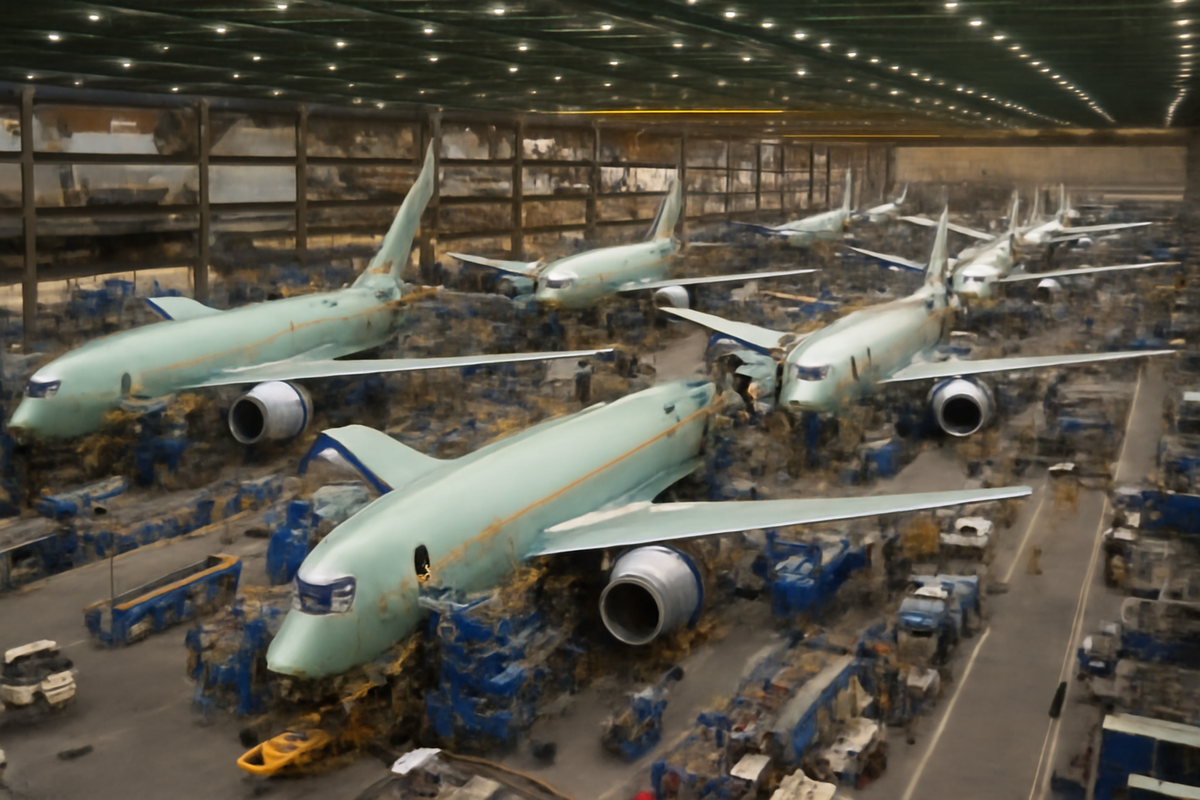
The first thing that hits you is the air. It smells faintly of new metal and machine oil, like rain on hot asphalt blended with the sterile sharpness of a hospital corridor. Then comes the sound—low, constant, like distant thunder held on a single note. Your footsteps, small and uncertain, echo against a concrete floor that seems to run on forever. You have just stepped inside the world’s largest factory: a building so immense it can hide eight half-built jets beneath its roof and still feel like it has space to spare.
The Building That Feels Like Its Own Weather System
From the outside, the factory looks less like a building and more like a landscape feature: a flat, gleaming expanse of metal and glass that sits on the horizon like a man-made plateau. But it’s only when you walk through the doors that your sense of scale begins to buckle.
The ceiling arches so high overhead that your brain, used to houses and offices and grocery stores, struggles to register it as “indoors.” Steel trusses crisscross in patterns that resemble an industrial cathedral. The air feels slightly cooler close to the floor, warmer higher up—subtle, but enough that the engineers joke the place has its own microclimate.
Stretching away in front of you, row after row of cavernous assembly bays divide the space. Under each bank of industrial light, a different giant is taking shape: the smooth white fuselage of a widebody passenger jet, the exposed ribs of a cargo aircraft, the open-mouthed nose of a plane waiting for avionics, wiring, and personality.
Eight such jets, each the length of a small city block, rest in various stages of assembly at any given moment. It’s like watching a time-lapse photograph paused at eight different frames—one aircraft just a skeleton of frames and stringers, another already wearing its airline livery, ready to meet the sky.
The Pulse of 30,000 People
On paper, the number sounds abstract: 30,000 employees. In person, that number feels like a living current. You see it in the river of reflective vests gliding past on bicycles (yes, bicycles are the easiest way to commute across the building), in the blur of tool carts, in the constant hush of people talking over the noise of machines.
There are veteran assembly technicians who can eyeball a misaligned panel from ten meters away. There are young software engineers in hoodies drinking coffee beside seasoned machinists with hands nicked from decades of metal work. There are quality inspectors, logistics coordinators, cleaners, planners, and quietly heroic forklift drivers who ferry gigantic parts like careful chess players, moving queens and rooks across a board the size of a neighborhood.
Shift changes have their own choreography. As one wave of workers filters out, another sweeps in, and the factory never really sleeps. Lights stay on; conveyor systems continue their slow crawl. The sheer continuity of it all is striking: no single person builds a jet here. Instead, work passes from team to team like a relay baton, each group leaving its mark, invisible yet essential, on something that will one day carry thousands of people above the clouds.
Where Time Is Measured in Airplanes
In most offices, time is measured in emails, coffee breaks, and calendar invites. Here, it’s measured in airplanes. “This bay turns a jet every few days,” one supervisor says, as casually as if describing the closing of a spreadsheet. But nothing about what you’re looking at feels casual.
A widebody aircraft, by the time it leaves the factory, may contain over six million individual parts. The fact that eight such machines can be under construction at once feels absurd until you look down at the floor and see how the process has been tamed into order.
The entire factory is organized like a living map of the build sequence. Fuselage sections arrive from one end, wings from another, tail assemblies from yet another. Everything is synced to an invisible timetable that hums in the background—arrival, inspection, preparation, installation, testing. The aircraft themselves glide from station to station, nudged forward by powerful towbars and floor-embedded guidance systems, like ships moving through docks.
| Scale Element | Approximate Value | What It Means in Daily Life |
|---|---|---|
| Factory Floor Area | Over 4 million sq ft | Like dozens of football fields joined side by side |
| Employees | ~30,000 people | A workforce equal to a small city |
| Jets Built Simultaneously | Up to 8 at once | Each longer than many office buildings |
| Total Parts per Aircraft | Millions of components | From bolts & cables to wings & engines |
| Shifts | Multiple, nearly 24/7 | The building rarely goes quiet |
The Quiet Precision Behind the Noise
From a distance, the factory sounds like chaos: the whirr of drills, the clank of metal, the distant beep of backing vehicles. But as you step closer to any one station, the noise resolves into rhythm and pattern.
A team lines up along the curve of a fuselage section, laser levels casting green lines across silvery skin, marking out the path for rivets. The workers talk in short, practiced phrases, like climbers on a mountain face. Every click of a rivet gun is logged, every component scanned into a database that knows exactly which part sits where on which jet.
Nearby, a specialist in a clean, white lab coat lowers a panel of avionics into place, connecting the nervous system of the airplane: bundles of wiring that will translate pilot commands into the movement of steel and composite. The tangle of cables looks chaotic, but each wire has a precise endpoint. One misplaced connection could mean hours, even days, of backtracking, so every motion is deliberate, checked, confirmed.
Digital Ghosts of Future Flights
Above the visible work, invisible data flows. Before a single panel is installed, the plane already exists as a digital twin, a high-fidelity model that tracks its virtual growth. Engineers walk the future structure in simulation, long before the real aluminum and carbon fiber arrive on the floor.
Huge screens glow with diagrams: color-coded outlines of wings, torsion loads, fuel capacity projections, maintenance predictions years in advance. At certain checkpoints, real-world measurements—torque readings, alignment tests, tolerance checks—are fed back into the model. Any deviation from expectations triggers alerts that ripple down the line.
Workers now carry rugged tablets instead of binders, their instructions updated in real time. A change in one subsystem—say, a small improvement in a hydraulic line—propagates instantly through the documentation, preventing the sort of mismatched information that used to plague old-school manufacturing.
Logistics on the Edge of the Possible
If the jets are the stars of this story, the supporting cast is the logistical system that keeps them fed. Outsiders might assume the drama happens only at the airplane’s skeleton, where wings are mated to fuselage. But nothing in this building moves without thousands of parts arriving exactly when they’re needed—and crucially, not too much earlier.
Too early, and the factory chokes on its own inventory, drowning in crates and containers. Too late, and the line stops, every idle worker multiplying the cost of delay. To avoid both fates, a quiet ballet unfolds 24 hours a day.
Containers glide in on rails and trucks from suppliers scattered across continents. Parts are sorted in enormous high-bay storage areas, where robotic systems pluck bins from towering racks faster than a human could climb a ladder. Barcode scanners blink like fireflies. Algorithms crunch thousands of variables—shipping times, weather forecasts, supplier reliability—to decide what rolls where, and when.
The Final Assembly Dance
Eventually, all of this preparation funnels into the most dramatic phase: final assembly. This is where the airplane begins to look unmistakably like itself. Wings arrive on thick, padded supports, gleaming and impossibly long. Tail fins, painted in the colors of airlines that will one day claim them, wait upright like flags at rest.
The joining of major sections is almost ceremonial. Teams swarm around the contact points; alignment is checked and rechecked with laser trackers. When the sections finally come together—nose, fuselage barrels, wings, tail—the building holds its breath for a moment. Bolts the size of a person’s hand are torqued down. A skeletal frame becomes a continuous body.
Engines arrive last, protected like jewelry. Standing close to one is a humbling experience: the intake is wide enough to swallow a car, the fan blades curved and glossy, each one worth more than many homes. Once hung beneath the wings, they give the aircraft a kind of face—purposeful, alert, almost alive.
Safety as a Religion
In a place where tons of metal are being moved, drilled, cut, and lifted, safety is not a side thought; it’s a culture. You see it in the worn edges of the safety posters taped to pillars, in the brightly colored tape indicating lanes and danger zones, in the way workers reflexively glance up before walking under a suspended load.
Each day begins with briefings: what’s moving, what’s being tested, which operations require special precautions. There are safety drills, incident reviews, and a constant, low-key pressure to speak up if something feels off. In a normal factory, a mistake might waste material. Here, a mistake might one day ride thousands of meters above the ground, carrying people and their unspoken trust.
Finished jets are not simply rolled out and blessed. They are tested again and again: pressure tests for the fuselage, functional tests for every control surface, power-ups of electrical systems, dry runs of fuel flow and engine response. After the building has done everything it can, the aircraft still must prove itself in the air.
First Flight: Leaving the Nest
There is a moment every aircraft shares: the first time its wheels leave the ground. It’s the day the factory’s world and the sky’s world overlap. By then, the jet has been towed out of the building, its paint glinting, its windows dark, its skin still carrying the fingerprints of everyone who touched it, even if they’re now invisible under layers of primer and clear coat.
Test pilots climb into the cockpit, climbing a narrow set of stairs from the tarmac. Inside, the cabin is still bare—no seats, no overhead bins, just cable runs, test equipment, and temporary stations. On the ground, engineers watch from control rooms, their screens glowing with live data from sensors embedded throughout the aircraft.
When it lifts off, climbing into its element, it carries with it the labor of 30,000 people and the discipline of a building that has turned production into something close to ritual. The flight is not about romance; it’s about validation. Systems are stressed and checked. Limits are approached cautiously. Only when the data sings back the right tune—pressures, temperatures, structural responses—can the airplane move forward in its journey toward carrying passengers.
The Human Side of a Mega-Factory
For all the scale and machinery, this place is full of small human moments. On a mezzanine, someone has taped a photo of a finished jet in airline colors, with a handwritten note: “My first plane.” A worker points to a row of windows on a fuselage and says quietly, “I always wonder who’ll sit there on their way to somewhere new.”
Many employees here rarely fly, but their work is inseparable from the idea of flight. They’ve seen planes in ways most travelers never will: in pieces, in naked aluminum, upside down in jigs, their bellies open and vulnerable. They know the numbers behind the romance—tolerances in millimeters, torque specs, wiring diagrams. Yet there’s still an undercurrent of awe.
Ask a longtime technician what keeps them here, and the answer is usually some version of: “I like knowing that what I build has to be right. There’s no halfway.” The pressure is part of the appeal. In a world of disposable gadgets and software updates, a jet is a commitment that will last for decades. The stakes remain high long after the nose wheel leaves the runway for the first time.
There are also rituals of departure. When a jet is finally signed off, painted, and ready, people come to the windows or edges of the tarmac to watch it taxi out. Some snap photos; others just stand with arms folded, following the aircraft until it’s a bright speck, then nothing at all. Tomorrow, the line will move again, and another partially built wing will take its place under the lights.
Why This Place Matters to the Rest of Us
Most travelers will never think about the building where their airplane was born. They will stand in boarding lines, slide their bags into overhead bins, buckle their seatbelts, and stare out of oval windows at the wing flexing gently against the sky. The cabin will smell of coffee and recycled air, not of metal and paint and industrial cleaners.
Yet every smooth takeoff, every long night flight over dark oceans, every gentle landing owes something to the choreography inside factories like this one. The world’s largest aircraft plant is a kind of terrestrial anchor for our airborne lives, a reminder that flight, for all its poetry, is grounded in painstaking, unspectacular craft.
When you step back outside, blinking in the sunlight after hours under artificial skies, the building behind you feels different. What looked like a giant box now feels like a living organism—a place where data and metal, sweat and algorithms, experience and ambition all combine to do something extraordinarily hard and make it look, from the outside, almost easy.
You hear one last distant echo from within: a drill spinning up, a forklift reversing, someone calling for a part across the floor. As the door closes, the sound becomes a muffled heartbeat. Inside, eight more jets are edging, millimeter by millimeter, toward the day they will lift away and leave the factory briefly empty, briefly quiet—until the next set of giants rolls in under the immense, echoing roof, and the cycle begins again.
FAQ
How many aircraft can this factory build at the same time?
The factory is designed to work on up to eight large jets simultaneously, each at different stages of assembly—from initial fuselage joining to final interior and systems installation.
Why does the factory need 30,000 employees?
Building modern aircraft is incredibly complex. The 30,000 employees include not just assembly workers, but also engineers, planners, quality inspectors, logistics teams, maintenance staff, safety managers, IT specialists, and many more roles that keep the operation running nearly around the clock.
How long does it take to build one jet?
The full process—from initial component manufacturing to final delivery—can take many months. Within the final assembly factory, an individual aircraft typically spends several weeks moving through different stations before heading to testing and paint.
Is everything automated in such a large factory?
No. Automation plays a major role, especially in material handling, drilling, and precision measurements, but human expertise is essential. Many critical tasks, particularly those involving judgment, inspection, and complex fitting, still rely on skilled people.
Can the public visit this kind of aircraft factory?
Some large aircraft plants do offer guided tours or dedicated visitor centers, though access to the main production areas is often limited for safety and security reasons. Tour availability and scope vary by manufacturer and location.

Hello, I’m Mathew, and I write articles about useful Home Tricks: simple solutions, saving time and useful for every day.