The trail tilted just a little to the left, the kind of subtle slope you don’t notice until your foot rolls on a loose pebble. Eleanor’s hiking pole jabbed the dirt, her torso tipped, and for that odd, suspended second, she felt the cold whisper of panic: this is how people fall. Then her other foot slid forward, her toes spread slightly inside her shoe, her arms opened like quiet wings, and her body rearranged itself over her feet. She didn’t crash. She didn’t even stumble. She simply…recovered.
“Well, that was new,” she said aloud, half laughing. Six months earlier, the same wobble on the same trail would have turned into a shaky, heart‑pounding near‑fall. Or maybe a real one. Back then, her balance had started to feel like a candle flickering in a draft—there, but fragile, unreliable.
What had changed wasn’t a gym membership or a complicated training plan. It wasn’t even more walking, though she did plenty of that. It was a quiet little habit she’d started in the most ordinary place: her kitchen. Bare feet on tile, tea kettle humming, one hand hovering over the counter “just in case,” and Eleanor, at 68, standing calmly on one leg.
The Day You Notice the Floor Feels Farther Away
For most of life, balance is something you never think about. You hop onto curbs without looking down. You take the stairs two at a time. You twist sideways to grab a falling grocery bag without wondering if you’ll go down with it.
Then somewhere around your sixties, the relationship between you and gravity begins to feel…negotiated. The world seems to come with more warnings: wet floor, step down, uneven surface. You find yourself reaching for railings, choosing the elevator “just to be safe,” or turning your head a bit more cautiously when someone calls your name.
Maybe it’s the first time you misjudge a step and slam your foot harder than you meant to. Maybe it’s a fall a friend takes—a broken wrist, a bruised hip—and the story circles the neighborhood like a cautionary ghost. Maybe it’s your doctor using that unsettling sentence: “We want to prevent falls.”
Balance, it turns out, is as much a sense as sight or hearing. It lives in your inner ear, your muscles, your joints, even the soles of your feet. After 60, this quiet system starts to lose some of its automatic sharpness, but that doesn’t mean the story is already written. Because balance isn’t just a gift you’re given or lose. It’s a skill. And skills can be trained.
Not with punishing workouts or intimidating gym equipment, but with small, deliberate invitations to your body: remember how to do this. One of the simplest, most powerful of those invitations? Standing on one leg.
The One-Leg Secret: A Tiny Habit with Big Ripples
If it sounds almost too simple, that’s part of its magic. No devices, no memberships, no special clothes. Just you, your feet, and a bit of attention.
Stand on one leg, and suddenly your whole body wakes up. Tiny muscles in your foot start scanning the floor, making micro-adjustments. Your ankle whispers with small corrections. Your calf, thigh, and hip muscles pull you upright, while your core acts like a gentle corset, wrapping you in stability. Even your eyes and inner ear join in, calibrating where you are in space.
All of this happens in seconds, and the more often you ask your body to do it, the better it gets. Neural pathways—the communication lines between brain and muscles—grow quicker, smarter, more efficient. What felt shaky and hesitant gradually becomes almost boringly steady.
The beauty of the one-leg habit isn’t just in the movement itself, but in how easily it nests into real life. You don’t have to carve out 30 minutes and unroll a mat. You just have to look at the little pockets of time that already exist in your day and slip balance practice quietly into them.
Waiting for the kettle to boil? One leg. Brushing your teeth? One leg. Standing in line at the pharmacy, with a cart to lightly hold? One leg. It doesn’t look like exercise, but to your nervous system, it’s serious training.
How to Start Without Feeling Silly—or Falling Over
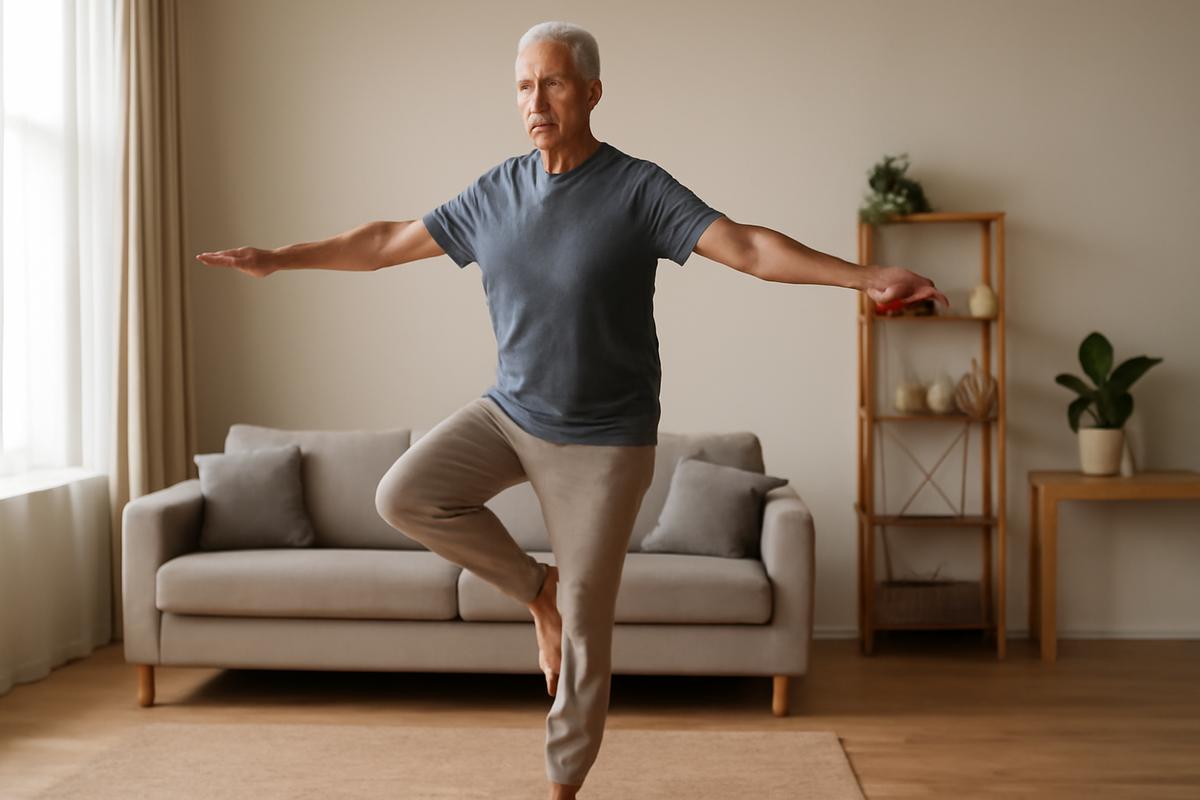
Picture yourself in your kitchen or living room. Flat shoes or bare feet. A sturdy counter, chair-back, or wall within easy reach. Here’s a gentle way to begin:
- Stand with feet hip‑width apart, weight evenly on both feet.
- Lightly rest your fingertips on the counter or chair.
- Shift your weight onto your left foot, feeling the whole sole connect with the ground.
- Lift your right foot a few centimeters off the floor—just the toes, at first if you like.
- Hold for up to 10 seconds, breathing normally.
- Lower your foot, rest, and switch sides.
In the beginning, you might feel your ankle quiver, your toes claw, your body sway more than you expected. That’s not a sign you’re failing; it’s proof your balance system is waking up. The internal conversation between brain and body is getting clearer, fresher, more responsive.
Do this for a minute or two, once or twice a day, and you’ve begun. That’s the habit. Simple, small, repeatable. A few days in, you might start to feel a shift: you’re less startled when you wobble. You can catch yourself sooner. You trust your feet a bit more.
Building Your Own Micro-Ritual of Balance
Habits don’t stick just because they’re good for us. They stick when they hook themselves to something we’re already doing, and when they feel almost too tiny to resist.
Think of your day as a landscape dotted with “balance islands,” moments already spent standing still.
- Boiling the kettle or waiting for coffee to brew.
- Brushing your teeth or washing your face.
- Stirring a pot on the stove.
- Waiting for the microwave.
- Standing at the sink rinsing dishes.
Choose just one or two of these as your anchors. Each time that specific moment appears, your cue is simple: stand on one leg.
Maybe it looks like this:
Every evening, while brushing your teeth, you stand on your right leg for 30 seconds, then your left for 30 seconds. That’s it. One tiny island of focused balancing in a sea of routine. After a week, it feels odd not to do it. After a month, it’s simply part of who you are.
Over time, you gently dial up the challenge—but always within the realm of comfort, never panic.
| Level | What You Do | How It Feels |
|---|---|---|
| 1. Supported Start | One leg lifted slightly, fingertips on counter or chair. | Wobbly but safe, like learning a new dance step. |
| 2. Light Touch | Same stance, but only one or two fingers resting lightly. | Ankles working, you can feel small muscles turning on. |
| 3. Hands Free | Arms by your sides or slightly out; no touching support, but it’s nearby. | More stable, breath smoother, mind calmer. |
| 4. Eyes Soft | Gaze at a fixed point ahead; hold longer—20–30 seconds each leg. | You feel “organized” over your standing foot. |
| 5. Extra Challenge | Turn head slowly side to side or reach one arm forward while balancing. | Like calm waves instead of wild swaying; controlled, confident effort. |
You never have to “graduate” past the level that feels both safe and pleasantly challenging. There is no exam. The goal is not acrobatics. The goal is simply this: when life nudges you off-center, you know how to find your way back.
Why This Simple Habit Matters So Much After 60
In the background of this small daily act is a much larger story: the way our bodies quietly change with age. Muscle mass tends to slip away if we don’t ask for it. Nerves that carry messages from joints and skin grow a bit slower. Vision and inner-ear function can dull. All of these threads are woven into the fabric we call balance.
Falls aren’t just “clumsy moments.” They are one of the major turning points in older adulthood. A fall can steal confidence long before it steals mobility. People begin to move less, to avoid the situations that feel risky. They give up gardening on uneven grass, stop walking in the woods, avoid busy sidewalks. Muscles weaken further, and ironically, this withdrawal increases the very risk they’re trying to escape.
The one-leg habit pushes gently in the opposite direction. It acts like a daily reminder to your system: you are still someone who can adapt, who can respond, who can stay upright in a world that isn’t perfectly level.
Here’s what begins to happen when you practice regularly:
- Stronger ankles and feet: Those “quiet” muscles around your lower leg turn on more quickly when the ground surprises you.
- Better joint awareness: Your body senses where your limbs are in space, even without looking, so you can react faster to stumbles.
- More stable core: Your trunk becomes less like a loose sack and more like a steady column that can twist, reach, and lean without toppling.
- Sharper reflexes: The loop between your balance system and your muscles tightens—less hesitation, more immediate correction.
- Renewed confidence: Perhaps the most powerful change of all: you begin to trust your body again.
Confidence, in this context, isn’t bravado. It’s the quiet knowledge that you can walk across a parking lot after rain, step off a curb, or navigate a crowded shop without feeling that thin thread of fear tugging at every step.
Listening to Your Limits (and Working with Them)
No habit, however simple, is one‑size‑fits‑all. Bodies over 60 tell different stories: some include arthritis, diabetes, neuropathy, joint replacements, or the lingering effects of old injuries. You might use a cane. You might have had a scare already.
So the one-leg habit is not about proving anything. It’s about exploring your capacity safely.
- Make safety non‑negotiable: Always practice near something solid you can hold—a heavy chair, countertop, or sturdy table.
- Keep the floor clear: No loose rugs, rolling stools, or pets underfoot in that area.
- Start very small: Even lifting your heel an inch as you keep your toes on the floor counts as a beginning.
- Use shoes if needed: If barefoot isn’t comfortable, a secure, flat shoe with a good sole is fine.
- Stop before fatigue: A little shake is okay; feeling drained or dizzy is your cue to rest.
If you have specific medical conditions—like significant neuropathy, recent surgery, a history of frequent falls, or vertigo—it’s wise to talk with a doctor or physical therapist about any new balance practice. They can offer variations tailored to your body’s needs, so this habit becomes an ally, not an added risk.
One useful mindset: let curiosity replace judgment. Instead of, “I should be better at this,” try, “Interesting, my right side feels less steady today. I’ll give it a little more time, a little more gentleness.” This soft, observant approach invites your nervous system to learn without the noise of self‑criticism.
Letting Balance Spill into the Rest of Your Life
The most beautiful part of this simple habit is how it leaks into the moments you don’t label as “exercise.”
One afternoon, you might notice you step confidently over the dog’s toy instead of walking around it. You reach up to the top shelf and feel solid through your feet. You walk across grass at a family picnic and realize the old anxiety—the quiet calculation of risk—has faded.
Balance lives in the small, ordinary movements: turning to close a car door, leaning to pull laundry from the machine, stepping into the tub. The better trained your body is in the quiet practice moments, the more effortlessly it responds in real life.
To deepen this connection, you can gradually bring tiny balance challenges into your day beyond the one-leg stand:
- Walk a straight line along a hallway, placing one foot almost in front of the other.
- Stand with your feet a little closer together than usual while washing dishes.
- Pause on the bottom stair, plant your foot fully, and feel your weight settle before taking the next step.
- When you turn around, do it a bit slower, noticing how your weight shifts from one foot to the other.
None of this needs to look dramatic. From the outside, it may just look like you’re moving with a quiet, deliberate grace. On the inside, your balance system is in conversation with the world, adjusting, learning, adapting.
The Story You’re Telling Your Future Self
There’s a kind of myth that aging is only about loss: less strength, less flexibility, less certainty in your step. But your nervous system never completely closes its doors. Your muscles still answer when called. Your balance can still sharpen with practice.
Every time you lift one foot and give your body a chance to find its equilibrium, you’re casting a small vote for the kind of older adult you want to be. Not an acrobat. Not a superhero. Simply someone who can keep walking the paths you love—literal and metaphorical—without feeling that the ground is your enemy.
Eleanor, out on her favorite trail, didn’t feel like a different person after six months of her kitchen habit. She still took her hiking pole. She still watched her footing. But when that pebble rolled under her boot and her body caught her, it sparked a quiet joy that stayed with her for days.
“Oh,” she thought, steadying herself. “I can still do this.”
That’s the real gift hidden inside a simple, almost invisible practice. It’s not about standing perfectly still on one leg for a full minute with your eyes closed. It’s about rewriting the story you tell yourself each time you walk across a room: I am someone who can adjust. I am someone who can recover. I am someone who still knows how to stand my ground.
In the time it takes a kettle to boil, you can remind your body what it knew all along: balance isn’t something you owned once and lost. It’s a relationship. And it can be tended—one quiet, steady, single‑legged moment at a time.
Frequently Asked Questions
How often should I practice standing on one leg?
A helpful target is 1–2 times a day for a few minutes each time. For example, practice during your morning and evening tooth‑brushing routines. Consistency matters more than duration; even short daily sessions can lead to noticeable improvements over a few weeks.
How long should I be able to stand on one leg?
There is no single “right” number. Many balance programs suggest working toward 20–30 seconds per leg without support, but it’s fine to start with 5–10 seconds. What matters is gradual progress: a little steadier, a little longer, over time.
What if I already have poor balance or have fallen before?
You can still benefit, but start very cautiously. Keep both hands close to a counter or chair, and keep your lifted foot low. You might begin by just lifting your heel, keeping your toes down. If you’ve had recent falls, surgery, or dizziness, consult a doctor or physical therapist before starting.
Is standing on one leg enough, or do I need other exercises?
Standing on one leg is a powerful, simple tool, but it works best alongside other gentle activities: walking, light strength work, and flexibility exercises. Think of it as a core piece in a simple balance-friendly lifestyle, not your only practice.
Should I do this barefoot or with shoes?
If your feet are comfortable and safe, barefoot can help wake up the small muscles and sensors in your feet. If you have foot pain, neuropathy, or feel unsteady, wear secure, flat shoes with good grip. Choose the option that feels safest and most stable for you.
When will I notice a difference in my balance?
People often feel small changes—less wobbling, more confidence—within 2–4 weeks of daily practice. Larger improvements, like feeling more secure on uneven ground or turning quickly without fear, tend to build over a few months of consistent effort.
Can I practice while holding onto something the whole time?
Yes. It’s better to practice safely with support than to avoid it out of fear of falling. Over time, you can gradually lighten your grip—from full hand to fingertips to just hovering your hand—so your balance system takes on more of the work at a pace that feels right for you.

Hello, I’m Mathew, and I write articles about useful Home Tricks: simple solutions, saving time and useful for every day.