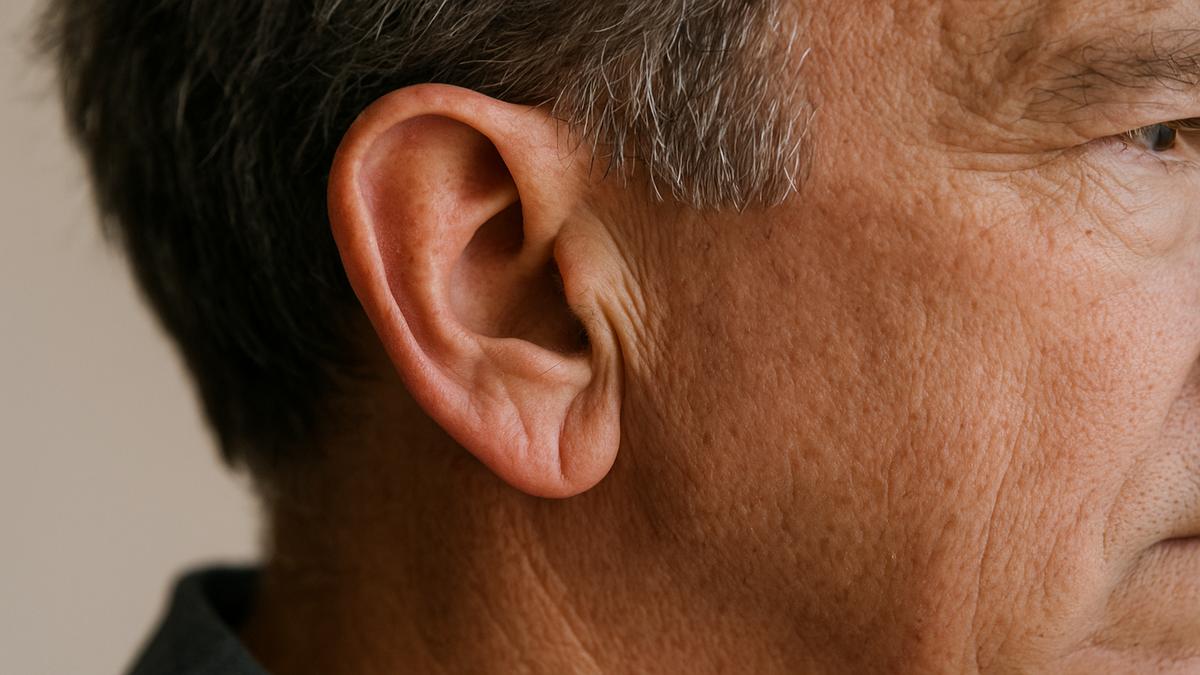
You’re washing your face one morning, half-awake, when something odd in the mirror pulls you closer. There, slicing diagonally through the soft curve of your earlobe, is a faint crease you’ve never really noticed. You tug at your ear, squint, tilt your head. A line, like a tiny canyon carved into skin that should be smooth. You shrug it off, but a question sticks: Why is it there?
The little line that whispers instead of shouts
The crease has a name—Frank’s sign, after the doctor who first connected that mysterious diagonal line to something far more serious: problems with the heart and blood vessels. It doesn’t hurt. It doesn’t itch. It doesn’t bleed. It just sits there, silently etched into your ear like a warning carved into bark before a storm.
Most of us are tuned to listen for the big alarms: crushing chest pain, slurred speech, one side of the face drooping. Those are the sirens of a heart attack or stroke, the moments that yank us out of the everyday and into an emergency. But our bodies are not always so dramatic. Sometimes, they leave small clues for years—tiny, quiet, easy to ignore. The earlobe crease is one of those clues.
Right now, as you read this, you might actually reach up. Fingers moving to your ear almost without permission. Is there a line starting near the ear canal and running diagonally toward the edge of the lobe? Is it shallow or deep, faint or clearly engraved? One ear or both? Or maybe your lobes are still smooth and plump, like untouched clay. Whatever you find, the story that crease may be trying to tell is worth listening to.
The strange connection between your earlobe and your brain
On the surface, your earlobe seems like one of the laziest pieces of real estate on your body. No bone. No muscle. No major job other than holding earrings and catching the wind. So how could a crease there be tied to something as dramatic and life-altering as a stroke?
The answer lives in the quiet highways running beneath your skin: your blood vessels. Over years, those vessels can stiffen and narrow as plaque builds inside them—a slow, silent process called atherosclerosis. This affects the major roads feeding your heart, your brain, and yes, even the tiny vessels serving your earlobes.
Researchers began noticing a pattern: people with that diagonal earlobe crease were more likely to have heart disease, clogged arteries, or a history of stroke. Not everyone with the crease had problems, and not everyone with problems had the crease—but the association was strong enough to raise eyebrows in cardiology clinics and neurology conferences around the world.
Think of it this way: the earlobe, with its delicate little blood vessels, is like a remote sensor at the outer edge of your body. When the inner plumbing begins to age or struggle, that soft lobe may begin to sag, its support structure weakening. Over time, it folds in on itself, leaving that diagonal line—like a small fault line hinting at deeper shifts beneath the surface.
What exactly is this “silent stroke sign”?
Some scientists believe the earlobe crease might be a visible marker of widespread vascular aging—meaning that the same processes stiffening and damaging arteries in your brain could be leaving clues in your ear. That’s why some call it a “silent stroke sign”: not because the crease itself proves a stroke is happening, but because it often appears in people whose risk is quietly climbing.
There’s another twist. Many strokes aren’t the explosive, movie-scene kind. They can be “silent strokes”—tiny injuries to the brain that you might not even notice as they happen. No dramatic collapse, no slurring, no loss of consciousness. Just a brief moment of dizziness you brushed off, a strange forgetful spell you blamed on stress, a clumsy step you laughed away.
Over time, these small, often unnoticed hits to the brain can pile up, affecting memory, balance, and mood. That’s what makes early warnings so valuable, even if they seem as mundane as a crease in your ear.
Check your ears: a tiny ritual with big questions
Pause here, if you haven’t already, and really look. You don’t need a doctor’s office, labs, or fancy machines. Just a mirror and a bit of honesty.
- Stand in front of a mirror with good light.
- Gently pull your earlobe downward and slightly outward.
- Look for a diagonal line running from the ear canal outward toward the edge of the lobe.
- Does it cross the whole lobe, or just part of it?
- Is it present in just one ear, or both?
You might find nothing. You might find a faint crease that appears only when you tug. Or you might see a deep, permanent fold, like a tiny scar that never fades.
Now, here’s the crucial part: if you do see a crease, it is not a diagnosis. It does not mean, by itself, that you are destined to have a stroke or heart attack. But it is a nudge—a question you should not silence. It’s your body’s way of asking, “How are things really going in there?”
What the science does (and doesn’t) say
Study after study has shown that people with a distinct diagonal earlobe crease often have higher rates of coronary artery disease, carotid artery disease, or a history of stroke. The exact numbers vary, depending on age, genetics, and other risk factors, but the pattern is persistent enough that many doctors now see the ear as another small window into vascular health.
But no serious scientist will tell you the crease is destiny. It’s a clue. Just one piece in a larger puzzle that includes blood pressure, cholesterol, blood sugar, smoking, weight, sleep, movement, and family history. Think of it less as a sentence and more as a carefully worded suggestion: maybe it’s time to look closer.
To make sense of it, imagine a table laid out on a kitchen table—simple, human, no white-coat language required. This isn’t a medical diagnosis, just a way to visualize what the crease might be saying about risk:
| Earlobe Crease Pattern | What It Might Mean | What You Can Consider |
|---|---|---|
| No visible crease | Lower likelihood of vascular aging, but not a free pass | Keep up healthy habits, know your numbers, don’t get complacent |
| Faint crease in one earlobe | Possible early or mild vascular changes, especially if other risks exist | Schedule a checkup, track blood pressure, cholesterol, and blood sugar |
| Deep crease in one or both lobes | Higher association with heart disease and stroke risk in many studies | Ask your doctor for a full cardiovascular and stroke risk evaluation |
| Crease plus other symptoms (chest pain, shortness of breath, weakness, vision changes) | Could signal active or serious vascular issues needing prompt attention | Seek medical care as soon as possible; do not wait and watch |
Again, this is about possibilities, not promises. But ignoring your ear’s quiet little memo would be like crumpling up a letter from the future without even reading it.
How a silent risk becomes a very loud day
Imagine a man in his fifties—let’s call him Arun. He’s the kind who hates doctor visits, jokes about “being fine,” and measures health mostly by whether he can still climb the stairs at work without stopping. He’s noticed the crease in his earlobe for years, deepening as his hair thins and the lines around his eyes grow more familiar. His father had a stroke in his sixties, but that was “age,” he says. “These things happen.”
One afternoon, hunched over his laptop, Arun feels a strange heaviness in his right arm. It’s like someone draped a wet towel over it. His words feel thick. Not wrong, exactly, but slower. He stands up, shakes it off, blames fatigue and too much coffee. The feeling passes. He doesn’t tell anyone.
Maybe that was a transient ischemic attack—a TIA, or “mini-stroke.” A clot briefly blocked blood flow to his brain, then drifted away. The brain, that delicate forest of neurons and pathways, got just enough oxygen again to keep going. No ambulance. No hospital. Life rolls forward.
But inside his skull, vulnerable areas of brain tissue have now been marked as high-risk. Next time, the clot might not move. Next time, the damage could be permanent. The silent warnings—the earlobe crease, the brief arm weakness—were signposts. Not guarantees, but generous chances to change course.
It’s possible to walk right past those chances. Many people do. Yet it’s just as possible to pause, turn back, and read them while there’s still time.
The everyday choices that muffle or magnify your risk
You can’t iron the crease out of your earlobe, and you shouldn’t try. What you can change is the world inside your arteries: the pressure of blood hitting the vessel walls, the layer of plaque building inside them, the tiny clots quietly forming or dissolving with each day’s choices.
Here are some of the most powerful levers—simple words, complicated in practice, but profoundly worth the effort:
- Blood pressure: High pressure is like turning up the water in an old plumbing system until the pipes bulge and strain. Quietly, relentlessly, it damages vessel walls—especially in the brain.
- Cholesterol and plaque: LDL cholesterol and other fats can form sticky layers inside arteries, narrowing the path for blood and making blockages more likely.
- Blood sugar: Diabetes and prediabetes erode blood vessels from the inside, accelerating aging and stiffness.
- Smoking: Every puff invites inflammation and damage into your vascular system, shrinking and scarring arteries.
- Movement: Regular motion keeps blood flowing smoothly, encourages healthier vessel linings, and supports the heart that powers it all.
- Sleep and stress: Chronic stress and fragmented sleep shower your circulation in stress hormones, pushing blood pressure and inflammation higher.
The earlobe crease does nothing by itself. It’s a signpost, not a switch. But if that signpost sends you to your doctor for a conversation, for blood tests, for a blood pressure reading, for changes that tame the storm forming in your arteries—then it may indirectly become one of the most important lines on your body.
Listening to your ear without panicking your heart
It’s easy, in the age of health headlines and viral scares, to tilt into anxiety. To see every freckle as cancer, every headache as a tumor, every crease as doom. That’s not the goal here. Your earlobe is not a curse or a crystal ball. It’s a nudge toward awareness, not a commandment of fear.
Here’s a calm, grounded way to respond if you find that quiet little line:
- Notice it, without spiraling. Take a mental note. Maybe even a photo to show your doctor. Then take a breath.
- Ask: What else is going on? Do you know your blood pressure? When did you last check your cholesterol or blood sugar? Do you smoke, sit a lot, or have a family history of stroke or heart disease?
- Make an appointment. Not the “someday when things slow down” kind. A real, on-the-calendar visit. Say you’ve noticed an earlobe crease and want a cardiovascular risk check. A good clinician won’t laugh—they’ll listen.
- Be honest during the visit. About how much you move, what you eat, whether you skip meds, how much you drink, how stressed you are. The more real you are, the more useful help you can get.
- Change one thing, then another. Grand, all-or-nothing overhauls often collapse under their own weight. Instead, stack small upgrades: a 20-minute walk most days, an earlier bedtime twice a week, half the sugar in your coffee, a real attempt to quit smoking with support.
Think of the earlobe crease as a soft-spoken friend, the kind who clears their throat in the back of the room while the loud, dramatic characters hog the spotlight. You could ignore that friend. Or you could turn and say, “I’m listening. What do you think I should know?”
The body’s quiet language
Our bodies speak in many dialects. Some are bold: a pounding heart, a splitting headache, a leg that refuses to move. Others are subtle, more like whispers: a flutter in your chest, a change in handwriting, a crease in an earlobe that wasn’t there a decade ago.
We learn the big warning signs of stroke—face drooping, arm weakness, speech difficulty—because they are emergencies that demand speed. But the quieter signs, the ones that arrive years earlier, are just as worth learning. Not to turn life into a paranoid scavenger hunt, but to honor the fact that your body is trying, always, to keep a conversation going with you.
So next time you stand before the mirror, water running, towel slung over your shoulder, try this small ritual: take three seconds to look at your ears. Not with fear, but with curiosity. Is there a line? Has it changed? And whether there is or not, ask yourself a bigger question: If my blood vessels could talk, what would they be asking me to change right now?
Your answer to that question will matter far more than the presence or absence of a crease. But sometimes, it takes a thin little line in a quiet corner of the body to bring that conversation into focus.
Frequently Asked Questions
Does having an earlobe crease mean I will definitely have a stroke?
No. An earlobe crease is associated with a higher risk of cardiovascular problems in many studies, but it is not a guarantee of stroke or heart attack. It is one possible warning sign among many and should prompt a proper medical checkup, not panic.
Can young people have an earlobe crease?
Yes, some younger people develop earlobe creases, especially if there are strong genetic or metabolic risk factors. In younger adults, a clear crease is even more reason to check blood pressure, cholesterol, blood sugar, and lifestyle habits with a healthcare professional.
Can weight loss or lifestyle changes make the crease disappear?
The crease itself often does not vanish once it is well formed, because it reflects structural changes in the tissue. However, lifestyle changes can greatly improve the health of your blood vessels and reduce your stroke and heart disease risk, regardless of whether the crease remains.
Is it worse to have a crease in both earlobes?
Some research suggests that bilateral (both sides) and deeper creases are more strongly associated with cardiovascular disease than a faint crease on one side. But again, it’s not the crease itself that harms you—it’s what it may be hinting about overall vascular health.
What should I ask my doctor if I notice an earlobe crease?
You can say something like, “I’ve noticed a diagonal crease in my earlobe, and I’ve heard it can be linked to vascular health. Could we check my stroke and heart disease risk?” Ask about your blood pressure, cholesterol, blood sugar, weight, and any other risk factors, and discuss concrete steps to lower your overall risk.
Are there other subtle signs of stroke risk I should watch for?
Yes. Brief episodes of weakness, numbness, trouble speaking, sudden vision changes, or difficulty with balance—even if they quickly pass—can be warning signs of a transient ischemic attack (mini-stroke). Persistent high blood pressure, frequent severe headaches with other symptoms, or chest pain also deserve prompt medical attention.
If my ears are smooth, does that mean I’m safe?
Not necessarily. Many people with serious vascular disease do not have earlobe creases. A smooth earlobe doesn’t guarantee low risk. The safest approach is to know your key numbers, maintain healthy habits, and talk regularly with your doctor, crease or no crease.

Hello, I’m Mathew, and I write articles about useful Home Tricks: simple solutions, saving time and useful for every day.