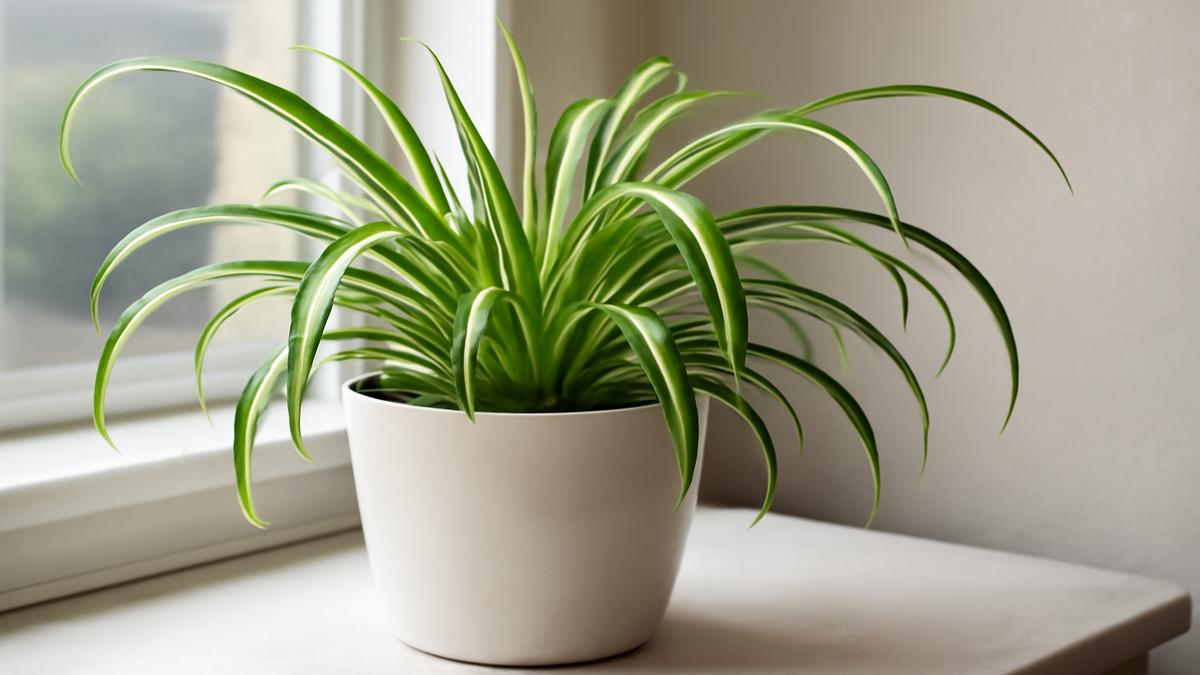
The first time I met it, the plant was sulking in the corner of a friend’s kitchen—one lonely spray of green, arching like a cat stretching in a shaft of sunlight. It wasn’t glamorous. No glossy, sculptural leaves. No fashionable variegation. Just a modest fountain of narrow, striped blades spilling out of a clay pot. “That thing?” I asked, watching a strand dangle over the sink. “That’s the one that never dies,” she said, rinsing her coffee mug. “Also, we don’t get spiders anymore.”
I laughed. A plant that refuses to die, quietly cleans your air, and keeps spiders away sounded like the kind of promise you’d see in a late-night commercial. But the more I noticed it—the way it thrived in a dark city kitchen, the way its baby offshoots cascaded down like green confetti—the more I realized this wasn’t hype. It was simply a plant that had survived decades of being underestimated: the humble, miraculous spider plant.
The Plant That Outlives Your Habits
Spider plants—Chlorophytum comosum if we’re being formal—are the underdogs of the houseplant world. They don’t shout for attention, don’t demand misting schedules or humidity monitors, don’t throw tantrums if you forget them for a week (or three). They just keep going.
Maybe that’s why you often find them in places designed for survival: dentist offices, waiting rooms, school corridors with fluorescent lighting that flickers like tired stars. Spider plants endure.
Imagine this: You come home late, drop your bag, and remember—too late—that you haven’t watered your plants in ages. The fiddle-leaf fig is sulking. The calathea looks like it’s writing its will. But there, by the window or shoved on top of a bookshelf, is the spider plant. A little drier than usual, maybe, but still bright, still green, still throwing out new shoots like it knows something you don’t.
That’s its secret magic: it fits your real life, not the idealized plant-parent version you tried to be that one January.
The Survivor’s Toolkit
Part of this toughness comes from where spider plants evolved—woodland edges and scrubby grasslands of South Africa, where conditions could swing from bright to shaded, damp to dry. In your home, that translates to a plant that can handle:
- Low to bright indirect light – north window, east window, even across the room from a south window.
- Inconsistent watering – it forgives forgetfulness better than almost any other common houseplant.
- Temperature swings – within reason; if you’re comfortable, it probably is too.
It’s not truly immortal, of course—but it’s about as close as an ordinary apartment dweller is likely to get.
Air So Clean You Can Almost Taste It
Stand close to a big, thriving spider plant, and the air feels… lighter. That may be your imagination, but it’s not entirely unearned. Spider plants became famous after an old NASA study tested how well certain houseplants could scrub pollutants from sealed indoor air. The spider plant showed a talent for removing things like formaldehyde and xylene—chemicals often found in furniture, paints, cleaning products, and building materials.
Picture your living room: the new sofa you saved up for, the paint on the walls, the pressed-wood bookshelf, the shoes lined up by the door. All of them, in tiny invisible ways, are slowly off-gassing. You can’t see it, but your spider plant is quietly taking in some of those compounds through its leaves and roots, transforming a fraction of that invisible cloud into something neutral, manageable, harmless.
You won’t notice a dramatic, cinematic “whoosh” of fresh air the day after you bring one home. But over time, with one big mature spider plant or a small forest of them, the space can feel subtly gentler, less stale—especially in small rooms with limited airflow: a bedroom, a study, that cramped little city kitchen where the window doesn’t really open properly.
The Way It Feels to Share a Room With Green
Beyond the science, there’s the emotional air-cleansing that happens when you share a room with something alive and quietly growing. A spider plant doesn’t need you the way some fussy plants seem to. It simply shares the space, a soft rustle of blades when you brush past, a constellation of baby plants hanging down like tiny green lanterns.
You wake up in the morning, pad barefoot across the floor, and there it is, catching the first weak ribbon of sunlight, leaves outlined in white. The room feels less like an arrangement of furniture and more like a small ecosystem you happen to belong to.
The Quiet Spider Deterrent
Then there’s the part that earned it a spot in so many homes: its uncanny reputation as a spider repellent. No, it doesn’t summon an invisible force field. Spiders might still wander through—an old house will always have the odd eight-legged visitor. But spider plants appear less inviting to them than cluttered corners or dusty lampshades.
Some homeowners swear that rooms with healthy spider plants tend to have fewer cobwebs in the corners and behind the curtains. It’s not that the plant emits a strong repellent like peppermint oil does. Instead, it seems to improve the micro-climate: slightly cleaner air, a little more moisture, and a living presence that’s regularly dusted, watered, and moved. Spiders thrive in still, dusty, undisturbed places. A thriving plant is the opposite of that.
And there’s a quieter, more psychological layer. When your eye has something gentle and green to rest on, you’re less likely to notice every flicker in the periphery and interpret it as a potential spider. Your nervous system calms a bit, anchored by that dependable spray of green.
Do Spiders Really Hate It?
Scientists haven’t framed a big controlled study around whether spiders avoid rooms with spider plants. This is house lore more than lab result—things people notice over many seasons, the way your grandmother noticed the way birds behave before rain.
But even if the plant isn’t a literal arachnid kryptonite, it changes your space so thoroughly—air quality, moisture, movement, the way you interact with corners—that your relationship with spiders will likely shift. Many people report exactly that: fewer webs, fewer surprise visitors, fewer middle-of-the-night shoe hunts.
A Living Fountain of Free Plants
The first time a spider plant sends out a runner, you might think it’s flowering or doing something exotic. A slender stem emerges from the dense tuft of leaves and arches out into the air like a question mark. From that stem, small clusters of leaves appear—miniature replicas of the parent, complete with roots just waiting for soil.
These are spiderettes, or offsets, or—if you’re feeling sentimental—baby plants. They dangle there in midair, catching light, learning the room from above. You can let them trail decoratively, like a hanging mobile, or you can snip a few and tuck them into little pots of soil or a glass of water. Within weeks, you have new, independent plants.
One plant becomes two, then five, then ten. You hand one to your neighbor who’s always complaining about spiders. You give one to a coworker who just moved into a dim studio with air that smells faintly like old curtains and the upstairs neighbor’s dinners. You tuck one on your windowsill, one on your desk, one on the top of the fridge.
You’ve created a small, green dynasty without spending a cent.
A Houseplant That Forgives Your Learning Curve
If you’ve ever killed a plant and felt that dumb sting of guilt, a spider plant is your path to redemption. You can learn about repotting, pruning, dividing roots, and propagating without the high stakes. Tough roots, forgiving leaves, patient nature.
Overwatered it? Let it dry out. Underwatered? Add a soak. Forgot to repot it for four years? Break apart that wild knot of roots and it will still bounce back. Trying to grow something with your kids? Let them pot the babies. The plant won’t hold a grudge if the soil is a bit lopsided.
Making Room for the One Plant That Never Complains
Spider plants are especially good at disappearing into your life in the best possible way—they don’t demand center stage, but they transform whatever corner you give them. They can be styled like design pieces or simply allowed to tumble wherever they want. Here are a few quiet, beautiful ways they slip into a home:
- Hanging beside a window, their spiderettes cascading like green waterfalls.
- Perched high on a bookshelf, softening the hard line of spines and boxes.
- On a kitchen counter by the fruit bowl, drinking in the steam from tea kettles and simmering pots.
- In a bathroom, where warm showers create the gentle humidity it loves.
- On a work desk, a green fringe to rest your eyes on between emails.
They don’t need the brightest spot—bright indirect light is ideal, but they’ll soldier through in those “almost enough light” spaces that defeat more dramatic houseplants.
Caring Without Fuss
You can sum up spider plant care in a few simple gestures rather than a strict schedule:
- Water when the top inch of soil feels dry.
- Keep it out of harsh, direct midday sun that can scorch the leaves.
- Trim brown tips if they appear (often from tap water salts or very dry air).
- Repot every couple of years—or when roots start bursting out of the pot.
It’s closer to looking after a hardy old herb in the garden than a fragile indoor diva. You learn its rhythm by glancing at it while drinking your coffee. After a few weeks, you’ll know when it’s thirsty just from the way its leaves relax or stand at attention.
Choosing Your Forever-Green Companion
Not all spider plants look identical. Some are lush green; others are traced with stripes of cream or pale yellow that catch the light like fine brushstrokes. The differences are subtle but charming, especially when you start to collect them.
| Type | Appearance | Best For |
|---|---|---|
| Classic Spider Plant | Green leaves with a creamy stripe down the center | Beginners and brightening dim rooms |
| Variegated “Reverse” Type | Creamy edges with a green center | Decorative hanging baskets and visual contrast |
| Solid Green Form | Deep green, slightly wider leaves | Low-light spots and simple, bold greenery |
Whichever you choose, care is essentially the same. What you’re really picking is the mood: bright and stripey, or calm and solid, or something in between.
A Pet-Friendly Ally
If your household includes a cat that believes leaves exist purely for batting and chewing, a spider plant is a blessing. It’s generally considered non-toxic to pets. Cats are notoriously drawn to its ribbon-like leaves, sometimes treating it like a personal salad bar or jungle gym.
While you don’t want your pet devouring half the plant in one sitting (mostly for their own stomach’s sake), a curious nibble or paw-slap isn’t a disaster. In a world where so many common houseplants are off-limits to pets, it’s deeply comforting to have one that’s both beautiful and safe.
Why This Plant, Of All Plants, Stays
If you keep plants long enough, you start to develop a quiet hierarchy. Some come and go like seasons in your life—an orchid that blooms briefly and then sulks, a trendy monstera you bought in a burst of optimism. Others settle in, becoming part of the architecture of your days.
Spider plants tend to fall into that second category. Years pass. Apartments change. Jobs shift. Relationships end or begin. You pack boxes, forget to label them, lose a mug you loved, misplace a book. But there, on the new windowsill in the next place, is the same old spider plant, or a child of it, or a grandchild. The same genetics, the same pattern of leaves, the same habit of sending out a hopeful runner the moment it feels a little too root-bound.
It’s not glamorous. It’s steadfast. It doesn’t just survive you—your travels, your mistakes, your busy months, your winter blues. It survives with you, adjusting, adapting, forgiving. It cleans a sliver of your air, softens the edges of your rooms, and, in its quiet way, makes the spiders think twice about claiming that corner behind the curtain.
One day you may look around and realize that without planning it, you’ve become a person whose home always has a spider plant. Like the friends who always have a kettle on, or the neighbor who always has herbs in the yard, you’ve grown a small, enduring habit of hospitality—toward yourself.
In the end, that’s what this “never dies” houseplant really offers: not just survival, not just cleaner air, not just fewer spiders, but continuity. A simple, living thread that stitches together all the places you’ll call home.
FAQ: The One Houseplant That Repels Spiders, Cleans Air, and (Almost) Never Dies
What is the plant you’re talking about?
The plant is the spider plant, Chlorophytum comosum, a common, hardy houseplant with long arching leaves, often striped green and white. Despite the name, it doesn’t attract spiders—if anything, it tends to make a room less inviting to them.
Does a spider plant really repel spiders?
Evidence is mostly anecdotal. Many people report fewer cobwebs and spider sightings in rooms with thriving spider plants. It’s likely that cleaner air, a more tended space, and less dust and clutter around the plant all contribute to making the area less appealing to spiders.
How does a spider plant clean the air?
Spider plants can absorb certain volatile organic compounds (VOCs) like formaldehyde and xylene through their leaves and roots. They then break these down or trap them in the soil–microbe system. While one plant won’t turn your home into a laboratory-clean environment, several healthy plants can gently improve indoor air over time.
Is it really that hard to kill a spider plant?
They’re very resilient. Spider plants tolerate low light, occasional neglect, and irregular watering better than most houseplants. You’d have to combine severe overwatering, long-term darkness, or total abandonment to truly lose one. Even then, a small surviving offset can often be revived.
Where should I put a spider plant in my home?
Place it in bright, indirect light for fastest growth—near a window with filtered sun or a few feet back from a bright window. It can manage in lower light but may grow more slowly and produce fewer babies. Avoid harsh, direct midday sun that can burn its leaves.
How often should I water a spider plant?
Water when the top inch of soil feels dry. In most homes, that means about once a week, a bit more in warm weather and less in winter. It prefers slightly moist but not soggy soil. If in doubt, let it dry out a little rather than overwatering.
Are spider plants safe for pets and kids?
Yes. Spider plants are generally considered non-toxic to cats, dogs, and humans. Curious pets may chew on the leaves, which can cause a mild stomach upset if they overindulge, but the plant itself isn’t poisonous.
How do I get more plants from my spider plant?
Wait until the plant sends out runners with small “baby” plants at the end. Snip off a baby with a bit of stem and either place it in water until roots grow longer or plant it directly into moist soil. Keep it lightly watered, and it will soon become an independent plant.
Why do the tips of my spider plant’s leaves turn brown?
Brown tips are usually from dry indoor air, salt or minerals in tap water, or occasional underwatering. Try using filtered or left-out tap water, avoid letting it get bone dry for too long, and trim the brown tips with clean scissors for a neater look.
Can a spider plant live for many years?
Absolutely. With basic care—occasional repotting, regular but not excessive watering, and decent light—a spider plant can live for many years. Even if the original plant ages, its constant stream of offspring means you can keep its lineage going almost indefinitely.

Hello, I’m Mathew, and I write articles about useful Home Tricks: simple solutions, saving time and useful for every day.