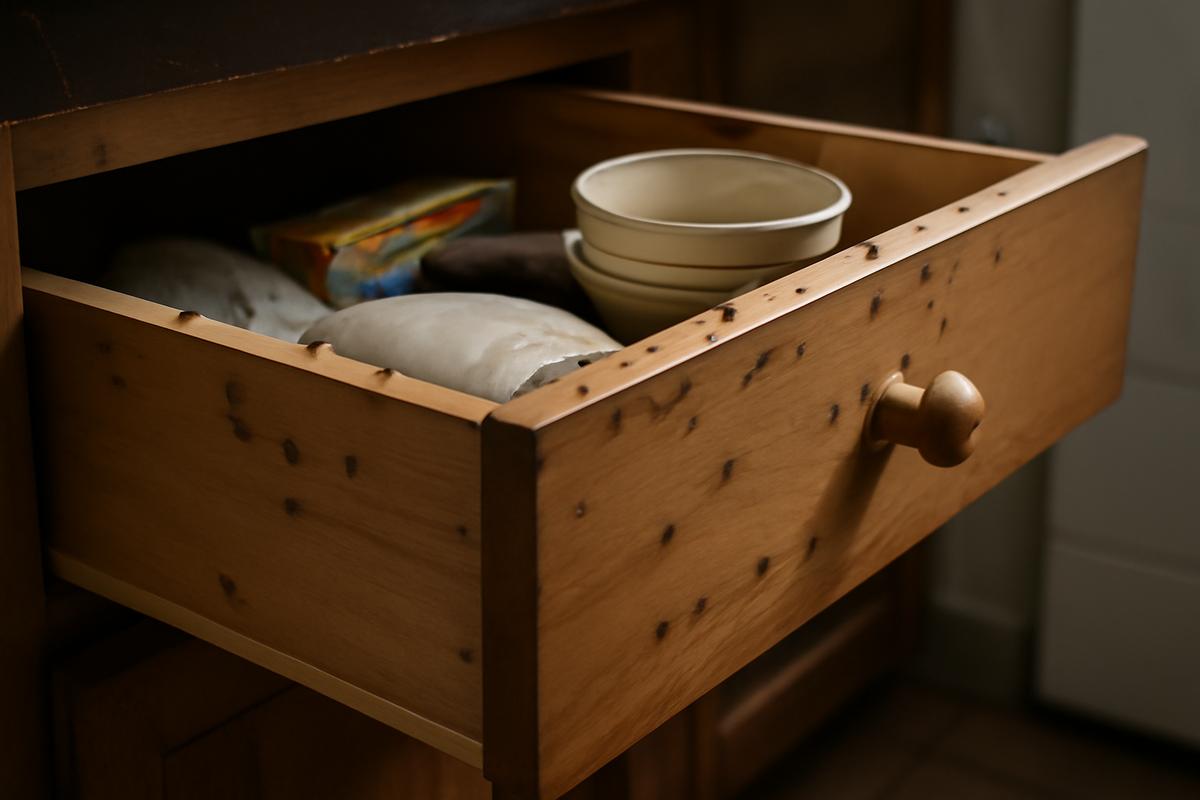
The first time I heard it, I thought it was the house settling—a faint, papery rustle from somewhere inside the kitchen. The lights were low, the refrigerator hummed its sleepy song, and the rest of the apartment lay in that quiet, late-evening pause. Then I heard it again. A delicate, almost secretive sound. When I pulled open the drawer beneath the counter, the smell reached me first: a stale, floury breath tinged with something slightly sour and suspiciously alive.
Inside, among neatly stacked tea towels and a forgotten birthday candle, lay a trail of powdery flakes and the tiniest scattering of dark specks. At the back, shoved up against the wood, was a half-open packet of almond flour I’d “just put there for a day” several months before. The corner was chewed. And crawling along the torn edge, moving with calm, horrible purpose, were three tiny beetles that looked like they owned the place.
The Drawer Habit You Don’t Think About—But Insects Do
The story usually starts the same way. You tidy the kitchen with that end-of-day mix of exhaustion and good intentions. Something small—an open packet of rice, a bag of nuts, a box of cereal with its inner lining already slit—doesn’t quite fit in the pantry. It’s late, you’re tired, and the nearest available space is right there: the drawer.
“Just for now,” you think. “I’ll find a proper spot tomorrow.” But tomorrow becomes next week, and the drawer, that quiet, dark, neatly sliding rectangle of wood, becomes a limbo zone—a place where food goes to wait. And while it waits, something else finds it.
We don’t usually think of drawers as anything more than storage: a place to tuck away the visible mess. But to an insect, especially one with a nose for starch, sugar, or oil, a drawer is a microclimate. It’s shaded, still, and warm. It smells like wood, fabric, dust, and you. And if you add an open bag of something edible—no matter how clean your home is—you’ve created a habitat.
This is the drawer habit that silently attracts insects: casually storing food—especially unsealed or poorly sealed food—in places designed for linens, tools, and odds and ends. Drawers are meant for things, not meals. The moment they become half-pantry, half-cabinet, they become a quiet invitation.
The Way a Drawer Feels to an Insect
Step back for a moment and try, just for the fun of it, to imagine the world from the height of a grain beetle or a pantry moth. Your entire life is ruled by texture, temperature, and smell. You sense air currents like we sense a change in light. The faintest dusting of flour, barely visible to us, is a shoreline of food to you.
A drawer, sealed in its wooden casing during most of the day, is a stable capsule of air. It is less disturbed by drafts, footsteps, or the echoes of doors opening and closing. The smell of what’s inside lingers and concentrates in that small volume. When the drawer slides open, it exhales a cloud of scent invisible to us but loud and bright to them.
A bag of nuts resting on a thin bed of dish towels is an ecosystem waiting to happen. Fragmented crumbs sift into the cloth, tiny oils stain the fibers, and that faint smell of fat and starch seeps down into the wood grain. A sugar packet that split months ago spills its crystals like sand, small enough to sift into every corner. To us, it looks like a faint dusting. To them, it’s a buffet.
And so they arrive—not with drama, but with the quiet patience of creatures that have followed scent trails for millions of years. A beetle squeezes through a seam. A single adult pantry moth—having slipped in through an open window one warm evening—finds a promising darkness and lays its eggs behind the paper lip of a cardboard box. Entire colonies begin from one unnoticed decision: “I’ll put that in the drawer for now.”
The Usual Suspects Hiding in the Dark
Open the wrong drawer at the wrong time, and you might meet them: the tiny tenants of your unintentional insect hostelry.
There are flour beetles, so small you could mistake them for flecks of pepper trembling across the surface of a tea towel. Grain weevils with their long, comical snouts, tucked like minute elephants into bags of lentils or rice. Pantry moth larvae, pale and slow, winding their way along the seam of a box or cloth, leaving behind faint silky threads like careless stitches.
They are not the result of filth or squalor, as we like to reassure ourselves. They are opportunists, following the oldest laws of survival: go where the food is and where nothing bothers you. A drawer with occasional crumbs, a forgotten snack bar, some dog treats, or a paper bag of seeds is exactly that.
Insects don’t require dramatic neglect to move in—just small, repeated invitations. A slightly greasy spoon tossed into a drawer with placemats “to wash later.” A cracked packet of instant oatmeal resting beside a stack of napkins. A handful of sunflower seeds knocked loose from a bag and swept out of sight, but never actually cleaned away.
How a Harmless Habit Turns Into a Hidden Colony
The worst part is how quietly it happens. Most infestations in drawers don’t begin with an invasion; they begin with arrival. Just one beetle carried home inside a bag of flour. One moth egg clinging to the fold of a cardboard box. One tiny hitchhiker in the seams of your groceries.
They don’t need your permission. They need time.
The cycle is patient and almost gentle at first. An insect lays eggs where soft food dust has settled. Larvae hatch, burrow, and nibble, leaving behind a soft stew of powder and cast-off skins. New adults emerge and go looking for more of this dim, forgetful paradise. Deep inside that second drawer by the stove—the one where no one ever really knows what’s in the back—life multiplies silently.
And because drawers are, by design, containers of secrets, it’s astonishing how long this can go unnoticed. You might smell something faintly musty, or notice that the dish towels don’t feel as crisp, or see the lightest flutter of a moth when you pull out a corkscrew. Perhaps, like many, you’ll blame “old house smells” or “seasonal bugs.”
But the real story is often smaller, more intimate: a quiet ecosystem supported not by large spills, but by pinches and whispers—powdered sugar that dusted off a bag, spice fragments from a jar that cracked at the lid, seeds that fell from bird food you meant to store “just for a week.”
The Subtle Signs Your Drawer Isn’t Just Yours Anymore
Before the horror of opening a drawer to find visible movement, there are softer warnings:
- A faint, stale odor when you open a drawer that should smell like cotton and wood.
- Fine dust or powder in the corners that doesn’t match what you’ve stored there.
- Tiny holes in packages, even when you’re sure you never tore them.
- Very small brown or black specks that don’t brush off like normal dust.
- A single, wandering moth in the kitchen you keep “meaning to swat” but never do.
These are not dramatic signs. They’re whispers. And they’re easy to ignore because the drawer habit itself is built on a kind of quiet denial: out of sight, out of mind. As long as the kitchen looks orderly from the outside, we’re content to overlook the pocket worlds hidden behind smooth wooden fronts.
Why Drawers Are So Irresistible to Insects (And So Dangerous to Your Peace of Mind)
On paper, a cupboard might seem equally appealing to an insect: it’s dark, it holds food, it stays mostly closed. But drawers have a few extra qualities that nudge them into prime real estate territory.
They sit lower, closer to the floor—closer to where insects naturally travel. The joints where the drawer meets its casing often have slim, steady gaps that are easier to slip through than the swinging edges of a cabinet door. And many drawers, especially those not used as frequently, have a quieter rhythm of disturbance. A drawer opened once a week is a world where generations can rise and fall between human check-ins.
More importantly, we treat drawers differently. Cupboards are for “real” food: jars, tins, bottles. Drawers are for everything else—tea lights, takeout menus, napkins, stray packets of sauce, half-used spices, dog biscuits, rubber bands, tasting spoons, forgotten sweets from a trip years ago. It is here, in this casual mixing of edible and inedible, that the real danger lies.
Mixed drawers become traps of neglect: we don’t catalog them, rarely empty them, and almost never completely clean them. When we do, it’s often with a quick brush of the hand, pushing crumbs and grit toward the back, not realizing we’ve just improved the soil for whatever might be living there.
The Hidden Menu Lurking in Everyday Drawers
If an insect could write a restaurant review of the average “junk drawer,” it might sound something like this:
- Starters: Sugar crystals from a torn sweetener packet, flour dust from a baking day, spice fragments from a cracked jar.
- Main course: A forgotten snack bar, dog treats, nuts in a zip bag that no longer zips, a loose teabag that split along its seam.
- Dessert: The slightly sticky edge of a honey packet, old chewing gum in its paper, dried fruit grains, chocolate crumbs.
We don’t see this as food because it’s incomplete, scattered, or sealed in our minds by habit: “That’s just a packet, that’s just some crumbs.” But the insect world has a radically different definition of enough. A single scattered teaspoon of food—spread invisibly across wood grain and fabric—can sustain far more life than we’d like to imagine.
And so the drawer becomes not only a feeding ground, but a breeding ground. Where you see a tangle of chargers, napkins, and tape, a beetle sees shelter. Where you see a folded tablecloth, a moth sees a quiet, fabric-dimmed cradle for its next generation. Their lives weave themselves into our storage systems, nesting in our habits.
Turning the Drawer From Invitation to Fortification
There’s a sort of gentle mercy in the fact that the solution doesn’t require perfection—only attention. Drawers don’t have to be sterile, only intentional. The very habit that invites insects in—casual, unconscious storing of food and crumbs—can be replaced with a different kind of habit: one built on small moments of awareness.
Start with a single drawer. The one you least want to open. Pull it out all the way, if you can. Feel the light touch the back corners that haven’t seen it in years. Take everything out—yes, even that wad of rubber bands and the tea lights you’re saving “for special evenings that never quite come.”
Then look, really look: explore with curiosity rather than disgust. What stories do the crumbs tell? What’s the oldest item in there, and when did you last use it? That dusty packet of seeds from three apartments ago. The hotel sugar packets. The “emergency” chocolate that expired during a different presidential term.
This is the moment you shift the story. Instead of treating drawers as soft landings for anything that doesn’t have a place, you choose: this drawer is for tools, or this is for fabrics, or this is for documents. It is not for snacks, not for “temporary” storage of cereal, not for half-finished treats you need to hide from yourself.
And then, you clean. Not by brushing crumbs to the back, but by wiping, vacuuming, and reclaiming the wood from the fine film of accidental offerings. You might notice the scent change, from murky to neutral. That’s not just cleanliness—it’s the removal of a signal. You’re silencing the fragrant beacons that whisper to insects, “Food here, all you can eat, barely any disturbances.”
Small Shifts That Make a Big Difference
These tiny changes in habit are what transform your drawers from insect magnets into quiet, uneventful spaces again:
- Decide that no food ever lives in non-food drawers—not even for a night.
- Use sealed containers for anything edible that lives in the kitchen: jars, tins, or airtight boxes.
- Empty and clean your busiest drawers every few months; your forgotten ones at least once a year.
- Notice smells and powders: any odd scent or dust is a clue worth checking.
- When you buy dried goods, inspect packaging for tiny holes or webbing before it ever touches a drawer.
None of this requires anxiety—only a kind of quiet partnership with the invisible lives around you. When you think of your drawers as ecosystems rather than dead spaces, your actions naturally adjust. You stop creating unintentional sanctuaries for the small, persistent creatures who thrive on our half-forgotten habits.
A Quick Reference: Drawers, Habits, and Insects
Here’s a compact overview you can come back to when you’re standing in front of that one drawer, debating whether to toss in “just this one thing.”
| Drawer Habit | Why Insects Love It | What to Do Instead |
|---|---|---|
| Storing open or loosely closed food packets | Easy access to steady food with minimal disturbance | Use airtight containers; keep all food in dedicated pantry areas |
| Keeping snacks or “emergency treats” in linen or tool drawers | Mixed materials (fabric, paper, food) create ideal shelter and nesting spots | Limit drawers to non-edible items only; store treats in sealed jars or tins |
| Rarely emptying or cleaning drawers | Accumulated crumbs and dust become a long-term buffet | Schedule seasonal cleanouts with full removal and wipe-down |
| Using drawers as “temporary” holding spots for groceries | Forgotten items turn into quiet breeding grounds over time | Put groceries away immediately in their intended locations |
| Ignoring faint odors or powdery residue | Allows infestations to grow unchecked for months | Investigate smells and powders; discard suspicious items promptly |
Living With the Tiny Neighbors—On Your Own Terms
There’s no such thing as an entirely insect-free home. Even the cleanest, sharpest, most organized kitchens are briefly visited by ants, moths, beetles, and other wanderers from the unseen highways of the natural world. Perfection is neither possible nor necessary.
But there is a difference between a space that welcomes guests and one that quietly, unknowingly offers them a lease.
The drawer habit—the one where we tuck food into places meant for cloth or tools, where we push crumbs beyond sight instead of actually removing them—is a tiny pattern with big consequences. It turns enclosed, peaceful spaces into insect sanctuaries. It transforms a piece of furniture into a hidden ecosystem where generations rise and fall without your knowledge.
When you open a drawer and see it as more than wood and handles—as a potential micro-forest of cloth, paper, dust, and scent—you begin to treat it differently. You notice what enters, what settles, and what lingers. You begin to see each little rectangle of storage not as a void to be filled, but as a small territory you curate.
And in that shift—from casual stuffing to conscious tending—you reclaim something more than cleanliness. You reclaim your right to live alongside nature without accidentally feeding it in the dark, without letting your quiet habits write invitations you never meant to send.
Next time your hand reaches out, grocery bag in one arm, “I’ll just put this here for now” on your lips, pause at the drawer. Picture the tiny beetle somewhere out there, following faint traces of flour like a compass. And then place the food where it belongs—with a lid, in the light, in a space meant for it.
You’re not just organizing your kitchen. You’re editing the story your home tells to the smallest, hungriest listeners.
FAQ: The Drawer Habit and Insects
Why do insects end up in drawers instead of just staying in the pantry?
Drawers are dark, warm, and rarely disturbed—ideal conditions for insects to feed and breed. When even tiny amounts of food or crumbs are present, drawers become safer and quieter than open pantry shelves, especially if you rarely empty or clean them.
Can insects really infest a drawer from just a few crumbs?
Yes. Many pantry pests are adapted to survive on very small amounts of food. A few scattered grains, sugar crystals, or flour dust can sustain larvae long enough for a small population to take hold, especially if fresh crumbs or spills keep appearing.
Is finding insects in a drawer a sign that my home is dirty?
Not necessarily. It’s more often a sign of small, unnoticed habits—like storing open food, rarely cleaning the drawer, or bringing in infested groceries. Even very clean homes can have insect problems if food and shelter are available in the wrong places.
What should I do if I find bugs in a drawer?
Empty the drawer completely. Throw away any food, paper, or fabric that shows signs of insects, webbing, or holes. Vacuum the drawer and surrounding area thoroughly, then wipe it down with soapy water. Inspect nearby drawers and pantry shelves to ensure the problem isn’t more widespread.
How often should I clean my drawers to prevent insects?
High-use kitchen drawers should be checked and wiped every few months. Less frequently used drawers should be fully emptied and cleaned at least once a year. A quick visual check for crumbs, odors, and unusual dust each time you rearrange items goes a long way.
Is it ever safe to store food in drawers?
It can be, if the food is in genuinely airtight, insect-proof containers and the drawer is kept clean. However, mixing food with textiles, papers, or tools in the same drawer increases the risk of unnoticed spills and hiding spots, so dedicated food storage zones are usually safer.
What kinds of food are most likely to attract insects into drawers?
Dry goods like flour, cereal, rice, pasta, nuts, dried fruit, seeds, pet food, and sugary snacks are especially attractive. Even very small leaks or crumbs from these foods can draw insects into nearby drawers and keep them there.

Hello, I’m Mathew, and I write articles about useful Home Tricks: simple solutions, saving time and useful for every day.