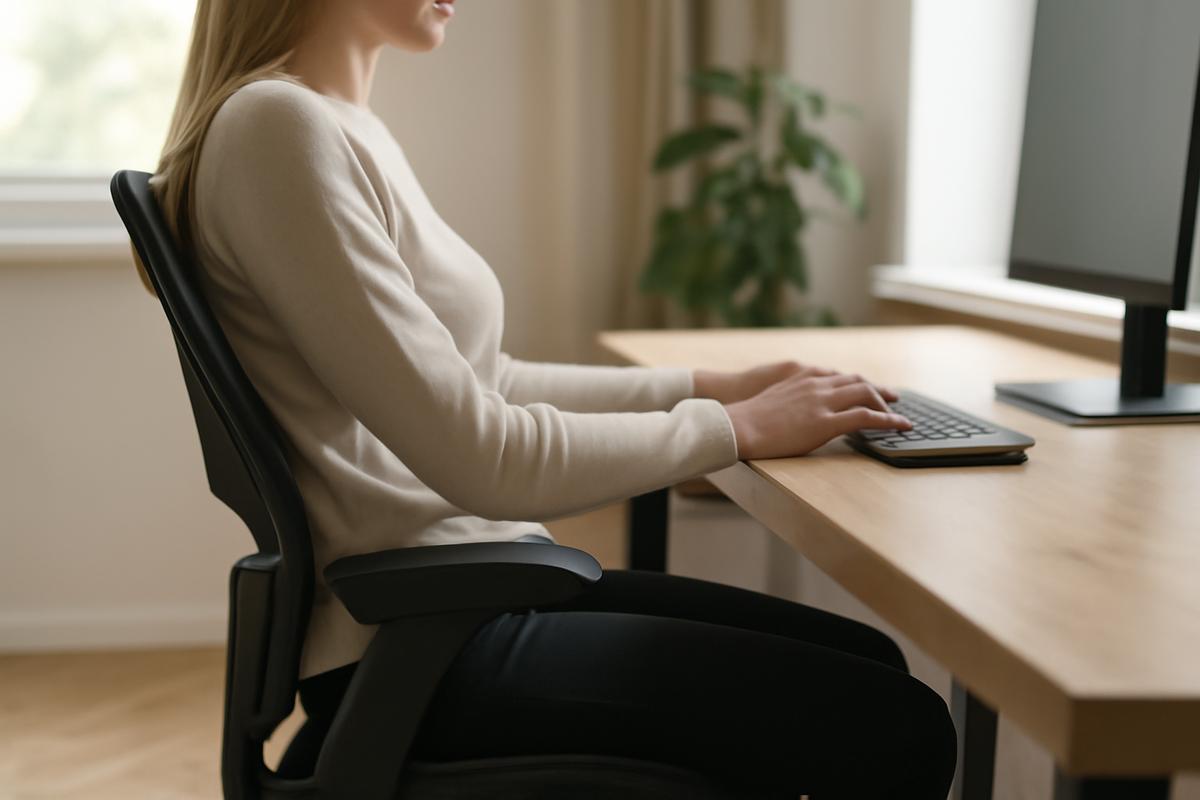
The first time I noticed the angle of a chair, it was because my back was on fire. Not the romantic, I-hiked-a-mountain kind of fire—more like a slow, disobedient burn that curled up from my lower spine and settled behind my ribs. I’d been sitting for hours in a café, sunk into one of those deep, plush chairs that feel like a hug when you first sit down. By the time I stood, my lower back let out a protest so sharp I grabbed the table for balance. That was the moment I began to suspect that comfort and kindness are not always the same thing—especially when it comes to the way we sit, and the angle at which we fold ourselves into our days.
The Secret Geometry of Sitting
Most of us don’t think about it. We flop into whatever seat is nearest—the office chair, the kitchen stool, the car seat molded by strangers, the couch that slowly swallows us whole. Our bodies bend to the furniture, not the other way around. And somewhere, deep where the spine meets the pelvis, our lower back quietly takes notes.
There’s a kind of quiet geometry happening each time you sit down. Your pelvis tilts. Your spine curves. Muscles either brace like cables on a bridge or slacken like old rope. The angle between your thighs and your torso decides how much pressure your lumbar discs must bear. It’s an intimate negotiation between bone and gravity, and it happens hundreds of times a day without your awareness.
For many of us, that negotiation stops being silent. It starts to arrive as an ache that greets you when you stand up from the couch. A sharp twinge when you bend to tie your shoes. A stiffness that makes mornings feel heavier than they used to. These are not random acts of betrayal. They are often the accumulated consequence of a single simple factor that hides in plain sight: the angle of your chair.
Imagine, for a moment, watching yourself from the side as you sit. If you could turn your body into a line drawing, you’d see segments and joints—an upside-down “L,” or sometimes more like a gently folded “V.” This isn’t just posture; it’s design. And the angle that matters most, surprisingly, is not in your back at all. It’s formed where your hips bend—a hinge connecting your spine to your legs—and it quietly decides whether your lower back gets to rest or must work overtime.
The Angle That Lets Your Spine Breathe
Ask a dozen people what “good posture” looks like, and you’ll get variations of the same answer: sit up straight, shoulders back, 90-degree knees, feet flat. It’s the classroom diagram many of us grew up with—upright, tidy, mathematically neat. But your lower back is not an equation on a blackboard. It’s more like a living tree trunk, made to hold an elegant curve, not a rigid line.
When you sit in a classic 90-degree position—knees bent at right angles, hips at right angles—your pelvis often tips backward, especially if the seat is flat and your back is unsupported. That subtle backward roll flattens the natural inward curve of your lower spine, what clinicians call the “lumbar lordosis.” Flatten that curve long enough, and the pressure on your lumbar discs increases. Muscles around the spine tense to keep you from collapsing. Ligaments stretch and complain. It may look “proper,” but your body reads it as strain.
Now picture something different: your hips opening a little more, your thighs tilted slightly downward, your spine rising gently as if it has just remembered its original shape. This is what happens when your sitting angle moves from that strict 90 degrees to somewhere between about 100 and 120 degrees—your trunk slightly reclined, your hips more open, your pelvis allowed to tip just enough forward to restore that easy lumbar curve.
Researchers and ergonomists have circled around this range for years. They call it a relaxed, open hip angle. You might call it the position where your spine quietly sighs in relief. In this angle—where your torso leans a bit back relative to your thighs—the pressure inside the lumbar discs typically drops compared to the 90-degree pose. Muscles around your lower back don’t have to constantly fight gravity; instead, the load is shared more evenly between joints, discs, and the backrest behind you.
It’s not a throne-like recline, where you’re practically horizontal. It’s more like the angle you naturally slip into when you’re sitting in a supportive chair, adjusted just right, and you suddenly realize you’re not thinking about your back at all. It’s that subtle sweet spot where your body forgets to complain.
Why Your Pelvis Is the Quiet Architect
Your pelvis is the unsung architect of your lower back’s fate. Think of it as the foundation of a house: if the base tips, every wall above leans with it. When you sit, your pelvis can tilt forward or backward. A forward tilt—just a little—encourages that gentle inward curve in your lower back. A backward tilt flattens and sometimes reverses the curve, stressing the structures that quietly hold you together.
The chair angle that protects your lumbar region is really the angle that lets your pelvis settle into a neutral or slightly forward tilt without you having to work for it. This is where the seat pan—the part you actually sit on—and the backrest angle matter more than any noble intention to “sit up straight.” If the seat is too flat or tilts backward, it coaxes your pelvis to roll under, dragging your spine with it. If the backrest is too upright, you must use muscle power to stay there, and muscles, unlike furniture, are not built to hold one position all day without protest.
Open the hip angle—let your thighs drop slightly, let your torso lean gently back—and your pelvis often finds a more natural alignment. That’s when your lower spine inherits the benefits. Blood can flow more freely. Muscles get to alternate between light engagement and rest rather than constant bracing. The small joints between vertebrae are no longer asked to be both hinges and pillars.
In a way, the lower back doesn’t ask for much. It just asks that we stop forcing it to behave like a permanent hinge at a harsh right angle.
Designing Your Daily Habitat
We like to think of “nature” as something outside—a forest trail, a shoreline, a mountain ridge. But your body is its own ecosystem, and your chair is part of its habitat. You spend hours in that habitat every day. If a bird built a nest that bent its wings at a painful angle, we’d call it a flawed design. Yet we routinely accept chairs that treat our spines the same way.
The good news: you don’t need a futuristic chair from a boutique catalog to protect your lower back. You need awareness, a few adjustments, and a willingness to nudge your sitting world closer to that open, protective angle.
Start by paying attention to how your hips and trunk relate when you sit. If someone photographed you from the side, would the line from your hip to your shoulders be perfectly upright? Or is there a gentle recline? Can you feel your weight resting partly into the backrest, or are you hovering, holding yourself up with effort?
Here are some tangible ways to bring that 100–120-degree magic into the furniture you already use, without turning your home or office into an ergonomic showroom:
- Adjust your backrest: If your chair has a recline or tilt mechanism, experiment. Lean it back enough that your trunk angles slightly behind your hips, not stacked directly above them. Your hips should feel more open, not pinched.
- Tip the seat slightly forward: Some chairs allow a slight forward tilt of the seat. This can help your pelvis roll just a bit forward, supporting the natural lumbar curve. If your seat only tilts back, that’s often a red flag for your lower back.
- Add a small lumbar support: A rolled towel or small cushion at your lower back can mimic a built-in curve, especially if your chair’s backrest is flat. This gentle pressure invites your spine into alignment.
- Mind your feet: An open hip angle doesn’t mean your feet should dangle. Use a footrest, box, or firm stack of books if needed, so your feet are supported while your hips remain slightly more open than 90 degrees.
- Allow movement: Micro-movements—shifting your weight, adjusting your position, leaning back and forward—help distribute pressure and keep blood flowing. The best angle is one you don’t hold like a statue.
The goal is not perfection. It’s kindness. You’re reshaping the habitat your spine lives in every day, so it doesn’t have to fight the furniture just to keep you upright.
How Different Chairs Treat Your Lower Back
Not all chairs are created with your lumbar spine in mind. Some whisper support, others shout resistance. The way they shape your hip angle and back support has real consequences over time. Here’s a simple comparison of how common seating styles often behave, and what they tend to mean for your lower back:
| Type of Seat | Typical Hip/Back Angle | Effect on Lower Back | How to Improve It |
|---|---|---|---|
| Standard office chair | Often near 90° if backrest is upright | Can flatten lumbar curve; muscles overwork to keep posture | Recline backrest slightly, add lumbar roll, adjust seat height so hips are slightly above knees |
| Deep sofa or lounge chair | Very open angle, but with slouching curve | Encourages C-shaped spine, increases disc and ligament strain over time | Use a firm cushion behind lower back, sit closer to edge, keep feet solidly supported |
| Dining/kitchen chair | Often 90° or slightly less, flat seat | Pelvis tends to roll back; back tires quickly, leading to slouching | Add seat cushion with slight forward slope; use small lumbar support; avoid sitting for very long periods |
| Kneeling chair | Open hip angle, trunk slightly inclined forward | Can preserve lumbar curve, but may load knees and shins; not ideal for all-day use | Use in short durations, alternate with other chairs, add padding if needed |
| Ergonomic task chair with recline | Adjustable, can be set to ~100–120° | Often best for disc pressure reduction and lumbar support when properly set | Fine-tune recline, lumbar depth, and seat height so your back is supported without effort |
Even on the smallest smartphone screen, the pattern is easy to read: the closer your sitting life drifts toward either rigid 90-degrees or soft, collapsing slouch, the more your lower back pays the price. Somewhere in the middle—firm yet forgiving, open yet supported—is the angle that turns your chair into an ally instead of an adversary.
The Body’s Small Signals
Your lower back is not a loud complainer at first. It starts with whispers: a bit of stiffness when you stand, a dull tension by late afternoon, a sigh of relief when you finally lie down. These are early messages, not just about your age or activity level, but about the shapes you hold yourself in day after day.
Some days, you may notice that after an hour at the computer, your hand instinctively presses into the small of your back, massaging an invisible knot. Or maybe you find yourself perching at the edge of the seat, leaning on one elbow, adjusting and readjusting like a restless bird on an awkward branch. Your body is trying to solve a geometry problem that your chair has imposed.
When you find and use a more protective chair angle, these small signals often begin to soften. You may discover that you can sit a little longer without that familiar ache creeping in. Standing up feels more effortless, less like prying yourself out of a mold. By the end of the day, your lower back isn’t shouting over every other sensation you might want to notice—like the temperature of the evening air on your skin, or the stretch of your legs as you walk.
And yet, even the best angle is not a magic spell. The human body is built for movement, not for prolonged stillness in any one shape. The chair angle that protects your lower back is less a final answer and more a starting point—a position from which movement is easier, less painful, and more sustainable.
So step out of the idea that you must hold the “right” posture like a pose. Instead, think of your back as a river that likes to curve and flow. The open hip angle, the reclined support, the neutral pelvis—they’re just banks guiding the water, not dams that freeze it in place.
Making Peace With the Chair
At some point, you might start to notice this everywhere. On trains, people hunched over glowing screens. In waiting rooms, slouched bodies sinking into low seats. In offices, rows of humans bent in nearly identical 90-degree angles, like folded paper cranes that forgot how to open their wings.
You may feel a quiet rebellion rise: a desire to adjust the angle of your own chair, to refuse the script that discomfort is just part of modern life. Perhaps you tilt your seat a little forward, recline a bit, slide a small cushion behind your lower back. The changes look minor, almost invisible from the outside. But inside your body, the architecture of pressure and strain is rearranging itself.
This is where things become less about ergonomics and more about relationship—the relationship between you and the objects that hold you through your day. The chair is no longer just a passive object; it’s a living part of your routine that you can be in conversation with. You listen to the feedback from your muscles and joints. You tweak the angle. You test, adjust, and test again, until you find that quiet, unremarkable moment when your lower back is no longer the protagonist of your day.
In that moment, you might notice your breath deepen. Your shoulders unhook from your ears. Your attention can leave your spine and return to what you were meant to be doing—writing, reading, listening, thinking. The chair angle that protects your lower back is the one that frees your attention for the rest of your life.
Bringing Nature Back Into the Way You Sit
Spend time watching people in a park—on a bench, on the grass, leaning against a tree—and you’ll notice something: they rarely hold one position for long. They shift, stretch their legs out, tuck them under, lean back, lean forward. Their bodies are in constant negotiation with gravity, curiosity, and comfort.
There’s a kind of wisdom in that natural fidgeting, one that modern sitting culture has slowly ironed out of us. Chairs with straight backs, rigid rules about “proper posture,” long hours of screen-bound work—they all conspire to keep us motionless, folded into angles that our spines tolerate at best, resent at worst.
Reclaiming the protective chair angle is a way of bringing a bit of nature back into this picture. Not the wild, windblown kind, but a quieter nature—the original preferences built into your bones and discs and muscles. Your lumbar spine wasn’t designed in a factory. It evolved to thrive in a world of squatting, walking, bending, resting on uneven ground, leaning against rocks and trees. It’s remarkably adaptable, but it carries memories of those more organic positions.
When you open your hip angle a little, when you support the gentle curve of your lower back instead of ironing it flat, you are listening to that ancestral memory. You’re telling your body: I see that you’re not meant to be folded sharply at the waist for eight hours straight. I can’t take us back to the forest, but I can make this chair a bit more like friendly terrain.
Over time, these small acts of alignment accumulate. They shape how you feel at the end of the day, how eagerly you step into the next one, how willing your body is to participate in the things you love—hikes, gardening, playing with kids on the floor, or simply standing at a window watching the sky change color.
In a world that often celebrates big, dramatic interventions—new workouts, new therapies, new treatments—it’s easy to overlook something as ordinary as the angle of your chair. But sometimes, the quietest changes are the ones that give your body room to heal, to breathe, to remember its own design.
So the next time you sit down, pause for a moment. Notice how sharply or softly your hips are bent. Play with the recline, the tilt, the cushions. See if you can invite your lower back into that gentle open angle, somewhere between upright and reclined, where your pelvis feels balanced and your spine feels like it’s standing in a soft breeze instead of a storm.
You may not see the difference in the mirror. But your lower back will know. And, little by little, it will thank you—not in words, but in the welcome silence of pain that never arrives.
FAQ
What is the best chair angle to protect my lower back?
An angle between your torso and thighs of about 100–120 degrees is often considered protective. This means your hips are slightly more open than 90 degrees, and your back is gently reclined with solid support, allowing your lower spine to keep its natural inward curve.
Is sitting perfectly upright at 90 degrees bad for my back?
Sitting at 90 degrees isn’t automatically bad, but it often leads to a flattened lower back and increased disc pressure, especially if you hold it for long periods. Many people also slouch over time from this position. A slightly more open, reclined angle typically feels and functions better for the lumbar region.
Can I fix my chair angle without buying a new chair?
Often, yes. You can adjust the backrest to recline slightly, use a small lumbar cushion or rolled towel, raise or lower your seat so hips are slightly above knees, and add a wedge cushion to create a gentle forward slope on a flat seat.
How often should I change positions while sitting?
As a general rule, shifting at least every 20–30 minutes helps reduce strain. Even small changes—leaning back, re-adjusting your hips, or briefly standing—give your spine and supporting muscles a chance to reset.
Do standing desks replace the need for a good sitting angle?
No. Standing desks can reduce total sitting time, which is helpful, but standing all day brings its own issues. Most people do best alternating between well-supported sitting, brief standing periods, and regular movement. When you do sit, your chair angle still matters.
Is a kneeling chair better for my lower back?
Kneeling chairs can open the hip angle and support a natural lumbar curve, which may feel good for some people in short bursts. However, they can place pressure on knees and shins and aren’t ideal for all-day use. They’re best as one option in a rotation, not the only seat you use.
What if my back already hurts when I sit?
Adjusting your chair angle can help reduce strain, but persistent pain deserves attention. Consider combining better sitting habits with regular movement, gentle stretching, and, if needed, guidance from a healthcare professional who can assess your specific situation.

Hello, I’m Mathew, and I write articles about useful Home Tricks: simple solutions, saving time and useful for every day.




