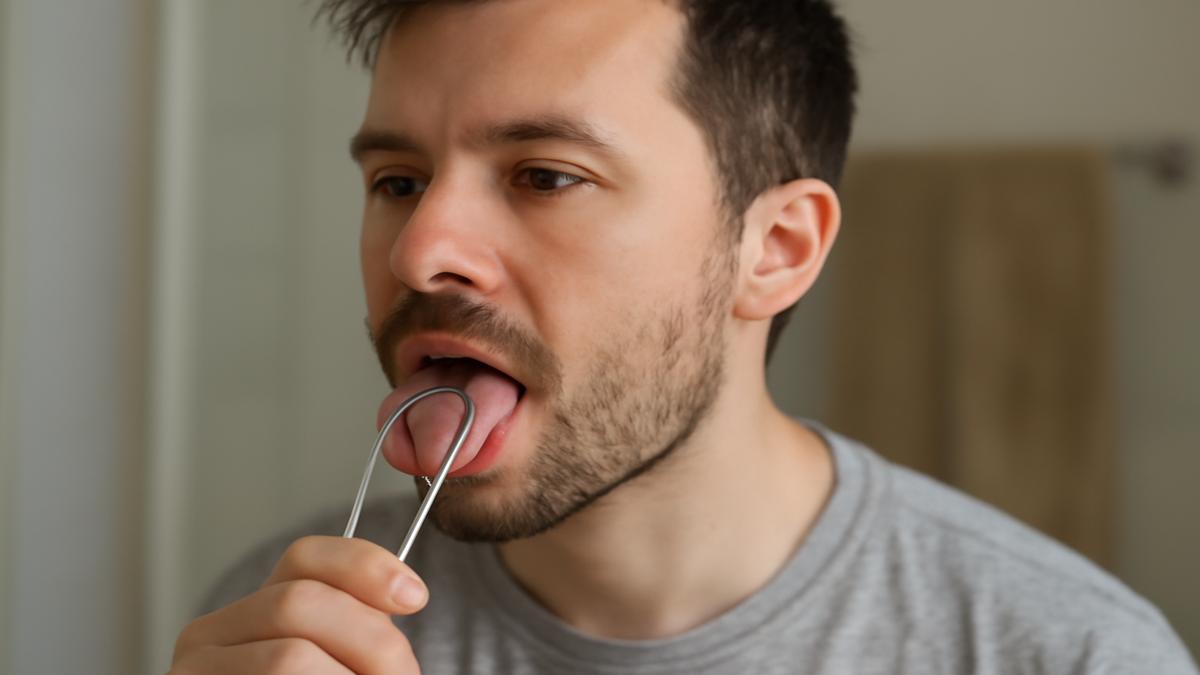
The first time you really look at your tongue—like, really look at it—it can be unsettling. Under the bathroom light, you notice it’s not just pink and smooth the way you vaguely assumed. There’s a soft white film, maybe yellowish near the back, like fog clinging to a hillside. You drag your toothbrush across it, gag a little, rinse, and pretend it never happened. Later, when you catch a faint, stale taste in your mouth or notice someone leaning back just a little during a conversation, you wonder—quietly, privately—if your breath is as fresh as you hope it is.
The Quiet Swamp at the Back of Your Mouth
Most of us grow up thinking bad breath lives in our teeth. Cavities, unflossed gums, forgotten popcorn shells wedged between molars: that’s where the trouble is, we’re told. So we brush, we floss (or at least tell our dentist we do), and we rinse with a minty, burning mouthwash that feels like punishment and cleanliness fused together.
Yet there is another landscape in your mouth, one that rarely gets invited into the conversation unless a doctor shines a light on it: the tongue. Not the pretty front part you see when you say “ahh,” but the back two-thirds—the rough, carpeted territory that never sees the sun and barely sees a toothbrush. That’s where the real story of bad breath begins.
If you run your tongue over your teeth, it feels smooth. If you run a clean finger gently along the back of your tongue and then smell it, the truth is…less smooth. There’s often a sour, sulfuric edge, something faintly rotten or metallic, a scent you’d never associate with the pleasant, minty self-image you carry around in your head.
That odor isn’t your imagination. It’s a living ecosystem. Millions of bacteria nestle into the tiny grooves and papillae of your tongue, breaking down food debris, dead cells, and proteins in your saliva, and in the process, they release volatile sulfur compounds—the same family of molecules that give rotten eggs, swamp gas, and certain hot springs their unmistakable sting.
Here’s the twist: these bacteria thrive especially well in low-oxygen, moist environments. Your back tongue, sheltered and warm, is essentially a well-protected, continuously fed wetland. You can brush your teeth until your gums complain, swirl mouthwash until your eyes water, but if you’re ignoring that soft, unseen swamp, you’re fighting bad breath with your back turned to the real problem.
The Nine-Second Ritual
Imagine, for a moment, that fighting bad breath wasn’t a matter of more products, stronger mints, or harsher mouthwashes—but of one small, precise movement. A nine-second ritual that clears out the hidden swamp and resets the entire atmosphere of your mouth.
A tongue scrape is exactly that: simple, quiet, unexpectedly satisfying. Not a new gadget, not a complicated routine, just a gentle sweep across the tongue’s surface—like skimming algae off a pond. That thin, pale layer that makes your tongue look cloudy? Much of it is bacterial buildup and residue that fuels odor from the inside out.
When you scrape, you’re not blasting your mouth with perfume or numbing it with alcohol-laced rinses. You’re physically removing the source—the actual material those bacteria live in and feed on. And the best part is that it does not require a heroic time commitment. Done well, a full tongue scrape takes about nine seconds.
Here’s how those nine seconds look in real life: you stand at the sink in the hush of early morning or the tired quiet of late night. You hold a tongue scraper—maybe a simple stainless-steel curve, maybe a smooth plastic arc. You stick out your tongue, feeling faintly ridiculous at first, and rest the scraper gently near the back, where the color deepens from pink to a darker, muted shade.
Then, with light pressure, you draw the scraper forward in a long, slow pull. A line of cloudy residue gathers along the edge. You rinse it away. Again. And again. Three or four passes, no more than nine seconds from start to finish, and the film that’s been sitting there for hours—maybe years—slides off and swirls down the drain. Your tongue looks cleaner, less coated. Your mouth feels oddly lighter, like opening a window in a stale room.
The Science Living on Your Tongue
For something so brief and almost meditative, the change under the surface is dramatic. Your tongue is covered with tiny bumps called papillae—valleys and ridges that trap microscopic leftovers of your day: food particles, dead cells, and clumps of bacteria. It’s like the forest floor of your mouth, always catching whatever falls from above.
Inside that soft-looking coat on your tongue is a whole community of bacteria working hard. Many of them are harmless and even helpful, but the ones that make your breath heavy and sour specialize in turning proteins into sulfur compounds. Hydrogen sulfide, methyl mercaptan, dimethyl sulfide—names that sound like chemistry homework but smell like something you’d walk around, not through.
When you use a strong mouthwash, you’re essentially throwing a scented fog over that busy forest floor. For a short time, you mask the smells. Some bacteria die, yes, but the film they live in doesn’t vanish. Within hours, the community rebuilds, like a city with resilient citizens and an endless food supply.
A tongue scraper works differently. It doesn’t negotiate. It doesn’t sweeten. It simply removes the film that shelters and feeds the bacteria. Studies have repeatedly shown that tongue cleaning—especially scraping—is more effective than brushing alone at cutting down volatile sulfur compounds. Not by magic, but by subtraction: less fuel, fewer odors.
Where brushing the tongue with a toothbrush tends to push things around and irritate the surface, scraping lifts the layer away more evenly. The motion is broad, from the back toward the front, clearing an entire swath at once. The result is a tongue that isn’t just perfumed, but physically cleaner.
The Small Tool That Changes the Air Around You
The tongue scraper itself is disarmingly simple, almost too simple to feel revolutionary. A slim U-shaped curve of metal or plastic, often no bigger than a couple of fingers wide. No batteries. No buzz. No heroic branding. It looks like the kind of object you’d overlook in a drawer, right up until the first time you use it.
Most people who try one report the same strange mix of reactions: mild horror and intense satisfaction. Horror at what comes off, satisfaction at the thought that it’s no longer sitting there, quietly flavoring their breath. That cloudy streak that appears on the scraper after the first pull feels like evidence of something that’s been going on behind your back.
Over a few days, that horror fades. You may still see residue, but less of it. Your tongue slowly shifts from coated to clearer, and a new baseline emerges—one where your mouth doesn’t carry the same morning heaviness, where your breath doesn’t feel like something to hide behind a hand or a mint.
And then there’s the ripple effect you don’t quite anticipate: food tastes a little brighter. Coffee has a sharper edge. Citrus seems more alive. That’s not a poetic flourish; it’s part of the tongue’s actual job. Those taste buds you rely on to interpret your world are little sensors sitting in a landscape that can get muffled by buildup. Remove the layer, and those sensors suddenly have a clearer channel.
Building a Nine-Second Ritual Into Your Day
Where this tiny practice starts to really matter is not in a single dramatic scrape, but in the quiet consistency of it. Something about a habit that takes less than ten seconds feels almost suspiciously easy—our skeptical brains are primed to trust only the complicated, the time-consuming. But this one asks very little and gives a surprising amount.
A simple way to make it part of your rhythm is to hitch it to something you already do without fail. You brush your teeth every morning? Place your scraper beside your toothbrush, visible, waiting. Brush, spit, rinse, then scrape. Three or four long, gentle strokes. Rinse the scraper. You’re done.
At night, the same: a bookend to your day, a small cleaning of the slate, so you’re not going to sleep with a crowded tongue surface fermenting away in the dark. Over time, it doesn’t feel like a chore; it feels like that moment when you wipe your glasses clean or clear fog from a window. A small, satisfying reset.
To make this more concrete, imagine what this could look like as a daily pattern:
| Time of Day | Action | Duration |
|---|---|---|
| Morning | Brush teeth, then scrape tongue 3–4 times from back to front | 9 seconds |
| Midday (optional) | Quick rinse with water and single light tongue scrape if needed | 5–9 seconds |
| Night | Brush, floss, then scrape tongue again before bed | 9 seconds |
Framed like this, tongue scraping becomes less a “hack” and more a hygiene ritual as ordinary as washing your face. It’s not dramatic, but your body starts to rely on the feeling of that clean slate, that low-level freshness that doesn’t shout mint but simply doesn’t offend.
Doing It Gently, Doing It Right
For all its simplicity, there is an art to a good tongue scrape, especially if you’re the kind of person who gags easily or has a sensitive mouth. Technique matters. The goal is to be thorough, not aggressive; respectful, not punishing.
Start by standing comfortably in front of a mirror. Stick your tongue out, but not so far that it strains. If you’re new to the sensation, begin closer to the middle of your tongue rather than all the way at the back. Place the rounded edge of the scraper gently down on the surface—no digging, no carving, just contact. Then, with slow, steady pressure, glide it forward toward the tip.
Rinse the scraper under running water, then move slightly left or right, repeating the motion. Three or four passes across the full width of the tongue are usually enough. You don’t need to press hard; the film lifts with light pressure. If your tongue feels sore afterward, you’re overdoing it. This is a sweep, not a scrub.
As your comfort increases, you can inch the scraper further back, always listening to your body. A brief, controllable gag reflex sometimes happens—it’s a natural response—but it often fades with practice as your brain learns that this new sensation is safe.
The most important parts are consistency and gentleness. You’re not trying to erase your tongue’s texture or strip it raw. You’re just clearing the debris that doesn’t belong there, the invisible layer that turns a living organ into a quiet factory for bad breath.
When Breath Becomes a Quiet Confidence
There’s a specific kind of self-consciousness that comes with worrying about your breath. It’s a small, persistent doubt that whispers in the background of your social life. You turn your head slightly when you laugh. You angle yourself away during meetings. You chew gum, pop mints, clutch travel-sized mouthwash like a secret talisman.
A nine-second tongue scrape won’t rewrite your personality, but it can ease that background hum of worry. When you know you’ve cleared the root zone—the hidden swamp at the back—you move through the day differently. Your mouth doesn’t feel like a liability. It feels like a room with the windows open.
This doesn’t mean tongue scraping exists in isolation, of course. Hydration, regular dental checkups, flossing, and underlying health all play their part. But there’s something grounding about this one, small action you can take on your own, twice a day, that directly changes the air you share with others.
After a few weeks of daily scraping, you may notice fewer morning apologies, fewer frantic searches for mints before a conversation. You may find that “morning breath” still exists, but in a softened, less aggressive way. Instead of waking up with a thick, stale taste, your mouth feels less like a cave and more like a room that simply needs a quick airing.
In a culture crowded with products that promise instant freshness through stronger scents, it’s quietly radical to choose removal over masking. To scrape instead of spray. To clear the source rather than smother the signs.
FAQs About Tongue Scraping and Bad Breath
How often should I scrape my tongue?
Most people do well scraping twice a day—once in the morning and once at night. If your mouth feels especially coated after certain foods or drinks, you can add a gentle midday scrape, but you don’t need to overdo it.
Can I just use my toothbrush instead of a tongue scraper?
You can brush your tongue with a toothbrush, and it’s better than doing nothing, but a dedicated scraper is usually more effective. The broad, smooth edge lifts the coating in one motion instead of pushing it around the surface.
Will tongue scraping make me gag?
It might at first, especially if you start too far back on the tongue. Begin in the middle, use a very gentle touch, and gradually move farther back as your body adjusts. Most people find the gag reflex lessens significantly with practice.
Can tongue scraping damage my tongue?
Not if it’s done gently. The key is light, steady pressure—never scraping so hard that it causes pain, bleeding, or lingering soreness. If your tongue hurts afterward, ease up on the force or the number of passes.
Does tongue scraping cure bad breath completely?
It often reduces bad breath dramatically because it removes a major source of odor-causing bacteria. However, if you have gum disease, tooth decay, sinus issues, dry mouth, or digestive problems, those can still contribute. Tongue scraping is a powerful tool, but it works best as part of overall oral and general health care.
When will I notice a difference?
Many people feel a cleaner mouth immediately and notice fresher breath within a day or two. Over a week or more of regular scraping, the coating tends to become thinner, and morning breath usually becomes milder.
Is any tongue scraper okay to use?
Simple designs work best. Stainless steel and smooth, sturdy plastic scrapers are common choices. Pick one that feels comfortable in your hand, has a rounded edge, and is easy to clean under running water.
Should I scrape my tongue if I have cuts or sores?
If you have open sores, burns, or painful spots on your tongue, pause scraping and let things heal. If irritation lasts more than a couple of weeks, it’s wise to see a dentist or doctor before resuming.
Can children use tongue scrapers?
Older children can, as long as they’re supervised and taught to use a very gentle touch. For younger kids, a soft toothbrush on the tongue may be safer until they’re coordinated enough to handle a scraper comfortably.
What if I scrape regularly but still have strong bad breath?
If you’re scraping gently twice a day, brushing, flossing, and staying hydrated but still notice persistent, strong odor, it may be a sign of gum disease, infection, dry mouth, or another medical issue. In that case, a visit to your dentist or physician is important to look for deeper causes.

Hello, I’m Mathew, and I write articles about useful Home Tricks: simple solutions, saving time and useful for every day.