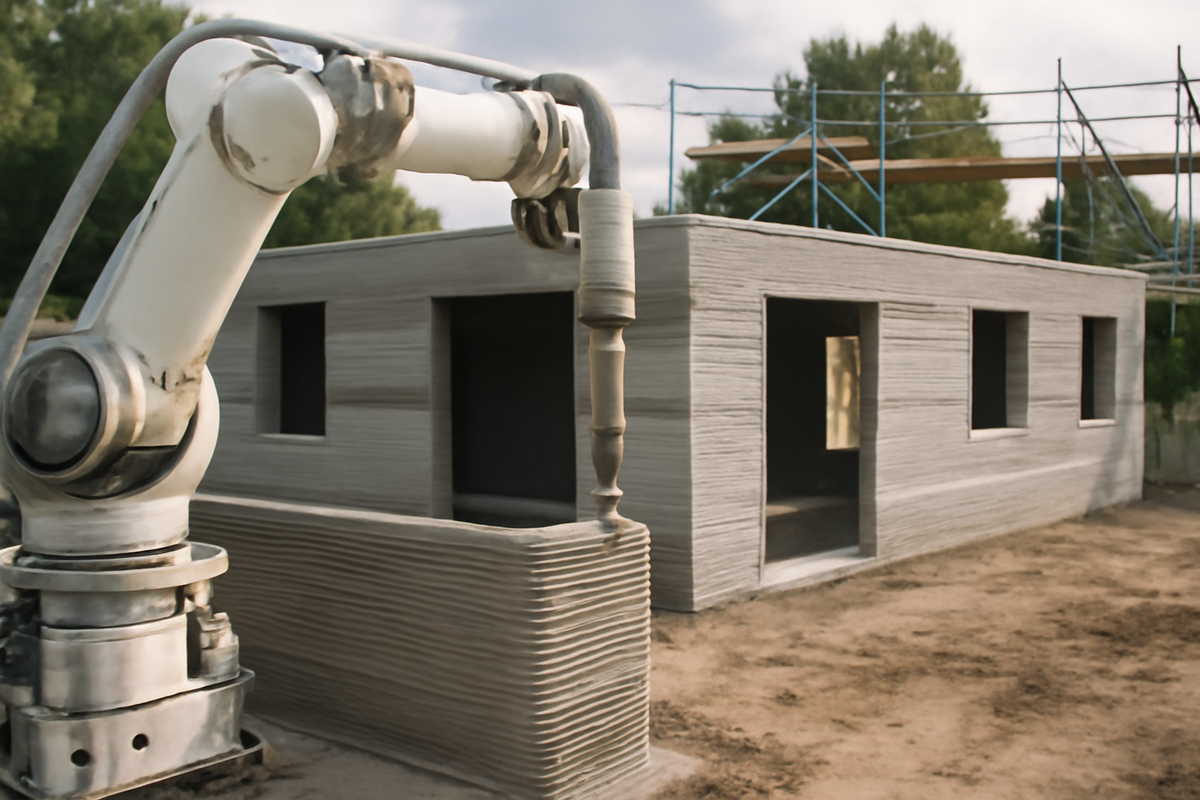
The first thing you notice isn’t the machine. It’s the sound—low, steady, like a giant metal bee humming to itself. The second thing is that there are no walls, no roof, no windows—just a bare concrete slab in an open lot and a few neatly stacked coils of a strange, mortar-like material. The third thing you notice is the time on your watch.
7:03 a.m.
By tomorrow morning, if all goes according to plan, this empty rectangle of foundation will be a fully enclosed, 200-square-meter home—printed, layer by layer, by a robot that doesn’t get tired, doesn’t take coffee breaks, and doesn’t complain about the weather. In a world where a two-bedroom apartment can cost more than most people’s yearly income, that promise lands somewhere between science fiction and a quiet, radical hope.
The Robot That Draws in Concrete
The robot itself isn’t what you’d picture if you’ve grown up on movies about humanoid house-building androids. There are no arms or legs, no expressive eyes, no chrome-plated fingers delicately placing bricks. Instead, it looks like a cross between a construction crane and an oversized desktop 3D printer: a gantry system on rails, with a thick hose feeding into a nozzle that glides back and forth with a slow, deliberate grace.
When the process starts, it’s oddly hypnotic. The nozzle hovers a few centimeters above the foundation and begins to trace a line. Out of its mouth spills a smooth, viscous mixture—a special concrete-like “ink”—that settles and firms just fast enough to hold its shape. The robot completes one loop around the perimeter, then rises a small fraction of an inch and traces the same path again, stacking a second layer, then a third.
Within minutes, you can see the ghost of a floor plan taking shape: curving walls that outline bedrooms, bathrooms, and hallways; thicker sections where future plumbing and wiring will pass; arcs where someone, someday soon, might place a couch or a table. It’s like watching a house grow out of the ground in slow motion, except “slow” is relative.
At its full pace, this system can lay down meters of wall every minute. Over the next 24 hours—barring interruptions—it will extrude all the structural walls of a single-story, 200 m² home: that’s about the size of a generous family house with multiple bedrooms, an open kitchen and living area, and even a shaded outdoor patio. Traditional construction might take weeks just to frame and enclose a building of this scale. Here, the bones of a house appear while you stand there sipping coffee.
The Smell of Wet Concrete and the Weight of a Crisis
The air around the site smells faintly of wet stone and fresh earth, dusted with that chalky tang you get near cement mixers. But the scene feels strangely peaceful—no shouting, no clanging rebar, no thunder of hammer-on-nail. A small team of technicians stands by, watching measurements on tablets, checking mix consistency, and occasionally stepping in to smooth a corner or adjust a sensor. Mostly, though, they let the machine work.
Behind this calm, there’s an invisible storm: the global housing crisis. Across continents, entire generations are being priced out of homeownership. In rapidly growing cities, populations balloon faster than developers can pour foundations. In some places, families spend years on waiting lists for what amounts to little more than a room with a door and a roof.
Every home built the old-fashioned way travels a familiar, labor-intensive path: land, permits, architects, contractors, materials, delays, cost overruns, weather setbacks, human fatigue. It’s no mystery why houses are expensive. They take time, skill, and lots of hands—hands that are in short supply in many regions where construction labor is aging or scarce.
So the idea that a robot might build a robust, liveable home in a single day feels like someone has reached into the tangled knot of the housing crisis and yanked on a loose thread that actually moves something.
The 24-Hour House, Step by Step
Of course, “24 hours” doesn’t mean you drive past an empty field one morning and return the next day to find a fully furnished, ready-to-move-in dream home, curtains and all. The magic sits mostly in the structural shell—the hardest, heaviest, and historically slowest part of the process.
Before the robot ever rolls onto the site, a foundation is poured and cured, just as with conventional building. The design team feeds a digital model of the house into the printer’s control system. That model doesn’t just describe where the walls go; it encodes their thickness, the precise curves and angles, the positions of door and window openings, and even built-in cavities for insulation, pipes, and wiring.
Once printing begins, the steps unfold like a quiet choreography:
- The robot extrudes the structural walls layer by layer, following the digital blueprint.
- Certain zones are printed with hollow channels so electricians and plumbers can later “thread” their systems into the finished shell.
- Openings where windows and doors will sit are carefully shaped and reinforced as the layers climb upward.
- In some systems, even basic conduits or junction boxes are inserted during printing, blending manual precision with robotic speed.
By the time the nozzle clicks off and the gantry lifts away, what’s left is a full-height, continuous set of curved and straight walls—solid, weight-bearing, and ready to be topped with a conventional roof system or a prefabricated modular roof that can be craned into place afterward.
Finishing the home—installing wiring and plumbing, adding windows and doors, fitting floors, cabinets, and fixtures—still takes days or weeks. But the most time-consuming phase, the creation of the structural shell, collapses from months to hours.
The Numbers, Up Close
Seen from a distance, the promise sounds bold but abstract. It becomes more real when you lay the numbers side by side. Consider this simplified comparison for a 200 m² single-story home:
| Aspect | Traditional Build | Robotic / 3D-Printed Shell |
|---|---|---|
| Structural shell time | 3–8 weeks | ~24 hours |
| On-site workers needed | 10–30 people at peak | 3–6 technicians |
| Material usage efficiency | Higher waste (offcuts, breakage) | Highly optimized, minimal waste |
| Design flexibility | Straight walls easiest; curves cost more | Curves and organic shapes nearly “free” |
| Labor conditions | Physically demanding, weather-exposed | More technical oversight, less heavy lifting |
These figures can vary by region and technology, but the pattern holds: time and labor shrink dramatically, while flexibility and efficiency expand.
What It’s Like Inside a Printed House
You step through the rough opening that will soon hold a front door, and the smell of curing material grows richer, almost earthy. The walls are unmistakably different. Instead of flat plasterboard spanning wooden studs, the surfaces curve gently, with visible, stacked ridges where each layer of printed material settled on the one below it. Some homeowners will later sand and plaster those lines away; others might choose to leave them exposed, like the growth rings of a tree, a quiet reminder that their walls were drawn rather than stacked.
Walk into the main living area and you feel the difference in acoustics. Thick printed walls tend to absorb and soften sound, giving the space a hushed, cave-like quality. There’s a coolness to the interior too; many printable concrete blends have high thermal mass, meaning they can absorb heat during the day and release it slowly at night, smoothing out temperature swings. In hot climates, that could be the difference between a stifling interior and a comfortable one, with less reliance on air conditioning.
Look closer and you see small gaps reserved for future services: a vertical channel where pipes will run, a niche where an electrical box will nestle, a reinforced lintel above where a large window will invite in morning light. This is not a crude shell hastily extruded from a generic tube. It’s a precisely scripted structure, each line and layer anticipating how the house will be lived in, powered, and maintained.
Not every surface is curved. In fact, part of the beauty of this method is its ability to mix straight and flowing lines with equal ease. Want a gentle sweeping arc around your kitchen island? No problem. Prefer a classic rectangular bedroom? Just as easy. Where traditional construction punishes complexity with higher costs and painstaking craftsmanship, robotic printing treats complexity as a line of code—one more curve in a digital drawing.
Promise and Unease on the Building Site
For the workers standing around this quietly humming machine, the emotions can be complicated. On the one hand, there’s awe. People who’ve spent years or decades on construction sites know how long it usually takes to raise a wall, to get a room to feel like a room. Watching those boundaries appear in hours touches something almost childlike: that feeling of building sandcastles or forts, only now the sandcastle will one day have a kitchen and a mortgage.
On the other hand, there’s an unease that hangs just below the excitement. If a handful of technicians can do the same work once done by dozens of laborers, what happens to the rest? Does this new efficiency mean fewer jobs, or different jobs?
Some experts see a path where the trade doesn’t disappear—it evolves. Instead of hauling blocks and mixing mortar under the sun, future builders might specialize in operating printers, maintaining equipment, calibrating materials, and finishing robotic shells with human skill. The job becomes less about brute force and more about trained precision. But transitions like that are rarely smooth or evenly distributed.
Zoom out, though, and another truth emerges. In much of the world, the housing gap isn’t a matter of builders being out-competed by machines; it’s about demand vastly outstripping what human crews, already stretched thin, can physically supply. There are entire regions where the number of homes urgently needed for low-income families, refugees, and climate-displaced communities is so large that even if everyone who wanted a construction job got one, they still couldn’t build fast enough.
In that light, robotic construction looks less like a rival and more like a reinforcement—a way to multiply the impact of the people who are already there, already working, already trying to put roofs over human heads faster than the next storm or rent hike can tear them away.
From Prototype to Neighborhood
The home growing in front of you is, in many ways, a demonstration. A proof that the schedules on engineering slides can survive the messy chaos of a real construction site, with its unexpected rain showers, clogged pumps, and twitchy sensors. But spin the camera forward a few years and you can imagine entire neighborhoods guided by variations of the same robotic choreography.
Instead of building one house at a time, what if a series of printers worked in parallel, laying down the shells of ten, twenty, fifty homes in a coordinated march? Streets could curve with the land instead of fighting it. Houses could be arranged to catch prevailing breezes, tuck into shade, or cradle shared courtyards and gardens. Each structure could be slightly different—tuned to its occupants, its microclimate, its local traditions—without exploding construction costs.
For disaster relief, the implications are immediate and visceral. After a hurricane, flood, or earthquake, when thousands are suddenly without shelter, relief organizations often race to deploy temporary solutions: tents, trailers, modular boxes that are quick to ship but not built to last. A mobile fleet of construction robots, supplied with locally sourced materials, could offer something else: durable, permanent homes erected quickly enough to matter in the chaotic weeks after a disaster, not years later.
Of course, technology alone won’t unlock that future. Policy, land rights, financing, training, and community trust are the gears that either mesh with innovation or grind it down. But the core act—the capacity to print a safe, sturdy home in a day—is no longer a fantasy. It’s already been done, again and again, in pilot projects from suburban fringes to remote villages.
What Still Stands in the Way
For all its promise, robotic homebuilding is far from a push-button miracle. Walk around the printed shell and you’ll see small reminders of the challenges still to be solved.
There’s the mix itself: a proprietary blend of cements, aggregates, and additives that must be tuned for each climate and use case. Print too fast, and the lower layers might slump. Print too slow, and the layers might not bond properly. Temperature and humidity can nudge the chemistry in fickle ways. Engineers are still learning how to make these recipes cheaper, greener, and more forgiving.
There’s regulation. Building codes in many regions were written with bricks, timber, and steel in mind, not extruded layers of printable mortar. Inspectors and permitting offices have to rewrite entire sections of their guidelines, deciding what counts as “safe” when the rules didn’t anticipate a robot drawing the walls.
There’s the matter of cost. While the shell itself may be cheaper than a conventional counterpart, especially at scale, the machines are expensive and specialized. Early projects may concentrate in places where developers, governments, or nonprofits can afford to experiment—and absorb the financial risk of the unexpected.
And then there’s acceptance. Will people want to live in a house printed by a robot? For some, the idea sparks curiosity and delight. For others, “robot-built” sounds cold, impersonal, or untested. Yet, if you’ve ever lived behind standard drywall, nailed to studs in a hurry by a rushed contractor, you know that human-made doesn’t always mean lovingly crafted.
As more printed homes are occupied, weathered, and lived in—as photos emerge not of machines on bare foundations but of kids doing homework beneath curved ceilings and grandparents stirring soup in printed kitchens—the emotional distance may close. The memory of how the walls were formed might fade, replaced by the more intimate concerns of any home: is it warm, safe, welcoming? Does sunlight land where you like to read? Does rain stay outside where it belongs?
A Different Kind of Blueprint
For now, the most powerful shift this technology offers might be conceptual. The 24-hour home suggests that housing, at least at its structural core, need not be as slow, brittle, and inflexible as we’ve long accepted. It hints at a future in which designing and building shelter is more like composing a piece of music on a laptop than carving it from a mountain with hand tools.
Imagine a library of open, adaptable digital house plans—each one designed for a specific climate, cultural tradition, or income bracket. Communities could browse, tweak, and remix them before printing. A family could adjust the shape of their living room or add a shaded porch with a few clicks, then watch that decision turn into walls the very next day.
In that world, the word “blueprint” takes on a new meaning. It stops being a final, sacred document pinned to a job site wall and becomes something more fluid, participatory, and alive—shaped by the people who will actually live inside its lines.
Standing in Tomorrow’s Living Room
By evening, the house has shoulders. Waist-high walls have grown to chest height, then eye level, then just above your head. The outlines of rooms are no longer theoretical; you can feel them in the way sound moves as you walk, in the shadows pulling long shapes across the floor as the sun drops. The robot’s hum continues into the night, lights mounted on its frame bathing the site in a pale, workmanlike glow.
Somewhere between one layer and the next, a quiet threshold is crossed. This is no longer a demonstration of a machine’s capability. It is a place. You step into one of the rooms—later someone will call it a bedroom, maybe paint its walls blue or yellow—and you stand there for a moment in the unfinished half-light, surrounded by fresh, ridged curves still drying and hardening.
You think about all the invisible stories this technology might touch if it scales: the young couple finally affording a home in a city that keeps drifting out of reach; the family rebuilding faster after a storm than the headlines can move on; the elderly woman who doesn’t have to leave her neighborhood because a small, efficient printed unit slipped gracefully onto a vacant lot nearby.
At some point, the robot pauses, then stops. The last layer finishes with a soft, final exhale. The nozzle lifts away. The hum fades, leaving only the crickets and the distant sounds of a city still wrapped in its own, slower methods of becoming.
Time on your watch: a little past 7 a.m., one full day later.
Where there was nothing but a flat slab yesterday, there now stands the solid, quiet skeleton of a home. Smooth arcs and straight spans. Doorways and window openings. A canvas waiting for roof beams, glass, wiring, furniture, and, eventually, life.
It is not perfect. It is not a universal answer to the tangled, human roots of the housing crisis. But it is a beginning—a reminder that our tools for shaping shelter can change as dramatically as our phones and cars have. And if a robot can sketch a safe, sturdy 200 m² home in 24 hours, then perhaps the story we tell ourselves about what’s possible in housing is due for a rewrite too.
Frequently Asked Questions
Are robot-built 3D-printed homes safe and durable?
Yes, when designed and built to code, printed homes can be as safe and durable as conventional ones. The printable mixes are engineered for strength and tested for load-bearing performance, fire resistance, and long-term durability, similar to traditional concrete.
Does a robot really build the entire house in 24 hours?
The robot typically completes the structural shell—the walls and main geometry—within about 24 hours of continuous printing. Other tasks such as roofing, plumbing, wiring, windows, and interior finishes still require additional days or weeks.
Are these homes cheaper than traditional houses?
Costs vary by region, but printing the shell often reduces labor and material waste, which can lower construction costs, especially at scale. However, the cost of the printer and specialized materials can offset some savings in early projects.
Can I customize the design of a printed home?
Yes. One of the strengths of robotic construction is design flexibility. Curves, non-standard layouts, and unique room shapes are easier to implement digitally and often cost far less than in traditional building.
What about jobs for human construction workers?
Robotic building changes the nature of construction work rather than simply eliminating it. Many roles shift toward equipment operation, maintenance, digital design, site preparation, and finishing trades. With thoughtful policies and training, it can create new technical opportunities while helping address housing shortages.

Hello, I’m Mathew, and I write articles about useful Home Tricks: simple solutions, saving time and useful for every day.




