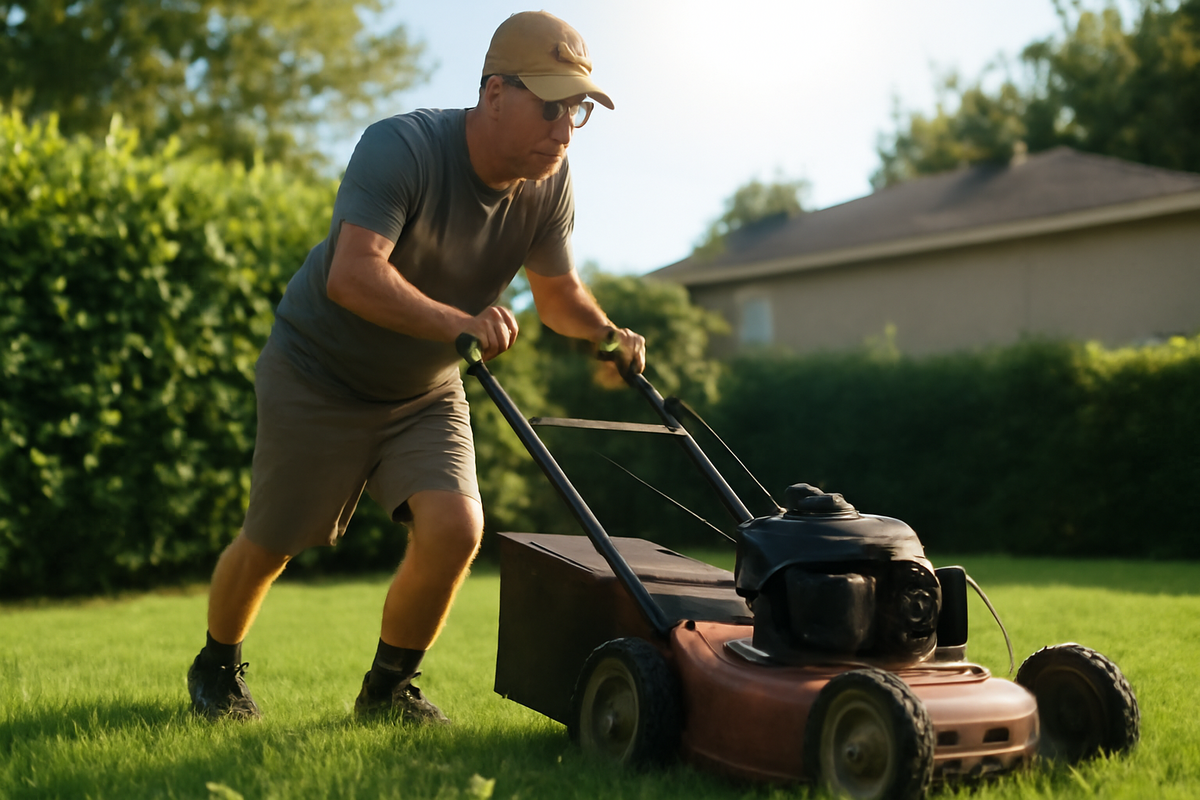
The first thing you notice is the silence. It’s a bright, white noon in early summer, the kind of day when the air quivers over tiled rooftops and the shadow of a single leaf looks sharp enough to cut. A blackbird whistles from the hedge. Somewhere, a dog is snoring under a garden table. And what you don’t hear—what you’re suddenly very aware you don’t hear—is the familiar, teeth‑rattling whine of a lawnmower.
The Day the Lawns Went Quiet
Across 24 departments, from sleepy villages to sprawling commuter suburbs, a new rule has slipped into daily life with all the subtlety of a drawn curtain: no mowing between noon and 4 p.m. The logic is simple enough on paper—protect workers, protect neighbors, protect the fragile air itself during the hottest, dirtiest hours of the day. But rules don’t live on paper. They live in people’s gardens, in their habits, in that thin edge between personal freedom and shared responsibility.
At first, it hit like a rumor. A neighbor waving a printed notice over the hedge: “Have you seen this? Apparently, we’re not allowed to mow at lunchtime anymore.” A line on a town hall bulletin: “To reduce heat exposure, air pollution, and noise disturbance, the use of lawnmowers and similar motorized garden equipment is prohibited from 12:00 to 16:00.” In some places, the regulation came wrapped in a heatwave decree; in others, it marched in with broader environmental policies aimed at noise and emissions.
Officially, the noon‑to‑four window is now sacred ground for stillness. No roaring engines. No buzzing trimmers. No leaf blowers sending dust devils down the street. For some, it feels like a small revolution in how summer sounds. For others, it lands like a locked gate on the only free hours they have.
Why Noon Became Off‑Limits
To understand this midday ban, you have to stand in the heat for a moment—really stand in it. Picture a gardener in a fluorescent vest, pushing a heavy mower over an endless green slope outside a municipal building. The sun is directly overhead, bouncing off every reflective surface, turning each breath into something thick and unwelcome. The machine spits out warm air and fumes; the handle vibrates through plastic gloves. The noise is so constant it stops being sound and becomes a kind of pressure inside the skull.
In recent years, summer in many of these departments has shifted from “pleasantly hot” to “hazardous.” Heatwaves that were once rare are now seasonal landmarks. Hospitals know the pattern: afternoon admissions spike with heat exhaustion, dehydration, respiratory problems. Outdoor workers—landscapers, grounds crews, municipal workers—are on the front line of that invisible onslaught.
The noon–4 p.m. mowing ban is, fundamentally, a public health measure. It aims to:
- Limit worker exposure to the most intense heat of the day.
- Reduce the concentration of exhaust fumes during peak temperatures, when air quality is already strained.
- Cut down on the relentless noise that fills residential areas exactly when many people are trying to rest or stay cool behind closed shutters.
There’s another layer, too. Heat doesn’t just make people suffer; it changes how pollution behaves. Hotter air can trap ground‑level ozone and fine particles, creating a kind of invisible smog that clinics feel long before most of us see it. Banning mowing during that window is a small but concrete way to dial down one of the many knobs turning the air dirty.
The New Midday Quiet: Blessing or Burden?
Walk through a suburb at one in the afternoon now and the difference is subtle but profound. You might hear the clink of cutlery from a shaded terrace, the lazy squeak of a swing, an ice cube chiming in a glass. But the metallic snarl of an engine? Absent. The ban has turned noon into a protected pause, a kind of civic siesta—at least in theory.
For some residents, it’s an immediate relief. Night‑shift workers can finally try to sleep through the day without being jolted awake by a mower passing directly under their window. Parents of toddlers, those perpetual hostages to the afternoon nap, quietly celebrate. People working from home find their video calls aren’t constantly ambushed by mechanical roars from three different directions.
Others are less charmed. Take, for example, the weekend gardener with a full‑time job. They leave the house at eight, return at six, and by then the air is thick with evening obligations—dinners, homework, the slow gravitational pull of the sofa. Noon on Saturday has always been the sacred hour of “I’ll just quickly do the lawn.” Suddenly, that ritual is illegal.
Then there are the professionals whose entire business model used to depend on the wide stretch of usable daylight. “We used to start at 8:30 and go straight through to 5:30,” says a landscaper in one affected department, wiping sweat with the back of his hand. “Now we have to stop dead in the middle and pick up again later. We lose time. The logistics are a nightmare.”
For them, the silence comes with a price tag. Routes have to be reorganized. Crews start earlier or push later into the evening. Shorter days mean more days spent on the same contracts—or higher prices passed on to the clients.
Who Wins, Who Loses? A Snapshot
Look at it from a distance, and the impacts of this rule begin to sort themselves into patterns—some predictable, some surprising. Here’s a simplified snapshot of how different groups are feeling the change:
| Group | How the Noon–4 p.m. Ban Affects Them |
|---|---|
| Professional landscapers & grounds crews | Must reorganize schedules, compress work into cooler hours, may face reduced productivity and higher operating costs. |
| Weekend & after‑work gardeners | Lose a convenient midday slot, may have to mow very early or closer to evening, sometimes clashing with local noise rules. |
| Shift workers, home workers, families with small children | Benefit from quieter afternoons, fewer sleep disruptions, and less intrusive noise while resting or working. |
| Elderly & vulnerable to heat | Reduced engine fumes and noise during hottest hours may ease breathing and stress, especially in dense neighborhoods. |
| Local wildlife | Enjoys longer periods of undisturbed feeding and nesting; fewer nests and insect habitats destroyed at peak heat. |
On a phone screen, this might read like a tidy little chart of winners and losers. On the ground, it’s much messier. People don’t fall neatly into categories; the same person can be both a noise‑sensitive remote worker and the weekend mower trying to squeeze everything into the margins of the day.
Mowing, Heat, and the Wild Life Between the Blades
Hidden inside this story about rules and routines is a quieter character: the lawn itself, and the life that moves through it. Behind the hum of engines lies a decades‑long obsession with short, uniform grass—a kind of suburban carpet that leaves very little space for anything wild, or unexpected, or inconveniently tall.
When mowing gets restricted—by weather, by policy, by habit—grass does something radical: it grows. It shoots up seedheads. Clover spreads low and white. Dandelions raise their yellow disks. The tidy green monologue of the lawn becomes a polyglot of species and textures. To the bees and butterflies and beetles, it’s like someone has finally opened the buffet.
The noon ban doesn’t automatically mean lawns are left longer, but it nudges in that direction. It compresses the window of possible mowing time, which in practice means some lawns get a little shaggier between cuts. For insects, that’s not a bad thing. For ground‑nesting birds and small mammals, fewer midday machines mean fewer sudden catastrophes rolling through their world in the hottest part of the day.
There’s also a subtle climatic twist. Taller grass shades the soil, helping it hold onto moisture longer. In a patchwork of small gardens, those pockets of cooler, damp ground can make a difference—less reflected heat, fewer baked‑hard surfaces radiating warmth back at the sky. Multiply that across thousands of households, and you begin to feel how micro‑decisions stack up into macro effects.
Some people, staring out at the slightly messier lawn their new schedule has forced upon them, are starting to reinterpret what “neat” looks like. Maybe the clover is acceptable. Maybe a small wild corner in the back isn’t a moral failing, but a contribution. The rule isn’t designed as a biodiversity measure, but it might accidentally open the door to more relaxed, nature‑friendly gardens.
When the Rule Collides With Real Life
Yet policy, like a poorly timed mower, can easily catch people in its blades. For single parents juggling work, childcare, and household tasks, the neatly framed “noon to four” can feel like an uninvited complication. Imagine someone whose only sliver of free time falls during a lunch break at home: grab a sandwich, push the mower for twenty minutes, done. Suddenly, that stopgap strategy is off‑limits.
Or think of the tiny village where the communal green has always been mowed at midday by a retired volunteer who likes to “get it done while the sun is high.” The new rule doesn’t care about tradition; it sees only emissions, decibels, and degrees Celsius. That volunteer now has to adjust or step back, and the green stretches a little wilder at the edges.
There’s frustration, yes, but also negotiation. In many places, residents are discovering that the letter of the rule is firm, but the spirit allows conversation. Some local councils are offering advice rather than fines at first: explaining risks, suggesting early morning or late‑afternoon slots, recommending electric mowers over gas‑powered beasts. Gardening businesses are experimenting with lighter tools, shaded rest periods, water breaks—workarounds that accept the logic of the ban while trying to preserve livelihoods.
In the background, there’s a faint generational crackle. Younger homeowners, more likely to have known life under the looming curve of climate graphs, often shrug and say, “It makes sense.” Older residents sometimes bristle at the idea of yet another rule pinning down what they can’t do in their own backyard. But these lines aren’t strict; climate anxiety and fatigue cross age brackets in unpredictable ways.
Adapting: From Annoyance to New Rituals
Over time, resistance has a way of softening into habit. Lifestyles bend; new rituals emerge. A decade ago, the idea of entire neighborhoods switching to early‑morning grocery runs to avoid the heat might have sounded absurd. Now, it’s common. The mowing ban is pushing a similar shift, especially in the height of summer.
In one cul‑de‑sac, a kind of unspoken pact has formed. On Saturday mornings, mowers cough to life one by one right after eight. Doors open, neighbors wave, someone jokes over the fence about “our collective mowing hour.” By ten, the noise fades. People retreat to their cool interiors or stretch out under parasols, the job done before the day turns harsh.
Elsewhere, electric mowers—lighter, quieter, sometimes with battery packs that look suspiciously like props from a sci‑fi film—are gliding across small lawns at seven in the evening, when the sun is low and the birds are winding down. Robotic mowers trace slow, methodical paths at dawn and dusk, their soft whirring almost indistinguishable from the rustle of leaves.
For some, the rule has sparked a deeper question: how much lawn do we actually need? Shrinking turf to make room for shrubs, vegetable beds, or wildflower patches has a practical appeal now. Less lawn equals less mowing equals fewer scheduling headaches. Suddenly, ecological gardening—once seen as a niche passion—is getting a quiet nudge from a heatwave policy.
Is This a Glimpse of the Future?
Laws are rarely about just one thing. On the surface, this is a story about grass, machines, and the clock. Underneath, it’s part of a broader, uneasy recognition: the rules of daily life are being rewritten by a climate that doesn’t care about our routines. What was once ordinary—mowing at noon under a bright blue sky—now comes with hidden costs we can’t ignore.
The 24 departments enforcing this rule may not remain alone. As summers grow tougher, more regions are likely to borrow similar measures, tweaking the hours, broadening the list of banned activities, or tying them to official heat alerts. What starts as a temporary response can easily harden into the new normal.
Some will see only the restrictions. Others will notice what slips in to fill the gaps. More quiet. Slightly shaggier lawns. A few more insects zigzagging above the clover. A child napping peacefully at one in the afternoon without a mower screaming under the window. A gardener, once chained to the midday slot, discovering that an early‑morning hour in the cool light feels less like a chore and more like a gift.
Change is often experienced first as inconvenience and only later as adaptation. The noon‑to‑four ban is no exception. It collides with habit, challenges entitlement, rearranges work, and demands creativity. But it also asks a question that is growing louder every summer: in a world that is heating up, what are we willing to do differently to keep each other safe—and what unexpected, maybe even beautiful, things might grow in the space those changes create?
Frequently Asked Questions
In which departments does the noon–4 p.m. mowing ban apply?
The rule currently applies in 24 departments designated by local or regional authorities. The exact list can vary over time, especially if the measure is tied to heatwaves or air‑quality alerts. Residents should check with their municipality or departmental prefecture for the most up‑to‑date information.
What types of equipment are affected by the ban?
Typically, the rule covers motorized lawn and garden equipment, including gasoline and electric lawnmowers, brush cutters, hedge trimmers, and leaf blowers. Manual tools such as hand shears and push reel mowers are usually exempt, but local regulations may specify the details.
Does the ban apply every day or only during heatwaves?
In some departments, the restriction is permanent during the warm season; in others, it is activated only during official heatwave or pollution alerts. The exact timing depends on local policy. Check local bylaws or public notices to see when the rule is in effect.
Are there penalties for mowing during restricted hours?
Yes, there can be fines for violating the time restrictions, especially after an initial warning phase. Enforcement tends to focus on repeat or blatant offenders. Authorities may prioritize education first, but the rule does carry legal weight where it has been formally adopted.
How can professional gardeners adapt to the new schedule?
Many professionals are shifting work to earlier mornings and later afternoons, rotating tasks so more strenuous or noisy work happens during cooler hours, and investing in lighter, electric tools. Some are also encouraging clients to reduce lawn surface or accept slightly longer grass to ease scheduling constraints.
What if my only free time to mow is around noon?
If your schedule is tight, consider breaking mowing into shorter sessions on different days, using a manual mower that may not fall under the ban, or adjusting other chores to free up an early‑morning or early‑evening slot. In some cases, neighbors collaborate—sharing tools or alternating mowing tasks—to make better use of the allowed hours.
Does this rule really help the environment?
By itself, the ban is a modest measure. It reduces noise during sensitive hours, limits engine emissions when air quality is often at its worst, and indirectly encourages less frequent mowing and more diverse, resilient gardens. It’s not a solution to climate change, but it is one piece in a larger puzzle of adapting daily life to a warming world.

Hello, I’m Mathew, and I write articles about useful Home Tricks: simple solutions, saving time and useful for every day.