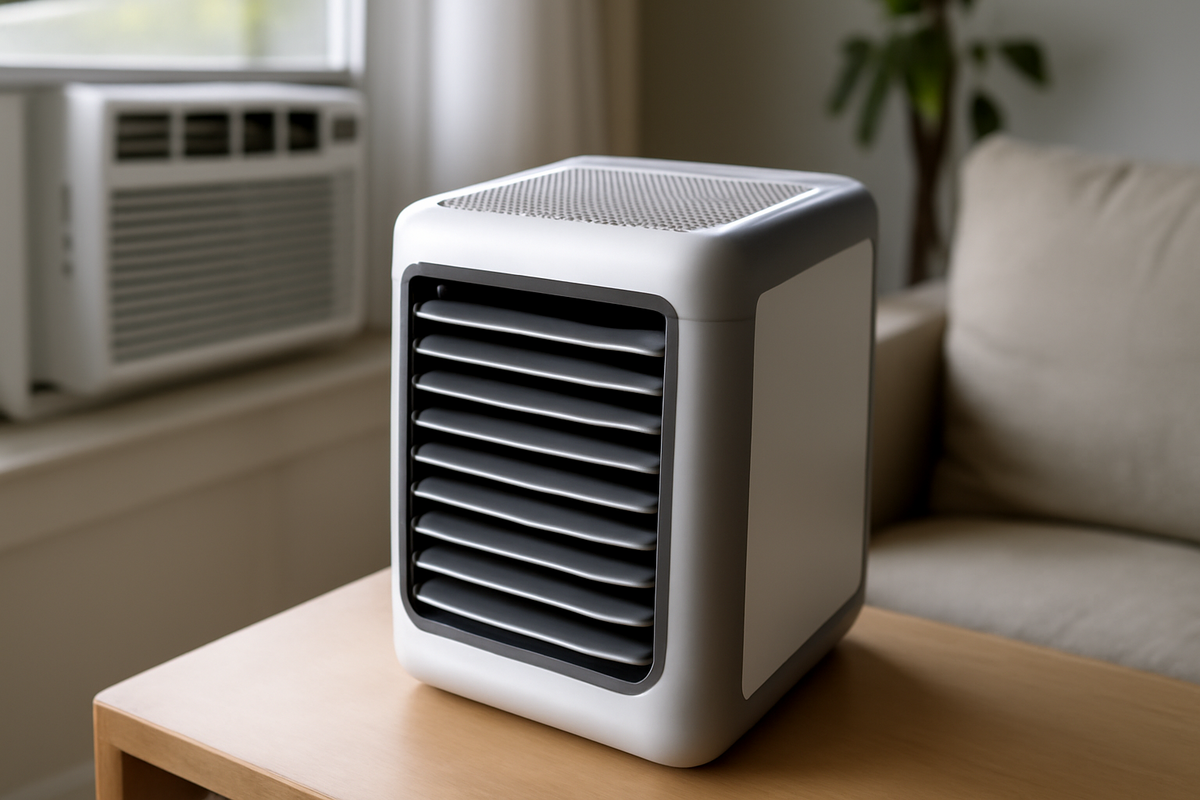
The first thing you notice is the silence. On a day when air shimmers above asphalt and heat pushes against the windows like a living thing, the room should sound like an airplane taxiing for takeoff. But instead of the familiar thrum and wheeze of an air conditioner, there is only a gentle whisper, like someone turning the page of a book. The air is cool against your skin—cooler than you expect. You look up, half expecting to see a bulky, humming unit clinging to the wall. Nothing. Just a slim panel, unassuming and still, quietly defying the heat outside.
A New Kind of Cool
For more than a century, cooling a room has meant wrestling with a trade-off: comfort in exchange for energy. Fans can stir the air, but not change its temperature. Air conditioners, those boxy workhorses of modern life, can push a room into blissful chill—but they do it with a voracious appetite for electricity and a habit of leaking gases that are disastrous for the climate.
Now, in labs and test buildings from Singapore to Silicon Valley, another kind of cooling device is emerging—one that promises to break this trade-off in a way that feels almost like a magic trick. It looks nothing like a window AC, and it works nothing like a fan. It can be built into ceilings, walls, or even windows. It uses no loud compressor, no chemical refrigerants, and in early tests, it uses far less energy than traditional AC while delivering the same (and sometimes better) comfort.
The secret is not a single invention, but a quiet revolution in how we think about heat: how it moves, how we feel it, and how to persuade it to go…somewhere else.
The Hidden Enemy Isn’t Just Hot Air
Stand on a scorching sidewalk in midsummer and close your eyes. The heat you feel on your face is more than warm air—it’s radiation. Not the ominous sci-fi kind, but invisible waves of infrared energy streaming from the sun, bouncing off roads, walls, cars, and even your own body.
Traditional air conditioning doesn’t think about this radiant heat very much. It treats the room like a sealed container of air that must be chilled as a whole. The unit pulls in warm indoor air, squeezes it through a set of cold coils that contain a refrigerant, and then blasts that cooled air back into the room. It’s like trying to cool a pot of soup by endlessly scooping, chilling, and pouring it back.
The new generation of cooling devices takes a different approach: instead of obsessing over air temperature, they focus on the radiant environment—the invisible exchange of heat between your skin and everything around you. They cool the surfaces that matter, and they manage heat at a deeper level, redirecting it away from the building and even from the planet’s warming atmosphere.
The Breakthrough: Cooling by Whisper, Not Roar
One of the most promising breakthroughs goes by a name that sounds part science fiction, part minimalist design: radiative sky cooling. The idea is deceptively simple. Outer space, as it turns out, is the ultimate sink for heat—an unimaginably cold backdrop that our planet is constantly radiating energy into, especially at night. Some materials can tap into that natural highway of heat, beaming warmth away from a surface straight through the atmosphere and out into the blackness beyond.
A new kind of cooling device uses super-thin, carefully engineered materials—called photonic or nanophotonic surfaces—to do just that. These materials are crafted to reflect nearly all incoming sunlight (so they don’t heat up) while strongly emitting thermal radiation in a specific range of infrared light that passes directly through the atmosphere into space. Think of it as a one-way road for heat leaving Earth.
On a rooftop, a panel made of this material can actually become cooler than the surrounding air, even under a hot midday sun. This “self-cooling” surface can then be linked to indoor systems—a network of pipes with water, a radiant ceiling panel, or a compact wall unit—that gently siphon heat out of your room and send it outward, silently, with almost no moving parts.
In early tests, such systems have managed to reduce indoor temperatures dramatically while using a fraction of the electricity a conventional AC would devour. Some designs combine radiative cooling panels with small, high-efficiency pumps and fans. Others piggyback on existing cooling infrastructure, cutting the workload of standard AC units by half or more.
The Science You Can Feel on Your Skin
The effect on your body feels subtly different from sitting under a blasting vent. Imagine walking into a stone church on a blazing day. The air might not be ice-cold, but the walls, floor, and benches are cool. Your skin senses it instantly: your body starts shedding heat to these surfaces, and you feel relief.
These new devices borrow from that same principle, but with exquisite control. Instead of relying on thick stone, they use thin, lightweight panels that are cooled by circulating water. The water, in turn, is chilled not only by efficient heat exchangers but also by those rooftop radiative panels that continuously dump heat into the sky.
Because they’re targeting radiant comfort, these systems don’t always need to crank down the air temperature as much. A room at 27°C (80°F) with cool surrounding surfaces can feel as comfortable—or even more comfortable—than a 23°C (73°F) room cooled only by air conditioning. That difference can mean 30–60% less energy used, even before you count the power saved by eliminating loud compressors.
What you feel, in practice, is a kind of calm coolness. Your skin isn’t hit by a harsh, directional blast. The air doesn’t dry your throat. The room seems to hold an even, enveloping chill, like walking into a shaded courtyard framed by cool stone.
How It Stacks Up Against Traditional AC
Because this still sounds like sorcery to many of us raised on window units and thermostats, it helps to see the differences laid out clearly. Here’s a simple comparison of what’s happening behind the scenes.
| Feature | Traditional AC | New Radiative / Advanced Cooling Device |
|---|---|---|
| Main cooling method | Chills indoor air using a compressor and chemical refrigerant | Removes heat via cool surfaces and radiative panels that send heat to the sky |
| Energy use | High; often the largest part of a summer electricity bill | Low to very low; early systems cut energy use by 30–70% |
| Noise level | Moderate to loud (compressor and fan) | Very quiet; gentle fans or pumps only |
| Refrigerants | Uses potent greenhouse gases (though new standards are improving this) | Little or no refrigerant; mainly water and advanced surface materials |
| Comfort feel | Cold air blasts; can cause drafts and dry air | Even, radiant coolness; fewer drafts, more natural-feeling |
What the table can’t show is the subtle psychological difference. With traditional AC, comfort feels like control—a thermostat number, a rush of cold air overriding the weather. With radiative or advanced panel-based cooling, comfort feels more like alignment. The building cooperates with the sky, slipping heat out the back door of the atmosphere, operating in tune with deeper physics instead of brute force electricity.
The Moment the Future Becomes Visible
Picture a late afternoon in a dense city. Heat lingers between high-rises, trapped and recycled by glass and concrete. In most buildings, compressors throb on rooftops, radiating more heat back into the city air even as they try to cool the rooms below. This is the feedback loop we’ve accidentally built: we cool ourselves by heating the air outside, which makes the next day even worse.
Now imagine walking into a mid-rise apartment building where the roof looks slightly different—a pale, almost glowing surface of radiative panels, shimmering faintly in the infrared. Inside, the hallways are calm and cool. No window units jutting out like metal tongues. No dripping condensate splashing onto sidewalks. On the top floor, water circulates silently through slim pipes beneath ceiling panels and through a compact module in the utility closet, never needing the violence of compression, expansion, and roaring fans.
On a thermal camera, the difference is stunning. Nearby roofs show up as hot orange and yellow, storing and spewing heat into the urban air. The new roof reads as a deep, quiet blue—sending its heat elsewhere, invisibly. In a single building, you can see the old story of cooling and the new story colliding.
Beyond One Device: A New Cooling Ecosystem
What makes this breakthrough especially potent is not just the device itself, but how it plugs into a broader ecosystem of smart cooling. The most advanced setups don’t rely on one trick. They braid several together, each addressing a different piece of the heat puzzle.
Radiative panels handle the slow, steady shedding of heat to the sky. Radiant ceilings or wall panels take care of your skin-level comfort. Small, ultra-efficient fans move just enough air to keep everything feeling fresh. Smart controls watch the weather, cloud cover, and indoor conditions, deciding when to lean on the panels, when to store coolness in a water tank, and when to barely run the backup chiller.
In some climates, these systems already achieve what used to be nearly unthinkable: all-day cooling with almost no active refrigeration. In hot, dry regions, the sky is clear enough and the air dry enough that radiative cooling can handle most of the workload on its own. In more humid, tropical climates, the technology still reduces the burden on traditional cooling, slicing energy use and emissions without sacrificing comfort.
The effect ripples outward. Buildings need smaller backup AC units, or none at all. Electrical grids strain less on peak days. Neighborhoods stop accumulating quite so much waste heat. And as the materials get cheaper and easier to install, retrofits on existing buildings—schools, apartments, offices—become a realistic path, not just a futuristic fantasy.
What It Means for the Planet—and for You
Behind every warm breeze wafting from a window unit, there is a quiet, global math problem. Air conditioning already accounts for a colossal share of electricity use worldwide, and as the planet warms, demand is exploding. Millions of people who have never had AC before are buying their first units, understandably choosing survival over energy efficiency charts.
If we cool the future with the same tools we’ve used in the past, global energy use could double or triple just for air conditioning alone. That means more power plants, more emissions, more strain on aging grids—particularly in places that are already vulnerable.
This is where the new devices become more than a clever gadget. They’re a way of bending that curve. Radiative and advanced panel-based cooling systems offer a path to make indoor comfort less of a climate cost and more of a climate solution. By using less power, they lighten the load on renewable energy systems trying to keep up. By skipping or minimizing refrigerants, they avoid a category of greenhouse gases that are thousands of times more potent than carbon dioxide. And by reducing waste heat in cities, they help soften the urban heat-island effect that makes overheated neighborhoods even more unbearable.
On the personal level, the calculus is surprisingly tangible. Lower energy use means smaller bills. Quieter operation means calmer spaces—bedrooms that stay cool without the constant drone, offices where you can hear your own thoughts. Maintenance shifts from finicky refrigerant checks to simpler elements—pipes, panels, pumps—that last longer and fail less dramatically.
It doesn’t require a collapse of the old world of cooling overnight. This new generation of devices can coexist with the AC units you already know. A radiative system on the roof that assists your current air conditioner could still slash your usage dramatically. Over time, as replacements become necessary, whole buildings may switch to these hybrid or fully radiative systems, the way we once shifted from oil lamps to electric lights—one upgrade at a time.
The Quiet Revolution Overhead
Change in technology often announces itself with a gadget: a new phone, a new car, a new screen. This particular revolution is more subtle. It’s in the feeling of a room that’s cool without being aggressively cold. It’s in the absence of a roar where you expect it. It’s in the eerie experience of touching a panel under a brutal sun and finding it colder than the air around it.
Walk through a future city summer and you might not immediately see what’s different. The sidewalks will still shimmer. The buses will still radiate heat. But listen closely, and the soundscape will have shifted. Fewer rattling window units pouring hot exhaust onto the streets. Fewer bulky rooftop chillers rattling against the sky. In their place: surfaces that quietly listen to the deep cold of space, pipes that pass along coolness like a secret, and rooms that welcome you with an even, almost organic calm.
It doesn’t feel like the kind of breakthrough that demands fanfare. It feels like something more grounded: a new pact with the heat that surrounds us. Instead of fighting it with ever-louder machines, we learn—slowly, ingeniously—to redirect it. To send it upward, outward, away. To keep our living spaces livable in a warming world, without adding quite so much heat to the problem we are all now, finally, paying attention to.
In the end, this is what the new cooling device really offers: not just cooler rooms, but a cooler story. One in which comfort is no longer an enemy of the climate, but an ally of better design. One where the path from scorching sidewalk to silent, cool refuge doesn’t run through a roaring box in the window, but through the quiet physics of the sky above your head.
FAQ
How much energy can these new cooling devices actually save?
Early tests and pilot projects show energy savings ranging from about 30% up to 70% compared with conventional air conditioning, depending on climate, building design, and how the system is integrated. Even when they don’t fully replace AC, they can dramatically reduce how often and how hard traditional units need to run.
Do they work at night and on cloudy days?
Yes, though performance varies. Radiative panels work both day and night, but they are most effective under clear skies. On cloudy or very humid days, their efficiency drops, so many systems combine them with small backup chillers, water storage tanks, or high-efficiency AC to ensure steady comfort.
Can these systems be installed in existing homes and buildings?
In many cases, yes. Retrofitting can involve adding radiative panels on the roof and connecting them to indoor radiant panels or existing cooling loops. The complexity and cost depend on your current building setup, but early retrofit projects show it’s feasible for apartments, offices, and schools.
Are they safe and environmentally friendly?
These devices are generally safer and more environmentally friendly than conventional systems. They typically use water instead of large quantities of chemical refrigerants, and the advanced surface materials are solid and stable. By cutting electricity use and refrigerant leakage, they also reduce climate impact.
Will they replace traditional air conditioners completely?
In some dry, sunny climates, they might eventually handle most cooling needs on their own. In many other places, they’ll likely work alongside smaller, more efficient AC units as part of a hybrid system. The real shift is that traditional AC can move from being the main actor to a supporting role, dramatically reducing its energy and environmental footprint.

Hello, I’m Mathew, and I write articles about useful Home Tricks: simple solutions, saving time and useful for every day.