The first time I realized microcement was in trouble, I was standing barefoot in a newly finished loft, staring at a floor that looked like a storm cloud had given up and decided to live indoors. It was supposed to be flawless: smooth, sculptural, “seamless,” as the designer had promised. Instead, faint hairline cracks traced along the surface like the beginnings of a spiderweb. Near the bathroom door, the soft sheen had already worn into a dull, scuffed patch where the tenants—who had moved in only three months earlier—always kicked off their shoes. The homeowner exhaled, long and slow. “We paid a small fortune,” she said. “And it already looks… tired.”
In that quiet moment, it hit me: we might be watching the end of an era. Microcement, the darling of Instagram-perfect interiors and minimalist hotels, had climbed to the top of the design world in less than a decade. But just as fast as it rose, its limitations—high maintenance, finicky installation, uneven performance—began to show. And 2025 is the year the love affair finally cools.
Yet this isn’t a story of loss. It’s a story of what comes next—of a new material quietly stepping into the spotlight, more durable, more forgiving, and far more in tune with the way people actually live. If microcement was a fantasy, this new generation of surfaces is reality: tactile, resilient, and unexpectedly beautiful.
The End of the Microcement Fantasy
Microcement didn’t become popular by accident. It had all the traits of a design crush: thin application over almost any substrate, that continuous, stone-like appearance, and a refined industrial vibe that looked stunning in photos. It turned bathrooms into spa caves and kitchens into galleries. It made modest apartments feel like boutique hotels.
But 2025 finds homeowners more informed, a little battle-scarred, and a lot less patient with materials that demand constant care. The complaints are repeating like a chorus:
- Cracking over time, especially on subfloors that move or flex.
- Staining from coffee, red wine, or cosmetics if sealing isn’t perfect.
- Slipperiness in wet areas unless treated with extra anti-slip finishes.
- Visible wear in high-traffic zones, creating patchy shine and dull spots.
- Highly skilled application required—and expensive specialists to fix mistakes.
In quiet conversations with contractors, designers, and homeowners, a pattern emerges. Microcement hasn’t entirely failed; it has simply revealed what happens when a trend runs ahead of practicality. Designed for controlled conditions, it was dropped into the everyday chaos of children, dogs, busy kitchens, and steamy bathrooms.
And so, while design magazines still feature perfectly lit microcement bathrooms, the real conversation in 2025 is happening behind the scenes: what can give us that same calm, monolithic beauty—without the fragile ego?
The New Reign: Hybrid Mineral Surfaces Step In
Enter the new sovereign of home surfaces: hybrid mineral surfaces. They’re not as catchy a buzzword as “microcement,” but you’re about to hear a lot more about them. Imagine the look of stone, the warmth of a crafted plaster, and the toughness of advanced resins and fibers, all fused into a single, ultra-thin, high-performance coat.
These next-generation materials—often based on mineral binders (like lime and cement blends) reinforced with flexible polymers and microfibers—are designed to solve microcement’s biggest problems while preserving everything people loved about it. They still offer a seamless, slab-like appearance, but beneath that smooth skin is a formulation built for movement, moisture, and time.
Instead of depending on a brittle, ultra-thin coat that must perform perfectly in every situation, hybrid mineral surfaces embrace the reality of modern homes: shifting subfloors, sudden temperature swings, heavy furniture drags, and kids who think scooters belong indoors.
And the biggest surprise? They don’t look like a compromise. They look like an upgrade: deeper texture, more comforting underfoot, and an honesty of material that feels less “showroom” and more “lived in.”
From Laboratory to Living Room
Behind these new surfaces is a quiet marriage of craft and chemistry. Manufacturers have been experimenting with blends that don’t just harden but flex slightly, that don’t just seal but breathe, and that can be tinted, polished, or lightly textured in ways that microcement struggled with.
In a small townhouse renovation I visited in early 2025, the owners had chosen one of these hybrid mineral finishes for their entire ground floor: kitchen, living area, hallway, even a powder room. The surface flowed from room to room, a soft, warm grey with the kind of depth you get when storm clouds pass behind mountains. The difference was immediate when I stepped on it: it felt solid but not cold, smooth but not slippery. In the kitchen, a spilled splash of tomato sauce had been allowed to sit “as an experiment,” the owner confessed, half amused. It wiped away with water, leaving no trace.
“We wanted the microcement look,” she said, “but not the microcement stress.” This is the sentence you will hear again and again in 2025: people want beauty, but they want it to survive real life.
How the New Material Actually Performs Day to Day
Marketing terms can blur together, so let’s get down to how this new class of surfaces behaves in the wild—the real test that microcement failed for so many households.
- Crack resistance: Reinforced with flexible polymers and microfibers, the surface can tolerate minor structural movement far better than traditional microcement. Small shifts in subfloors are less likely to telegraph into visible cracking.
- Stain and moisture handling: The latest sealers are designed not as a brittle topcoat, but as an integrated part of the system, resisting stains from coffee, oils, soaps, and cosmetics, even in showers and kitchens.
- Slip safety: Subtle textures and matte finishes balance elegance with grip, especially in bathrooms and entryways. You can still opt for a silky finish, but designers are nudging clients toward tactile, safer surfaces.
- Repairability: One of microcement’s curses was that patch repairs often looked like scar tissue. New mineral hybrids can be feathered and blended with much better color and texture consistency, so small fixes don’t scream for attention.
- Comfort: Slightly softer underfoot than traditional cementitious finishes, they pair beautifully with underfloor heating, creating that barefoot-friendly warmth many microcement spaces never quite delivered.
The result is a surface that doesn’t need you to tiptoe around it. You can drag a chair, drop a pot, let your dog skid around a corner, without feeling as if you’ve offended a delicate artwork.
Where They Shine: Rooms and Uses
While microcement often failed the high-moisture, high-use challenge, these new materials are claiming precisely those spaces as their territory:
- Bathrooms and wet rooms: Continuous, low-joint surfaces with smart slip control and moisture resistance make them ideal for shower walls and floors.
- Kitchens: Splash zones, cooking oils, and high foot traffic are handled with comparative ease, especially when paired with a consistent maintenance routine.
- Open-plan living areas: A seamless surface visually expands space, tying living, dining, and kitchen zones together into one calm, flowing plane.
- Staircases: Once a cracking point for microcement, stairs now benefit from more flexible and adhesive formulations, with integrated nosing solutions.
- Feature walls and built-ins: Media walls, fireplace surrounds, and custom benches gain sculptural presence with subtle texture and color depth.
This is where the shift becomes obvious: we’re not just swapping one grey coating for another. We’re trading anxiety for ease.
Living With It: Texture, Light, and the Quiet Drama of Surfaces
One of the joys of these new mineral surfaces is how they play with light. Microcement was often applied flat and tight, with a somewhat uniform sheen. Hybrid surfaces, by contrast, invite a little more movement: barely there trowel marks, soft mottling, gentle tonal shifts.
In the late afternoon, when sunlight slips low across a floor finished in this material, you don’t just see a color—you see a landscape. Tiny ridges of hand-troweling catch the light like ripples on a lake. Shadows pool softly along the base of walls, uninterrupted by grout lines. It feels calm, human, and markedly less “slick.”
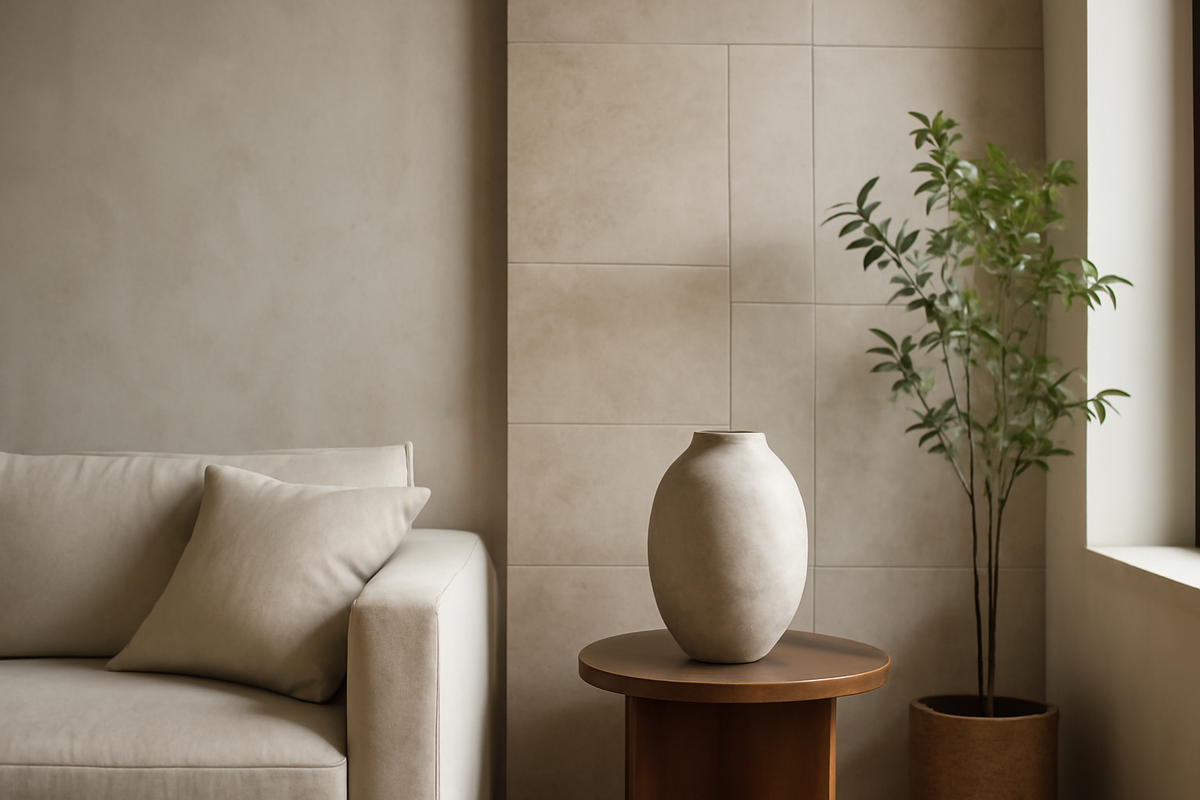
The color palette is evolving too. While the cool charcoals of the late 2010s still have their fans, 2025 is leaning into mineral warmth: clay-tinted neutrals, soft shells, mushroom beiges, stone-like greiges. These shades make a room feel less like an art gallery and more like a place to breathe.
The tactile quality may surprise you most. Run your hand along a wall and it’s not perfectly smooth; it’s very slightly velvety, like worn river stone. Your fingers catch on the tiniest undulations—subtle signals that this is a crafted surface, not a printed panel.
A Quick Side-by-Side: Microcement vs. Hybrid Mineral Surfaces
To see the shift clearly, it helps to compare them directly.
| Aspect | Microcement (Old Standard) | Hybrid Mineral Surfaces (New Generation) |
|---|---|---|
| Crack Resistance | Prone to hairline cracks on moving substrates | Enhanced flexibility and reinforcement reduce cracking |
| Stain Protection | Strongly dependent on perfect sealing; easily stained | Integrated systems and advanced sealers improve resistance |
| Slip Resistance | Can be slippery when wet unless treated further | Designed textures and matte finishes for safer footing |
| Installation Tolerance | Highly sensitive to installer skill and substrate prep | More forgiving systems with better bonding and flexibility |
| Look & Feel | Sleek, industrial, often very uniform | Softly textured, more natural and stone-like |
For homeowners, the translation is simple: fewer surprises, less babysitting, and a finish that ages gracefully instead of dramatically.
Installation: Fewer Mysteries, More Mastery
One of microcement’s quiet downfalls was how unforgiving it could be in the hands of anyone less than an expert artisan. Perfect results required near-perfect conditions: stable substrates, immaculate preparation, precise mixing, flawless timing. Any shortcut—or just bad luck with humidity and temperature—could show up later as cracks, bubbles, or peeling.
The new breed of mineral surfaces still demands skill, but they’re engineered to handle reality better. Primers, base coats, reinforcement meshes, and finishing coats are designed as part of a complete system, not a patchwork of products. This gives installers a clearer roadmap and more reliable performance.
For the homeowner, the crucial shift is transparency. Good installers now walk clients through the layers: how the substrate is stabilized, where reinforcement is placed, how many coats are applied, what kind of sealer is used, and what maintenance truly looks like. Instead of a mysterious “magic plaster” that may or may not behave, it’s a deliberate build-up of layers, each serving a purpose.
And when something does go wrong—a dropped tool that chips a corner, or a heavy impact that scars the surface—repair protocols are better tested and documented. Installers can return, blend, and re-finish small areas without ripping everything out, avoiding the heartbreak that once shadowed microcement projects.
Cost, Value, and the 2025 Mindset
Do these new materials cost more? Sometimes, yes—at least initially. But 2025 homeowners and designers are thinking in terms of lifespan rather than pure upfront savings. The question isn’t “What’s the cheapest way to get this look?” It’s “What will still feel beautiful, solid, and calm in ten years?”
In that longer view, the calculus changes. You might pay a touch more for the material and for a trained installer, but you gain durability, fewer repairs, and less risk of having to redo entire rooms. The emotional value—of not tiptoeing, not worrying that every drop of red wine is a disaster—is harder to quantify but very real.
There’s also a subtle sustainability angle. A surface that lasts longer, that resists fashion cycles and doesn’t need frequent ripping out and replacing, is inherently less wasteful. The new materials are designed not to shout “2025” but to whisper something more timeless: stone, earth, sky, shadow.
How to Choose If You’re Renovating in 2025
If you’re planning a renovation this year and wondered whether to jump on the microcement train, the timing is revealing. That train is slowing down, and a more interesting one is pulling into the station.
Here’s how to move wisely:
- Ask for specifics: Instead of saying “I want microcement,” tell your designer or contractor the feeling you want: “seamless, stone-like surfaces that handle moisture and wear.” Then ask what systems they recommend and why.
- Check the system, not just the look: Make sure the installer is using a complete, compatible system from primer to sealer. Mixing brands can undo the benefits.
- See real-life examples: Ask to visit spaces that have been lived in for at least a year. Photos right after installation hide a lot; real wear tells the truth.
- Understand maintenance: No surface is truly zero-maintenance. Learn what cleaning products to use, how often resealing is recommended, and what early signs of trouble look like.
- Be honest about your lifestyle: Have pets, kids, a love of cooking, or a tendency to drop things? Tell your installer. The right finish texture and sealer can be tailored to your reality.
Most of all, resist the urge to chase a specific trend word. Microcement had its moment in the sun—and will still be used, successfully, in controlled and well-managed projects. But the energy now is shifting toward more resilient, more forgiving, yet no less beautiful mineral surfaces.
Microcement’s reign isn’t ending in a dramatic coup. It’s stepping aside, a little sheepishly, as something wiser and more robust takes the throne. And for anyone who has ever stood on a gorgeous but delicate floor and felt a twinge of anxiety, this change feels like a deep, relieved breath.
Frequently Asked Questions
Is microcement really “over” in 2025?
It’s not disappearing overnight, but its peak hype has clearly passed. In 2025, many designers and contractors are steering clients toward newer hybrid mineral systems that offer similar aesthetics with better durability, crack resistance, and ease of maintenance.
What exactly are hybrid mineral surfaces?
They are thin-layer finishes made from mineral binders (like cement and lime blends) combined with polymers, fibers, and advanced sealers. The result is a seamless, stone-like surface that’s more flexible, more stain-resistant, and more forgiving than traditional microcement.
Can these new materials be used in showers and wet rooms?
Yes, many are specifically designed for high-moisture environments. When installed correctly as a system—on top of proper waterproofing—they perform very well on shower walls, floors, and other wet areas.
Do hybrid mineral surfaces crack like microcement?
No surface is completely immune to cracking, but these newer systems are formulated with better flexibility and reinforcement. On stable, properly prepared substrates, they are significantly less prone to hairline cracking than classic microcement.
Are they more expensive than microcement?
Costs vary by brand and region, but they can be similar or slightly higher. However, their improved performance and lifespan often make them better value over time, especially by reducing the risk of repairs or full replacement.
Can they be applied over existing tiles?
In many cases, yes. With proper cleaning, priming, and sometimes reinforcement, these systems can be installed over existing tiled floors and walls, minimizing demolition. A professional assessment is essential to confirm suitability.
What do they feel like underfoot?
They typically feel solid, smooth, and slightly warmer and softer than traditional concrete. Paired with underfloor heating, they create a particularly comfortable, barefoot-friendly surface.
How do I maintain them?
Regular sweeping or vacuuming and cleaning with gentle, pH-neutral cleaners is usually enough. Harsh abrasives and strong chemicals should be avoided. Depending on the system, a reseal every few years may be recommended for high-traffic or wet areas.
Will this new trend date my home in a few years?
The current direction is toward quieter, more timeless finishes: soft mineral tones, subtle textures, and natural light play. Done thoughtfully, these surfaces read as classic and architectural rather than tied to a specific year or trend.

Hello, I’m Mathew, and I write articles about useful Home Tricks: simple solutions, saving time and useful for every day.