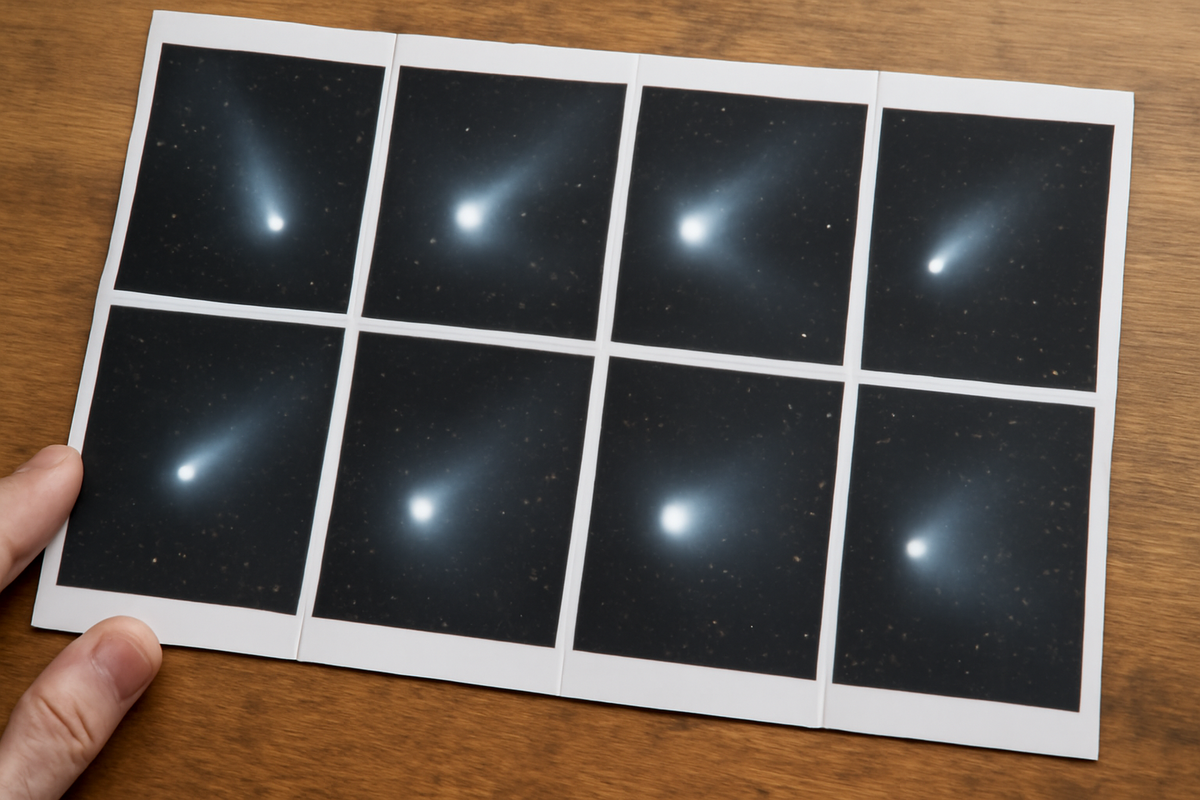
The first time the new images of interstellar comet 3I ATLAS appeared on the big monitor in the control room, nobody spoke. A few chairs rolled closer. Someone’s coffee went cold, forgotten on the edge of a console. On the screen, a ghostly, sea-green smear of light stretched out against pure black—a visitor not just from another corner of our solar system, but from another star entirely. It had no right to be here, slicing once through our planetary neighborhood and then heading back into the dark with a kind of quiet arrogance. But for a brief moment, thanks to eight watchful observatories scattered across our planet, we had it surrounded.
A Visitor With No Return Ticket
Comets, in the classic sense, are our old regulars—icy wanderers that swing around the Sun on long, stretched-out orbits like comically slow boomerangs. They return every few years, or decades, or millennia, leaving humanity to wait patiently for their encore. But 3I ATLAS is not one of those familiar performers. It’s a drifter—a piece of someone else’s star system that just happens to be cutting through our own on a one-way trajectory.
The “3I” in its name tells the story quietly. It’s only the third confirmed interstellar comet ever named by humanity, after the enigmatic ʻOumuamua (1I) and the more classic-looking 2I/Borisov. “ATLAS” comes from the survey that first spotted it—the Asteroid Terrestrial-impact Last Alert System, a network of telescopes designed to find objects that could pose a threat to Earth but which, in this case, caught something more haunting than hazardous.
What transforms this latest chapter in the story is not just that we found another interstellar wanderer. It’s that, for the first time, we’ve captured it from multiple angles in unprecedented detail, almost like a cosmic 3D photoshoot. Eight observatories—some perched on dry mountain ridges, some nestled under cold, crystal skies—turned their eyes to the same moving, fading target and stitched together a set of views that feel less like astronomy and more like biography.
Eight Eyes, One Comet
On paper, the idea sounds simple: coordinate a handful of observatories, point them all at the same thing, and collect data. In reality, it’s a high-wire act. Weather shifts. Instruments fail. Schedules compete. And 3I ATLAS, traveling tens of kilometers every second, does not slow down to accommodate anyone’s planning.
But the payoff is extraordinary. Each observatory sees the comet from a slightly different angle, under slightly different conditions. Some focus on visible light, others on infrared heat or ultraviolet glow. When you stack those views together, what emerges is not just a streak of brightness on a black background, but a textured, living object: gas expanding, dust jets curling, the subtle rotation of its nucleus implied in the changing shape of its tail.
Imagine standing at the edge of a dark field, watching a single firework rocket up into the sky. From behind you, someone films the scene. From far to your left, another camera catches the same moment. From a rooftop, a drone records the pattern from above. Later, played back together, the firework display feels richer, almost knowable. That is what these new images of 3I ATLAS do for planetary scientists. They don’t just show a comet; they show its behavior.
| Observatory | Location | Primary Wavelength | Key Contribution |
|---|---|---|---|
| Subaru Telescope | Mauna Kea, Hawaii | Optical | High-resolution structure of the coma and dust tail. |
| Very Large Telescope (VLT) | Paranal, Chile | Optical / Near-IR | Spectra revealing compositional fingerprints. |
| Gemini North | Mauna Kea, Hawaii | Near-IR | Thermal glow mapping dust grain sizes. |
| Keck Observatory | Mauna Kea, Hawaii | Optical / IR | Time-series imaging tracking rotation. |
| ESO NTT | La Silla, Chile | Optical | Wide-field images of the extended tail. |
| Pan-STARRS | Haleakalā, Hawaii | Optical | Survey images anchoring trajectory. |
| Space-based Telescope A | Earth Orbit | UV | Tracing gas jets and volatile release. |
| Space-based Telescope B | Earth Orbit | Infrared | Measuring overall dust temperature. |
The Shape of an Alien Snowball
From a distance, every comet looks similar: fuzzy head, thin tail streaming away from the Sun. But the new multi-angle images of 3I ATLAS refuse to flatten it into a stereotype. When you look at the processed frames side by side, you can almost feel the subtle quirkiness of this particular chunk of ice and rock.
In visible light, the coma—the luminous envelope around the nucleus—appears slightly lopsided, its brightness more intense on one side. That asymmetry hints at jets: narrow fans of escaping gas, erupting from active patches of the surface like vents. From one observatory’s vantage point, a jet seems to lean slightly upward. From another, it drapes sideways, the whole structure shifting angle over hours. By tracking these changes, scientists can infer the rotation of the nucleus, like watching the spinning of a distant top through its swirling dust.
Infrared images, taken at longer wavelengths, paint a different portrait. Here the comet glows faintly with its own heat—a whisper more than a shout. The dust tail becomes a thermal map: warmer inner regions close to the nucleus, cooler, fading particles stretching away. Grain size reveals itself in tone and brightness, telling us whether 3I ATLAS sheds mostly microscopic powder or larger, gritty crumbs. Those details matter, because they hint at how tightly the nucleus is packed, how fragile its crust is, and how long it has drifted through the interstellar medium before crossing our path.
Then there’s the ultraviolet perspective, a kind of X-ray of the comet’s soul. Certain gases fluoresce under solar UV light, and by mapping these emissions, scientists can reconstruct which ices are evaporating. Water, carbon monoxide, carbon dioxide—they each leave subtle signatures. Compared side by side with typical solar-system comets, 3I ATLAS looks familiar in some wavelengths and faintly foreign in others, like a person who almost—but not quite—shares your accent.
The Sound of Data in the Dark
The romance of a comet is mostly visual—the idea of a glowing traveler, the long tails scratched across the sky. But behind the beauty is an orchestra of data, humming and clicking through servers as astronomers pull out meaning from what, at first, is nothing more than speckled noise.
Long after sunrise silences each observatory dome, their machines keep working. Images are corrected for distortions, for airglow, for the twinkling interference of our own atmosphere. Software tracks the changing position of the comet against the star field, recentering, stacking, enhancing faint details. And then the real magic happens: combining all of that from different observatories, under different skies, into one consistent, physical model.
Multi-angle observations allow astronomers to build a rough 3D sense of the comet’s envelope, not unlike medical imaging reconstructing an organ from many slices. They can estimate how material is flowing off the nucleus, not just in a flat plane, but through real space—how the tail bends out of the page, how the jets tilt and twist. That, in turn, lets them test models of outgassing, spin, and internal structure.
From these images, you can almost hear the quiet struggle of the comet against sunlight: frozen molecules waking up, boiling off, carrying dust with them into the void. You can sense the tug of gravity from our Sun, curving its path but not capturing it. You can feel the patience of the telescopes, waiting for their brief window each night to add another fragment to the story.
What an Interstellar Comet Whispers About Other Suns
It’s tempting to speak about 3I ATLAS as a solitary wanderer, an eccentric loner in the vast dark. But comets like this are, in a very real sense, refugees. Somewhere, long ago, this object likely orbited another star, part of a distant system’s outer debris—a cousin to the icy Oort cloud that fringes our own Sun’s reach.
There, perhaps a passing star, a migrating giant planet, or a slow gravitational nudge over eons finally gave it enough of a kick to escape. Once cut loose, it entered the interstellar medium, a place we usually experience only through filtered starlight and radio waves. For millions or billions of years, it drifted between suns, outliving the civilizations that would one day give it a technical name and measure its orbit with mathematical precision.
When scientists examine the colors, spectra, and dust properties revealed by these multi-angle images, they’re searching for the fingerprints of that origin story. Does 3I ATLAS carry ices that condense only in particularly cold, outer reaches of a star system? Is its ratio of carbon monoxide to water different from most local comets? Are its dust grains more processed, more weathered by cosmic rays? Every difference—and every similarity—tells us something about how planet-forming disks behave around stars we may never directly visit.
In that sense, the eight observatories are doing more than characterizing a pretty visitor. They are, in a quiet, methodical way, performing archaeology on a star system light-years away, using a single lost fragment as their only artifact.
The Dance of Coordination Across Hemispheres
None of this would be possible without a level of human choreography nearly as intricate as the comet’s own gravitational ballet. Astronomers in Hawaii swap notes with counterparts in Chile and with teams running telescopes that orbit high above Earth’s atmosphere. They trade exposure plans, schedule windows, and real-time position updates. If thin cirrus clouds creep over one site, another observatory might extend its coverage to fill the gap.
There is something profoundly human about this: people scattered across continents and time zones, all looking at the same tiny moving speck and agreeing, without needing to say it aloud, that it matters. On screens, the comet is a cluster of pixels. In the mind, it’s an emissary from elsewhere—proof that our solar system is not isolated, but one whirlpool among many in a galaxy filled with loose stones and lost iceballs.
Seeing in Layers: How Multi-Angle Changes the Story
Before multi-angle imaging campaigns like this, our mental picture of interstellar objects was flat, literal. A comet passed, we took a few snapshots, measured its orbit, and watched it fade. Now, with each new data point coming in from different longitudes and latitudes, the narrative gains texture.
From one angle, 3I ATLAS seems to trail a simple fan-shaped dust tail. Shift perspective, and that fan suddenly reveals a subtle twist, a ribbon curling off the main flow. Follow the comet over several nights, and those ribbons drift, as though some invisible hand were turning the nucleus by fractions between frames. These are the kinds of details that let astronomers move from speculation to evidence: Is the nucleus elongated? Does it tumble chaotically, or spin steadily like a gyroscope? Are its active regions clustered or scattered?
The answers ripple outward. Understanding the spin and structure of 3I ATLAS, and how its material escapes, reveals how robust or fragile such interstellar castaways are. That, in turn, shapes how we think about the delivery of organic material across space, the seeding of young planetary systems, and the long-term stability of small bodies wandering between stars.
Why This Brief Encounter Matters
There is a bittersweet current running beneath all of this work. 3I ATLAS will not loop back. The orbit calculations laid over those new images are merciless: a hyperbolic trajectory, open-ended, one pass and gone. If human civilization lasts long enough, we might catalog hundreds of such objects, with their own strange chemistries and trajectories. But each one is still a rare roll of the cosmic dice.
This scarcity sharpens the experience. Every pixel wrung from a cloudy night, every spectrum squeezed from faint photons, becomes a kind of promise kept—to future scientists who will have better tools, to future storytellers who will need raw material for their myths of the sky. We may never again see this exact balance of ices, this particular spin, this exact tone of greenish glow in the coma. Once it slips back into the interstellar dark, all that remains are the images.
And yet, what images they are. When processed and composited, the multi-angle views give 3I ATLAS an almost sculptural presence. You can trace the arc of its tail as it bends under the solar wind, see the ambush point where sunlight first wakes its frozen face, sense the slow shedding of material that has been locked away since before our Sun ignited. It’s as though a stranger stepped briefly under a streetlamp, and in that instant, eight photographers captured not just their silhouette, but the texture of their coat, the line of their jaw, the direction of their gaze.
Looking Ahead: More Eyes, More Stories
The publication of these latest images is not an ending, but a rehearsal. Astronomers know that 3I ATLAS won’t be the last interstellar object to drift through our skies. Survey technology is getting sharper, faster, more all-sky. Instruments like these eight observatories—and their successors—are teaching us how to respond when the next wanderer appears: how to coordinate quickly, how to divide up the spectrum, how to carve three-dimensional, time-evolving stories out of two-dimensional light.
There’s even talk, in the quieter corridors of space agencies and research institutes, of sending spacecraft to intercept future interstellar visitors. To not just watch them from afar, but to fly alongside them, sampling dust, sniffing out gases, taking close-up images that would make today’s best data look like charcoal sketches. If that future happens, it will be built on the foundation of observations like these—on the careful, patient work of turning eight separate glimpses into one coherent, honest portrait of a visitor from another sun.
For now, though, we have this: a set of images that, when you scroll through them, feel almost like watching a time-lapse of a snowball evaporating in slow motion, far from the warmth of any home but ours. On the screen, 3I ATLAS shimmers, tail flicking, drifting, always drifting, out of our lives and back into the deep night between the stars.
Frequently Asked Questions
What is interstellar comet 3I ATLAS?
3I ATLAS is the third confirmed interstellar comet detected passing through our solar system. Unlike typical comets that orbit the Sun, it follows a hyperbolic path, indicating it originated around another star and is merely passing through before heading back into interstellar space.
Why are the new multi-angle images important?
Multi-angle images from eight observatories allow scientists to reconstruct the comet’s structure, rotation, and activity in greater detail. Different viewing angles and wavelengths reveal how gas and dust are escaping, how the tail bends in 3D, and how the comet’s properties compare with comets native to our solar system.
How do multiple observatories work together on a single object?
Teams coordinate observing schedules, share updated positions, and divide tasks across wavelengths. Ground-based telescopes in different time zones and space-based instruments complement each other, providing nearly continuous coverage and a richer, layered dataset.
What can 3I ATLAS tell us about other star systems?
By studying its composition, dust grain sizes, and outgassing behavior, scientists infer conditions in the distant system where it formed. Differences from local comets hint at how disks around other stars evolve, what kinds of ices are common, and how material is ejected into interstellar space.
Will we ever see 3I ATLAS again?
No. Its orbit is open-ended and not bound to the Sun, so it will pass through once and then leave our solar system forever. The only record we will keep are the images and measurements taken during this brief encounter.
How is 3I ATLAS different from ʻOumuamua and 2I/Borisov?
ʻOumuamua appeared more asteroid-like and showed unusual acceleration, while 2I/Borisov looked much like a typical comet. 3I ATLAS behaves more like a classic comet, with a distinct coma and tail, but its detailed composition and dust behavior provide new contrasts and comparisons among interstellar visitors.
Could a spacecraft visit an interstellar comet in the future?
In principle, yes. Several mission concepts propose rapid-response spacecraft that could rendezvous with a newly discovered interstellar object. The techniques and expectations being refined now—using multi-angle, multi-wavelength observations—will be crucial in planning such missions when the next visitor appears.

Hello, I’m Mathew, and I write articles about useful Home Tricks: simple solutions, saving time and useful for every day.