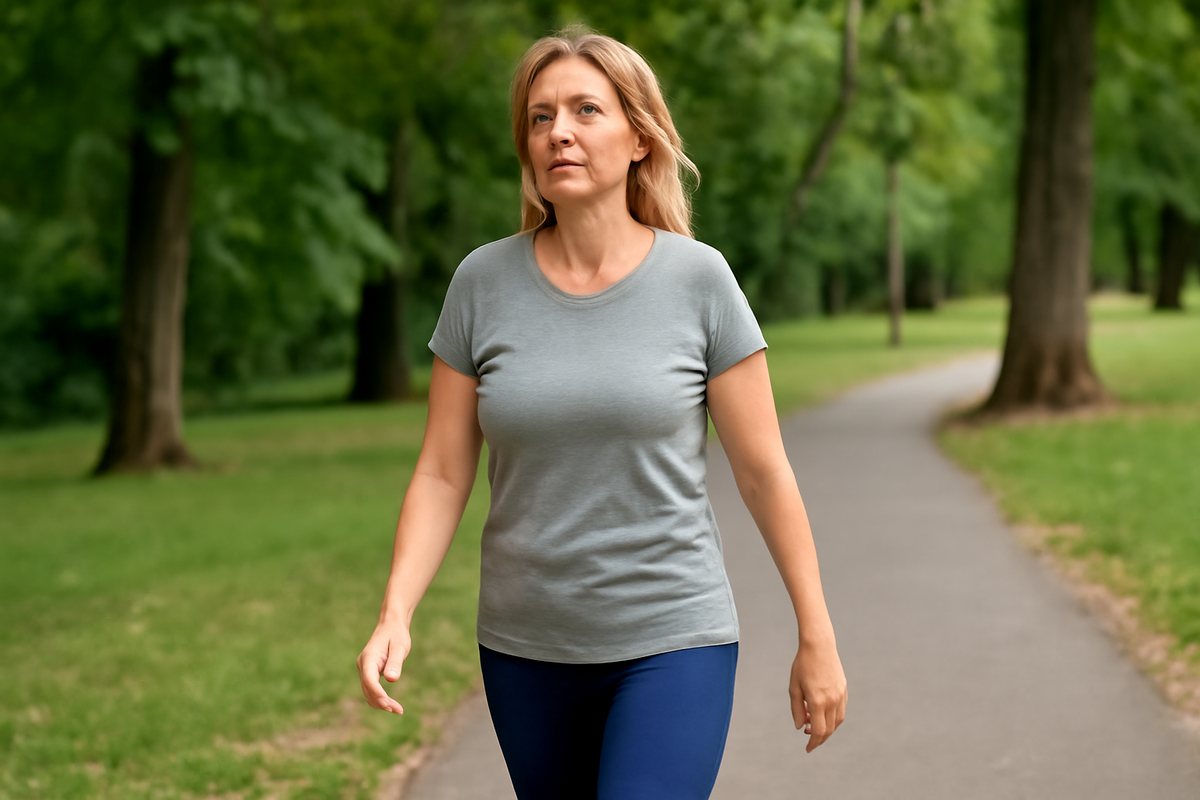
The first thing you notice is the sound of your feet. A gentle, rubber-on-concrete whisper, rhythmic and oddly comforting. It’s early—too early for traffic to be loud, too early for kids on bikes. Just the faint hum of a city waking up and the steady cadence of your own walk. Your breath rises in little puffs in the cool air. You tighten the strap of your watch, noticing your step count ticking up. “This has to be good enough,” you tell yourself. “I walk every day. That should keep me fit… right?”
It’s a familiar hope, especially after 40. The gym feels crowded with people who seem to know what they’re doing. Your knees aren’t thrilled about burpees. And walking? Walking feels safe. Accessible. Human. But somewhere between your third lap around the neighborhood and that stubborn tightness in your back, a quiet doubt slips in: is walking alone really enough?
To answer that, we need to step into the science, listen to what experts say, and also honor the lived reality of a body that has crossed into its forties—where recovery takes longer, priorities shift, and “fit” starts to mean more than just a number on the scale.
Why Walking Feels So Right—And Why We Love It After 40
There’s a reason walking is the movement so many people return to after 40. It doesn’t require special equipment, you can start exactly where you are, and it fits into real life—between school drop-offs, Zoom calls, aging parents, and grocery lists. It’s also deeply human. Our bodies were built to walk long before they were ever asked to sit for eight hours a day.
When you walk, your senses wake up. The smell of wet pavement after a light rain. The distant bark of a dog. Sunlight slipping through leaves and sliding across your skin. Your mind begins to unclench, like a fist slowly opening. This is part of walking’s magic: it’s not just a physical act, it’s a mental reset button. Studies have repeatedly shown that walking reduces stress, improves mood, and boosts cognitive function. For many people over 40, this alone can feel life-saving.
Physically, walking has clear benefits:
- It improves cardiovascular health by gently challenging your heart and lungs.
- It helps regulate blood sugar, especially when done after meals.
- It supports joint health by encouraging synovial fluid to move through your hips, knees, and ankles.
- It burns calories and can aid in weight maintenance when combined with mindful eating.
No wonder health organizations around the world recommend 150 minutes a week of moderate-intensity activity—often pointing to brisk walking as a prime example. But here’s the uncomfortable truth most of us would rather skip: “recommended minimum” is not the same as “optimal,” and it’s certainly not the same as “all your body needs, forever.”
The Hard Question: Is Walking Alone Enough After 40?
Ask most exercise physiologists whether walking alone is enough to stay fully fit after 40, and you’ll hear a careful answer that sounds something like this:
“Walking is an excellent foundation. But on its own, it has limits—especially as we get older.”
To understand why, imagine “fitness” as a four-legged table. The legs are:
- Cardiovascular health
- Muscle strength
- Mobility and flexibility
- Balance and bone density
Walking is really good at supporting one of those legs—your heart and lungs. It gives a small, indirect boost to the others, but usually not enough to counteract what naturally happens after 40: muscle starts to fade unless you actively fight for it, bone density quietly declines, and balance slowly erodes until suddenly it doesn’t feel so slow anymore.
Experts often talk about a simple but powerful truth: after about age 30, we begin losing muscle mass each decade if we’re not doing anything to maintain it. After 40 and 50, that loss accelerates. The medical term is sarcopenia, but what it feels like is this: things that used to be easy—carrying groceries, climbing stairs, getting up off the floor—start to feel heavier, harder, more draining.
Here’s the twist: walking, even brisk walking, doesn’t ask your muscles to do enough hard work to stop that decline. It’s like always reading light articles but never tackling a full book—better than nothing, but not enough to build deep capacity.
The Big Myth: “If I Walk A Lot, I Don’t Need Strength Training”
Many people cling to this belief, especially those who truly love their daily walk. It’s understandable. Strength training has an intimidating image: heavy weights, loud gyms, complicated machines. But your muscles don’t know if you’re in a perfectly lit boutique studio or your living room. They only know one thing: are you asking them to work harder than usual?
Walking mostly uses your muscles in a low-intensity, repetitive way. Your calves, glutes, and hip muscles activate with every step, but they’re not being truly challenged. You’re not asking them to lift, push, or pull more than your body is already used to. Over time, they adapt, and the training effect flattens out like a plateau.
That’s why, when experts look at people over 40 who only walk, they see some beautiful wins—and some serious gaps:
| Fitness Area | What Walking Improves | What Walking Misses |
|---|---|---|
| Heart & Lungs | Better endurance, lower resting heart rate, improved circulation. | Limited high-intensity challenge unless you add hills or speed intervals. |
| Muscles | Some leg activation, gentle core use, reduced stiffness. | Not enough resistance to maintain or build significant muscle mass. |
| Bones | Basic weight-bearing impact that helps more than sitting. | Doesn’t load bones heavily enough to strongly protect against osteoporosis. |
| Balance & Coordination | Improves general movement confidence, especially outdoors on varied paths. | Lacks specific balance challenges needed to reduce fall risk as we age. |
| Mobility & Flexibility | Keeps joints from getting too stiff, especially hips and ankles. | Doesn’t move joints through full range like targeted stretching or mobility work. |
So when experts say walking alone has limits, they’re not attacking your daily ritual. They’re just pointing out the empty chairs at the table.
What Changes in Your Body After 40 (And Why Walking Needs Backup)
Imagine your body at 40, 50, or 60 as a wise but slightly stubborn friend. They’ve been through a lot with you. They’re less impressed with quick fixes, slower to bounce back from all-nighters, and more responsive to consistency than intensity. To keep that friend feeling strong and steady, you have to understand what’s quietly shifting beneath the surface.
Some of the biggest age-related changes include:
- Slower metabolism: You burn fewer calories at rest, partly because of muscle loss.
- Decreasing muscle mass: Without resistance training, you lose strength and power each decade.
- Declining bone density: Especially in women after menopause, bones become more fragile.
- Reduced balance and reaction time: Neural pathways aren’t as quick, and small stumbles become bigger hazards.
- Joint wear and tear: Especially in knees, hips, and lower back.
Walking does help with some of this—it lubricates joints, improves circulation, and supports metabolic health. But it doesn’t send the strong, “wake up and rebuild” signals that resistance work and more targeted movement provide.
One exercise scientist put it this way: “Walking is like paying your basic utilities. Strength, mobility, and balance training are how you invest in renovations so the house doesn’t fall apart.”
That doesn’t mean you need to train like an athlete. In fact, for most people over 40, the most powerful changes come from surprisingly small shifts.
How to Turn Walking into a Foundation Instead of the Whole House
Think of walking as your daily anchor—your non-negotiable movement baseline. Then, instead of replacing it, you add small, strategic pieces around it. These don’t require a gym membership or an hour-long routine. They can be woven into the edges of your day, the way you’d tuck herbs into the corners of a garden.
Here are simple, realistic ways experts suggest upgrading “just walking” into a more complete, age-smart movement plan:
- Add strength twice a week: Bodyweight squats, wall push-ups, hip bridges, and rows with resistance bands. Ten to twenty minutes can be enough if you work consistently.
- Play with walking intensity: Try short intervals where you walk faster for 30–60 seconds, then slower for 1–2 minutes. Hills, stairs, or gentle inclines work beautifully.
- Practice balance: Stand on one leg while brushing your teeth, or walk heel-to-toe along a hallway. It feels simple—until it doesn’t.
- Layer in mobility: After your walk, spend five minutes gently circling your hips, rolling your shoulders, and stretching your calves, hamstrings, and hip flexors.
You don’t need perfection; you need repetition. The body you’ll have at 60 is being built, quietly, by what you do this month, this year, this morning after breakfast.
The Emotional Side: When Walking Is Also Your Therapy
There’s another layer to this conversation that experts are increasingly acknowledging: walking isn’t just exercise. For many people, it’s emotional medicine.
Maybe you walk to clear out the static in your brain. To feel like a human being again after a long day of caregiving or spreadsheets or worries that won’t let go. Maybe it’s your only slice of solitude in a life stuffed with other people’s needs. Asking “Is walking enough?” can feel, emotionally, like someone questioning whether your quiet time is valid.
That matters. Because fitness after 40 isn’t just about optimizing muscles and bones. It’s about crafting sustainable habits that you’ll actually keep. If you resent your workouts, they won’t last. If you love your walks, they will.
So instead of replacing your walks with a rigid program, think about protecting them—and then gently expanding the story. Can you do ten squats before you lace up your shoes? Can you hold a 20-second plank when you get back, while your body is already warm? Can you sprinkle two minutes of balance practice into your cool-down?
Your walks become the doorway, not the whole house. They stay sacred, but they’re no longer the only thing you rely on to carry your long-term health.
Realistic Expectations: What Walking Alone Can and Cannot Do
If you decide—for now—to keep walking as your only consistent movement, it’s helpful to be clear-eyed about what you can reasonably expect:
Walking alone can often:
- Improve mood, reduce anxiety, and support mental clarity.
- Help manage weight when paired with mindful eating.
- Improve basic cardiovascular fitness and stamina.
- Reduce stiffness and support joint comfort, especially if you move regularly.
- Support blood sugar and blood pressure when done consistently.
Walking alone is less likely to:
- Maintain strong, functional muscle mass into your 60s and beyond.
- Significantly improve bone density, especially after menopause.
- Protect against falls by training balance and quick reactions.
- Offer the metabolic boost that strength training gives by preserving muscle.
- Address posture imbalances, weak glutes, or back pain on its own.
That doesn’t make walking worthless; it makes it incomplete. The distinction matters. You’re not failing if walking is what you can manage right now. But you deserve the full truth about what it can do—and what it can’t—so you can make choices that match your long-term hopes for your body.
Designing a Gentle, Doable “Beyond Walking” Routine
Imagine a week not as a schedule to cram, but as a landscape to move through. Your walks are the path you already know well. The challenge now is to plant small “movement landmarks” throughout that landscape—easy, repeatable additions that don’t demand more willpower than you actually have.
Here’s one example of how a realistic week might look for someone over 40 who walks most days and wants to go just one step beyond:
- Monday: 30-minute brisk walk + 10 minutes of simple strength (squats, wall push-ups, hip bridges).
- Tuesday: 20–30-minute easy walk; add 2 short faster intervals if energy allows.
- Wednesday: Rest from structured exercise or take a gentle stroll; spend 5–8 minutes stretching hips, hamstrings, and calves.
- Thursday: 30-minute walk with hills or intervals + 5 minutes balance practice (single-leg stands, heel-to-toe walking).
- Friday: 20-minute easy walk + second short strength session.
- Weekend: One longer, relaxed walk in nature if possible; think of it as a mental reset day.
This kind of rhythm doesn’t require you to become “a gym person.” It honors your love of walking while quietly addressing the gaps: muscles, bones, balance, and mobility. You’re not chasing a younger version of yourself. You’re investing in the one you are now—and the one you hope to be decades from now, still able to carry your own bags, climb your own stairs, and step into the world on your own two feet.
As you walk, you might start to notice the world a little differently. A low wall becomes a place to practice step-ups. A park bench turns into a spot for elevated push-ups. A sturdy tree becomes a landmark for your first fast walking interval. The neighborhood that once just wrapped around your steps now quietly supports your strength.
In the end, the question “Is walking alone enough after 40?” is less about rules and more about honesty. Walking is beautiful. Powerful. Worth protecting. But your body is asking for a fuller conversation: “Can we also get stronger? Can we be steadier on our feet? Can we keep doing the things we love, not just this year, but ten and twenty years from now?”
Your daily walk is an answer. It’s just not the whole answer. And that’s not a failure; it’s an invitation.
FAQ
Is 10,000 steps a day enough to stay fit after 40?
The number itself is less important than the mix of activities. Getting close to 10,000 steps can support heart health and weight management, but without some strength, balance, and mobility work, you’re still missing key components of long-term fitness.
Can I stay healthy if walking is the only exercise I do?
You can absolutely improve and maintain some aspects of your health through walking alone, especially cardiovascular health and mood. However, for optimal aging—strong muscles, solid bones, and good balance—experts strongly recommend adding basic strength and mobility work.
How fast should I walk for it to “count” as exercise?
A common guideline is to walk at a pace where you can talk, but not easily sing. Your heart rate should be moderately elevated, and your breathing slightly heavier. That’s what most experts call “moderate intensity.”
Do I need a gym to add strength training to my walks?
No. Bodyweight exercises like squats, lunges, wall push-ups, hip bridges, and resistance-band rows can all be done at home. You can add a few of these before or after your walk, two or three times a week, and see meaningful benefits.
What if I have joint pain when I walk?
Mild discomfort that eases as you warm up is common, but sharp or worsening pain is a signal to pause and seek guidance. A physical therapist or qualified health professional can help adapt your walking, suggest supportive footwear, and recommend strengthening exercises to reduce strain on your joints.
Is it too late to start strength training in my 40s or 50s?
It’s absolutely not too late. People in their 60s, 70s, and beyond can gain strength and improve function with appropriate training. Starting in your 40s or 50s is actually a powerful way to protect your independence and mobility later in life.
How many days a week should I walk if I’m over 40?
Most guidelines suggest aiming for at least 150 minutes of moderate-intensity activity per week, which could be 30 minutes of walking five days a week. From there, you can adjust based on your energy, schedule, and goals—just remember to leave space for a little strength, balance, and mobility work along the way.

Hello, I’m Mathew, and I write articles about useful Home Tricks: simple solutions, saving time and useful for every day.