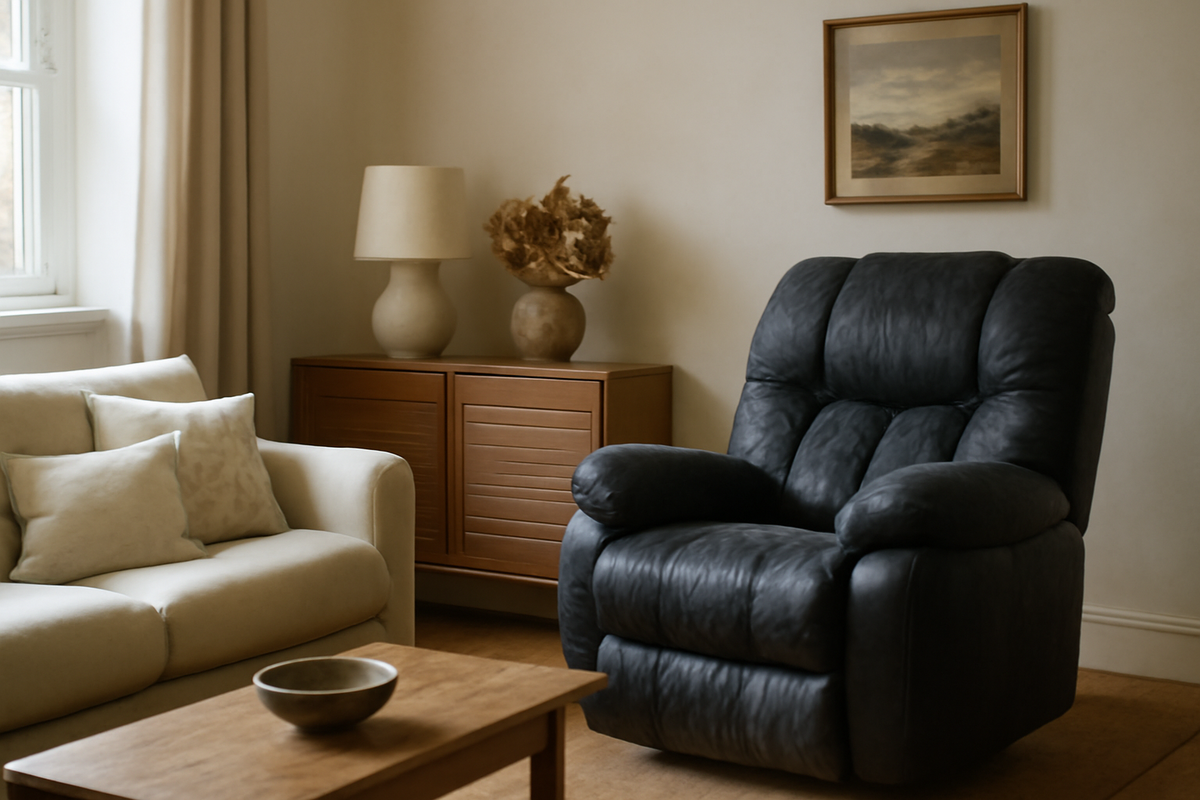
The couch arrived on a Tuesday, the kind of gray, forgettable day when cardboard boxes feel like events. It took two delivery guys, one scraped knuckle, and a muttered curse to wrestle it through the doorway. Plastic crinkled, foam blocks tumbled to the floor, and there it was: enormous, overstuffed, gleaming in a suspicious shade of greige that looked like wet oatmeal in certain light. “It’ll make the room cozy,” the owner had said, weeks earlier, eyes bright on the showroom floor. “It’s a statement piece.”
It was a statement all right. Just not the one they thought.
Within an hour, the living room—once airy, full of promise—felt oddly smaller. The sunlight that used to skate across the rug now died somewhere in the cushions. The windows felt shorter. The coffee table suddenly looked like dollhouse furniture. Guests walked in and did the same little pause: a polite smile, a quick glance around, then their gaze would land on that one hulking thing that had quietly taken over the room.
This is the moment interior decorators talk about with a kind of almost tragic sympathy. Because there is one furniture piece that, more than any other, can quietly ruin a room. And it’s probably not what you think.
The Monster in the Room: The Oversized Sectional
Ask a handful of interior decorators for the single biggest furniture mistake people make, and the answer shows up again and again, like an elephant parked in the corner:
The too-big sectional sofa.
Not all sectionals. Just the ones that swallow a room whole.
You know the type. They wrap around two walls like a padded fortress, deep enough to lie down and lose your phone, your keys, and possibly your sense of scale. They looked amazing in the showroom—spread across a massive, echoing warehouse under sympathetic lighting, styled with eleven cushions and a throw blanket that implied Sunday naps and artisanal coffee.
But showrooms are liars by design. That sectional that looked “normal” in 5,000 square feet of space comes home and behaves like a parked SUV in a compact garage. The walls close in. Walking paths disappear. An entire side of the room becomes non-negotiable territory: sofa zone or nothing.
Interior decorators quietly wince when they see it. They know the same sad story: someone wanted comfort, flexibility, movie-night bliss. The sectional promised all of that. Instead, it ate the room’s architecture.
“It’s the scale,” one designer explained over coffee, hands sketching invisible boxes in the air. “People underestimate scale. A sectional is innocent in theory. But oversize it, and it doesn’t just sit in the room—it defines it… usually in all the wrong ways.”
How One Sofa Hijacks an Entire Space
Spend a few minutes in a room dominated by an oversized sectional, and the problem isn’t just visual; it’s physical. Your body feels it first.
You step in and your usual paths—toward the window, the bookshelf, the cozy reading corner you thought you’d create—are blocked. You edge sideways between the armrest and a wall. The coffee table suddenly feels too close. There isn’t a natural place to put a floor lamp without bumping knees or cords.
The room becomes a one-trick pony: it does “TV and lounging,” and not much else.
Decorators talk a lot about “flow,” and it can sound maddeningly vague—until you try to navigate around a sofa that pretends to be a small continent. Flow is just how your body moves through the room, how your eye travels, how easy it feels to exist there without performing elaborate sidesteps.
An oversized sectional interrupts that in at least four ways:
- It eats walking space. Circulation paths get narrowed or vanish entirely.
- It hogs the best light. The deepest, comfiest corner usually ends up blocking a window or a view.
- It dictates all other furniture choices. Chairs, tables, even lamps become afterthoughts, forced to bend around the main beast.
- It shortens the room visually. The bulk of it pulls your eye down and in, making the space feel smaller and sometimes even lower-ceilinged.
Ironically, people often choose massive sectionals for small rooms—“to maximize seating.” But decorators will quietly tell you a secret: cramming in the biggest possible sofa doesn’t maximize anything except frustration.
Sometimes, two smaller pieces—say a compact sofa and a lounge chair—offer more flexible seating, better balance, and kinder walking paths than one giant L-shaped creature.
Why We Keep Falling for the Giant Sofa Trap
So why do so many otherwise thoughtful people keep dragging these mammoths into their homes? The reasons are surprisingly human.
We’re Chasing the Dream of Comfort
The sectional is a symbol. It says: we host game nights, we watch movies as a family, we sprawl and snack and nap and live large. It’s the visual shorthand for “cozy home life,” a soft, upholstered promise that life will be slower and more connected if only we can all fit on one enormous couch.
Showrooms and glossy photos feed that fantasy. You see friends laughing on generously padded corners, children draped over piles of pillows, sunlight pooling on a chaise like an invitation. The emotional pull is powerful. Who cares about scale when comfort is on the line?
We Underestimate Our Room Size—Every Time
Something about empty rooms tricks the brain. A space with bare walls and no furniture feels echoey and huge. People stand in the middle, arms spread, and say, “We could fit anything in here.”
Then the numbers betray them. A 9×12 room is not a stadium; it just sounds bigger in a rental listing. A standard sectional can eat 8–10 feet in one direction and 6–8 in the other. Add in walking space, side tables, maybe a floor lamp, and suddenly that once “huge” living room is a snug little cave.
We Trust the Showroom (Which Was Never Designed for Us)
Furniture stores arrange their pieces inside massive volumes of air. High ceilings. Wide aisles. Careful lighting. A sectional that looks moderately sized under twenty-foot ceilings morphs into a woolly mammoth in a home with eight-foot ceilings and smaller windows.
Designers, almost to a person, beg their clients: measure, then measure again. Tape outlines on the floor. Walk around them. Imagine where your knees, your coffee cup, your dog will go. Because once the sectional arrives, it’s too late. Returning that beast is an adventure few people are willing to repeat.
What Decorators Wish You’d Do Instead
Ask decorators what they do when they walk into a sectional-dominated room, and you’ll see a distinct pattern: they start imagining ways to shrink, divide, or break up the bulk without sacrificing comfort.
1. Consider Two Sofas—or a Sofa and Chairs
Two smaller pieces facing each other, or a compact sofa plus a pair of deep, inviting chairs, can create just as much seating as a sectional, while offering better flow. This setup also encourages conversation; people face each other naturally instead of craning around a corner cushion.
2. Use Scale Like a Dimmer Switch
Big furniture isn’t the enemy; disproportion is. A generous sofa can work beautifully if the other pieces—rug, coffee table, chairs, lighting—are scaled to match. Think of it like music: if the bass is thundering and everything else is whispering, you don’t get richness, just noise.
A balanced room has a rhythm of sizes: one or two large pieces, a few mediums, and some smaller, lighter elements to keep things from feeling heavy.
3. Float, Don’t Shove
There’s a reflex many of us have: shove the biggest thing against the wall. It feels like the only way to “save space.” Decorators often do the opposite—they pull seating away from the walls, even if it’s just a foot or two. That breathing room visually lightens the piece, makes the room feel more thoughtful, and allows for better traffic flow behind or around it.
4. Leave Negative Space on Purpose
Empty floor is not wasted. The eye needs places to rest as much as the body does. When a room is packed, every corner filled, your nervous system reads it as visual noise.
Designers are surprisingly ruthless about this. They will tell you, quite calmly, to choose fewer pieces. A slightly smaller sofa and one less side table can transform the whole emotional temperature of a room.
| Common Choice | What Happens | Decorator’s Alternative |
|---|---|---|
| Huge sectional in small room | Blocks windows, poor circulation, room feels cramped | Compact sofa + 1–2 armchairs; or a smaller, modular sectional |
| Sectional shoved into two walls | Dead corner, awkward angles, no visual breathing room | Float sofa slightly from walls; add slim console or floor lamp behind |
| Sectional chosen only by seat count | Looks crowded, feels heavy, hard to add side tables or lamps | Prioritize scale and proportions first; supplement seating with poufs or occasional chairs |
| Dark, bulky upholstery | Visually shrinks the room, shows lint and dust | Mid-tone or lighter fabric; slim arms; visible legs to lift the piece |
The Subtle Art of Seeing Your Room as a Landscape
At their best, good decorators think more like nature writers than furniture salespeople. Walk through a well-designed living room, and it feels a bit like hiking a trail that was thoughtfully planned: shifts of scale, open clearings, sheltered nooks, occasional “viewpoints” that invite you to pause.
The biggest mistake the oversized sectional makes is that it flattens all of that. It turns the room into one emotional note: sit here, face that, do this.
Instead, designers look for:
- Vistas: What do you see when you first step in? Is there a clear line of sight to a window, a painting, a plant, a fireplace?
- Resting spots: Not just one gigantic lounging zone, but small pockets where one person can read, another can sip tea, someone else can check their phone without being pulled into the TV orbit.
- Light journeys: How does daylight move across the room? Does furniture block it, or invite it in, bouncing off surfaces and textiles?
When you place a giant sectional along two walls, you’re often blocking vistas, erasing potential resting spots, and building a soft dam against the natural movement of light.
Picture, instead, a room where the main sofa faces a window, not just a screen. Where a single reading chair lives under a pool of lamplight in a corner. Where a small bench against the wall can host a guest or serve as a spot to drop your bag. The room begins to feel less like a fixed installation and more like a living, breathing landscape you can inhabit in layers.
How to Tell if Your Sectional Is Secretly Sabotaging Your Room
You may already own a sectional and feel a little defensive reading this. Maybe you love it. Maybe it’s where your kid took their first real nap, or where your dog likes to curl up against your leg. This isn’t about villainizing the piece itself—it’s about how it behaves in the space.
Decorators suggest a simple home test. Stand in your doorway and ask yourself:
- Do I see anything besides sofa first? Light, art, a view, a plant?
- Could someone walk through this room without turning sideways?
- If three people are here, can one person sit somewhere not on the sectional and still feel part of the room?
- Is there at least one corner of the room that feels visually calm and not dominated by upholstery?
If the answer to most of these is “no,” your sectional might be running the show a little too forcefully.
Sometimes the solution is surprisingly small: rotate the piece, pull it six inches away from the wall, remove one end unit if it’s modular, or swap a chunky coffee table for something lighter on legs. Other times, the answer you don’t want to hear is also the most liberating: it might be time to let the beast go and start fresh with something humbler.
The Kind of Comfort That Lasts
There is, buried under all of this, a question that decorators quietly hold in their work: what kind of comfort are you actually after?
There is the immediate, undeniable comfort of sinking into a deep corner cushion, wrapped in fabric and familiarity. But there’s another kind of comfort—a slower, more atmospheric one—that comes from a room breathing easily around you. The comfort of walking without bumping into arms and edges. Of morning light sliding across the floor unobstructed. Of being able to move a chair, re-angle a lamp, or shift a table to match your mood or your season.
That kind of comfort doesn’t shout. It doesn’t arrive in a single piece of furniture that promises to solve everything. It shows up in proportion, in restraint, in the small, thoughtful spaces between the things you bring home.
The truth interior decorators keep trying to share is that your room isn’t meant to revolve around a sofa—not even a beautiful, nap-worthy one. It’s meant to revolve around the people who live there, and the invisible paths they carve each day: from the kitchen to the window, from the bookshelf to the door, from the floor where a child plays to the chair where someone reads.
When a sectional—any sectional—honors those paths, it can be a blessing. But when it blocks them, no amount of cushions will make the room feel right.
So before you let another massive couch cross your threshold, pause in the empty space. Listen to the room itself, to its light and corners and doorways. Imagine not just where you’ll sit, but how you’ll move, where your eyes will rest, where the first spill of morning sun will land.
Because in the quiet math of a well-loved home, the most comfortable room isn’t the one with the biggest sofa. It’s the one where every piece—especially the largest one—knows when to step back and let the space, and the people in it, breathe.
Frequently Asked Questions
Is a sectional always a bad idea?
No. Sectionals can be wonderful in larger rooms, open-plan spaces, or family rooms where lounging is the main purpose. The issue isn’t the sectional itself, but its size and placement relative to your room.
How do I know what size sofa my room can handle?
Measure your room, then tape the sofa’s footprint on the floor with painter’s tape. Leave at least 75–90 cm (about 30–36 inches) for walkways. If the taped outline makes the room feel cramped, the sofa is too big.
Can I make an existing oversized sectional work better?
Sometimes. Try pulling it slightly away from the walls, removing one modular piece if possible, swapping bulky tables for lighter ones, or relocating it to a larger room. If none of that helps, you may need to replace it with smaller pieces.
What’s a good alternative to a large sectional in a small room?
A compact sofa paired with one or two cozy chairs often offers more flexibility and better flow. Add an ottoman or poufs for extra seating that can be moved when not needed.
Do decorators ever recommend really big sofas?
Yes—when the room can genuinely support them. In large, open spaces or long living rooms with generous circulation, a big sofa or sectional can help create intimacy. The key is balanced scale and enough empty space around it so the room still breathes.

Hello, I’m Mathew, and I write articles about useful Home Tricks: simple solutions, saving time and useful for every day.