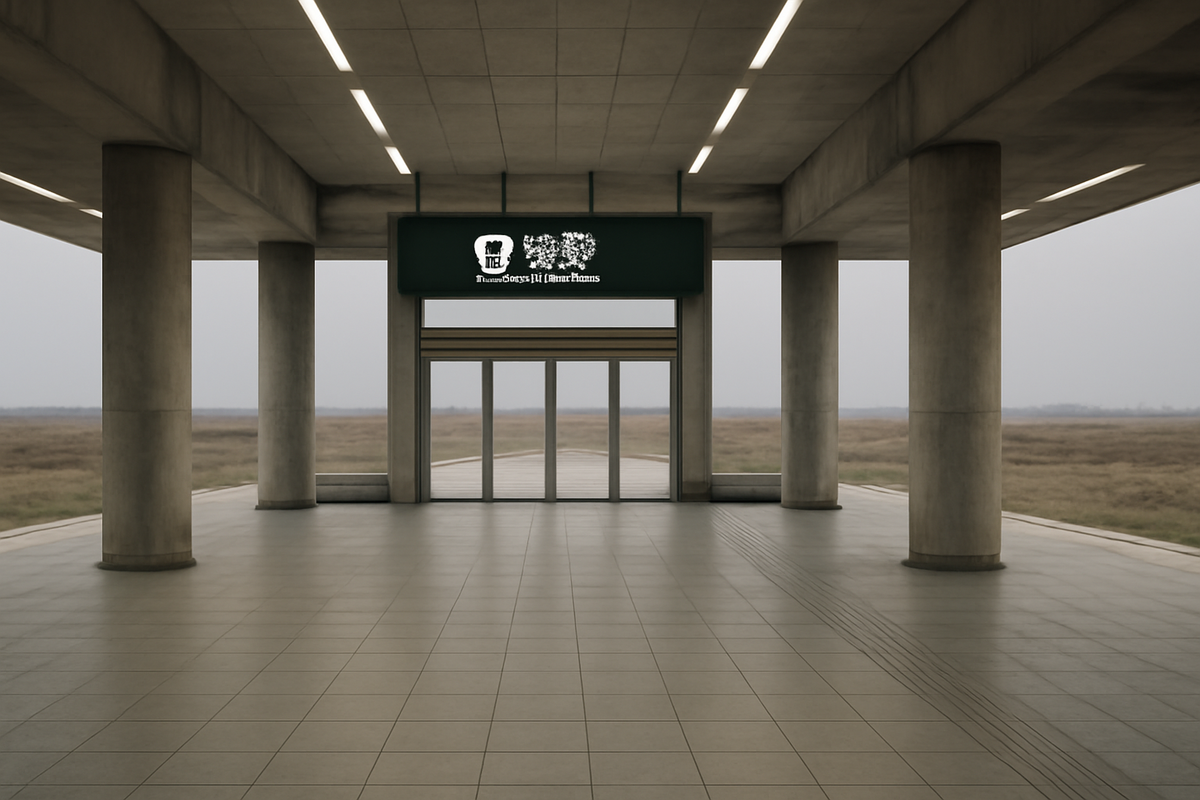
The first time I stepped off a subway train into an empty station on the outskirts of a Chinese city, it felt like stumbling into a cathedral built for ghosts. The platform stretched in both directions, gleaming under bright white lights. Escalators hummed softly with no one riding them. A digital sign blinked precise train intervals—3 minutes, always 3 minutes—despite the fact that I was the only passenger getting off. It was 2009, barely a year after Beijing’s Olympic glow had faded, and I remember thinking: Why on earth did they build all of this out here?
The Stations to Nowhere
Back then, the phrase “subways to nowhere” floated around foreign media with a mix of disbelief and smug certainty. It was 2008, and across China, city governments were sketching underground maps the way kids draw fantasy kingdoms. New lines seemed to sprout overnight: vast networks racing out toward fields, factory shells, and construction fences. Aerial photos showed elegant, looping subway routes serving…empty land.
On paper, it looked insane. Stations were opening where only dusty roads and a lone convenience store existed. Platforms designed for thousands of daily commuters echoed with footsteps from a mere handful. Some exits spilled out into wheat fields or half-finished roads that simply stopped at a ditch. International commentators pointed and laughed. This, they said, was what happened when a country drank too deeply from the well of state planning and cheap credit.
China, by 2008, had fallen in love with infrastructure the way some people fall in love with fast cars. Highways, bridges, airports, high-speed rail—if it moved people or goods, Beijing wanted it, bigger and faster than anyone else. But the subways were different. Highways you could build as you went. Railways could follow proven corridors. Subways, buried deep and painfully expensive, wanted faith. You had to believe that one day, the city would grow around them.
Yet for many of these new lines, the future still looked theoretical. They threaded through districts labelled on planning maps with phrases like “Future Technology Hub” or “Eco-Living Zone,” even as the ground above remained an expanse of dirt and rebar. To many outside observers, it wasn’t just ambitious—it was naive.
The Numbers Behind the Quiet Platforms
Walk down one of those quiet platforms in the late 2000s, and the mismatch between scale and use could feel almost comic. Three sets of wide exits, each capable of disgorging crowds, funneled perhaps a dozen people an hour. Security scanners stood ready for rush-hour lines that never materialized. Ticket machines sat in neat rows, glowing patiently, serving a trickle of curious riders and the odd construction worker catching a cheap ride back to the city center.
But out beyond the silence, the math was brutal. Subways are expensive to build and even more expensive to run. Tunnel boring machines, signaling systems, ventilation, safety infrastructure—these are sunk costs you can’t recoup with half-empty carriages. Every train that rolled into those far-flung stations risked being a steel tube of lost revenue.
And yet, talk to local officials at the time, and they seemed almost serene about it. “The city will come,” they said. “Give it ten years, maybe fifteen. We must build ahead of demand.” They spoke the way gardeners talk about planting trees they’ll never sit under. Foreign economists, however, took a harsher view: they called it overbuilding, malinvestment, a bubble driven by cheap loans and political vanity.
That tension—between faith in the future and fear of pointless extravagance—hung over every photo of empty stations in the middle of nowhere. But the story didn’t stop in 2008. It kept moving, and by 2025, the platforms that once looked like monuments to recklessness had something new to say.
The Future Arrives, But Not the Way They Imagined
Fast forward to a morning in 2025. Imagine stepping off the same line where you once stood alone. The floor is no longer pristine; it’s scuffed with the traffic of thousands of shoes. You’re shoved aside by commuters in hurried winter coats, earbuds in, shoulders set. The ticket gates beep constantly now—a rhythm that sounds like a heartbeat. Outside, the wheat fields are gone. In their place: a forest of high-rises, glass-fronted malls, schools, and office towers in various stages of completion.
At first glance, it would be tempting to say: They were right all along. The empty stations were not foolish; they were prophetic. The city did come. And in many places, that’s exactly how it played out. Lines that were mocked as white elephants in 2008 turned into lifelines by 2020. Some of those “stations in the middle of nowhere” now sit under the feet of half a million daily travelers.
But if you look a little closer, the story is more complicated. Yes, the people came—but they arrived with different expectations, different habits, and into a world that has changed in ways the planners did not fully predict.
Smartphones rewired how Chinese cities function. By the mid-2010s, millions were hopping onto dockless bikes, ride-hailing apps, and then electric scooters to cover the “last mile” to stations that once felt remote. E-commerce and food delivery meant that residents could live farther from traditional mains streets and still feel connected. New subway stops no longer needed bustling street markets outside their exits to feel alive; they just needed Wi-Fi and decent staircases.
At the same time, storms grew stronger, summers hotter, and the argument for dense, rail-linked living went from planning theory to survival strategy. When heatwaves hit, city dwellers fled overheated buses and congested roads for the cool predictability of trains humming beneath the streets. Suddenly, the idea of “overbuilding” tunnels looked less like a financial blunder and more like a form of climate adaptation.
And yet, even as some stations blossomed into central nodes of daily life, others still sat at the edge of things, underused, waiting for a future that kept being postponed.
The Hidden Costs of Overconfidence
To understand why 2025 makes those heady 2008 decisions look naive, you have to step back from the success stories and listen to the silences. There are stations whose escalators now run on reduced schedules to save power. Stations where only one exit is open because the surrounding blocks never fully developed. Corridors whose white tiles have dulled beneath harsh cleaning chemicals, but not the wear of crowds.
What went wrong in those places wasn’t just timing—it was faith in a single, unstoppable direction of growth. City planners and local governments in the 2000s believed three big things would go on forever: fast urban population growth, relentless land value appreciation, and rising tax revenues. Subways were built as if that momentum would never slow.
But demographic curves bent. China’s population began to peak and then shrink. Some smaller cities discovered that not everyone was moving in from the countryside anymore; some were even leaving. The real estate engine that had once turned empty stations into future goldmines began to sputter. Developers pulled back. Projects stalled. A few half-finished apartment clusters, already connected to subway lines, became strange concrete islands in seas of uncertainty.
You can see the consequences in the financial ledgers of municipal subway companies. Operating costs kept climbing—electricity, maintenance, staffing—while fare revenue didn’t always grow as expected. To keep trains running, cities leaned heavily on subsidies. What looked in 2008 like a one-way bet on endless growth became, in 2025, a balancing act between public service and unsustainable debt.
The naivety wasn’t in the idea of building early. It was in assuming that infrastructure alone could guarantee the future you wanted.
When Tracks Shape Cities—and When They Don’t
Stand on a crowded subway in a Chinese megacity today, and you can feel how powerfully rail lines shape urban life. Developers still boast “only 300 meters from the station” in their ads. Cafés cluster near station exits, feeding office workers and students. Entire neighborhoods’ fortunes rise or fall with the flick of a red or green line on a planning map.
But not every rail line is destiny. Some lines—especially in smaller or slower-growing cities—reveal the limits of concrete as a magic wand. A subway stop buried in an area that lacks good schools, decent jobs, or meaningful green spaces doesn’t automatically become a magnet. Residents might pass through, but they don’t build a life there. The stations in those districts can feel strangely disconnected—public spaces that people inhabit only in motion.
This tension is visible when you compare different kinds of “middle of nowhere” stations:
| Type of Station | What Planners Expected | What 2025 Reveals |
|---|---|---|
| Edge-of-city “Future CBD” stops | Skylines, corporate towers, high-value commuters | Patchy development; some thrive, some half-filled office parks |
| Suburban housing cluster stops | Family communities, daily rush-hour crowds | Often busy, but vulnerable to real estate slowdowns and aging populations |
| Industry-focused stops | Workers commuting to booming factories | Automation, factory relocation, and weak demand in some zones |
| Eco-town / “Future city” concept stops | Showcase sustainable urbanism | Mixed results; some remain more vision than reality |
In many ways, the tracks did their job: they made distant land accessible, cut commute times, and signaled that a place “mattered.” But they couldn’t single-handedly conjure strong local economies, quality public services, or a sense of belonging. That required a kind of patient, people-centered planning that didn’t always keep pace with the rush to pour concrete.
Climate, Pandemics, and the Fragile Certainty of Concrete
There’s another twist 2008 planners didn’t fully see coming: how fragile even the most solid infrastructure can feel when the world starts to shake. The COVID-19 pandemic sent ridership tumbling across the globe, and China was no exception. For stretches of time, those once again half-empty trains and platforms looked eerily like the mocking photos from the late 2000s—evidence, some said, that cities had built too much, too fast.
But as lockdowns eased, people returned. Maybe not in the exact same numbers, and not always at the same times of day, but the subway regained its quiet claim on everyday life. Offices went hybrid, some commuters shifted to bikes, but trains remained part of the city’s skeleton. They showed a strange duality: both vulnerable to shocks and deeply resilient.
Then there was climate change. As extreme weather events grew more common, subways faced new threats: flooding tunnels, overwhelmed drainage systems, heat waves that pushed ventilation systems to their limits. Building deep and early, it turned out, wasn’t enough. Cities now had to retrofit and defend the very infrastructure that once seemed to promise an unshakeable future.
In this light, the subways built “in the middle of nowhere” told a fresh story. They weren’t just gambles on growth; they were also bets that the physical layout chosen in the 2000s would make sense in a world of 2030s climate realities. Some of those bets look wise today—dense, transit-oriented communities are easier to cool, easier to evacuate, and less dependent on cars. Others, sprawled out toward floodplains or water-stressed regions, appear much less clever.
The Lesson Beneath the Tracks
So when you look back from 2025 at the 2008 decision to carve subways into empty land, was it naive? In one sense, yes. It was naive to assume that economic growth, population trends, and the real estate market would march obediently along the same upward path for decades. It was naive to believe that infrastructure, no matter how grand, could substitute for flexible, adaptive governance.
But in another sense, there’s a different kind of naivety we rarely talk about: the belief that cities can play it safe by always waiting for demand to fully materialize before building. The climate crisis, demographic shifts, and technological jolts have made “just-in-time” citymaking feel just as reckless as overbuilding once did.
Perhaps the deeper lesson hidden in those once-empty platforms is this: cities need the courage to build for futures that might not arrive exactly as imagined—but they also need the humility to keep adjusting when reality pushes back.
That might mean accepting that some stations will never be as busy as planners dreamed, and rethinking how to use them—turning excess space into community centers, art venues, or cooling shelters during heat waves. It might mean slowing the impulse to extend every line further outward, and instead strengthening links within existing neighborhoods. It certainly means factoring climate risk into every decision about where and how to dig.
When you stand on a platform today, listening to the approaching rumble of a train, it’s easy to forget how much hope and error are buried in the walls around you. Subways feel inevitable once they exist. But each station represents a moment when someone took a bet—on commuters who hadn’t moved there yet, on companies that hadn’t founded themselves yet, on a climate that wasn’t yet as unstable.
In 2008, China built vast subway stations in the middle of nowhere, trusting a future of endless growth. In 2025, we know that future was always going to be messier. Some of those stations are triumphs. Others are cautionary tales. All of them remind us that cities are not just made of concrete and steel, but of stories we tell about tomorrow—and our willingness to rewrite those stories when the ground beneath us shifts.
FAQ
Why did China build subway stations in seemingly empty areas?
Many lines were designed to “build ahead of demand.” Planners expected rapid urban expansion and wanted transit in place before people and businesses arrived, rather than scrambling to add it later.
Did those “subways to nowhere” eventually become busy?
In many major cities, yes. As housing, offices, and services grew around them, a number of early underused stations turned into busy hubs. But others remain lightly used due to slower development or changing economic conditions.
Was the decision to build so much subway infrastructure a mistake?
It’s mixed. The networks brought huge mobility and environmental benefits in many places, but optimism about endless growth and real estate demand proved unrealistic, creating financial strains and some underused lines.
How did climate change affect the value of these subway systems?
Climate pressures made dense, transit-linked neighborhoods more valuable, but also exposed vulnerabilities like flooding and heat stress. Subways became both crucial climate solutions and infrastructure that itself needs protection.
What is the main lesson for future city planning?
Build with foresight—but pair ambition with flexibility. Infrastructure should anticipate growth and climate realities, while allowing cities to adapt when demographic, economic, or environmental trends diverge from the original plans.

Hello, I’m Mathew, and I write articles about useful Home Tricks: simple solutions, saving time and useful for every day.