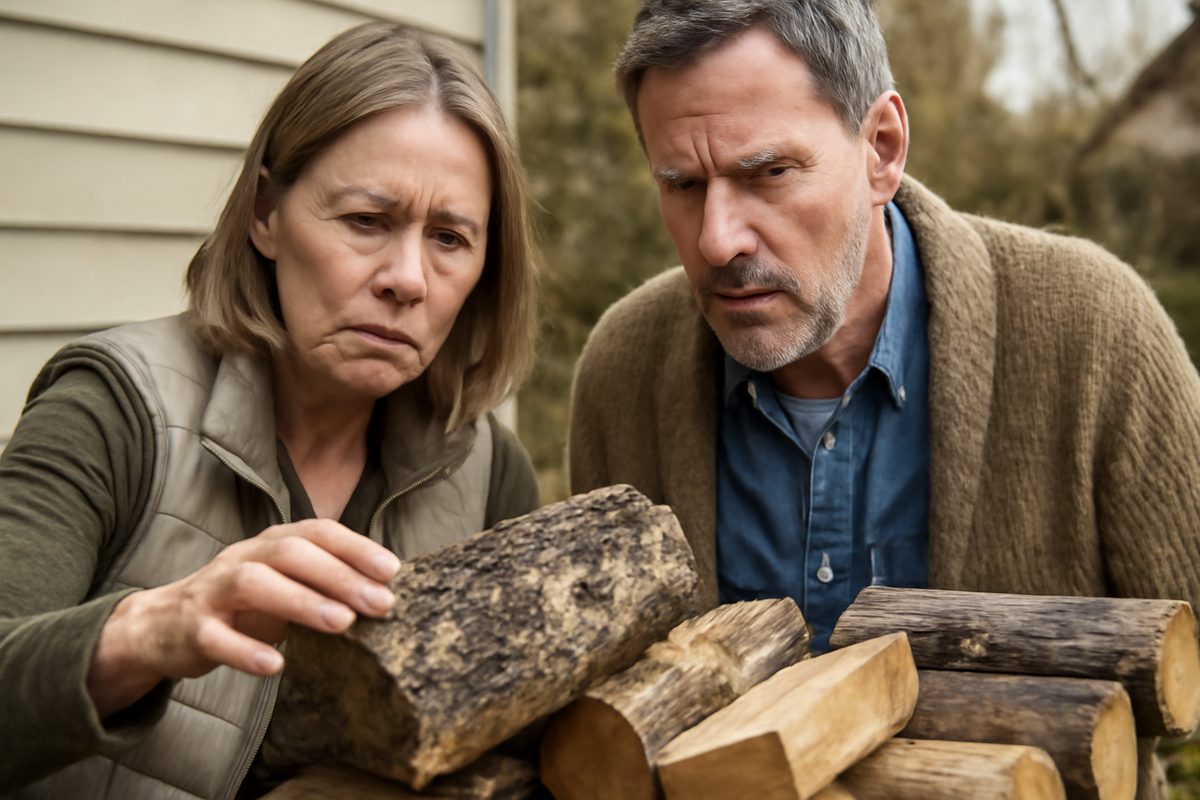
The first hint that something was wrong came on a Tuesday night in January, when the air bit at the windows and the furnace groaned just a little too often. Ben hauled in an armful of firewood from the stack by the shed, the same stack he’d split back in late spring, feeling oddly proud as he dropped the logs into the brass basket by the hearth. Months of planning, cutting, stacking, waiting—it was finally time to cash in on all that patient effort. But when he struck the match and coaxed the kindling into a timid flame, the logs hissed. They didn’t catch. They just smoked, sulked, and smoldered. After half an hour of fussing, the living room smelled like a damp campsite and the glass door of the stove was fogged with gray. The firewood, the stuff he’d been so sure would burn hot and bright this winter, was almost completely unusable.
When a Fire Refuses to Burn
There’s a particular kind of frustration that comes from watching a fire that should be roaring instead collapse into a dull, wheezing mess. You strike the match, arrange the kindling like you’ve seen in every tutorial, and wait for that satisfying whoosh of ignition. Instead, the log sweats. It sweats moisture you can’t see but can definitely smell—heavy, earthy, slightly sour. The ends of the wood darken and glisten. Smoke curls up in lazy, reluctant ribbons.
Ben and his partner, Anna, stood in front of their wood stove that night, poking, rearranging, opening and closing the air vent as if the problem was purely mechanical. “Maybe this log is bad,” Anna said, fishing one out and swapping in a new one from the basket. Five minutes later, the same result. More smoke. No flame. Their months-old firewood, cut and split with care, was failing them.
They weren’t alone. Every winter, homeowners who had the best intentions of “getting ahead” on their firewood discover that what they thought was seasoned, ready-to-burn wood is still clinging stubbornly to the very thing that fire hates: water. The mystery usually doesn’t begin in the forest or the woodlot. It begins in the invisible chemistry inside the log and in the quiet weeks after splitting, when the wood is either allowed to breathe—or is slowly suffocated.
Seasoned vs. “Sat Around for a While”: Why Time Alone Isn’t Enough
The difference between seasoned firewood and wood that simply “sat there” for a few months comes down to moisture content. Freshly cut wood can hold 40–60% moisture by weight. Well-seasoned firewood, the kind that catches easily and burns hot, usually lands somewhere below 20%. That number isn’t just trivia; it’s the line between heat and headache.
Water is stubborn. In a log, it doesn’t just live on the surface. It’s deep in the cells, tucked into the vascular structure that used to carry sap and nutrients. When you split wood, you give that moisture an escape route—more exposed surface area, more places for evaporation. But evaporation needs more than just time; it needs movement. Air has to flow. Sun has to reach the wood. Rain has to be kept out. Temperature swings help draw moisture out of the fibers.
Ben thought he had that box checked. He’d cut his maple and ash in late May, split it in June, and stacked it in July. That sounded respectable, like the kind of timeline your neighbor with the well-used chainsaw would approve of. But the way that wood was stacked—and where it lived for those months—told a different story.
He’d built his stacks tight, almost like walls, thinking “tighter stack, less wasted space.” He tucked them snugly against the back of the shed, under a solid blue tarp that he dutifully pulled low around the sides “to keep it dry.” The result: a beautiful, neat row of wood that never really got a chance to breathe. No sun on the sides. No wind weaving through. Just trapped, moist air doing what trapped moisture always does—it lingered.
The Silent Work of Air, Sun, and Time
Seasoning wood is less like storage and more like slow-motion dehydration. You’re not protecting the wood from the elements so much as exposing it to the right ones in the right way. Airflow is king. Sun is queen. Rain is an annoying cousin you tolerate but try to keep at a distance.
The classic mistake is the fully-tarped stack. It feels responsible: you’re “keeping it dry.” In reality, once you cover the top of the stack (good), then seal the sides (bad), you’ve built a greenhouse for humidity. Every warm afternoon drives moisture toward the outside of the wood, but it hits the impermeable tarp and simply… hangs there. Night falls, temperatures drop, and that vapor condenses back into the wood or into the ground beneath it, where it can creep up from below.
Then there’s stacking directly on earth. Grass, soil, or leaves underneath keep the bottom layer perpetually damp. Even if the top looks “crusty dry,” those lower courses act like a damp sponge, rehydrating anything they touch. When you grab wood from the pile, you don’t separate the good from the bad; you just carry the problem inside.
When homeowners like Ben finally try to light a fire, they’re not just fighting damp wood; they’re battling physics. Instead of energy going into making heat and flame, it’s going into boiling off water. Every hiss from the log is a tiny declaration of wasted energy. The room fills with smoke that should have been warmth.
The Hidden Clues Months Earlier
Most failed firewood stories have their clues written months before the first match is struck, like quiet red flags fluttering in the yard, ignored in summer’s distraction.
Back in July, when the cicadas buzzed and the afternoon light slanted across Ben’s backyard, the wood looked fine. The ends had checked—those hairline cracks that appear as wood dries. The bark was intact. It felt lighter than it had in June, and when he thumped two pieces together, they made a respectable clunk. He never thought to question whether that clunk was the right kind of clunk.
Wood that’s ready to burn has a sharp, almost musical knock to it when two pieces meet. Wood that’s still holding too much moisture sounds dull, flat, as if something is padding the impact. There’s a subtle weight difference too: seasoned wood feels surprisingly light for its size, almost like picking up a loaf of bread that looks denser than it turns out to be.
Then there’s the smell. Freshly split logs, especially resinous species like pine or spruce, carry an almost intoxicating, green scent. Over time, that sharpness fades. Seasoned hardwood smells quiet, dry, almost dusty. It doesn’t announce itself. Ben’s wood, even in late autumn, still had a faintly sour, green scent when he split a few larger rounds. He noticed it, paused for a second, and told himself, “Well, it’s been a rainy year. It’ll be fine.”
A simple moisture meter, the kind with two metal prongs and a tiny digital screen, would have ended the mystery before it began. Pressed into a freshly exposed face of a split log (not the old, weathered end grain), it would likely have flashed a number in the mid-20s or even low 30s. Not terrible, but not there yet—not if the goal was a reliable, low-smoke fire on the first real cold snap.
How Dry Is “Dry Enough”? A Quick Look at Moisture and Burn Quality
There’s a world of difference between “burns if you fight with it” and “burns beautifully.” It helps to understand where your wood falls on that spectrum.
| Moisture Content | What It Looks/Feels Like | How It Burns |
|---|---|---|
| 35–50% (Very Wet / Green) | Heavy, cool to touch, fresh smell, ends mostly uncracked | Hisses, steams, makes lots of smoke, hard to start, low heat |
| 25–34% (Partially Seasoned) | Noticeably lighter but still slightly heavy; some cracks at ends | Will burn with effort and good draft; more smoke, less efficient |
| 18–24% (Seasoned / Usable) | Light for its size, clear checking at ends, drier smell | Lights fairly easily, burns hot, moderate smoke |
| 12–18% (Well Seasoned / Ideal) | Quite light, ends well-checked, may have some loose bark | Ignites quickly, burns clean and hot, minimal smoke, less creosote |
Ben’s wood sat in that awkward middle zone: not green, not ready. In July, it was on its way. By September, it was close. By November… it needed another couple of weeks of good air and sun. Instead, as autumn storms rolled in, he pulled the tarp tighter, wrapped the sides, and quietly locked in the last of the moisture.
Stacking, Covering, Waiting: The Part Everyone Gets Wrong
It’s odd how little attention we pay to the way we stack wood, considering how much that single choice decides whether our winter evenings are cozy or exasperating. The difference between a usable pile and a half-rotted, still-damp mess isn’t mystical; it’s practical.
First, the ground. Wood wants to be off it. Pallets, rails, 4x4s—anything to create a small crawl space for air to move and for moisture to dry out instead of seeping upward. That extra three or four inches changes everything for the lowest course of logs.
Then, the shape. Crisscrossed ends (sometimes called “holtz haus” or simply stacked corners) not only stabilize the pile but let air slip in at multiple levels. A long row, a single log deep or at most two, will season far faster than a square heap. The tighter and deeper the pile, the more the center becomes its own damp little climate, insulated from sun and wind.
And finally: the cover. The best time to leave firewood uncovered is when it’s fresh-split and summer is generous. Sun and air should do their work without interference. Cover usually belongs to the late game, when rain and snow threaten to re-wet what the previous months have carefully dried.
The trick is to cover only the top. A sheet of metal roofing, a cut-to-size tarp, even repurposed plastic panels—whatever you use, it should act as a hat, not a full-body raincoat. The sides need to breathe. Think awning, not cocoon.
Ben, like many people, reversed this logic. Worried about “keeping the wood dry,” he overprotected it just when it needed exposure most. And the result was as predictable as it was disappointing: nice-looking, neatly stacked, underseasoned wood.
When “Next Winter’s Wood” Becomes “This Winter’s Frustration”
Part of the story here is timing. The old-timers’ rule of thumb—“cut this winter, burn next winter”—exists for a reason. In some climates, especially humid ones, hardwoods need a full year, sometimes a year and a half, to reach that under-20% sweet spot.
Ben had started late. His logs were trees in May, rounds in June, splits in July. By the time real drying began in earnest, midsummer had already passed. Could that wood have been ready in time? Possibly—if everything else had gone right: off the ground, open to wind, only the top covered late in the season. Instead, he compressed the timeline and stacked in a way that slowed everything down just when it needed to speed up.
The irony is that the solution isn’t to give up and go back to fossil-fueled heat; it’s to adjust expectations forward. The wood you split this spring isn’t for this Christmas; it’s for the next one. The pile in your yard is a time machine you load months in advance. Once you think like that, the urgency drops away—and so does the temptation to cut corners and wrap that stack like a present the moment clouds appear.
When Wood Fails Indoors: Smoke, Soot, and Sore Throats
The trouble with underseasoned wood doesn’t stop at the match. Bring those damp logs indoors, and the problems multiply: smoky rooms, glass doors on stoves that blacken overnight, sticky creosote building up in chimneys, and fires that never seem to top out at that bone-deep warmth you were hoping for.
As water boils off inside the stove, it cools the firebox temperature. Cooler fires mean more unburnt compounds in the smoke, which then cling to the cooler surfaces higher up in the flue. That dark, tarry film—creosote—isn’t just ugly; in thick layers, it’s dangerous. It can ignite and turn a quiet winter evening into a sudden chimney fire.
People often blame their stove, chimney, or even the draft in their house for these symptoms. In reality, their fuel is sabotaging the system from the start. Asking a woodstove to perform well on wet wood is like asking a car to sprint on half-frozen gasoline. It will move, technically. It won’t be happy.
By mid-January, Ben and Anna had grown tired of the heavy, throat-scratchy air that came every time they tried to coax a blaze from their stack. What they did next is what many frustrated homeowners eventually do: they sought out truly seasoned wood—and discovered just how dramatic the contrast could be.
Seeing (and Feeling) the Difference
When a neighbor offered them a half-cord of oak that had been split two summers prior and stacked exactly right, the difference was immediate. The first piece caught quickly, flames licking eagerly up the dry surface. There was no hiss, no sluggish, gray uncertainty—just a steady, golden burn and a comforting, resin-wood aroma that stayed mostly in the stove instead of hanging in the room.
The glass stayed clear. The air in the living room felt lighter. The heat that radiated from the stove wasn’t the awkward, stop-start kind they’d gotten used to but a deep, stable warmth that made the furniture, the rugs, and even the silence feel softer.
Later, carrying another armful of their own wood out to a side pile to let it keep seasoning, Ben could feel the difference by touch alone. His wood still had that faint coolness of trapped moisture, even after months. His neighbor’s wood felt almost room temperature, dry, crisp at the edges. Side by side, the story became obvious: same idea, different execution.
Turning This Winter’s Lesson into Next Winter’s Comfort
Behind almost every tale of unusable, months-old firewood is the same quiet transformation: annoyance turning to understanding, then to a different kind of satisfaction. The lesson is not that firewood is fussy; it’s that it’s honest. It tells you the truth about the choices you made months earlier.
The rhythm that emerges when you accept that is surprisingly pleasant. Late winter or early spring: dropping trees, bucking rounds, stacking them loosely for a brief pause. Early summer: splitting, stacking properly—off the ground, open to sun and breeze, tops left uncovered until storms threaten. Late summer and fall: top cover only, taking a moisture reading here and there, watching the numbers slide down into the teens.
By the time the first freezing night arrives, the wood you’ll be burning has already told you its story. It’s light in your hands, it rings when you knock it, it shows dry, pale faces where you split it recently to check. When you lay it on the coals, it doesn’t argue. It answers the match with gratitude.
And that other pile—the one that smoked up your house, that hissed and sulked and left a bitter taste in your throat? It hasn’t failed you forever. It just needs more time. Move it to a better stack, lift it from the ground, relieve it of its tarp prison, and let the seasons finish what you rushed. Next winter—or the one after—that same wood may yet become the quiet backbone of a long, radiant evening by the fire.
FAQ
How long does firewood really need to season?
In many climates, hardwoods need 9–12 months to season properly, sometimes up to 18 months in very humid areas. Softwoods can be ready in 6–9 months. Cutting in late winter or early spring for the following winter is a safe rhythm.
Can I speed up the seasoning process?
You can’t cheat the physics, but you can optimize the process: split wood smaller, stack it off the ground, keep rows narrow and long, expose them to sun and wind, and only cover the top. These steps help wood reach burnable moisture levels as quickly as your climate allows.
Is it okay to burn slightly wet wood if I mix it with dry wood?
Mixing some marginal wood (around 22–24% moisture) with very dry wood can work if your stove has good draft, but consistently burning wet wood (over about 25%) leads to more smoke, creosote buildup, and poor heat output. It’s better to set wet wood aside to dry fully.
Do I really need a moisture meter?
You can get by with experience—judging by weight, sound, and appearance—but a basic moisture meter is inexpensive and removes guesswork. It’s especially useful when you’re learning or buying wood from others who claim it’s “seasoned.”
Why is my “barn-stored” wood still not burning well?
Wood stored in enclosed barns or sheds with little airflow can dry very slowly. Without moving air and some temperature variation, moisture lingers in the fibers. Wood often seasons faster outdoors in a well-ventilated stack with just the top covered than it does in a still, closed building.

Hello, I’m Mathew, and I write articles about useful Home Tricks: simple solutions, saving time and useful for every day.