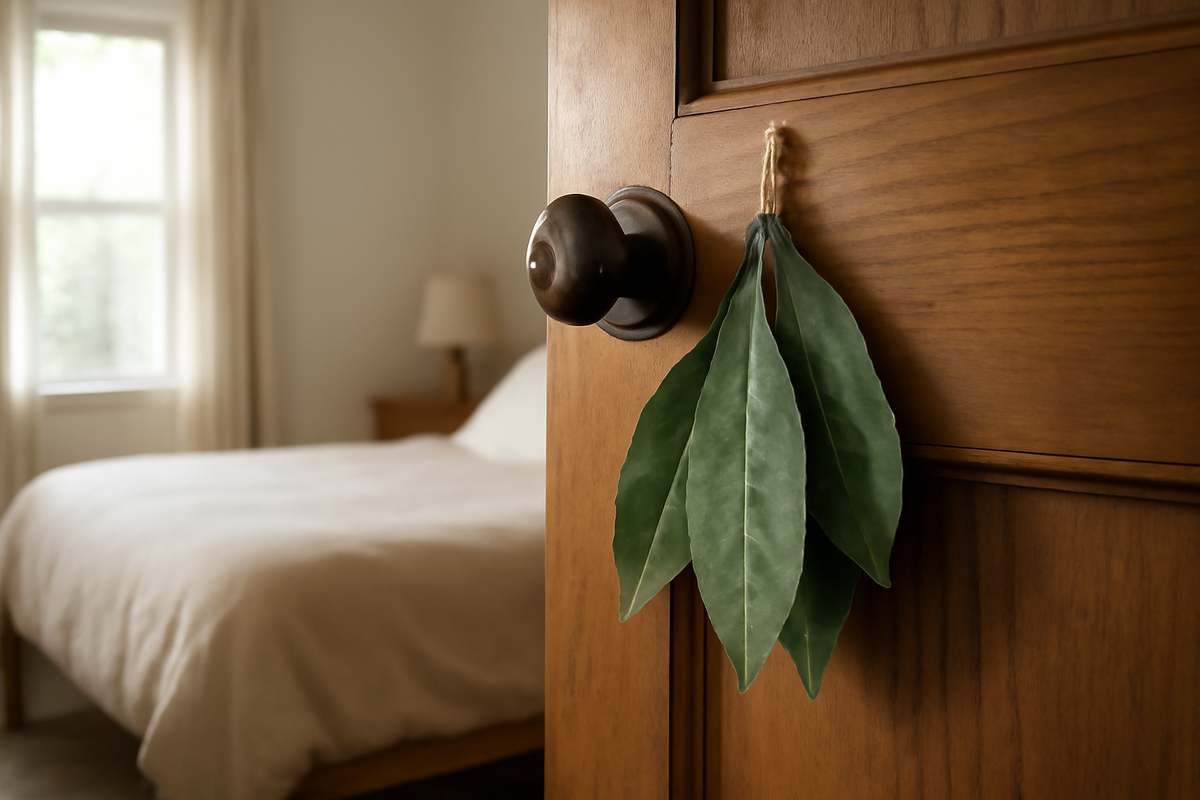
The first time someone told me to hang bay leaves on my bedroom door, I laughed. Not a rude laugh—more the disbelieving, this-can’t-possibly-do-anything kind of laugh. The idea sounded like something rescued from an old storybook: a little green charm, dangling quietly, guarding the threshold between waking and sleep. But later that night, when I stood in the doorway with a bit of twine and a handful of bay leaves, the laughter faded into something else: curiosity, a faint nostalgia for rituals I’d never been taught, and a strange sense that this simple act connected me to thousands of people I would never meet.
Why Bay Leaves Found Their Way to the Bedroom Door
Bay leaves—those familiar, stiff little ovals that crackle in your fingers—don’t look like much at first. We know them from soups and stews, where they simmer quietly and never quite dissolve, like a visiting guest who keeps to their corner but somehow changes the whole mood of the room.
But long before they landed in our stockpots, bay leaves had a very different reputation. In ancient Greece and Rome, they were symbols of victory and prophecy. Poets and warriors wore laurel wreaths braided from bay branches; temples burned them as sacred offerings. People believed that bay could shield them from storms, sickness, and bad luck. In some old European and Mediterranean households, a sprig of bay hanging at the door was as common as a broom in the corner.
Those echoes are still alive today. In many places, especially in folk traditions that quietly persist under the noise of modern life, people still recommend hanging bay leaves on the bedroom door. Ask why, and the answers come flowing: for protection, they’ll say. For calm dreams. For cleansing the air. For shifting the energy of the room after a hard season. The reasons rarely come stamped with scientific citations—but they come from a deep, lived intimacy with plants, the kind that grows when generations listen closely to the world around them.
The Quiet Science Behind a Folk Ritual
Step closer to a bay leaf and crush it lightly between your fingers. It releases a resinous, slightly sweet, almost peppery aroma—sharp but comforting, like a forest pantry. That scent isn’t just flavor; it’s chemistry. Bay leaves contain essential oils such as eugenol, cineole, and linalool, compounds also found in other strongly aromatic herbs. These oils have been studied for mild antimicrobial, anti-inflammatory, and calming properties.
No, hanging a small bunch of bay leaves on your bedroom door won’t turn your space into a sterile laboratory or a certified wellness clinic. But it may do something subtler. The gentle aroma that drifts into the room—especially when the door opens and closes, or when a current of warm air brushes past—can slightly perfume the space. For some people, that faint, herbaceous scent feels grounding. It recalls kitchens and gardens, the steam of a winter broth, the slow patience of cooking. And scent is deeply tied to memory and emotion.
Modern research into aromatherapy suggests that certain natural fragrances can influence mood—helping some people feel more relaxed, focused, or soothed, simply through inhalation. Bay isn’t as famous as lavender or chamomile in this arena, but it plays in the same sensory orchestra. When you stand in your doorway and your eye catches the shape of those leaves and your nose picks up that quiet greenery, your body may decode those signals as safety, familiarity, and warmth.
That might be the real magic: not a supernatural shield, but a sensory cue that whispers to your nervous system, “You’re home now. You can let go.”
The Subtle Ritual of a Simple Plant
Rituals are rarely about the object alone—they’re about what the object invites you to feel. Imagine the slow, intentional act: you gather a few dried bay leaves, maybe give them a quick rinse and let them dry again, then tie them together with a piece of thread or twine. You stand in the doorway, decide on the perfect spot—high enough not to tangle in your hair, low enough to see when you look up from your phone at night.
In that moment, you are doing something you don’t normally do with doors or herbs. You’re not cooking, not cleaning, not checking notifications. You’re crafting a tiny threshold marker. The doorway, usually ignored, becomes a frame. The room beyond it turns, suddenly, into a space you are choosing to tend.
This kind of intention matters. Psychologists call it “environmental cueing”: the things we place around us affect how we behave and how we feel. A plant on the windowsill, a candle by the bed, a photo taped to the wall—these are signals we send ourselves. A simple bunch of bay leaves swinging from the doorknob can say, wordlessly, “This place is protected. This space is for rest.”
What People Hope Bay Leaves Can Do
When you start asking people why they hang bay leaves on the bedroom door, the answers often sound like soft-spoken wishes rather than guarantees. There is no one, tidy explanation, just a constellation of hopes that gather around this small, aromatic leaf.
| Reason | What People Believe | What You May Actually Feel |
|---|---|---|
| Protection | Shields the room from “bad energy,” negativity, and misfortune. | A reassuring sense of safety and boundary at the threshold. |
| Calmer Sleep | Encourages peaceful dreams and keeps nightmares away. | A gentle bedtime ritual that signals the body to unwind. |
| Purified Air | Cleanses the atmosphere of the room. | A fresher, herbal scent that can feel cleaner and lighter. |
| Good Fortune | Attracts luck, prosperity, and positive changes. | A mindset of hope and openness to new opportunities. |
| Emotional Reset | Clears emotional residue after arguments or hard times. | A symbolic “fresh start” that helps you move forward. |
Does any of this happen in a way that can be measured by microscopes and lab tests? Probably not in the way folklore describes. But we vastly underestimate the power of symbols—especially when we choose them ourselves.
Think of it this way: if hanging a few leaves on your door helps you close the day with an intention of calm, if it encourages you to pause before stepping into your room and leave behind the day’s noise, then it’s already doing something real, in the quiet architecture of your mind.
A Doorway Becomes a Threshold
There’s a difference between crossing a line on the floor and crossing a threshold. One is just movement; the other is transition. In older houses and older cultures, doorways were never just carpentry. They were scribed with symbols, decorated at holidays, blessed, swept, anointed, watched. People knew instinctively that where you enter and leave a space carries weight.
Hanging bay leaves on the bedroom door can turn that invisible border into an intentional crossing. Some people like to pause there for just a moment before bed—one hand brushing the leaves, inhaling the faint scent, letting the mind drop the last of the day’s anxieties outside the room. For others, the bay leaves serve more as a quiet guardian that needs no interaction; it’s simply there, like a tree you pass every day, grounding the edges of your life.
No one needs to know what it means but you. To a visitor, it might look decorative or quirky. To you, it might signal: “Behind this door, I rest. Behind this door, I am safe.”
How to Hang Bay Leaves on Your Bedroom Door
You don’t need to be particularly crafty or spiritual to try this. You just need a bit of curiosity and a few basic supplies. The process is simple, but the more attention you bring to it, the more satisfying it tends to feel.
Gathering and Preparing the Leaves
Most people use dried bay leaves, the same kind sold in the spice aisle. If you’re lucky enough to have access to a bay tree, you can pick fresh leaves and dry them yourself by tying them in small bundles and hanging them upside down in a dry, shaded spot for about a week or two.
Choose leaves that are intact, not crumbling or heavily spotted. A few tiny imperfections are fine; they give character. Gently wipe away any visible dust. Some like to briefly hold the leaves in their hands, letting them warm and release scent before tying them, as if waking the plant up and introducing themselves.
Crafting the Bundle
A small bundle of three to seven leaves is usually enough. Too many and it becomes bulky and fragile. Lay the leaves so their stems cluster together, overlapping slightly like fish scales. Then wrap the stems with thread, string, or twine. Natural fibers look and feel especially fitting: cotton, linen, jute.
If you’re drawn to symbolism, you can choose colors: white for peace, green for growth, blue for calm, red for protection. If you’re more practical, choose whatever you have in the drawer. What matters is that the bundle holds together comfortably and can be hung without pulling itself apart.
Finding the Right Spot
There are a few common ways to place your bay leaves:
- Loop the bundle securely around the inner door handle or knob.
- Hang it from a small hook or nail near the top of the frame.
- Attach it to a ribbon or cord that drapes over the door and hangs on the inside.
The ideal spot is somewhere you’ll see often but won’t brush against so hard that the leaves break. A light, occasional movement when the door opens can actually help release the scent, rather like a breeze stirring branches.
Once it’s there, step back and look. Does it feel out of place, or does it quietly belong? Adjust until it feels like it has “clicked” into the room—this is less about design rules and more about a felt sense of harmony.
Living With a Small Green Talisman
Days pass, and the strangeness of having a small bundle of bay leaves on your bedroom door begins to fade. It becomes part of the landscape: a silent, green punctuation mark on the threshold. But every now and then, especially when life is turbulent, you might find yourself noticing it again.
Maybe you come home late after a long, fracturing day, your thoughts scattered and jagged. You close the front door, move through the familiar tunnel of your hallway, and there it is—the bay, a tiny, unassuming beacon. There’s something unexpectedly comforting about the fact that it has been there all along, steady, unchanged, dispassionate. Plants don’t care about your inbox, the argument you had, or the news you just read. They exist in a different time scale, one that moves with weather and seasons, not deadlines.
That little cluster of leaves represents that slower rhythm. In touching it, smelling it, or even just seeing it, you’re reminded—however briefly—that you, too, are a breathing body belonging to the living world, not just a mind attached to a glowing screen.
Over weeks, the leaves may grow more brittle, their color fading from deep green to olive, then to a soft brown. Some people replace them at the start of each month, or each season, treating it as a small reset ritual. The old leaves can be crumbled into compost or buried in a garden, completing a quiet circle: doorway to earth, earth to doorway.
Why So Many Still Recommend It
On paper, the act of hanging bay leaves on a bedroom door is almost comically simple. A handful of dried leaves. A piece of string. A hook or a knob. Yet this tiny habit weaves together many of the things we crave in a hurried, digital age: a sense of groundedness, a conscious threshold between public and private self, a thread tying us to older ways of relating to plants and places.
Many still recommend it not because they can guarantee specific outcomes—no one can promise that a sprig of bay will banish your insomnia or turn your luck overnight—but because it offers a doorway, in the metaphorical as well as literal sense. A doorway out of numbness and into connection. Out of endless mental chatter and into a small act of care for your own environment.
It asks almost nothing, and in return it gives a story to your space: this is a room that someone took the time to bless in their own quiet way. It could be you; it could be the person who lived there before. Either way, you join an invisible lineage of people who have seen more in a plant than mere seasoning.
So if you find a bundle of bay leaves on someone’s bedroom door, resist the urge to dismiss it as superstition or decor. It may be both, and it may be something else entirely: a reminder that sometimes, the smallest, most ordinary plants can become anchors in the restless tides of our days.
FAQ: Hanging Bay Leaves on the Bedroom Door
Do I have to believe in superstition for this to “work”?
No. You can treat it purely as a scent and design choice, or as a mindful ritual. The “effect” comes less from belief in magic and more from the mood, symbolism, and sensory cues you create for yourself.
Is it safe to hang bay leaves in the bedroom?
For most people, yes. Bay leaves are commonly used in cooking and are generally safe to handle. However, if you have allergies to aromatic plants, asthma, or respiratory sensitivities, start with a very small bundle and see how you feel.
How often should I replace the bay leaves?
Many people replace them every one to three months, or when the leaves become very brittle, dusty, or lose their scent. Some align replacements with the start of a new month or season as a symbolic fresh start.
Can I combine bay leaves with other herbs on the door?
Yes. Some people like to add sprigs of rosemary, lavender, or sage. Just make sure the bundle isn’t too heavy for the string or hook, and be mindful of how the combined scents feel in a small room.
Will hanging bay leaves cure sleep problems or anxiety?
No, bay leaves are not a medical treatment. They can be part of a calming bedtime ritual or a comforting environment, but they don’t replace professional help, healthy sleep habits, or any treatment your doctor recommends.
Does it matter which side of the door I hang them on?
Most people hang them on the inside of the bedroom door so the leaves face into the private space. You can also hang them directly on the knob or frame. Choose whichever placement feels most meaningful and practical for you.
Can I use fresh bay leaves instead of dried?
You can, but fresh leaves will wilt and darken more quickly. Dried leaves tend to keep their shape and scent longer. If you use fresh, allow them to dry naturally on the door and replace them more often.

Hello, I’m Mathew, and I write articles about useful Home Tricks: simple solutions, saving time and useful for every day.