The last time your microwave whirred to life, did you listen to it? That low hum, the rattle of a loose glass plate, the faint smell of yesterday’s dinner being reheated into something a little dryer, a little tougher, a little less exciting. It’s familiar, yes. Comforting, sometimes. But quietly, in kitchens around the world, something else has slipped onto the countertop—sleek, quiet, almost smug in how well it cooks. And once you’ve tasted what it can do, the microwave suddenly feels like a tired relic of another era.
The quiet revolution on the countertop
For decades, the microwave has been the unquestioned monarch of convenience. Press a few buttons, accept mediocrity, and move on. But as we’ve started to care more about how our food tastes, where it comes from, and how we cook it, the old buzzing box has begun to show its age. We want speed, yes—but not at the cost of rubbery leftovers, sad vegetables, and crustless pizza.
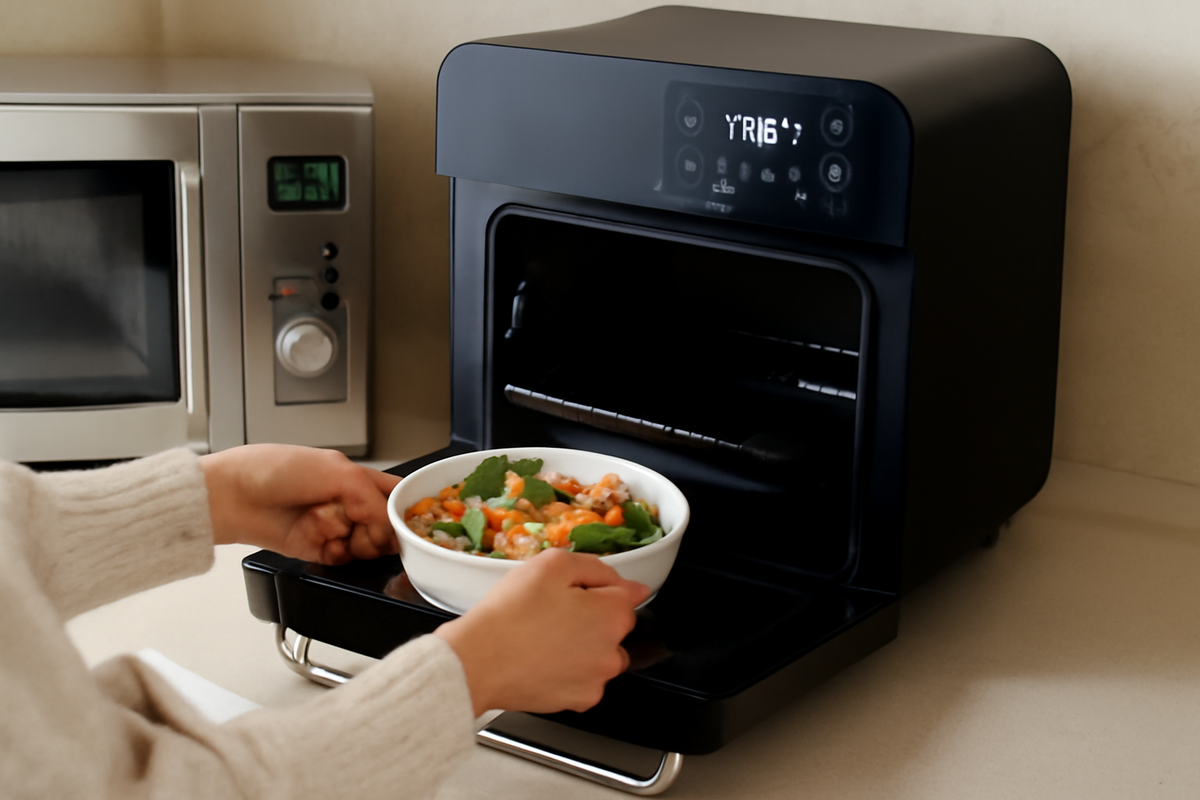
Enter the modern countertop convection oven and its slick cousin, the hybrid air fryer–oven. These aren’t just “toaster ovens 2.0.” They are compact, powerful, and surprisingly smart machines that use circulating hot air, precise temperature control, and, in many cases, steam or multiple heating modes to cook food faster and better than a microwave ever could.
Imagine this: instead of microwaving last night’s roast chicken into a dry, chewy disappointment, you slide it into a countertop oven set to convection reheat. A fan whirs softly as hot air wraps around the meat, crisping the skin back to a golden, shattering crunch while the inside warms gently. It comes out tasting almost like it did the first night—moist, rich, fragrant. No rubber, no mystery hot spots, no “this is fine, I guess” resignation.
That’s the quiet revolution happening in modern kitchens: we’re realizing that convenience doesn’t have to mean compromise.
The science of why food tastes better
If microwave cooking has always felt a little…off, there’s a reason. Microwaves work by exciting water molecules inside your food. That rapid movement turns to heat, but it doesn’t encourage browning, caramelization, or crisping—the things that make food smell incredible and taste complex. A microwave heats fast, but it doesn’t really cook in the full, sensory sense of the word.
Convection ovens and air fryer–ovens work differently. They rely on a heating element and a powerful fan to circulate hot air around the food. That air wraps around every surface, searing, browning, crisping. The result is texture. Think blistered edges on roasted vegetables, bronzed chicken skin, bubbling cheese on lasagna—all impossible to get from a microwave alone.
There’s something innately satisfying about the sound and scent of that kind of cooking. The faint crackle you hear when a tray of potatoes hits 400°F. The rising wave of garlic and thyme from a pan of roasting carrots. The glow from the oven door as fat hisses and spits, turning into flavor.
And yet, these modern appliances still keep the one thing we originally fell in love with the microwave for: speed.
| Feature | Microwave | Convection / Air Fryer Oven |
|---|---|---|
| Primary Heating Method | Microwaves exciting water molecules | Heated coils + circulating hot air |
| Texture | Soft, often soggy; no browning | Crisp, browned, caramelized surfaces |
| Reheating Quality | Uneven, can dry out food | Even heating, restores texture and flavor |
| Cooking Versatility | Mostly reheating, defrosting | Roasting, baking, grilling, air frying, reheating |
| Energy Use (per meal) | Low, but limited results | Often more efficient than a full oven, better results |
1. Convenience without the compromise
Picture a Tuesday night. You’re hungry, tired, borderline grumpy. In the past, you’d toss a container of leftovers into the microwave, poke a few buttons, and eat something hot but uninspiring in front of your laptop. Now, imagine pulling the same leftovers—a slab of lasagna, maybe—from the fridge and sliding it into a compact convection oven instead.
You press “reheat,” maybe adjust the temperature slightly. In minutes, the cheese is bubbling again, the edges are crisping, the sauce is hot all the way through instead of volcanic in one corner and lukewarm in the middle. You carry it to the table, and for a moment, it feels less like reheating and more like reviving.
Modern countertop ovens are built around this idea: preserving the soul of the original meal. Pizza gets its crunch back instead of turning limp. Fries resurrect into crisp golden batons. Roasted vegetables remain caramelized and tender, not shriveled and sad.
The convenience is still there—no one is asking you to slow-roast a chicken after work—but the gap between “fast food” and “good food” narrows dramatically.
2. A new kind of everyday cooking
Spend a week with a good air fryer–oven and you start to notice your habits changing. That bag of frozen vegetables you used to steam into mush in the microwave? Now you toss them with a bit of oil, salt, and pepper, spread them on a tray, and 12 minutes later you have charred, sweet, roasty broccoli or carrots that taste like they came out of a full-size oven.
A handful of chickpeas becomes a pan of crispy snacks. A fillet of salmon, brushed with lemon and herbs, emerges with a flaky interior and a delicately crisp top in under 15 minutes. Breakfast potatoes. Toasted nuts. Whole baked sweet potatoes, their centers sticky and caramel-sweet. Things you’d never bother with on a busy night suddenly feel incredibly doable.
There’s a sensory shift too. You start to cook by sound and smell again. The quiet white noise of the fan becomes background music. The aroma of roasting food sneaks down the hallway, pulling people into the kitchen. With a microwave, food appears—hot, yes—but almost sterile in process. With convection, there’s a small ritual, a gentle patience, even if it’s still all done in under half an hour.
And for those who feel guilty firing up a giant oven just to bake a single chicken breast or handful of vegetables, the countertop option feels efficient, almost economical—heat where you need it, when you need it, and nowhere else.
3. The energy and space equation
Modern life has its own strange math. We’re juggling rising energy costs, shrinking apartments, and a growing desire to cook real food instead of relying on takeout. In that equation, the microwave has long been the default answer: small footprint, low electricity use, good enough.
But “good enough” starts to look less appealing when a single appliance can now perform most of the tasks of a full oven—roasting, baking, reheating, even dehydrating—while still taking up less space than a standard microwave and often using less energy than preheating a big, empty box of steel.
Many convection and air fryer–ovens heat up rapidly, sometimes within just a couple of minutes. That intense, focused heat means shorter cooking times and fewer wasted watts. Instead of preheating the main oven for 20 minutes to bake a small batch of cookies or roast a tray of vegetables, you flick on the countertop oven and you’re basically ready to go.
In small urban kitchens, van-life conversions, tiny homes, and dorms, people are discovering they can skip a traditional oven entirely. A good convection or air fryer–oven plus a portable cooktop or induction burner becomes a complete cooking setup. The microwave, once the champion of cramped spaces, suddenly finds itself demoted.
4. The taste of intention
What we cook and how we cook it says something about the kind of life we’re trying to create. Microwaves emerged from an age obsessed with speed and novelty—TV dinners, instant ramen, powdered mashed potatoes. Food was fuel, convenience was king, and texture and nuance were optional at best.
Today, even those of us with the busiest schedules are reaching for something a little different. We scroll through photos of blistered sourdough, caramelized sheet-pan dinners, and golden roast chickens on our phones. We want food that feels alive, imperfect, a little handmade. We crave crunch, fragrance, char. We want vegetables that taste roasted from the inside out, not just warmed on the surface.
A convection or air fryer–oven nudges us gently in that direction with almost no extra effort. It makes it easier to eat roasted vegetables instead of nuked ones, crispy tofu instead of pale cubes, revitalized leftovers instead of limp ones. It invites us to season, to drizzle, to think about heat and time, even in small ways.
You can feel the difference in the first bite of an air-fried potato wedge—hot, crunchy, steaming, a faint echo of a real gastropub fry instead of a microwave-soft cube. Or in a slice of reheated pizza whose crust crackles as you fold it, cheese strings stretching luxuriously instead of congealed into a sad rubber sheet.
This isn’t about gourmet perfection. It’s about everyday pleasure, about food that feels like it’s taking care of you instead of just keeping you going.
5. So, is it really time to say goodbye to the microwave?
Here’s the honest part: some people will keep their microwaves, and that’s fine. If you live on instant oatmeal, reheat coffee three times a morning, or rely heavily on certain packaged convenience foods, a microwave still has its uses. It excels at super-quick warming of liquids, steaming some vegetables in a pinch, or softening butter in 20 seconds flat.
But for more and more households, the question is shifting from “Do I need a microwave?” to “What if I didn’t?” What if the thing that took up that precious square of counter space actively made my meals better instead of just faster?
For plenty of people, the transition happens gradually. The microwave gets used less and less as the shiny new oven takes over reheating, then roasting, then baking. Weeks go by and the microwave door stays closed. It becomes, first, a glorified bread box or storage unit. Then, one day, it quietly disappears during a kitchen reorganization or move—and no one really misses it.
In its place is something that hums with a different promise: the promise that weeknight meals can be both fast and deeply satisfying, that leftovers can taste like second acts instead of reruns, that even a solo dinner eaten in sweatpants on the couch deserves crunch and color and that warm kiss of real heat.
Standing in front of a modern convection or air fryer–oven, watching through the glass as your food transforms, there’s a small, grounding joy in it. You can see the edges of bread turning gold, hear the hiss of fat on a sheet pan, smell the sugars in carrots or onions beginning to caramelize. It tugs you back into the moment, away from screens and deadlines, and into the simple magic of heat and time.
That might be the biggest reason these modern appliances are quietly replacing microwaves: not just because the food tastes better, but because the act of cooking—even quickly, even simply—feels better too.
Frequently Asked Questions
Can a convection or air fryer–oven fully replace my microwave?
For many people, yes. You can reheat leftovers, cook frozen foods, bake, roast, and even toast. The main thing you might miss is ultra-fast tasks like heating a mug of water or softening butter in seconds. If you rarely do those, you probably won’t miss the microwave.
Isn’t an air fryer just a small convection oven?
Essentially, yes. Most air fryers are compact convection ovens with powerful fans. Hybrid models that look like toaster ovens often give you more space, more control, and more versatility than basket-style air fryers.
Does food really taste that much better than microwave cooking?
In most cases, absolutely. Anything that benefits from crisping, browning, or even heating—pizza, vegetables, chicken, potatoes, baked goods—comes out noticeably better from a convection or air fryer–oven than from a microwave.
Will using a countertop convection oven use more energy than a microwave?
Per minute, a microwave may use less energy. But because a convection or air fryer–oven cooks more efficiently and can often replace a full-size oven for many tasks, your overall energy use can be similar or even lower, especially if you’re not heating a large oven for small meals.
How long does it take to reheat leftovers compared to a microwave?
Reheating is usually a bit slower—think 6–10 minutes instead of 2–3—but the results are dramatically better. Many people find the slight extra wait is worth it for revived texture and flavor instead of soggy, unevenly heated food.

Hello, I’m Mathew, and I write articles about useful Home Tricks: simple solutions, saving time and useful for every day.