The first frost hadn’t yet glazed the raised beds white, but the air already tasted of metal and woodsmoke. You stood at the garden’s edge, hands jammed into your sleeves, looking at those neat wooden rectangles of soil that had fed you so generously all summer. Now they were just…bare. Stripped tomato vines, collapsed bean trellises, a few stubborn marigolds bending under the weight of cold dew. It felt like the garden was exhaling its last warm breath of the year.
You almost turned back inside, toward the kettle and the promise of evening. But then you noticed the corners of your beds—the thin, unused strips of soil right along the edges. Wasted space, you thought. Or maybe, a perfect place to tuck in something quiet but powerful. Somewhere between the rustle of drying leaves and the crow’s call from the telephone wire, a small, practical idea arrived with surprising force: this is where the garlic goes.
The Quiet Experiment at the Bed’s Edge
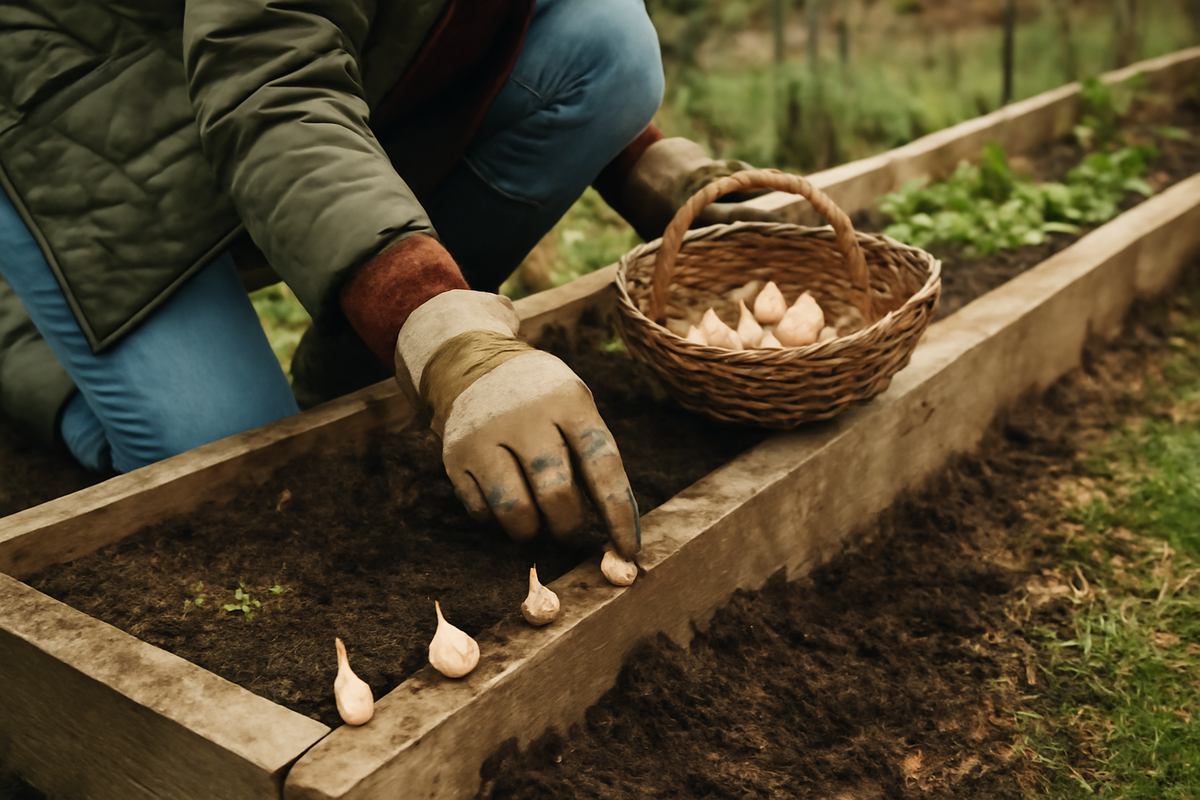
The first time you plant garlic along the edge of a raised bed, it feels almost like a side thought. Not the center-stage crop with labeled rows and careful spacing—just a fringe, a living border pressed into the margins of your garden. You break open the papery bulbs, feel each clove under your thumb, and push them into the soil like you’re pressing secret messages into an envelope.
The world above ground is preparing to sleep, yet you’re doing the opposite—sowing something that belongs to winter. It’s a strange kind of rebellion against the instinct to “put the garden to bed” and forget about it until spring. But garlic is different. It doesn’t just endure winter; it uses winter. And when you line it up along the edges of your raised beds, it quietly goes to work on more than just next summer’s harvest. It starts reshaping the very health of your soil in the cold months when everything looks still.
Planting garlic at the edges isn’t simply about squeezing in one more crop. It changes wind patterns over the soil. It shifts how moisture holds or drains away. It invites some underground residents and discourages others. It’s a living, slow-motion transformation that happens when no one’s looking—except you, if you’re curious enough to keep watching the empty-looking beds through winter.
Why the Edge is Where the Magic Happens
In nature, edges are where things get interesting. Forest meets meadow. Stream meets bank. Light meets shade. These transition zones, ecologists will tell you, are full of life and complexity. Your raised bed has an edge, too—a literal boundary where soil meets air, where wood or stone meets the living earth.
When that edge is bare in winter, it’s vulnerable. Cold wind whips over the top, drying out the surface. Heavy winter rains can wash fine particles away. The top layer of soil microbes—the tiny workers that decompose organic matter and release nutrients—can be battered by freeze-thaw cycles like an unprotected skin chapped by the wind.
Now imagine those same edges lined with garlic: narrow upright leaves piercing snow, small green spears that act like miniature windbreaks. Each clove you planted becomes a stake in the ground that says, “Hold this place together.” The soil right around the roots doesn’t shift so easily. Water that might have skittered across the surface instead slows down, seeps in, and lingers. Microbial life has something to gather around—roots that leak sugars and other exudates into the soil all winter, feeding invisible communities that don’t show up on seed packets or in glossy catalogs.
Edges are also where temperature swings can be most extreme in raised beds, especially the parts closest to the wooden or metal frame. Planting garlic there adds a living buffer. Root systems help moderate those swings by keeping the soil structured and aerated. That structure matters: instead of solid blocks of frozen mud, you get a crumbly, frost-tilled matrix. Come spring, when you slide a trowel into the bed, you’ll feel the difference—less resistance, more resilience.
Winter Roots, Living Soil
Garlic doesn’t rush. After you press the cloves into the soil in fall—flat side down, pointy side up, like little white boats—it takes a moment to wake up. Roots slip into the cool earth before the real freeze begins, establishing delicate networks that will hold firm all winter long. Above ground, there may be only a tuft of green by the time snow comes. Below ground, an entire story unfolds.
Roots are not just anchors. They’re feeders and communicators, dripping tiny amounts of sugars, amino acids, and organic compounds into the surrounding soil. Microbes gather like birds around a feeder, consuming those offerings and, in return, unlocking minerals and nutrients that will later be available to the garlic—and, indirectly, to whatever you plant nearby in spring.
By planting garlic along the edges rather than in the main body of the bed, you do something clever: you reserve the center for your spring crops while still keeping the biological engine of the bed humming all winter. The outer ring becomes a winter workshop where earthworms, fungi, and bacteria keep turning the slow gears of decomposition and nutrient cycling. Fallen leaves tucked between the garlic rows break down more efficiently. Bits of leftover mulch don’t just sit; they transform.
Garlic is also famously antimicrobial, but in the soil, that doesn’t mean it wipes everything out. Instead, it seems to nudge the underground community, suppressing certain plant pathogens and encouraging a more balanced microbial mix. It’s less of a scorched-earth warrior and more of a skilled mediator, quietly reducing the odds that disease-causing organisms will take over the bed during winter’s lull.
Practical Magic: How Edge Garlic Changes Your Whole Bed
There’s something uniquely satisfying about planting a crop that works the night shift in your garden. The effects of edging your raised beds with garlic don’t shout; they show up as a series of small but meaningful changes that you notice over time.
| Edge Garlic Effect | What You Notice in Winter–Spring |
|---|---|
| Better soil structure | Soil is crumbly, not compacted; trowel slides in easily. |
| More active soil life | More worms under mulch, faster breakdown of leaves. |
| Improved drainage and moisture balance | Less standing water, soil not as soggy or cracked. |
| Pest discouragement | Fewer vole tunnels and less nibbling at roots near edges. |
| Nutrient cycling during the “off season” | Beds feel “ready” earlier; early greens establish quickly. |
Over a few seasons, you may notice that the “good soil” no longer lives only in the middle of the bed. It creeps outward. That once-neglected strip along the walls starts to look darker, more alive. Even crops that don’t directly follow garlic in rotation seem to benefit when grown near those worked-over edges.
There’s another practical layer to this: raised beds often dry out and warm up earlier than in-ground plots, but their rims can be the harshest spots—exposed, wind-scoured, and temperature-fluctuating. Garlic doesn’t mind this as much as more delicate crops. By letting garlic claim that border real estate, you turn a problem zone into a productive one. You also simplify your planning: the edges become your perennial fall-planting zone, while the center stays flexible for rotation and experiments.
Edge Planting Without Losing Space
There’s a worry that tends to surface at this point: if garlic is along the edge, will it compete too much with everything else? In practice, the opposite often happens. Rather than hogging resources, edge garlic tends to define boundaries in a way that helps you organize the bed more intuitively.
You plant your spring peas or lettuce in the middle, and the garlic is simply there—like a fence line but alive. Its roots mostly work the outer lane, while your annuals focus more on the interior. You can weave around the garlic when you water or mulch, and by the time summer’s crops start reaching for the sun, the garlic is close to harvest. You pull it, hang it to dry, and suddenly your edges are open again, refreshed and enriched.
The Sensory Ritual of Planting Garlic in Fall
On the surface, planting garlic sounds mechanical: break bulbs, space cloves, bury, done. But step into the garden on a cool fall afternoon, and it becomes something else entirely—a kind of quiet ritual you might even start to look forward to more than the bright chaos of spring sowing.
You kneel beside the raised bed and press your hands into the soil. It’s cooler now, denser, smelling less of summer’s sweetness and more of mineral and leaf mold. You feel the rough grain of the wooden frame under your palms as you measure out a finger’s width from the edge, then another. Each clove is roughly the length of your thumb from knuckle to tip apart from its neighbor. You tuck it in carefully, point upward, like planting a small arrow aimed at next year.
There’s a sound to it—the quiet click of clove against stone, the hush of soil falling back into place, the soft thud of your palm patting it firm. Above you, the sky might be pewter gray, a flock of birds stitching its way south. Or maybe the low sun is turning every dry stem into a shard of gold. Either way, you’re doing winter work: different from spring’s urgency, slower and more deliberate.
By choosing the edges, you move in a pattern that traces the shape of your beds. You follow their lines, walking the perimeter, making small, repeated gestures that feel almost meditative. When you finish and dust off your knees, the garden doesn’t look dramatically changed—just a few barely visible rows hugging the borders. Yet you know what’s under there. You’ve drawn a green outline around the blank canvas of winter.
Designing Your Winter-Ready Raised Beds
Once you’ve tried edge garlic in one bed, it’s hard not to imagine it everywhere. It’s easy to go overboard, of course, but there’s a tidy kind of pleasure in mapping out where those cloves will go year after year. You might start to think of each bed not as a seasonal project but as a continuous cycle with a clear winter strategy.
In autumn, your steps might follow a rhythm:
- Clear the summer crops, leaving roots in place where possible.
- Loosen the soil lightly near the edges, being careful not to overwork it.
- Plant garlic cloves in a single or double row along each side, a short distance from the wooden frame.
- Tuck in a thin blanket of straw or shredded leaves, enough to protect but not smother.
You’re not just planting; you’re sketching the outline of next spring’s beds. Maybe the center will hold spinach and radishes first, then give way to peppers and basil. Maybe you’ll dedicate one bed to early carrots, whose fine roots will love slipping into the already-aerated soil. Whatever you choose, you start from an advantage: your winter garlic has been working behind the scenes, keeping the soil alive while everything else took a break.
There’s a subtle psychological benefit, too. A raised bed with edges full of garlic never looks entirely abandoned. Even in January, when snow blurs the corners and the garden path is hardened with frost, you know there are living things awake under there. Instead of seeing your garden as something that “shuts down” at the first freeze, you begin to see it as a year-round collaborator, always doing something even when your hands are mostly wrapped around a mug indoors.
Garlic as Winter Guardian of the Garden
With time, garlic at the edge starts to feel less like a clever trick and more like installing guardians along the border of your garden. They’re not dramatic. They don’t demand much. But they watch over the soil in a season when most of us aren’t watching.
On a thaw day in February, when you venture out to check on things, those guardians are the first to speak. A faint, green blade here. Another there, leaning against a melting shard of ice. You brush aside a bit of mulch and see bright new growth pushing up through the sleepy brown. The soil around them isn’t lifeless; it’s laced with worm castings and the fine threads of fungal networks. The bed is not waiting for spring to turn on the engine. It’s already idling, warm and ready.
By the time you harvest those garlic heads in early summer, you’ll have forgotten, a little, that they were ever a winter project. You’ll be thinking of garlic butter and braided strings and the pleasure of peeling back those papery wrappers. But if you pause and remember the way your raised beds looked in late autumn—edges lined with possibility rather than emptiness—you’ll understand why the soil feels different now, why it’s darker, looser, more fragrant when you dig.
Planting garlic at the edge of raised beds is a simple gesture. No special equipment, no rare seed, no complicated timing. Just cloves, soil, and intention. But in that quiet, edge-hugging line of plants, you’re doing something profound: you’re refusing to let winter be dead time for your garden. You’re inviting life to stay and work through the coldest months, right up to the margins of your beds.
And as you stand there on a chilly fall evening, pushing those last few cloves into the darkening soil, the garden doesn’t feel like it’s ending anymore. It feels like it’s turning the page.
Frequently Asked Questions
When is the best time to plant garlic along raised bed edges?
Plant garlic in fall, typically 2–4 weeks before your ground freezes hard. The goal is to give the cloves time to root, but not enough warmth to sprout tall green growth that could be damaged by deep freezes.
How close to the edge of the raised bed should I plant garlic?
Aim to plant cloves about 2–3 inches (5–7 cm) in from the inside of the bed frame. This keeps them from drying out against the wood or metal while still claiming the edge space efficiently.
Will garlic along the edge compete with my spring crops in the middle?
Competition is usually minimal if you keep spring crops more toward the center. Garlic roots work mostly in the outer lane, and garlic is harvested by early summer, freeing up edge space for later plantings.
Do I need to mulch garlic planted at the edges?
Yes, a light mulch of straw, shredded leaves, or grass clippings helps regulate soil temperature, reduce erosion, and protect cloves from freeze-thaw heaving. Keep mulch loose so new shoots can push through.
Does edge-planted garlic really improve winter soil health?
While you won’t see instant miracles, gardeners commonly notice better soil structure, more visible soil life, and improved moisture balance in beds where garlic grows through winter. Its root activity and living presence help keep the soil biologically active during the cold months.
Can I plant other crops along the edges with garlic?
You can, but it’s often simplest to let garlic own the edges in winter, then follow it with shallow-rooted summer crops like leafy greens or flowers after harvest. Rotating edge crops year to year also helps maintain long-term soil health.

Hello, I’m Mathew, and I write articles about useful Home Tricks: simple solutions, saving time and useful for every day.