The first thing you notice is the sound—the soft, eager hiss of sliced zucchini meeting a pan of hot olive oil. The kitchen smells like late summer in an old Mediterranean village: green, peppery, a little grassy, like crushed leaves on a sunburned hillside. For years you’ve heard the warnings in your head: “Never fry with olive oil. It’s dangerous. It turns toxic. It loses all its goodness.” Yet here you are, wooden spoon in hand, watching the oil shimmer and wondering: have we been getting this all wrong?
The origin of the “never fry with olive oil” myth
If you grew up in a health-conscious household in the last few decades, olive oil probably came with instructions: Use it raw. Keep it away from heat. Save it for salad. Somewhere along the way, olive oil was framed as too delicate—something that should never go near a sizzling pan.
The story usually went like this: olive oil has a “low smoke point,” and once it starts to smoke, it creates harmful compounds and loses all its heart-protective powers. vegetable and seed oils were marketed as “better for cooking,” more “stable,” more “professional.” Olive oil was relegated to the quiet corners of vinaigrettes and bread dipping saucers.
This belief spread so far and so fast that it almost became a rule. Yet it also carried a strange contradiction. Visit Italy, Greece, or southern Spain, and you’ll find grandmothers—living into their nineties—frying fish, eggplant, potatoes, even desserts, in olive oil without a trace of anxiety. The villages with some of the longest-living populations on earth have been casually using olive oil for practically everything, including frying, for generations.
So how do we reconcile the “never heat it” rule with real life in Mediterranean kitchens? To answer that, we have to understand what actually happens to olive oil when it hits the pan—and what modern food science has finally been able to prove.
What really happens when olive oil meets heat
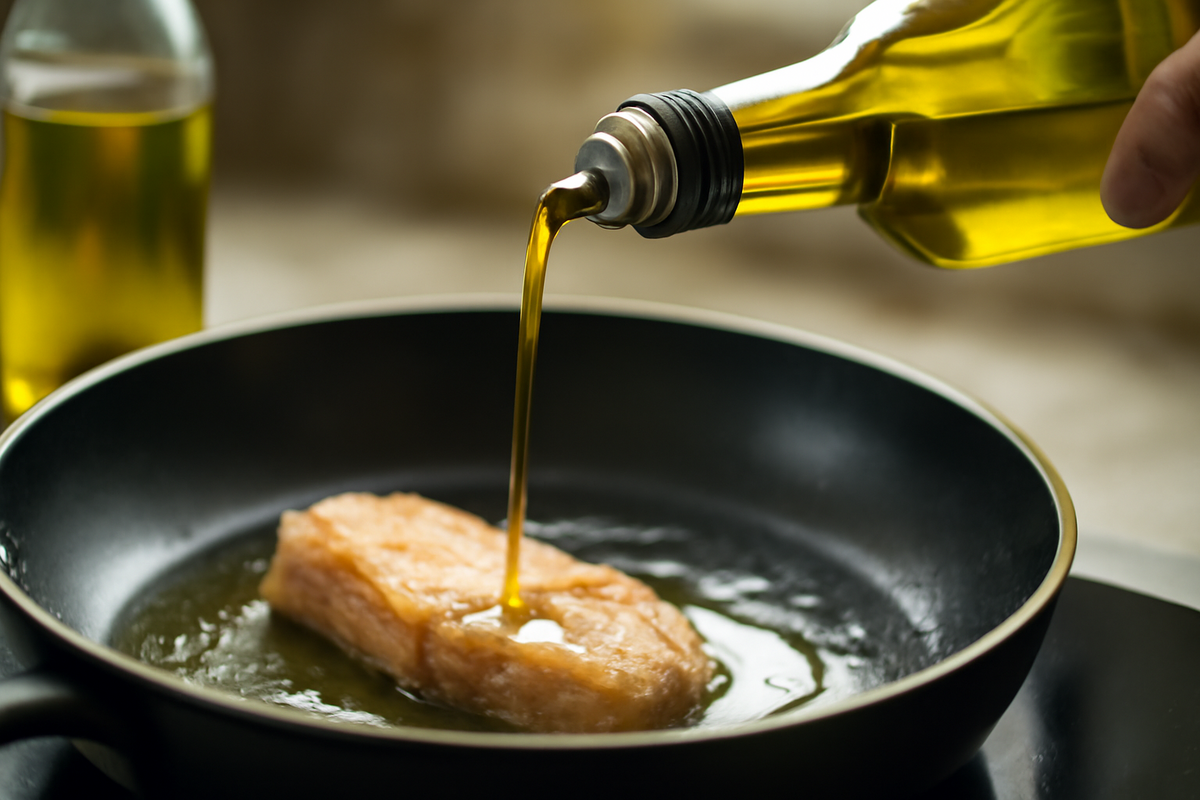
Picture a pan on the stove, medium-high heat. You add a glug of extra virgin olive oil. It spreads in a thin, golden film, then begins to shimmer—tiny ripples dancing across the surface. That shimmer is a visual cue: the oil is hot enough to cook with, but not yet smoking.
The smoke point—the temperature at which an oil starts to visibly smoke and break down—is where most of the fear comes from. People often claim olive oil has a very low smoke point, around 160–170°C (320–338°F). But those numbers are usually based on old data, low-quality oil, or misinterpretation.
Modern tests show that good extra virgin olive oil typically has a smoke point between about 190–210°C (374–410°F). Refined or “light” olive oil can go even higher. And typical home frying—sautéing vegetables, flipping eggs, cooking fish—happens somewhere between 160–190°C (320–374°F). That means, in most home kitchens, you’re cooking below the point where extra virgin olive oil starts to smoke.
But the more important question isn’t just about visible smoke. It’s about something you can’t see: oxidation. When oils heat up, their molecules can react with oxygen, forming compounds like aldehydes and polar compounds that, in excess, may stress the body or contribute to inflammation over time. The oils most vulnerable to this are those full of delicate polyunsaturated fats—like many common seed and vegetable oils.
Olive oil, by contrast, is dominated by monounsaturated fat, a more stable type. It’s also naturally rich in antioxidants and polyphenols. These act like tiny guardians in the pan, slowing down damage when the oil is heated. In simple terms: good olive oil comes with its own internal fire extinguisher.
The science vs. the sizzle: is olive oil safe for frying?
In recent years, food scientists have put various cooking oils through their paces in the lab—heating them for long periods, testing them at frying temperatures, and measuring what actually forms under real cooking conditions.
The findings challenge a lot of what we’ve been told. In one much-discussed line of research, oils like sunflower and canola produced more harmful oxidation products than extra virgin olive oil when subjected to prolonged high heat. Olive oil consistently formed fewer potentially harmful compounds and remained more stable, even when heated for longer than you ever would at home.
Part of this comes down to fat structure: olive oil’s high monounsaturated fat content simply doesn’t break down as readily. Part of it is the built-in polyphenols—those peppery, slightly bitter compounds that you taste in good extra virgin olive oil when it hits the back of your throat. They do more than add flavor. They’re working quietly to keep the oil from degrading.
Of course, overheated oil—any oil—isn’t ideal. If you’re pushing the heat until your kitchen fills with smoke, the oil starts to darken, or you’ve reheated the same pan of oil many times, you’re venturing into territory where degradation ramps up. But this isn’t unique to olive oil. It’s a universal rule: if it’s smoking and burning, it’s not doing you any favors.
For most everyday uses—shallow frying, stir-frying, sautéing—extra virgin olive oil holds up well. Not just adequately; in many cases, better than the supposedly more “neutral” or “high-heat” oils lining supermarket shelves.
Flavor, texture, and the magic of Mediterranean frying
Beyond chemistry, there’s an entirely different side to this story: how frying with olive oil feels, tastes, and transforms food.
Imagine sliding a fillet of fish into a pan of hot olive oil. The edges gently bubble. The kitchen fills with a savory aroma, a mix of sea breeze and cut grass. The fish takes on a delicately crisp exterior while staying tender inside. A squeeze of lemon, a scattered handful of parsley, and you’ve recreated a scene that plays out daily in small coastal tavernas.
Olive oil brings a kind of layered flavor to fried foods that’s hard to match. It adds a subtle fruitiness to crispy potatoes, a roundness to zucchini fritters, a depth to eggs that makes them feel almost luxurious. It carries herbs and spices beautifully—garlic infused in warm olive oil, chili flakes blooming gently in its heat, rosemary needles sizzling until fragrant.
The key is balance. When you’re frying with extra virgin olive oil, you don’t need aggressively high heat. Medium to medium-high is often enough. You’re looking for that poised point where food sizzles the moment it touches the pan but doesn’t splatter violently or instantly burn at the edges.
This is what Mediterranean cooks have intuitively mastered. They don’t fuss over precise temperature numbers. They watch, listen, and smell. When the oil ripples and a test piece of bread or vegetable starts to bubble immediately—but not fiercely—they know the pan is ready.
Used this way, olive oil doesn’t just survive frying; it elevates it. The food absorbs some of the oil’s beneficial fats and flavors. Meanwhile, the oil itself, though it will lose some of its delicate aromas and a portion of its polyphenols with heat, still retains a meaningful part of its healthful profile.
Isn’t olive oil “too expensive” or “wasteful” for frying?
There’s another practical myth that keeps people from frying with olive oil: the idea that it’s a luxury ingredient meant only for drizzling, and that using it in a pan is somehow extravagant or wasteful.
Yet, if you look at traditional Mediterranean kitchens—often far from wealthy—olive oil is treated less like a rare treasure and more like a daily staple. It’s stored in big cans or bottles. It’s used liberally, yes, but also thoughtfully.
You don’t need an ultra-fancy, competition-winning, green-gold olive oil for frying. Reserve those intensely aromatic bottles for finishing—on soups, on grilled vegetables, on fresh bread. For daily frying, a good, honest extra virgin or even a quality, refined olive oil (sometimes labeled “pure” or “light”) works well. It offers stability, mild flavor, and a more accessible price point.
There’s another surprise: fried food doesn’t necessarily soak up more olive oil compared to other fats. If the oil is properly heated before adding the food, the outer surface of what you’re frying quickly seals, limiting absorption. Lukewarm oil, on the other hand, tends to make food greasy—regardless of the type.
In many home kitchens around the Mediterranean, people even reuse olive oil for multiple frying sessions, so long as it hasn’t been overheated or burned, and has been strained of crumbs. While it’s ideal from a health standpoint to keep re-use limited, thoughtful use and moderate re-heating can still fit into a realistic, balanced approach to cooking.
Health reality check: benefits, limits, and best practices
So where does all of this leave us? Is frying with olive oil a short-lived fad, a dangerous habit, or a legitimate part of a healthy kitchen?
The strongest signal comes not from any single study, but from the everyday lives of millions of people who have, for generations, cooked this way. The Mediterranean diet—rich in vegetables, legumes, whole grains, fish, and olive oil, including in cooked and fried dishes—is consistently associated with lower rates of heart disease, better metabolic health, and longer life expectancy.
No, that doesn’t mean you should deep-fry everything and expect a halo of health just because you used olive oil. But it does mean that frying and health are not mutually exclusive—especially when you pair the right oil with the right technique and the right overall eating pattern.
Here’s a simple way to compare common cooking oils for home frying at a glance:
| Oil | Main Fat Type | Typical Smoke Point* | Stability When Heated | Best Use at Home |
|---|---|---|---|---|
| Extra virgin olive oil | Mostly monounsaturated | ~190–210°C (374–410°F) | High, thanks to antioxidants | Sautéing, shallow frying, roasting |
| Refined / “light” olive oil | Mostly monounsaturated | ~220–240°C (428–464°F) | High | Higher-heat frying, baking |
| Sunflower or corn oil | High polyunsaturated | ~220–230°C (428–446°F) | Lower; more prone to oxidation | Occasional high-heat frying |
| Canola (rapeseed) oil | Mixed mono + polyunsaturated | ~200–230°C (392–446°F) | Moderate | General cooking, baking |
| Coconut oil | Mostly saturated | ~175–200°C (347–392°F) | High, but very different fat profile | Occasional frying, baking |
*Approximate ranges; actual smoke point varies with quality, refinement, and impurities.
Within this landscape, extra virgin and refined olive oils both stand out as strong, stable options for most types of home frying. The choice between them can be practical: extra virgin for flavor-forward dishes at moderate heat, refined olive oil for higher-heat or more neutral-tasting applications.
How to fry with olive oil the smart, healthy way
To let olive oil shine in your pan without losing its best qualities, a few simple guidelines help:
- Keep the heat moderate to medium-high, not maximal. If your oil is smoking heavily, it’s too hot—turn it down or start again.
- Preheat the oil before adding food. A small test—like dipping in a corner of bread or a single vegetable slice—is enough. It should bubble gently, not sit flat or explode with ferocity.
- Use fresh, good-quality oil. Rancid or very old oil is already oxidized before it meets the pan. Store olive oil away from heat and light.
- Avoid reusing oil many times over. If the oil looks very dark, smells off, or has a thick, sticky feel, it’s time to discard it.
- Pair frying with a generally plant-forward plate. A fried zucchini or fish, served with a big salad, beans, or whole grains, looks very different nutritionally from a fast-food style deep-fried meal.
Used this way, frying with olive oil becomes less like a guilty pleasure and more like an art—one grounded in both tradition and modern evidence.
So, myth or health boon?
The old warning—“never fry with olive oil”—turns out to rest more on half-remembered lab numbers and marketing than on real-world cooking. It confused the idea of smoke point with safety, ignored the protective role of antioxidants, and overlooked the lived experience of entire food cultures.
No oil is perfect, and none is a magic shield against poor diet overall. But in the hierarchy of everyday cooking fats, olive oil—and especially good extra virgin olive oil—sits in a rare sweet spot: flavorful, relatively stable when heated, and backed by decades of research linking it to better heart and metabolic health.
Imagine returning to that pan of zucchini from the beginning. They’re golden now, with just-charred edges. You shower them with salt, maybe a squeeze of lemon, maybe a grating of garlic or a handful of mint. You taste one straight from the pan; it’s soft inside, crisp at the edges, wrapped in a gentle, fruity richness that only olive oil can give.
This is not the enemy. This is a piece of a larger, more generous way of eating—one where we trust both our senses and the steady accumulation of real evidence. Fry with olive oil thoughtfully, and it’s not a crime against health. It’s closer to a quiet celebration of it.
Frequently Asked Questions
Does heating olive oil destroy all its health benefits?
No. Heating olive oil does reduce some of its delicate antioxidants and aromas, especially at higher temperatures or over long cooking times, but it does not erase all of its benefits. Even after cooking, olive oil still provides mostly monounsaturated fat, which is linked with better heart health. Using moderate heat and avoiding burning helps preserve more of its good qualities.
Is extra virgin olive oil safe for frying, or should I use refined olive oil instead?
Extra virgin olive oil is safe for most home frying—sautéing, shallow frying, stir-frying—at moderate to medium-high heat. If you regularly cook at very high temperatures or want a more neutral flavor, refined (“light”) olive oil is also a good option. Many people keep both on hand: extra virgin for flavor and finishing, refined for higher-heat applications.
What happens if olive oil starts to smoke in the pan?
If your olive oil is lightly smoking, it means the temperature is higher than ideal. Turn down the heat and let it cool slightly before adding food. If it smokes heavily, darkens significantly, or smells burned, the oil is degrading. It’s best to discard it, wipe the pan, and start again to avoid off-flavors and unnecessary breakdown products.
Is deep-frying in olive oil healthy?
Deep-frying—no matter the oil—adds a lot of calories and should be an occasional technique rather than a daily habit. That said, if you choose to deep-fry, olive oil is a relatively stable option compared with many seed oils. Keeping the temperature controlled (not excessively hot), avoiding repeated re-use of the oil, and pairing fried foods with plenty of vegetables and lighter meals helps keep it in balance.
How can I tell if my olive oil is good for cooking?
Look for olive oil that smells and tastes fresh, not waxy, flat, or like crayons or old nuts. A gentle peppery or slightly bitter note is normal in extra virgin olive oil and signals the presence of polyphenols. Store it in a cool, dark place with the cap tightly closed, and try to use it within a few months of opening. If the oil smells rancid or stale, it’s best not to cook with it.

Hello, I’m Mathew, and I write articles about useful Home Tricks: simple solutions, saving time and useful for every day.