The first time I heard someone say, “Forget the foil behind your radiators—there’s a smarter trick,” I was standing in a narrow hallway, watching my breath fog in the cold air of an old stone house. The radiators were ticking quietly, bravely warm to the touch, and yet the room felt as though it belonged more to late November than to mid-January. The homeowner, a woman in a thick wool jumper, laughed when I asked about the sheets of crinkled foil taped behind each radiator. “That,” she said, “is last decade’s hack. Let me show you what actually works.”
The Myth of the Shiny Shortcut
Foil behind radiators has the kind of appeal you find in old household lore: simple, cheap, reassuringly visible. You can see it glinting back there and believe it must be doing something heroic. The logic sounds tidy enough—stop heat escaping into the wall, reflect it back into the room, job done.
But step into a room that relies on that trick alone and your body tells you the truth long before the energy bills do. The air around you feels uneven, pockets of almost-stuffy warmth followed by currents of cool that lick around your ankles. The radiator might be working; the room is not.
As building science caught up with our improvised hacks, something became increasingly clear: the foil is a distraction from what really governs how quickly and efficiently a room warms up—how the heat moves through the space, how the air flows, how the surfaces and objects in the room store and release warmth. Radiators are not just hot slabs of metal; they’re quiet conductors in a room-sized performance, and most of us have been ignoring the choreography.
That homeowner in the wool jumper understood that, even if she never used the technical language. She didn’t talk about convection currents or thermal mass. She talked instead about “letting the room breathe” and “training the warmth where to go.” And that’s where the smarter trick comes in.
The Smarter Trick: Curating the Heat Path
The trick homeowners now swear by isn’t a single product or a fancy gadget. It’s a small, intentional rearranging of the room to guide the heat where it’s most effective—a quiet, almost invisible “curating of the heat path.” Once you see it, you can’t unsee it.
Stand near a radiator that’s tucked behind a chunky sofa or buried behind heavy curtains. Place your hand just above it. The air there is hot, rising in a wavy column you can almost trace with your fingers. Now take a step back. That rising warmth hits the underside of the windowsill or the back of the sofa and spills sideways, trapped, losing momentum before it has a chance to circulate. Your room isn’t getting the full benefit. You’re heating fabric and furniture more than human beings.
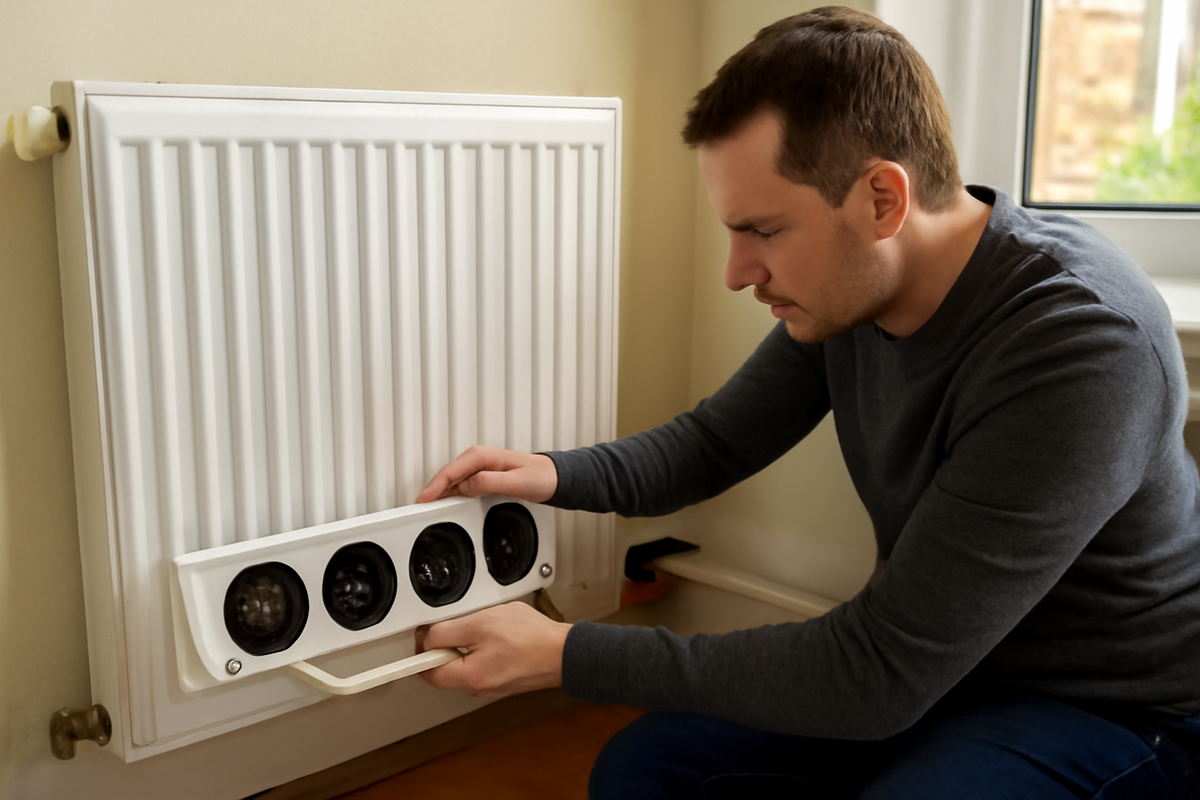
The smarter approach isn’t glamorous: you redesign the flow of warm air. You give the radiator breathing space. You lift curtains just clear of the top of the radiator, nudge furniture away by the width of your palm or a handspan, and, if you’re willing to go a step further, you add a small, low-energy fan to gently push warm air outward. Not a stiff, noisy desk fan blasting your shins—a slow, almost imperceptible push that turns that stagnant pocket of heat into a moving, room-filling current.
In that old stone house, we did exactly that: moved a sofa out by about ten centimeters, clipped the curtains so they ended just above the radiator, and set a silent, low-wattage fan on the floor, angled upwards along the back of the radiator. The temperature sensor on the mantelpiece told the story better than any opinion. The room reached a comfortable warmth nearly a third faster than before, with the boiler cycling off sooner. No shiny foil in sight—just air given permission to move.
The Invisible Comfort You Can Feel
What’s striking about this trick is how it feels before you ever look at the numbers. You walk into the room and notice the difference in your body. Instead of feeling heat clinging shyly to one side of the room, there’s a gentle evenness, as if someone smoothed out the temperature with an invisible hand. Your feet don’t complain as much about the cold floorboards. Your shoulders unknot a little sooner.
That’s not magic. It’s convection—the way warm air rises and cooler air slides in to take its place, a slow, looping current that can either be nurtured or sabotaged. For decades, we’ve unknowingly sabotaged it with what we put around our radiators: furniture pushed tight against them, laundry draped right over them, thick curtains pooling across the floor and swallowing entire columns of rising heat.
Reclaiming that path is the heart of the new wisdom. Homeowners who’ve tried it start talking not about thermostats or boiler brands but about how their rooms suddenly feel “alive,” how the cold corners thaw faster, how the space between two radiators on opposite walls stops being a climatic no-man’s-land. What changed isn’t the source of the heat—it’s the way the room cooperates with it.
Seeing Your Room as a Landscape of Heat
Imagine, for a moment, that your room is a landscape. The radiator is a hot spring on one edge. The window, especially on a winter night, is a glacier—cold, unyielding, quietly pulling warmth from the air that touches it. Interior walls, carpets, bookshelves, even that stack of magazines under the coffee table, are all terrain with different abilities to absorb and release warmth.
When you place a tall sofa directly in front of a radiator, you’re building a cliff in front of your hot spring. The heat pools, stagnates, and warms the back of the furniture like a sunbaked rock face while the rest of the valley shivers. Close heavy curtains over a radiator tucked beneath a window, and it’s like dropping a dam straight into the river of warm air.
The smarter trick is to lower the cliffs, open the channels, and let that invisible river move. Radiators thrive on space: ten to fifteen centimeters of clearance in front, a little room above, and nothing that catches the warm air as it rises. Some people slip simple radiator shelves above them—not for decoration, but as a little overhang that nudges the warm air into the center of the room instead of letting it cling to the cold glass of a window.
And then there’s the quiet star of this story: the low-speed fan. Not a new invention, but newly appreciated. Place it near the base of the radiator, or just in front at floor level, pointed along the length of it. Run it at its gentlest setting. You probably won’t hear it, but you’ll feel the shift within minutes: the warmth stops stacking itself uselessly at the ceiling and gets pulled across the room, passing over couches, chairs, and carpets, sharing itself along the way.
A Small Fan, A Big Difference
In many homes, the addition of a fan feels almost embarrassingly simple. One homeowner, an engineer with a dry sense of humor, called it “teaching my radiator to speak up.” He’d grown tired of the foil and the folklore. Instead, he bought a compact, low-power fan, the kind used to circulate air in small rooms, and pointed it discreetly at the underside of his living room radiator.
He took notes. Before the change, it took nearly an hour for the room to feel comfortably warm on a frosty evening. After the fan joined the cast, the time dropped by about twenty minutes. The thermostat on the wall confirmed it: the air temperature rose more quickly and more evenly. But what won him over wasn’t the data; it was how it felt to walk barefoot across the wooden floor without flinching.
For many people, this is the moment the old foil trick falls away like an outdated superstition. Why chase marginal gains behind the radiator when you can transform how the entire room behaves with a simple shift in airflow? You’re not trying to trap every last micro-degree of heat. You’re trying to help the warmth reach you before it drifts away to the ceiling or into the walls.
| Approach | What It Actually Does | Effect on Warm-Up Speed |
|---|---|---|
| Foil behind radiator | Reflects a small amount of radiant heat if wall is uninsulated | Minor improvement, often barely noticeable |
| Clearing space around radiator | Lets convection currents form freely and spread warmth | Moderate to strong improvement, especially in cluttered rooms |
| Shortened curtains / radiator shelf | Prevents warm air getting trapped against cold windows | Makes warmth feel more even and stable |
| Low-speed fan at radiator | Pushes warm air into the room instead of letting it pool | Often a big improvement; rooms heat noticeably faster |
Listening to the Room: A Simple Reset Ritual
Once you start thinking this way, every room becomes a quiet puzzle: where is the heat being born, and where is it getting lost or trapped? You don’t need specialist tools to solve it—just a bit of curiosity and a willingness to move things around.
Try this simple ritual on the next cold evening. Turn the heating off and let the room cool slightly. Then stand in the doorway and just look. Where are the radiators? Are they hidden behind couches, bookcases, or piles of shoes? Do curtains fall across them like a soft barricade? Is there a cold corner where you always feel the draft first?
Now, imagine the warmth as colored smoke emerging from each radiator, rising and rolling across the ceiling, down the walls, and into the spaces where you sit, eat, or work. Where does that smoke get stuck? Where does it never quite reach?
Shift the furniture just enough to free the radiator’s front and top. Shorten or tie back heavy curtains so they end above the radiator. If you have a small fan, place it near floor level, angled to push air gently across and up past the radiator. Turn the heating on and pay attention—not only to what the thermostat says, but to how the warmth moves over the next half hour.
For many people, the most striking change isn’t the final temperature but the journey. The room feels less like a patchy quilt of hot and cold, more like a slowly rising tide of even comfort. You’re not standing by the radiator to warm your hands anymore; you’re standing anywhere, and it simply feels right.
The Quiet Power of Surfaces
There’s another layer to this story that often goes unnoticed: what your room is made of. Thick bookshelves stuffed with paper, lined rugs, heavy wooden tables—all of these are quiet batteries for heat, absorbing and releasing it over time. When you improve the airflow, you’re not only warming the air faster; you’re charging these thermal “banks” more effectively.
Once those surfaces are warm, they give back to you long after the boiler stops. Sit in a well-warmed room with a solid wooden table and a thick rug underfoot, and you’ll feel the difference between air that’s merely been heated and a space whose very bones are holding onto warmth. That’s why a room with good circulation often feels more comfortable at a lower thermostat setting. The heat has seeped into the fabric of the room, not just skimmed across its surface.
In this light, the foil sheet behind a radiator starts to feel strangely flimsy. It’s trying to salvage a trickle of radiant heat lost into the wall, while the real opportunity is right in front of you: orchestrating how the warmth inhabits the whole space, including the things you touch—the armrest of a chair, the floor under your feet, the books along the far wall.
From Hacks to Habits: A New Way of Warming Up
The shift away from foil and toward smarter airflow isn’t just a new heating “hack.” It’s part of a gentle, growing movement among homeowners who are learning to live with their houses as responsive, changeable environments rather than as static backdrops. People are paying attention to drafts, to where their breath shows up in the morning, to why the corner near the bookshelf always feels colder than the rest.
In conversations over cups of tea and in late-night messages between friends in old houses, these observations add up. “I moved the armchair away from the radiator and, suddenly, my whole evening felt different.” “We put a fan in front of the hallway radiator, and for the first time the stairs don’t feel like a wind tunnel.” These are small changes, but they echo the way we’re learning to renegotiate comfort more thoughtfully, rather than just cranking the thermostat up a notch.
It’s not about perfection, or turning every room into a lab experiment. It’s about noticing that warmth has a personality in your home—sluggish in some corners, restless in others—and giving it just enough guidance to become a better guest. Radiators are, after all, only one part of the story. The smarter trick is understanding that the rest of the cast—furniture, curtains, fans, the very layout of your space—can either muffle or amplify what they’re trying to do.
So if you’re still tempted to reach for that roll of foil, pause for a moment. Step back. Look at the shape of your room, the placement of your furniture, the path the air must take from radiator to window to doorway and back again. The more you pay attention, the less appealing the shiny shortcut will seem. The real gains are not hidden behind the radiator; they are in the open, in how you let the warmth move and breathe.
Your home already knows how to hold onto heat. It just needed you to listen to it differently.
Frequently Asked Questions
Does foil behind radiators work at all?
Foil can reflect a small amount of radiant heat back into the room, especially on uninsulated external walls. However, in many modern or already insulated homes, the effect is minimal compared with improving airflow and reducing drafts.
How far should furniture be from a radiator?
A gap of around 10–15 cm (about the width of your hand) in front of the radiator is usually enough to let warm air rise and circulate. Larger furniture like sofas should not sit directly against the radiator if you want the room to warm quickly and evenly.
Won’t a fan just cool the room down?
At low speed, a fan doesn’t significantly cool the air; it moves it. When used near a radiator, it helps distribute warm air more evenly, allowing the room to heat faster and reducing cold spots. Most people find they can lower the thermostat slightly once the circulation improves.
Are radiator shelves actually useful?
Yes, when placed just above a radiator, a shallow shelf can deflect rising warm air away from cold windows and into the room. This helps reduce heat loss through glass and improves the feeling of overall comfort, especially beneath large windows.
What’s the best quick win to heat a room more efficiently?
Clear space around your radiator, shorten or tie back heavy curtains above it, and, if possible, add a quiet, low-speed fan aimed along the radiator. These simple changes often make a noticeable difference within a single evening, without any major expense or renovation.

Hello, I’m Mathew, and I write articles about useful Home Tricks: simple solutions, saving time and useful for every day.