The first thing you notice is the sound: a whisk ticking against a metal bowl, rhythmic and soft, like a quiet metronome in the kitchen. The light outside is fading, but inside, under the yellow glow of a single lamp, milk is warming slowly in a small pot. Somewhere between the gentle steam and the sugar dissolving is a perfume that doesn’t belong to any one country or decade. It belongs to late afternoons when homework was done, when the grown-ups were tired, and when the simplest thing in the fridge could turn into dessert. Eggs in milk. Barely a recipe. More of a spell.
Remembering the Dessert That Was Never Written Down
Every family seems to have a version of this story: a grandmother in a faded apron, a parent in a hurry, an older sibling playing at being a chef. There is a pot, there is milk, there are eggs, there is sugar. Nothing fancy, and yet it felt, at the time, like real magic. You didn’t get a neat recipe card with exact grams and oven temperatures. You just watched.
The milk would be poured “up to here” in the pot. Sugar added “until it looks right.” Eggs cracked with a quick, expert tap that sounded like a secret being opened. The air filled with something sweet and round and safe. Some families called it custard, some called it egg-milk, some didn’t call it anything at all. It was simply “that thing we make when everyone needs cheering up.”
Maybe your version was baked until a skin formed on top, that odd, softly wrinkled layer that divided families into two camps: those who loved it and those who peeled it away. Maybe it was never baked, just warmed, stirred, and drunk from big mugs that warmed your hands. Maybe it tasted of vanilla, or cinnamon, or nothing more than milk and comfort.
Now, as an adult, you might pass by elaborate desserts in glass cases without flinching. But the memory of eggs in milk can ambush you: a smell in a café, a bit of steam from someone else’s kitchen window, or the way your own child looks at you when they’re too tired to ask for anything complicated. And suddenly you remember that dessert doesn’t have to be dramatic to be transformative. It just has to be warm, quick, and honest.
The Science of Comfort: Why Eggs and Milk Feel Like a Hug
There is something oddly biological about the comfort this dessert brings. It isn’t just nostalgia. It’s chemistry and physiology working in your favor. The warmth of the milk in your hands, the soft, custardy texture on your tongue, the sweet round flavor that isn’t sharp or showy—your body recognizes this combination as safe and soothing.
Milk carries its own quiet richness, fat and protein woven together in a way that coats the mouth. Eggs bring in their silken heft, the ability to thicken a liquid just by being gently heated. When you marry the two, you get something that behaves like velvet. Not aggressively sweet, not crumbly, not crunchy—just smooth. Your jaw relaxes because there’s hardly any work to do. Your shoulders follow.
The heat matters, too. Warm food communicates care, some ancient part of the brain insisting that someone stood by a fire for you. You could, of course, chill this dessert and enjoy its cool firmness from the fridge, but straight from the stove, just thickened, it feels like it’s been made in this exact moment for you. There are no leftovers from yesterday’s plan, no industrial process, no packaging to peel. It’s as if the kitchen decided, in real time, to be kind.
Even the smell—the milky sweetness rising with the steam—has its own power. It threads through the house, under doors, into corners, telling everyone, “There’s something on the stove, this evening is not lost.” You smell it and remember other kitchens. Other evenings. Other tired grown-ups doing their best with what they had.
The Barely-Recipe: How to Make Eggs in Milk in Minutes
There are endless ways to do it, and every family defends their method like folklore. But the heart of the dessert stays the same: warm milk, beaten eggs, sugar, and a little patience. Here is one simple, flexible version—more a story of what happens in the pot than a set of commandments.
Gathering the Simple Things
You’ll need:
- Milk, enough to fill the small pot you like best
- Eggs, usually 1–2 for every cup of milk, depending on how thick you like it
- Sugar, to taste—start with a spoonful per egg, adjust according to your sweet tooth
- A whisper of something fragrant: vanilla, a cinnamon stick, lemon peel, nutmeg, or nothing at all
Set the milk in a pot over gentle heat. Not roaring flame—more like a quiet conversation. If you’re using cinnamon or lemon peel, drop them in now so they have time to talk with the milk. The edges will start to shimmer, tiny bubbles kissing the sides of the pot. That’s your cue to be present. Don’t walk away. This dessert asks you to stand there and pay attention, which is part of how it works its calm on you.
Whisking Memory into the Bowl
In a separate bowl, crack the eggs. The shells give way with that satisfying snap. Add sugar. Start whisking. The yolks break and spread their deep color into the white, the sugar scratching softly as it dissolves. As you whisk, the mixture lightens, thickens, becomes satin. This is the moment where grown-up thoughts slow down for a second. All you have to do is make tiny circles with your wrist.
Now, tempering—the gentle meeting of hot and cold. Ladle a small amount of the hot milk into the egg mixture, whisking quickly. This keeps the eggs from turning into little strands of scrambled egg. The smell rises up—warm milk, raw sugar, the faint edge of whatever spice you added. When the eggs and milk have made peace with each other, pour the mixture back into the pot, whisking or stirring steadily.
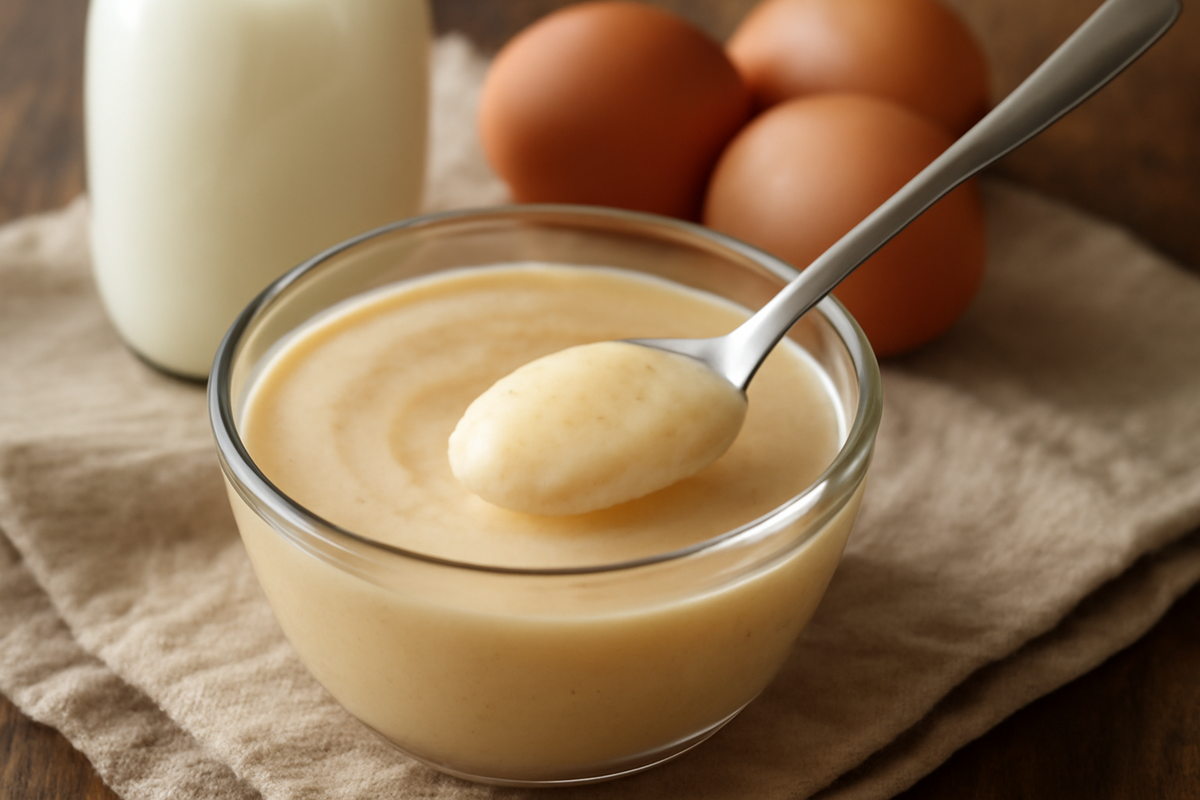
Keep the heat low. This is a dessert of patience, but not of waiting; you’re there, stirring, watching the surface changing. It will thicken slowly, the spoon tracing lines that linger for a heartbeat before smoothing over. If it coats the back of your spoon and you can run your finger through that coating to leave a clear line, it’s ready. You’ve crossed from milk to something else, something you could almost call custard but still feels like home food, not restaurant food.
| Milk | Eggs | Sugar | Texture / Result |
|---|---|---|---|
| 1 cup (240 ml) | 1 egg | 1–1.5 tbsp | Light, drinkable, like a warm dessert drink |
| 1 cup (240 ml) | 2 eggs | 2–3 tbsp | Thick, spoonable custard |
| 2 cups (480 ml) | 3 eggs | 3–4 tbsp | Family-style dessert, enough for 2–3 bowls |
Turn off the heat. For some, this is the moment to strain it through a sieve into small bowls or mugs, catching any shy little curds that formed along the way. For others, those soft flecks are proof that a human hand made it, not a machine, and they leave them in. Either way, you’re only minutes away from holding a spoonful of your own past.
Steam, Spoons, and the Sound of Evening
The first spoonful is always too hot, and you always take it anyway. It grazes your tongue, and your whole mouth fills with a flavor that is both immediate and strangely difficult to describe. It tastes like milk, of course, but milk transformed—concentrated, deepened, sweetened just enough. The egg gives it body, a slow-moving richness that lingers a second longer than you expect.
You can hear the quiet clink of spoon against ceramic, the tiny knock as the bowl meets the table when you set it down. Steam clouds your glasses, or your eyelashes, or just the air between your face and the bowl. If you grew up in a cold climate, maybe the kitchen window is fogged, your breath merging with the breath of the dessert. If you grew up where evenings were hot even in winter, maybe the fan is turning lazily above, pushing the steam aside, but you eat it hot anyway because this is how it was meant to be eaten.
Across from you, someone else takes their first spoonful—your child, your partner, a friend who has never tasted this before. Their eyes close for a fraction of a second. “It’s so simple,” they say, and it’s true, but they’re also a little surprised that something this simple can feel so complete. There are no crunching layers, no surprise centers, no shards of caramel. Just warmth, sweetness, and a texture that says: slow down, you’ve arrived.
This is a dessert that invites silence. You don’t rush through it like a quick snack. You don’t scroll your phone between bites. It almost feels rude to multitask. You hold the bowl with both hands and let your mind wander: to the person who first made this for you, to the kitchen they once stood in, to the way their hands moved. Maybe they are no longer here, but in the thick line of custard sliding off your spoon, there is something of them. A method, a gesture, an unspoken “have a little more.”
Little Twists, Same Soul
One of the quiet joys of eggs in milk is how easily it accepts small variations, like a familiar song you can hum in different keys. You don’t need to change much to make it feel like a brand-new memory built on the bones of the old one.
Try adding a few drops of vanilla extract to the eggs and sugar before whisking, and suddenly your kitchen smells like a bakery. Or tuck a piece of lemon peel into the milk and fish it out at the end, leaving behind that light, bright fragrance that hovers just above the sweetness. A dusting of nutmeg or cinnamon on top as you serve can turn each bowl into a tiny landscape, brown specks against pale gold.
Some people like to bake the mixture in the oven, pouring it into a shallow dish and setting that dish inside a pan of hot water. It emerges with a firmer set and that famous glossy skin on top, trembling slightly, like the surface of a pond when you drop a pebble. You can spoon through that top layer or break it with the back of your spoon and scoop up the custard beneath. Same ingredients, different ceremony.
You can lean towards the drinkable version, too. Use more milk, fewer eggs, and you get something that pours easily into a mug, a dessert you can sip, eyes half-closed, while listening to the radio late at night. A warm, sweet egg‑milk drink that feels like the gentlest of lullabies.
If you’re feeling practical, you might think: protein, calcium, a bit of sugar for energy. It is comfort that also nourishes. For the picky eater in your life, for the one who is “not really hungry” but will always accept a warm, creamy spoonful, this is a subtle act of caretaking. You’re not just feeding a sweet tooth; you’re saying, “Your softness is allowed here. Your tiredness is allowed here.”
Restoring Childhood in the Space of a Weeknight
There are days when the distance between who you were as a child and who you are now feels impossibly long. So many responsibilities, so many tabs open in your head. You cannot, of course, go back. But you can stand at a stove for ten minutes and make something that collapses the distance just a little.
Eggs in milk is the opposite of performance cooking. No one is posting step-by-step videos of it with dramatic music and slow-motion chocolate drips. It doesn’t photograph especially well—pale, simple, unadorned. But its value isn’t in how it looks. It lives in the small actions: the turning down of the heat, the steady stirring, the quiet decision to stop everything else and make this. In those few minutes, you’re not scrolling, you’re not replying, you’re not optimizing. You’re just existing with a pot and a spoon.
Children recognize this kind of focus instinctively. If you make it while they’re around, watch their faces. The questions slow. The fidgeting calms. They hover nearby, drawn by the smell. This is not the frantic energy of a complicated cake with frosting and decorations; it’s the deeper rhythm of a ritual. Something that can be repeated on rainy days, on sick days, on days when nothing went the way it was supposed to but you still managed to end with sweetness.
And for yourself, it’s a small reclaiming of time. You don’t need a free weekend or a list of special ingredients. You need eggs, milk, sugar, and the willingness to pause. To crack and whisk and stir. To taste and adjust. To sit down with a bowl that doesn’t demand your admiration, only your attention.
In that first slow spoonful, you might hear echoes: a voice from your childhood kitchen telling you not to eat too fast, a laugh from someone long gone, the rain on a window that you watched while you ate this same soft, sweet thing years ago. Those echoes won’t fix everything. But they soften the edges of the day.
And tomorrow, or next week, or whenever life again feels too sharp, the route back will be waiting for you in the fridge: a carton of milk, a small box of eggs, the sugar jar on the shelf. A dessert that takes minutes, costs almost nothing, and somehow restores a part of you that you thought was lost somewhere in the clutter of adulthood.
Frequently Asked Questions
Can I make eggs in milk without refined sugar?
Yes. You can sweeten the mixture with honey, maple syrup, or even a bit of mashed ripe banana. Add your chosen sweetener to the eggs before whisking. Just remember that liquid sweeteners can slightly change the texture, sometimes making it a touch looser and more fragrant.
Why did my custard turn grainy or lumpy?
This usually happens when the eggs get too hot too quickly and scramble. Keep the heat low, temper the eggs with a little hot milk before combining, and stir constantly. If it still ends up a bit lumpy, you can strain it through a fine sieve for a smoother result.
Can I use plant-based milk for this dessert?
You can, though the texture will be different. Oat milk and soy milk tend to work best because they have more body. The eggs will still thicken the mixture, but it may not be as rich as with dairy milk. Adjust sweetness and flavorings to suit the milk you use.
Is this the same as classic custard or crème anglaise?
It’s very close in spirit and ingredients. Eggs, milk, sugar—these are the backbone of custards around the world. But “eggs in milk” is often looser in rules and more homey in texture. It’s the simpler, less formal cousin of the fancy custards you see in cookbooks.
How long does it keep, and how should I serve leftovers?
Once cooled, you can refrigerate it for up to two days in a covered container. It will thicken more as it chills. You can eat it cold, like a soft pudding, or gently rewarm it over low heat, stirring often. If it thickens too much when reheated, whisk in a splash of milk to loosen it.

Hello, I’m Mathew, and I write articles about useful Home Tricks: simple solutions, saving time and useful for every day.