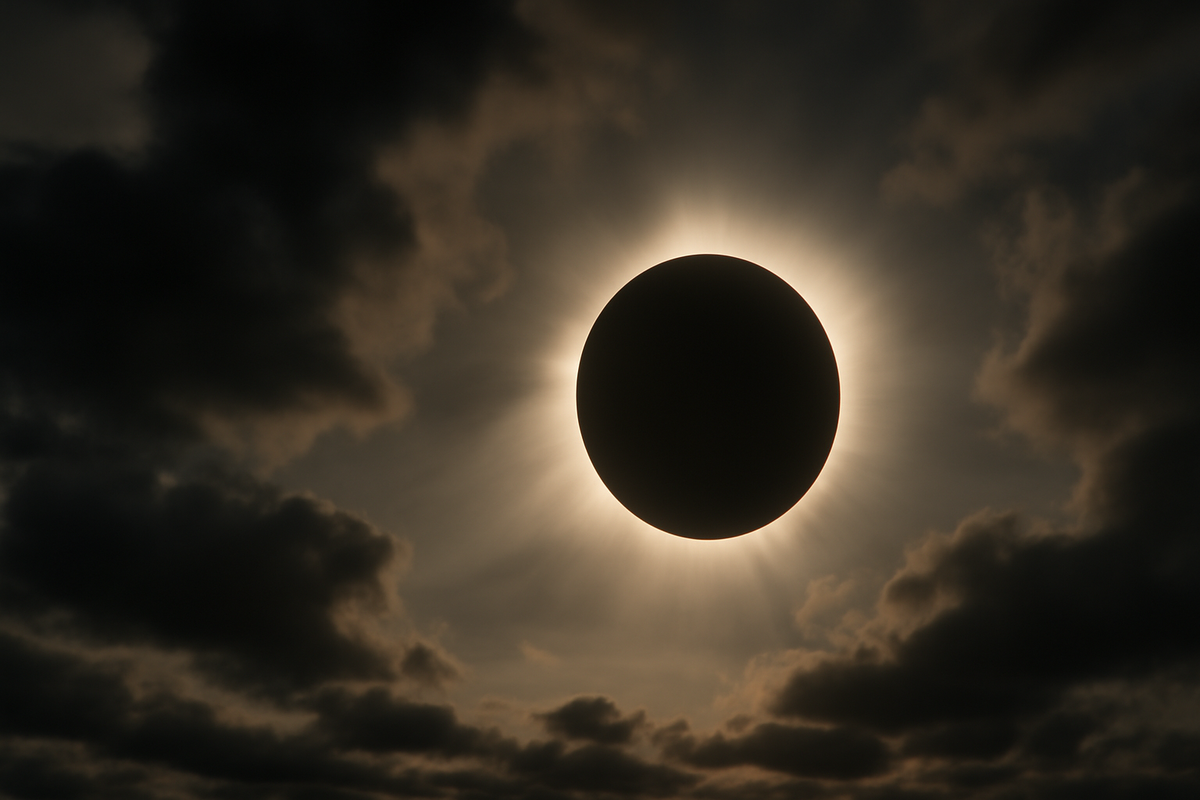
The first hint that something enormous is coming is not in the sky at all, but in the way people are talking. Words like “once in a lifetime,” “eclipse of the century,” “six full minutes of night in the middle of the day” float through news headlines, astronomy blogs, coffee shop conversations. Even if you haven’t yet looked up the path or circled a date on your calendar, you’ve probably felt that flicker of anticipation: for a brief, impossible moment, the sun itself will go dark—completely, utterly, breathtakingly gone.
The day the sun will blink
Picture this: you’re standing in an open field or on a windswept ridge, somewhere along a narrow path drawn invisibly across the Earth. The afternoon feels ordinary at first. The sun is high enough to feel warm on your face; the sky is familiar, blue and steady. And then, almost shyly, the light begins to change.
Shadows sharpen like they’ve been drawn in graphite. The color drains out of the world until it looks as if someone has turned down the saturation on your surroundings. Birds grow unsettled. A breeze picks up—cooler than it should be for the time of day. You glance at your watch. The minutes crawl toward a moment you’ve been planning for months, maybe years.
Up above, the moon is moving with silent precision. Inch by imperceptible inch, it slides across the face of the sun. With safe eclipse glasses pressed to your eyes, you watch the golden disk become a bitten cookie, then a crescent, then a narrowing arc of light. People around you murmur, or fall completely quiet. Someone says, “Is it supposed to be this dark already?” And it’s still only partial.
Then comes the moment that all of this has been building toward: totality. The last bead of sunlight breaks into what astronomers call Baily’s beads—a string of bright pearls along the moon’s rugged edge—followed by a single blinding sparkle known as the diamond ring. And then… the sun is gone. A black hole is hanging in the sky where daylight used to be, framed by the ghostly silver halo of the solar corona. The world around you drops into twilight. For six long, impossible minutes, day forgets itself and becomes night.
This is the eclipse of the century, and if you’re willing to travel—if you’re willing to put yourself, quite literally, in the moon’s shadow—you can stand under that impossible black sun and feel the world tilt, just a little, beneath your feet.
Where on Earth the shadow will fall
Total solar eclipses are not rare on a cosmic timeline, but they are particular. Each one lays a pencil-thin ribbon of darkness over the planet, usually far from home, often over oceans or uninhabited lands. This one is generous: a path thousands of kilometers long, as much as 200 kilometers wide, arcing over landscapes that range from empty desert to crowded cities, wild coasts to high mountain plateaus.
At the center of that path lies the prize—those crucial extra minutes when the moon is exactly the right distance from Earth, and the geometry of orbits lines up just enough that totality lingers. In some places, that lingering will last close to six astonishing minutes. For eclipse chasers, that number matters. Most total eclipses give you two or three minutes; six minutes feels like a lifetime in the currency of celestial events.
Maybe you’ll choose the stark clarity of high desert air, where the sky is almost violently blue and the horizon stretches so far that you can watch the shadow rush toward you like a storm. Or maybe you’ll search for a coastal town along the path, where the sea will reflect the eerie twilight and fishing boats will pause to watch the sky go dark. Some will head for mountaintops, hoping to rise above clouds and haze; others will crowd into small towns that have never before seen such a rush of visitors, their main streets turned into impromptu festivals of telescopes and food trucks.
Wherever you end up, the crucial detail is this: you must be within the path of totality. A 99% partial eclipse is still daylight; the sun is still too bright to look at directly and the corona never blooms fully into view. Totality is the difference between “interesting celestial event” and “mind-bending, primal experience that reorganizes your sense of scale in the universe.” The line between those two realities is measured in kilometers—and on eclipse day, those kilometers matter.
When the sky will go dark
An eclipse is not just a place, it’s a schedule. The moon’s shadow races across the Earth at thousands of kilometers per hour. In any given spot, the moment of totality will be over almost before your nervous system has caught up with what your eyes have seen. For this eclipse, that black shadow will chase the sun from west to east, touching ground in the late morning, sweeping across continents, and leaving the planet again in the fading light of afternoon.
Each town and village along the path will have its own exact timetable: the first nibble of the moon against the sun, the time totality begins, the moment when it ends and bright day snaps back. Astronomers will publish second-by-second predictions. Local observatories and science centers will print posters: “Totality begins at 13:27:45. Ends at 13:33:51.” People will learn those numbers like a kind of ritual chant.
To help you visualize the rhythm of this cosmic performance, imagine a simple travel card printed and pinned to your fridge, a reminder that the universe keeps its appointments with absurd precision:
| Region (Example) | Approx. Local Time of Totality Start | Approx. Duration of Totality |
|---|---|---|
| Western desert location | 11:15 a.m. | 4–5 minutes |
| Central path “sweet spot” | 1:30 p.m. | 5–6 minutes |
| Eastern coastal area | 4:10 p.m. | 3–4 minutes |
This is only a sketch, of course; the real numbers for your chosen viewing point will be more precise, more exacting. As eclipse day approaches, you’ll likely find yourself checking them again and again: on your phone, on a printed chart, on some hand-drawn map with a coffee-ring stain. It’s not anxiety so much as reverence: the understanding that this thing will happen exactly on time whether you are ready or not.
How six minutes can feel like a lifetime
Six minutes does not sound like much. It’s shorter than a pop song, a coffee order, a slow elevator ride. But under a total solar eclipse, the normal rules of time loosen and bend. Those 360 seconds stretch, crackle, dilate.
The first minute of totality is all astonishment. Your body’s instincts are screaming that something is wrong. Midday has gone dark; the temperature has dropped; the sun has become an absence. People gasp. Some forget they have cameras or phones in their hands. The world has the unsettling feel of a dream, or a movie set after the lights have been rearranged.
The second and third minutes are when your senses start to recover enough to notice details. The corona—delicate, feathered, radiant—spills outward from the black disk of the moon in fine, intricate streamers. With the sun’s usual glare gone, planets step forward: Venus bright and bold, maybe Jupiter hanging nearby. The horizon glows in a strange, 360-degree sunset ring: orange and pink and violet all the way around, as if you’re standing at the center of a bowl of twilight.
By the fourth minute, you’ve learned the basic geography of this temporary universe. You might risk tearing your eyes away from the sky to look around. Streetlights have clicked on. Dogs look confused. A rooster may crow in panic. In the distance, you can see the land laid out in washed-out blues and grays, like a watercolor painting left to dry in the dark.
And then, without your permission, your brain starts counting down, even if you haven’t looked at your watch. This can’t last, you think. The world is not allowed to be this strange for long. Somewhere, high above the atmosphere, the moon is still moving in its patient orbit. The shadow’s center is already drifting away from you.
In the final seconds, the sky begins to brighten along one edge as the sun’s disk starts to peek out again. The diamond ring returns, impossibly bright, and you must tear your eyes away and put your eclipse glasses back on. Light slams back into the world like a door kicked open, colors flooding in, shadows softening. Birds restart their daytime routines. The eclipse has moved on.
Later, people will argue about how long it felt. “Maybe two minutes,” one will insist. “At least ten,” another will counter. That’s the thing about six minutes of totality: it doesn’t obey our usual clocks. It lives instead in the deep, elastic part of memory reserved for births and storms and moments when the world reveals its mechanics in a single, breathtaking gesture.
Choosing your perfect place under the shadow
Planning to witness this eclipse is part astronomy, part logistics, part personal pilgrimage. Long before the moon’s shadow touches the Earth, travelers will be plotting their own paths: tracing maps, watching weather statistics, weighing comfort against clarity.
There are practical questions. Do you want the reliable dryness of a desert, with minimal cloud risk but harsh temperatures? Or the milder climate of a coastal city, where sea breezes might bring afternoon clouds but also lend the experience a sense of drama? Are you willing to camp in a remote field, far from light pollution and crowds, or do you prefer a town with hotels, electricity, and a café that’s open before dawn?
Then there are the emotional choices. Some people want to share the moment with thousands of strangers, standing shoulder to shoulder at a music-and-science festival engineered around the event, the crowd erupting in cheers as the sun goes dark. Others prefer an almost private revelation: a couple on a rocky headland, a family in the back pasture of a borrowed farm, a solitary traveler on a plateau above treeline, hearing only the wind and their own heart beating.
Whatever you choose, give yourself room on either side of the eclipse: arrive early, leave late. Eclipse day will bring traffic jams, overwhelmed gas stations, grocery store lines, and overloaded cell towers. Embrace it as part of the adventure. The Earth doesn’t get in the way of the moon and sun very often in just this way; when it does, the rest of us can afford to be patient.
What you’ll need (and what you won’t)
There’s a certain pleasure in packing for a celestial event, in gathering small, earthly objects to prepare for an extraterrestrial alignment. At the top of the list is non-negotiable: safe, certified eclipse glasses or solar viewers. Before and after totality, when even a sliver of sun is visible, its light is still dangerously intense. The corona is only safe to view with the naked eye during the brief window of complete coverage—those precious minutes of totality when the sun’s bright disk is entirely hidden.
A simple pair of eclipse glasses is enough to transform you into a safe sky-watcher, but many people will bring more: solar filters for cameras, tripods, binoculars with proper filtration, small telescopes. If you do, remember that every extra piece of gear is also an extra distraction. The veteran eclipse chasers will quietly tell you: get a couple of good photographs if you must, then stop. Put the camera down. Look with your own eyes. Let this one live mostly in your nervous system rather than your memory card.
Beyond optics, think about basics: layers for the temperature drop, a hat for the pre- and post-eclipse sun, water, sunscreen, snacks, a portable chair or blanket. If you’re far from towns, a paper map is wise; GPS is excellent until a cell tower goes down, or a million people open the same navigation app at once.
You don’t need specialized knowledge. You don’t need a degree in astronomy. Curiosity is enough. An awareness that the Earth is a moving body circling a star, and that the moon is our companion in that journey, is already more cosmic understanding than most of our ancestors had. Stand under the shadow with that awareness and you are, in a very real sense, doing science with your own senses.
The strange life of a world in mid-eclipse
One of the most delightful parts of a total solar eclipse is watching how the rest of the living world responds. The universe is about to perform a high-precision orbital ballet, but down here on the surface, it feels a bit like an elaborate practical joke played on creatures who rely on the regularity of light.
As the sun’s face is gradually eaten by the moon, the first signs are often subtle: an edginess in the birdsong, a hesitation in the usual afternoon chorus. Bees change their flight patterns; flowers that close at night may begin to fold. Farm animals drift toward their evening behaviors. Cows cluster near gates. Chickens head for the coop. Pets might pace or cling closer than usual, picking up on cues that you can’t quite sense yet.
The air itself feels different. With less solar energy pouring down, the ground begins to cool, and a soft, uncanny wind often rises, as if the atmosphere is adjusting a blanket that no longer quite fits. People wrap their jackets tighter without noticing why.
Then there are the shadows. Watch them. Light filtered through gaps in leaves will turn the ground into a canvas of tiny crescent suns, hundreds of miniature eclipses projected onto sidewalks and car hoods. Jab your fingers together and look at the shadow your hands cast—you’ll see the same effect, dozens of little arcs quivering in the dimming light.
All of it adds up to a feeling animals and humans share: some part of the world’s machinery has shifted into an unfamiliar gear. When totality finally hits, the shock is not just visual but ecological. For six minutes, your environment behaves like evening, even though your watch and your body clock mutter that it shouldn’t be. And then, just as life begins to settle into that false night, the light returns, and the world shrugs off the trick and moves on.
Remembering that we live in a clockwork universe
The eclipse of the century is an event written in the language of gravity and geometry, but experienced in the language of awe. For a brief while, human time—our appointments, our deadlines, our scrolling feeds—surrenders to celestial time, the slow ticking of orbits refined over billions of years.
This, perhaps, is the deepest gift of standing under totality: not just the spectacle, but the recalibration. You feel, viscerally, that you live on a moving sphere in a well-ordered system, one object among many tracing invisible curves through space. The sun, which normally feels like a constant—blunt, unapproachable, always slightly out of perception—suddenly becomes a delicate, structured entity, crowned in magnetic fire. The moon, so often just a pale ornament of the night, reveals itself as an active participant, capable of extinguishing daylight with the casual sweep of its orbit.
When you step back into ordinary daylight after the eclipse, nothing in your daily life will have changed. The grocery list is still waiting. The emails still pile up. The dog still needs walking. And yet, something in you will have shifted half a degree. You will have seen, with your own eyes, that our everyday daylight is not guaranteed but granted, moment by moment, by a geometry that—most of the time—we take entirely for granted.
So mark the date. Find your place on the path. Plan your drive, your train ride, your hike, your dawn departure. Gather your friends or choose to stand alone. When the day comes, look up as the sun begins to dim and remember that, for six unforgettable minutes, you are about to stand inside the workings of the solar system itself, a tiny figure in a vast, precise, and astonishing clockwork.
FAQ
Is it really dangerous to look at a solar eclipse?
Yes—except during the brief period of totality. Any time even a small portion of the sun’s bright disk is visible, its light can permanently damage your eyes if you look without proper protection. Use certified eclipse glasses or solar viewers, and only remove them during totality when the sun is completely covered.
Why is this eclipse being called “the eclipse of the century”?
This title is used because of the unusually long duration of totality—up to about six minutes in some areas—and the fact that it passes over accessible, populated regions. Long, easily observed total eclipses are rare, making this one of the standout events of the century.
What is the “path of totality”?
The path of totality is the narrow track on Earth’s surface where the moon completely covers the sun. Only within this band will observers experience total darkness and see the solar corona. Outside it, people see only a partial eclipse and never reach full night-like conditions.
Can weather ruin the eclipse?
Clouds can block your view of the sun, so weather is a major factor. The eclipse will still occur, of course, but you may not see it. Many eclipse watchers study climate records and choose locations with historically clearer skies, and some remain mobile on eclipse day to chase better conditions.
Do I need special equipment to enjoy the eclipse?
Beyond safe eclipse glasses, you don’t need anything. Cameras, telescopes, and binoculars (with proper filters) can enhance the experience, but they can also be distractions. Many experienced observers recommend spending most of totality simply looking and absorbing the moment.
Will animals really behave differently during the eclipse?
Yes. Many animals respond strongly to changes in light. Birds may go quiet or head to roost, insects may change their activity, and farm animals often display dusk-like behaviors. Observing these reactions can be one of the most fascinating parts of the experience.
When will the next long total solar eclipse happen?
Total eclipses occur somewhere on Earth every year or two, but ones with very long durations over land are much rarer. Exact dates depend on your location and future orbital alignments. Astronomy organizations and observatories regularly publish long-term eclipse forecasts for those eager to plan the next journey into the shadow.

Hello, I’m Mathew, and I write articles about useful Home Tricks: simple solutions, saving time and useful for every day.