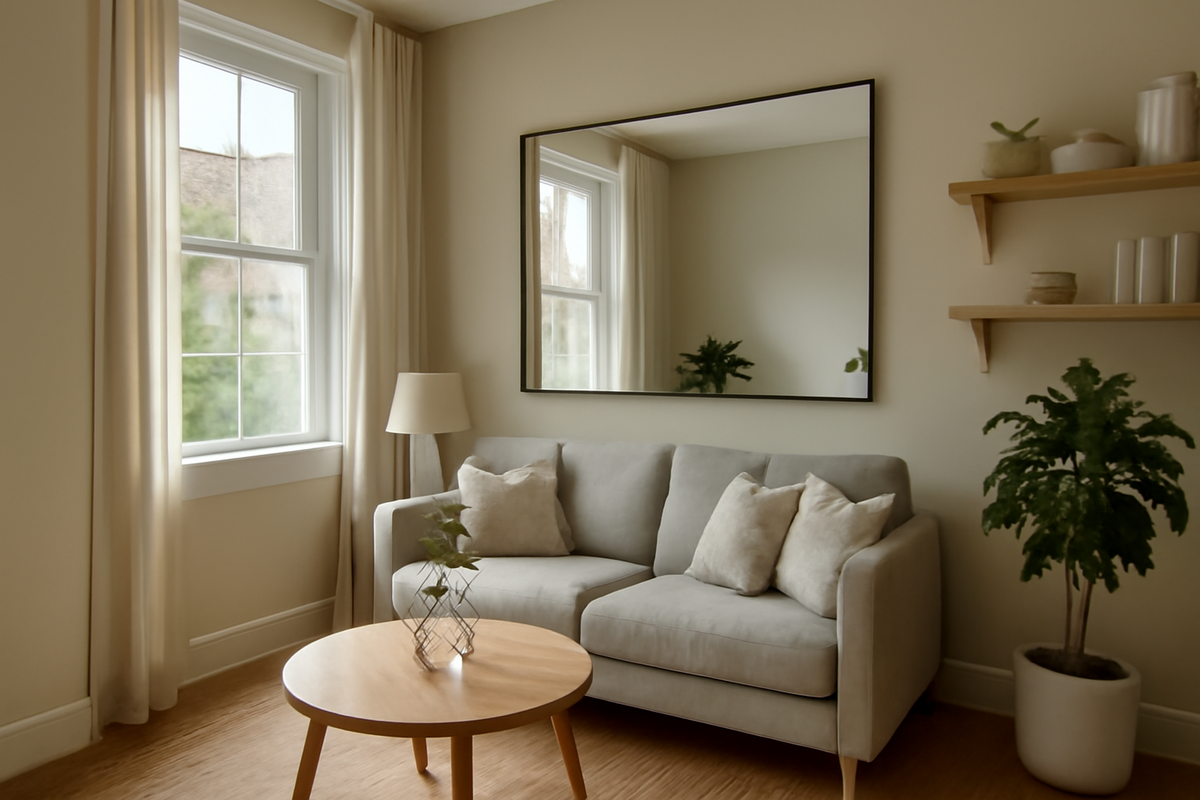
The door clicks shut behind you and suddenly the room feels like it’s leaning in. The walls seem a little too close, the ceiling a little too low, and the furniture a little too… present. You do a slow spin, taking in the tiny living room/office/guest space you’re supposed to “make work,” and all you can think is: there is no way this will ever feel like anything but a shoebox.
The Quiet Magic Trick Hiding in Plain Sight
This is exactly the kind of room decorators secretly love. Not because it’s an easy fix, but because it’s a perfect stage for one of their simplest, most satisfying tricks — a trick that doesn’t involve knocking down walls, moving plumbing, or calling in a contractor with boots and a clipboard.
The trick is this: they treat the room like a reflection, not a container.
They don’t start by asking, “Where does the sofa go?” or “How many chairs can we squeeze in?” They start with, “What do we want this room to reflect back?” Light? Height? Calm? Drama? Once that’s decided, they build the illusion around it, mainly with three elements you already have access to: mirrors, color, and lines.
It sounds suspiciously underwhelming, right? Mirrors, paint, and a bit of geometry. But when you walk into a small room a decorator has touched, you don’t notice the ingredients — you notice the feeling. You feel taller. You breathe easier. You realize you’re not thinking about square footage anymore.
The Mirror Moment: Doubling a Room Without Moving a Wall
Let’s start with the star of the show: mirrors. Not as decoration, but as architecture.
Imagine you walk into a narrow living room: one window at the far end, light pooling weakly in the center, the corners a bit gloomy. A decorator walks in, quietly scans the walls, then leans a tall mirror against the wall opposite the window. It’s simple, almost lazy. But you feel the effect immediately.
Light that used to hit the wall and die there now bounces, shimmers, and spills back into the room. The window has a twin. The room suddenly has “depth.” You don’t mentally stop where the wall is; your eyes keep traveling, as if the room continues past its physical limits.
That’s the neat trick: mirrors aren’t just reflectors, they’re portals. They tell your brain a very gentle, beautiful lie — that there is more space than there really is.
Where Decorators Actually Put Mirrors (And Why It Works)
Here’s how decorators quietly turn mirrors into space-making tools instead of shiny clutter:
- Opposite a window: This is the golden rule. It maximizes natural light and gives the illusion of an extra opening to the outside world.
- Behind a key piece of furniture: A mirror behind a sofa, console, or dining table expands that “zone” and makes it feel grander.
- At the end of a short hallway: It visually extends the corridor, pulling your eye through instead of stopping it abruptly.
- Low and large in tight spaces: In a small bedroom or entry, a large, simple mirror leaned on the floor makes the whole lower half of the room feel less dense.
The key isn’t just using mirrors — it’s choosing them like you’d choose windows. Clean frames, as tall as you can manage, and placed where they reflect something worth looking at: a tree outside, a bookshelf, a pretty light fixture, even a well-made bed.
How Big Should the Mirror Be?
Decorators almost always go bigger than you think is reasonable. In a small space, people often default to small pieces — a skinny little mirror, a tiny piece of art, a miniature lamp. But visually, that shrinks the room further. A single, large mirror feels like a deliberate feature; many small ones feel like visual noise.
Think of a mirror in a small room as a calm, reflective lake instead of a scattering of puddles. One big, clear surface. It lets the rest of the room breathe.
| Room Type | Best Mirror Shape | Ideal Placement |
|---|---|---|
| Tiny Living Room | Tall rectangular | Opposite or diagonal to window |
| Narrow Bedroom | Full-length | Beside wardrobe or behind door |
| Small Dining Area | Wide rectangular | On wall beside table |
| Compact Entryway | Round or arch | Above console or shoe cabinet |
Color That Backs You Up Instead of Boxing You In
Mirrors do a lot of heavy lifting, but color is the quiet partner in the background, deciding whether the room feels like an open breath or a closed fist.
Walk into a tiny room painted a warm, soft off‑white. The light hits the walls and gently diffuses, like cream stirred into coffee. Corners blur a little. Shadows soften. You feel that the room has edges, but they aren’t harsh; they don’t shout “stop” at your eyes.
Now imagine the same room painted in a mid‑tone, chalky green. Not dark, not light, just… solid. The walls feel a little nearer. The corners are visible, clear. It might be cozy, but there’s a definite sense of enclosure. Cozy can be lovely, but if you’re craving spaciousness, it’s the wrong kind of hug.
The Shade Shift That Changes Everything
Decorators making a small room feel big tend to follow a simple rule: if you want airiness, keep the walls light and similar in tone to the ceiling and floor. The less contrast, the less your eye gets stopped by visual “lines.”
They might choose a very pale grey with a warm undertone, a barely-there beige, or a whisper of blush or blue — just enough color to keep the room from feeling sterile, but still light enough to reflect as much brightness as possible.
The ceiling? Often, they’ll paint it the same color as the walls or one shade lighter. That trick quietly erases the line where the wall ends and the ceiling begins, so your eye glides upward instead of seeing a hard boundary. It’s a gentle nudge: this room is taller than you think.
One Color, Many Surfaces
Another decorator move: minimize visual interruption. If your walls are one color, but your trim is bold white and your doors are something else entirely, your brain starts mapping the room into blocks and frames. It notices every line, every change. That makes the room feel segmented.
Instead, a lot of designers now paint the trim, doors, and even radiators the same color as the walls in small rooms. Suddenly, everything recedes. The walls turn into a single envelope of color, and the contents — furniture, lighting, art — can float more gracefully within it.
Lines, Legs, and the Art of Letting the Floor Breathe
After mirrors and color, there’s a quieter player in the illusion of space: lines.
Not straight lines on a blueprint, but the way your eye moves across the room. Decorators think a lot about sight lines — those clear visual paths where nothing bulky blocks your view. In small spaces, protecting those paths is everything.
Consider two sofas in the same tiny living room. One is low, boxy, and hugs the ground. It has a solid base, no visible legs, and sits like a heavy block on the floor. The other stands on slim, raised legs, with just enough space underneath to let light and flooring continue beneath it.
The actual dimensions might be similar, but the second sofa looks lighter, looser, almost airy. You can see more of the floor, and in a small room, visible floor is visual space.
Floating, Not Crowding
Decorators use a few simple moves to keep lines light and uninterrupted:
- Raised furniture: Pieces with legs — think mid‑century styles or modern light frames — let the room feel less choked.
- Low backs near windows: A chunky high‑backed sofa in front of the only window will chop the room in half. A lower profile keeps sight lines open.
- Glass or open bases: A coffee table with a glass top or open metal frame doesn’t visually block the center of the room.
- One big rug: Several small rugs break the room into islands. One large rug pulls everything into a single, coherent area, making the space feel unified and bigger.
The rule beneath it all: if the eye can keep moving — across the floor, under furniture, along walls and up to the ceiling — the room will always feel larger than its measurements.
Smart Scaling: Why Big Things Can Make a Small Room Look Larger
There’s a funny, almost counterintuitive moment that happens when decorators work in small rooms: they often go big. Not with quantity, but with scale.
Instead of three tiny side tables, they’ll use one substantial one. Instead of a sprinkle of small framed art, they’ll hang one hero piece or a tight, tall gallery that reaches near the ceiling. Instead of six perch-like chairs, they’ll choose two generous armchairs and call it a day.
This is the part that makes people nervous. When space is tight, it’s tempting to default to “small everything.” But too many small pieces create a jittery, cluttered feel. Your eye jumps from object to object, never resting, always reminded of how many things had to be squeezed into so few square feet.
A few well-chosen, slightly oversized pieces do something different. They introduce calm. They say: this room isn’t apologizing. It might be small, but it isn’t scrambling.
Editing Down, Opening Up
Decorators often start tiny‑room projects not by adding, but by removing. They strip the room back to the essentials: a place to sit, a surface to work or eat, a place for light, a spot for storage. Then they’ll choose the largest version of each that still fits comfortably, leaving breathing room around them.
That breathing room — the space between the sofa and the wall, the gap around the bed, the margin between furniture and doorways — is what makes the room feel bigger than its footprint. Empty space isn’t wasted; it’s what makes the room feel like a room, not a storage unit.
Light Layering: How Decorators Make Walls Seem to Melt
Stand in a small room lit only by a single ceiling fixture. The light hits the center of the floor, leaves the corners dim, and throws everything into sharp shadow. The walls feel like boundaries. The ceiling feels like a lid.
Now imagine the same room after a decorator’s visit. The overhead light is still there, but now there’s a lamp on the console table, a soft glow in the corner by the chair, maybe a small one on the windowsill. At night, instead of a single harsh source, light pools and overlaps gently in different places, washing the walls, brightening corners, stretching upward.
When light comes from multiple low and mid-level sources, the room stops feeling like a box and starts feeling like a landscape — one with layers and zones instead of hard edges.
Light, Mirrors, Color: The Triple Illusion
This is where the trick really clicks into place. The mirror opposite the window doubles the natural light by day. The pale walls bounce it further. The slim-legged furniture lets it glide underneath, while the layered lamps in the evening prevent any part of the room from sinking into shadow and visually shrinking.
It’s not just one idea — not “add a mirror” or “paint it white” — but the combination, repeated quietly across every choice: reflect, soften, elongate.
The Trick, Summed Up in a Single Walkthrough
Imagine once more that original shoebox room. You open the door again, but this time it’s after the decorator has worked their quiet magic.
The walls are a soft, warm neutral — not stark white, but light enough that sunlight drifts across them and lingers. The ceiling matches, maybe just a shade lighter, floating instead of pressing down.
Opposite the small window, a tall mirror leans casually, almost as high as the door. Outside greenery dances in its reflection, doubling the little slice of outdoors you get to claim. Light you never noticed before now spreads across the floor.
A slim sofa on tapered legs faces a simple glass coffee table. The rug beneath is generous, stretching almost wall to wall, pulling every piece of furniture into one coherent story instead of scattering them. You see the floor under the couch, under the chair, beneath the console — unbroken, continuous.
On the wall behind the sofa, one large piece of art hangs a little higher than you’d expect, drawing your gaze upward. Above the small dining nook, a pendant light is scaled just right — not tiny, but not overwhelming — and a low lamp on the sideboard glows, pooling light gently along the wall.
The room hasn’t grown. The tape measure would tell you the same cold numbers. But you don’t feel them anymore. You feel the stretch. You feel the openness. You feel, very simply, like you can breathe here.
That’s the decorators’ neat trick in a sentence: they don’t fight the room’s size — they change what your eyes and your body notice first. Light, reflection, continuity, calm. When those come forward, square footage stops being the main character.
Frequently Asked Questions
Do mirrors really make a small room look bigger, or is that just a myth?
They really do — not by changing the actual size, of course, but by changing how your eye reads the space. Mirrors bounce light, create a sense of depth, and visually extend sight lines. When placed opposite or near windows or open areas, they make the room feel wider, brighter, and less confined.
How many mirrors should I use in a small room?
Usually one or two large mirrors are better than lots of small ones. Too many mirrors can feel chaotic and distracting. One well-placed, substantial mirror that reflects something attractive (a window, art, or a clear part of the room) is often enough to transform how big the space feels.
What wall color is best to make a small room look bigger?
Light, soft tones work best: warm whites, pale greys, gentle beiges, or very muted pastels. The aim is to reflect more light and reduce harsh contrast. Painting the ceiling the same color or a shade lighter helps blur boundaries and makes the room feel taller and more open.
Can dark colors ever work in a small room?
They can, but they create a different effect. Dark colors in a small room make it feel cozy, cocoon-like, and intimate rather than spacious. If you want a room to feel bigger, light tones are usually more effective. If you’re after drama and moodiness, a dark color can be stunning — just don’t expect it to feel airy.
What kind of furniture should I choose for a tiny space?
Look for pieces with visible legs, slim profiles, and simple lines. Avoid bulky bases that sit heavy on the floor. Choose fewer, slightly larger pieces rather than lots of small ones, and give each item breathing room around it. Glass tables, open shelving, and raised sofas all help keep the room feeling light.
Does clutter really make a small room feel smaller?
Yes. Visual clutter — too many objects, colors, patterns, or small pieces of furniture — interrupts the flow of the room and constantly reminds you of its limits. Editing down to what you truly use and love, then giving those pieces space, makes the room feel calmer and larger.
How can I use lighting to make my room feel bigger?
Layer your lighting instead of relying on a single overhead source. Combine a ceiling light with wall lights, floor lamps, or table lamps at different heights. This spreads light evenly, softens shadows, brightens corners, and helps the walls visually recede. The result is a room that feels more expansive and less boxy.

Hello, I’m Mathew, and I write articles about useful Home Tricks: simple solutions, saving time and useful for every day.