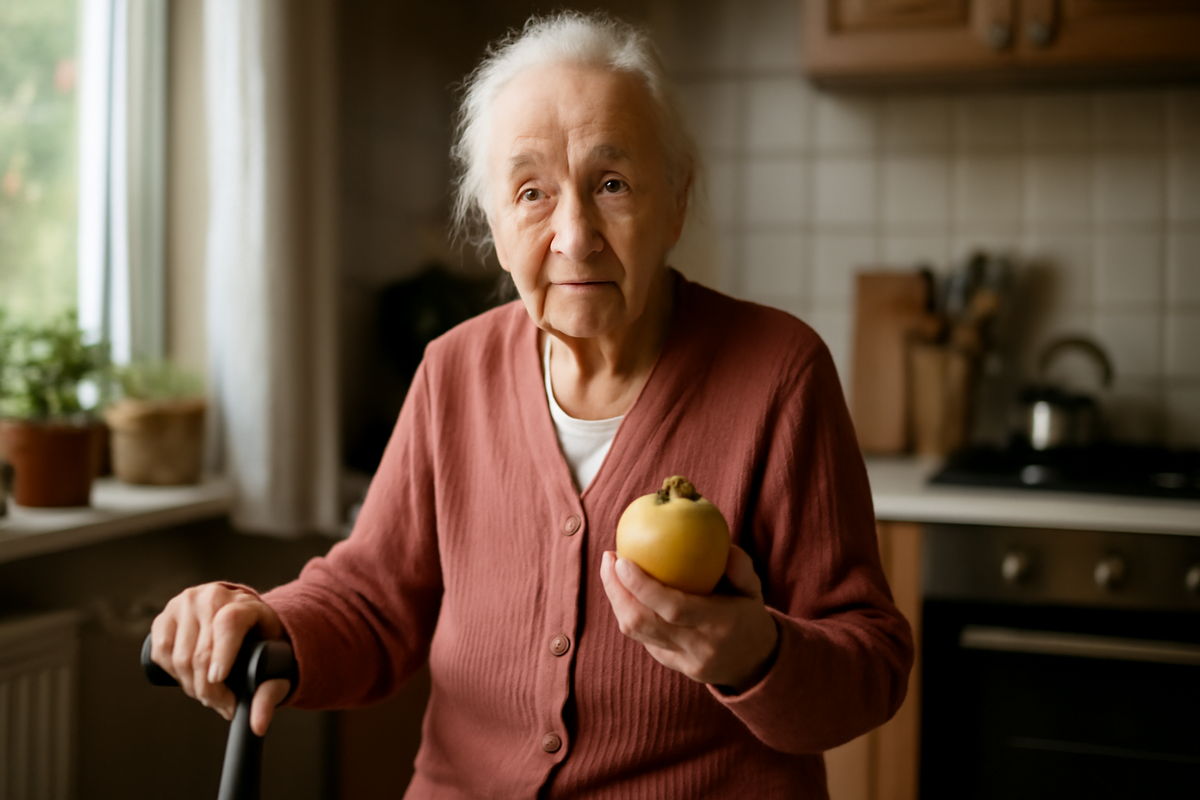
The first thing you notice about her is the hands. Not the years on her face, not the slight stoop of her shoulders, but the hands—thin, papery, and still moving with crisp purpose as they pin wet white shirts on a sun-struck washing line. It’s six in the morning, the air is cool and pale, and 101-year-old Elena is already three chores into her day. Somewhere in the kitchen, barley coffee gurgles softly on the stove, and a radio from another era hums a scratchy folk song. “People think long life is a miracle,” she says, squinting into the rising light as if she’s addressing the sun itself. “It is not. It is repetition.”
The Refusal
Elena lives in a stone house that folds into the hillside the way old things do when they’ve had time to settle. Grapevines drape across the roof like lazy green cursive. The garden below is a patchwork of lettuce, beans, tomatoes, and herbs that perfume the path as you walk through—rosemary, basil, wild fennel snagging your cuffs. The nearest town is a bus ride and a patient wait away, and the nearest care home might as well be a foreign country.
“They tried,” she says, meaning her sons, her grandchildren, the kindly doctor with the soft, rehearsed tone. “They said, ‘Nonna, it is safer, there are nurses, there are call buttons on the wall.’” She lifts a shoulder. “I don’t need a button. I need my own keys.”
Her refusal wasn’t dramatic. No slammed doors, no tearful speeches. Just a steady, stubborn no repeated like a quiet mantra, the same way she’s repeated her morning stretches for seventy years or more. “I have seen people go to homes,” she says. “They stop deciding small things. When to eat. When to sit in the sun. They forget how strong they are, because no one asks them to be strong.”
She leans over her chipped kitchen table, her tea steaming between us. “If my legs carry me, then my life is here. When they stop, we will talk again. Not before.”
The Morning Ritual of Movement
Before her first sip of tea, before she even pulls back the curtains, Elena moves. It is not glamorous. There’s no yoga mat, no mirrors, no smartwatch ticking off calories. In the pre-dawn hush, with the floor still cool under her bare feet, she performs what she calls “my little repairs.”
She stands facing the open window, one hand resting on the back of a worn wooden chair. “Ten for the ankles,” she murmurs, rolling each joint in slow, deliberate circles. “Ten for the knees.” Her movements are neither fast nor particularly elegant, but they are steady and utterly non-negotiable. “I do not think, ‘Do I feel like it?’ That is a dangerous question. I do it, and then I feel like it.”
Elena bends at the waist, fingertips brushing her shins, then the floor, pausing to breathe deeply as she hangs there, like a willow bowing to the earth. She straightens slowly, hands sliding up the fronts of her legs to her hips, spine unrolling vertebra by vertebra. “My mother did these when she was old,” she says. “She called them ‘making space inside.’ If you don’t make space, everything gets stuck—blood, thoughts, even sadness.”
On a narrow shelf near the door, a small notebook lies open. Inside is a short column of numbers—just dates and two letters: W and S. “Walk and stretch,” she explains. “If I miss a day, I see it. I don’t like to see it.” The notebook is not a punishment; it is a quiet witness to her own consistency. The body, she has decided, rewards what is repeated.
| Time | Habit | Purpose |
|---|---|---|
| 6:00–6:30 | Gentle stretches & joint rotations | Keep mobility, wake up the body |
| 6:30–7:00 | Prepare simple breakfast | Support digestion, avoid rush |
| 7:00–8:00 | Outdoor walk or garden chores | Sunlight, cardio, fresh air |
| Midday | Cook from scratch & social call | Healthy food, emotional connection |
| Evening | Light dinner, reading, reflection | Calm nervous system, better sleep |
Eating Like the Land Still Matters
By seven, her kitchen smells like warm bread and simmered tomatoes. A dented pot of beans rests on the stove, having soaked overnight. “I don’t diet,” she says, ladling olive oil into a pan with a measured, practiced hand. “Diet is something people start and stop. This”—she gestures at the onions, garlic, greens, beans—“this is how we live.”
Her breakfast is modest but intentional: a hunk of whole-grain bread, a smear of soft cheese, a small handful of olives, a sliced tomato sprinkled with salt and oregano. On colder days, she warms leftover beans and drizzles them with oil and lemon. There is no sugar swirl, no towering stack of processed anything. “If I eat heavy, my mind is heavy,” she says. “I like my thoughts light.”
She eats slowly, almost ceremonially, pausing to look out the window, to let a mouthful really exist before it disappears. “We used to be hungry,” she says, not as an accusation but as a simple fact. “Now people eat all the time, and still they are not satisfied. They eat with their hands, not with their attention.” She taps her temple. “You must eat here too.”
Her rules are deceptively simple: food that remembers where it came from, enough but not too much, and something raw with every meal. Lunch is usually the main event: a bowl of minestrone dense with vegetables, perhaps, or a plate of chickpeas tossed with lemon, garlic, and parsley, always with a side salad torn from the garden. Dinner, by comparison, is quiet—a little soup, a piece of fruit, some nuts. “I stop eating when the sun goes to rest,” she says. “My stomach also needs night.”
She has outlived three doctors and almost all the diet trends that once promised miracles. What she trusts instead is rhythm. Beans and greens, olive oil and herbs, a small glass of red wine when there is company. “I don’t eat to be young,” she says. “I eat so the years I have are not heavy to carry.”
Small Labors, Strong Bones
After breakfast, the day disperses into a series of small, purposeful labors. To an outsider, they might look like chores. To Elena, they are the architecture of her independence. The laundry is done by hand and hung in the sun. The floors are swept with a broom that has bristles worn soft at the edges. Herbs are snipped and tied into bundles to dry, their scent filling the dim pantry.
“People ask me what exercise I do,” she says, kneeling in the damp soil to pull a weed with steady fingers. “I say: I carry my life.” She does not own gym clothes. Her weights are sacks of potatoes, buckets of water, baskets of figs. “If your body does nothing difficult, it forgets.”
She kneels and stands using only the support of a chair or the edge of the garden wall, practicing the motion as if it were a private workout. “Every time I get up from the ground by myself, I win another week without the care home,” she jokes, eyes glinting. There is pride in these small victories, but also realism. “I am not strong like when I was a girl. But I am strong enough for today. That is all I ask.”
Her day is punctuated by walking. A slow circuit around the house mid-morning. A longer stroll, with a cane more as companion than necessity, in the late afternoon. When it rains, she does laps along the corridor, one hand on the wall, counting quietly under her breath. “You don’t need big muscles,” she says. “You need a body that remembers what to do.”
She has a simple test: if she can still hang laundry, climb the terrace steps, and reach the top shelf where she keeps the good plates, she stays. “The day these are impossible,” she says, “then we will see.” But in the meantime, she deliberately chooses inconvenience—the stairs instead of the chair lift, the hand mixer instead of the electric one. “Comfort is like sugar,” she adds. “Sweet now, trouble later.”
The Social Vitamins
In the early afternoon, she changes her blouse, brushes her hair, and puts on a pair of small pearl earrings. There is no mirror in the hallway; she does this by feel, fingers finding the tiny clasps after decades of practice. “For myself, I am fine,” she says. “For others, I make a little effort. Respect is also a medicine.”
Almost every day, someone arrives. A neighbor with fresh gossip and eggs. A grandson needing advice about a leaking roof. A woman from the village who pretends she’s just “passing by” but inevitably ends up at the table, voice softening as the conversation deepens. Elena pours coffee, cuts fruit, opens the last jar of last summer’s peach jam.
“Loneliness kills,” she says plainly. “Worse than cigarettes.” So she does not wait for company; she creates it. If no one has appeared by three in the afternoon, she reaches for the old landline phone. She calls her sister’s daughter, a friend from church, a neighbor who is recovering from surgery. “I ask them about their knees, their children, their tomatoes,” she says. “When you ask about the small things, people tell you the big things.”
She refuses the idea that old age should be quiet and invisible. “They want to put us all in one building together,” she says of care homes, “like books that no one is reading anymore.” She laughs, a short, bright sound. “I am still being read.”
Even the mailman lingers. “She always has a story,” he says, accepting a fig from her outstretched hand. The stories are never grand—how the river used to flood the fields, how her father learned to mend shoes, how they once made a whole winter’s worth of soup from one stubborn pig. But threaded through them is an invisible message: I am still here, with something to give.
Before bed, she sits with a small stack of letters and photos. On some evenings, she writes postcards, her handwriting shaky but legible. Happy birthday. I am proud of you. Don’t work too much. Call your mother. This, too, is a habit: the daily practice of not disappearing from the lives of others.
Rest as a Discipline
Elena’s clock is the sky. When the light tilts gold and the hills soften into blue, her day begins to narrow. “If you chase the night, the day will punish you,” she says, gently folding a dishcloth over the back of a chair. She does not drink coffee after lunch, does not watch screens that glare blue light into her evening. Her rituals are dim and analog: a small lamp, a dog-eared book of poems, the radio turned low.
Dinner, usually taken before the last bird has settled into its nest, is light—soup, a piece of fruit, a few olives, a square of dark chocolate broken carefully along its seams. “My digestion is an old lady,” she shrugs. “You must be kind to old ladies.”
Before bed, she performs a final inspection of her body as if it were a house she is responsible for. Teeth brushed. Hands washed in warm water. A little cream on her knees. She sits on the edge of the bed and stretches her legs out in front of her, flexing and pointing her feet ten times. “I say to them, ‘You did well today.’” She pats her calves, her hips. “Gratitude is like oil in the machine.”
Her sleep schedule would bore most people: in bed by nine, up by six. But her nights are deep and mostly unbroken. When she wakes at three or four—which happens more often now—she doesn’t fight it. She lies quietly, hands on her belly, and breathes. “I tell myself a little story,” she says, “about all the days that brought me here. By the time I reach my wedding, I am asleep again.”
To her, rest is not a reward at the end of work; it is work of another kind, an active investment in tomorrow’s strength. “If I stay up late for television,” she says, “who will hang the washing in the morning? Not the television.”
Why She Still Refuses the Care Home
Ask her directly, and she does not romanticize her independence. “Of course I am afraid sometimes,” she admits, fingertips grazing the wooden arm of her chair. “If I fall, if I become confused, if I wake up and forget which door is mine—that is real.”
But the fear of losing her place in her own daily story is larger. In a care home, she imagines a life where the edges of days blur: meals at set times, medication in tiny cups, crafts scheduled like weather. “They would be kind,” she says. “I do not doubt this. But they could not give me my morning light in this kitchen, my feet in this soil, my key in this door.”
She is not naive about the future. There is a folded piece of paper in the drawer beside her bed with phone numbers, instructions, small wishes. She has spoken with her family about what she wants, and what she will accept if her body or mind lays down its tools. “I refuse the care home now,” she clarifies. “Not forever. I refuse to go there before I must.”
Her daily habits are not just about health; they are about earning one more day of choice. One more morning stretch by an open window. One more tomato sliced with a practiced hand. One more neighbor welcomed in, one more small labor completed by arms that still remember how to lift. “Every day I take care of myself,” she says, “I am voting to stay.”
As evening drapes itself over the hill and the last light glances off the grape leaves, she walks you to the gate. Her steps are small but steady, the gravel crunching under her shoes. She rests one hand on the gatepost and smiles, eyes bright in the fading light. “People think long life lives in a secret,” she says softly. “But it lives in what you do when no one is watching.”
She closes the gate behind you herself. Tomorrow, she will do it again.
FAQs
What are the key daily habits this centenarian follows?
Her core habits are simple and consistent: gentle stretching every morning, daily walking and small physical tasks, eating mostly whole and minimally processed foods, maintaining regular social contact, and going to bed and waking up at predictable times.
Does she follow any specific diet plan?
No formal diet. She naturally eats in a traditional, Mediterranean-like style: lots of vegetables, beans, whole grains, olive oil, herbs, modest portions, very little sugar, and light evening meals. She focuses on food that is close to the land and cooked from scratch.
How does she stay active without going to the gym?
Her “exercise” is woven into daily life—washing clothes by hand, gardening, walking up and down stairs, carrying groceries, and doing light housework. She also practices simple standing stretches and joint rotations every morning.
Is completely avoiding care homes realistic for everyone?
No. She recognizes that some people genuinely need professional care for medical or safety reasons. Her story is about delaying dependence, not denying necessary help. Her daily habits are her way of staying capable for as long as possible.
What role does social life play in her longevity?
Social connection is central. She sees visitors often, calls friends and relatives, tells and listens to stories, and makes an effort with her appearance for others. She believes that being needed, seen, and engaged with others is as vital as food or exercise.
How important is sleep in her routine?
Very important. She keeps early, regular bedtimes, avoids heavy food or strong coffee in the evening, and treats rest as a responsibility rather than a luxury. She protects her sleep to ensure she has enough strength for the following day’s independence.
Can younger people apply these habits to their own lives?
Yes. While not everyone can copy her circumstances, the principles—daily movement, simple whole foods, meaningful small tasks, social connection, and consistent sleep—are adaptable at nearly any age and can support better health and resilience over time.

Hello, I’m Mathew, and I write articles about useful Home Tricks: simple solutions, saving time and useful for every day.