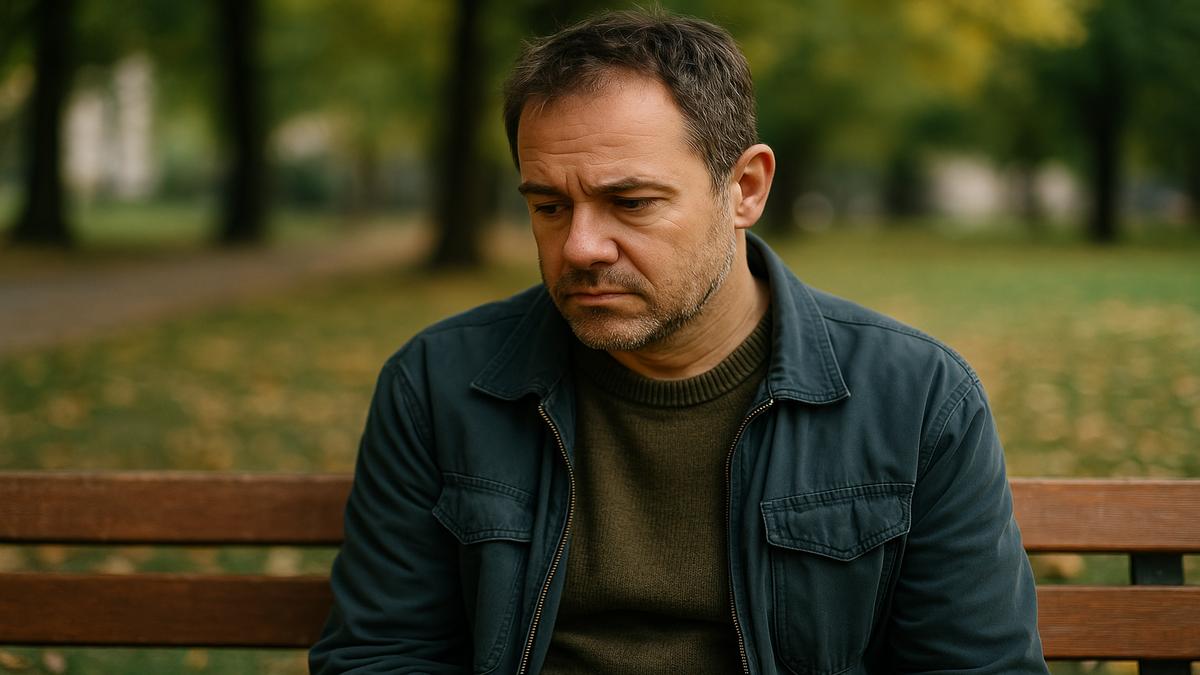
The moment it hits you is rarely dramatic. Sometimes, it’s on a Tuesday afternoon in the supermarket, staring too long at rows of cereal that all taste vaguely like cardboard and childhood. Or it arrives on a quiet commute home, that strange sense that life is… fine, mostly, but the fizzy excitement you once carried like a secret inside your chest has gone a little flat. You’re not miserable. You’re functioning. But something feels thinner, as if the world has lost a layer of saturation—and you find yourself wondering, quietly, “Is this it?”
The U-Shaped Curve Hiding in Plain Sight
For decades, economists and psychologists have poked at this uneasy question with surveys, graphs, and equations. When they plotted self-reported happiness across thousands of people’s lives—from early adulthood through old age—a consistent shape kept emerging from the data like a sandbar at low tide: a U.
It didn’t matter whether people lived in the United States, Europe, or parts of Asia and Latin America; whether they were rich or scraping by; whether they had children, never wanted them, or lost them. Adjust for health, income, culture, and other obvious suspects, and the contour held. Happiness, it seems, tends to be relatively high in our teens and early twenties, dips meaningfully in midlife, and then climbs again as people grow older.
Within that big, smooth curve, though, lies a sharper question scientists have relentlessly tried to answer: Is there a specific age when joy takes its biggest hit for most adults? Not a vague “sometime in your 40s,” but an actual year you can circle on the calendar of your life and say, “Ah, there it is. The trough.”
As more long-term studies have come online—following the same group of people over decades—the numbers have started to converge. For many adults around the world, well-being tends to bottom out somewhere around the mid-to-late 40s. In several large analyses, the average nadir hovers startlingly close to one particular moment: about age 47 or 48.
Before you wince and declare those years off-limits, it’s worth slowing down. This is not a curse, not a prophecy carved into stone. The science doesn’t tell you who you will be at that age. Instead, it offers a map of currents—strong ones—that most of us are likely to feel tugging at our ankles as we cross midlife’s wide, strange river.
The Year the Mirror Starts Asking Questions Back
Midlife is less about candles on a cake and more about collisions—between expectation and reality, between fantasy and the deadlines of time. Even if you never sat down and wrote out a “life plan,” you probably carried one quietly in your head: where you’d live, the work you’d do, the kind of love you’d find, the person you’d become. By your late 40s, those hazy someday ideas have either materialized, shapeshifted, or slipped away.
This is the point when a lot of people feel an almost physical friction between the life they imagined and the one they inhabit. Maybe you did everything “right”—checked all the boxes—and still feel a little hollow. Or maybe things never went according to the map: the career never took off, the marriage ended, the kids didn’t arrive, or a parent’s illness pulled your life sharply off course.
Researchers have found that around this time, life satisfaction tends to dip even when people don’t report any big external crisis. Objectively, things might look okay or even good. Income, for many, has peaked. Professional skills are sharper than ever. Social networks are established. And yet, the emotional ledger can feel strangely in the red.
Part of the reason lies in how our minds quietly move the goalposts. In our twenties, the future is an open sky—enough space to hold grand dreams. By our forties, that sky has edges. We realize with a jolt that some doors have closed, not because we failed, but simply because time moved forward while we were busy living. That subtle narrowing can feel like loss, even when we’re proud of what we’ve built.
The midlife dip isn’t just about regret, though. It’s also about the invisible workload of being in the middle of everything—between generations, between roles, between versions of ourselves.
The Squeeze of the Middle Years
Ask someone in their late 40s how many people depend on them, and you’ll often watch their eyes do the math: children (maybe teenagers with their own emotional weather), aging parents who suddenly need rides to doctors and help organizing bills, coworkers counting on their experience, communities leaning on their unpaid labor.
Midlife can feel like the moment you finally get strong enough to carry a lot—and then everyone hands you something heavy. The pressure is subtle but pervasive: earn enough, care enough, be present enough, stay healthy enough. No wonder the U-shaped curve bends downward here. It isn’t a failure of character; it’s physics.
Scientists tracking stress hormones, sleep patterns, and mental health across the lifespan see the same bulge in the middle years. People in their 40s and early 50s often report feeling “pulled thin,” less by one cataclysmic event and more by an accumulation of responsibilities that leave very little unclaimed time or energy.
Here’s where the research gets both sobering and oddly comforting: this dip—this sense of “What am I doing?” and “Is it too late?”—is not just common. It is, in statistical terms, expected. The data suggests it’s built into the arc of how humans experience time, ambition, and aging. Which may explain why, even in countries with strong social safety nets and high standards of living, the same midlife sag shows up again and again.
What the Numbers Quietly Reveal
To make sense of this pattern, researchers analyze vast surveys where people rate their life satisfaction on a sliding scale. Then they overlay ages, incomes, health markers, family situations, and more. Over time, a picture comes into focus that’s both surprising and strangely reassuring.
| Life Stage | Typical Experience of Well-Being | Key Psychological Themes |
|---|---|---|
| Early Adulthood (18–29) | Higher optimism; excitement mixed with anxiety about the future. | Possibility, exploration, identity-building, experimentation. |
| Early Midlife (30–39) | Moderately high satisfaction; increasing stress from work and family. | Commitment, building careers, raising children, establishing stability. |
| Midlife Dip (40–49) | Noticeable dip in reported happiness, with a low point around 47–48 for many. | Reevaluation, comparison, time-awareness, responsibility overload. |
| Later Midlife (50–64) | Gradual rise in satisfaction; more emotional balance, less volatility. | Acceptance, recalibration of goals, changing roles at work and home. |
| Older Age (65+) | Higher life satisfaction on average, despite health concerns. | Meaning, gratitude, savoring, focus on relationships and legacy. |
The table smooths out sharp edges, but the underlying story is very human. Our twenties glow with anticipation and illusion: we routinely overestimate how happy material success or social status will make us. We imagine our future selves with the same bright naivete that we imagined adulthood as children.
Then midlife arrives and quietly corrects the fantasy. We discover that promotions, bigger homes, or the “right” partner never fully silence the deeper questions. Instead of being broken, we are simply becoming acquainted with reality. From a scientific point of view, the dip around 47 or 48 is the emotional cost of that recalibration.
Later, something gentler happens. As people move into their fifties and sixties, they become better at regulating emotion, less tormented by comparison, and more focused on what genuinely matters. Happiness rises again—not the dopamine rush of “big life moments,” but a steadier, quieter form of contentment.
The Brain’s Way of Letting Go
Underneath the numbers, the brain is rewiring its priorities. Studies using brain imaging and long-term observation have shown that older adults tend to pay more attention to positive experiences and less to negative ones, a phenomenon psychologists call the “positivity effect.” It isn’t denial; it’s pruning—an adjustment that favors emotional well-being over relentless ambition.
In contrast, middle-aged adults are wired, almost by design, to track threats, problems, and shortfalls. You’re juggling bills, deadlines, family dramas, health warnings, and the echo of your own hopes. The brain’s natural vigilance system hums on high alert. No wonder joy feels more fragile.
When researchers ask people across ages how much time they spend savoring ordinary pleasures—a good meal, a walk, sunlight on the floor—an interesting pattern appears. Older adults tend to linger more. They know time is finite, so their attention softens and opens. Midlife adults often move too fast to fully register these small joys. The difference isn’t moral; it’s mechanical, driven by the demands and context of each stage.
So, Is 47 Really the Saddest Year?
It’s tempting to latch onto a single dramatic number. “Brace yourself for 47” sounds like the kind of headline that might trend for a day and then dissolve. The reality is more nuanced—and more useful.
When we say that well-being bottoms out around age 47 for many adults, we are speaking in averages, not destinies. Some people glide through those years with surprising ease; others hit their roughest patches earlier or later. What the research clarifies is not that something is uniquely wrong at that age, but that the combined weight of responsibilities, recalibrated expectations, and time awareness reaches a common peak for a lot of people.
This means that if you find yourself in midlife feeling restless, disillusioned, or oddly sad without a clear external reason, it’s not evidence that you chose the wrong career, married the wrong person, or missed your one shot at happiness. It may simply mean you are standing in a very crowded, invisible hallway of human experience.
There is comfort in knowing your struggle fits a pattern shared by millions of others you’ll never meet—people sitting in cars in parking lots, staring out over steering wheels, trying to catch their breath before going inside.
What People Actually Do in the Dip
People don’t just endure the midlife dip; they respond to it, often in messy, creative ways. Some buy sports cars or sign up for triathlons, chasing a jolt of youth. Others quietly return to long-abandoned passions: painting, writing, playing music badly but joyfully in basements and spare rooms. Some leave careers that never fit; others stay put but renegotiate their boundaries.
From the outside, these shifts can look like cliché “midlife crises.” From the inside, they are frequently attempts—clumsy but sincere—to realign life with values that have become clearer. Research suggests that, contrary to stereotype, most midlife course corrections are not reckless implosions but modest adjustments that bring people closer to what actually matters to them.
Strikingly, when the same people are interviewed again after the dip, many describe that unsettling period not as a disaster, but as a turning point: the season when they stopped living on autopilot and started asking, sometimes for the first time, “What do I really want this next stretch of life to feel like?”
Bending the Curve While You’re Inside It
You can’t rewrite the basic script of human psychology, but you can improvise inside it. Knowing that a dip is statistically likely gives you a chance to meet it with curiosity rather than panic.
One powerful strategy researchers highlight is shifting your metric of success from “more” to “deeper.” Midlife is often the time when no amount of external achievement can fully quiet the internal dissonance. So the goal quietly changes. Instead of collecting experiences like trophies, you start asking how fully you inhabit the ones you already have.
Connection, not consumption, becomes the deeper currency. Studies repeatedly show that close relationships—friendships, family bonds, chosen communities—are the strongest predictor of well-being in later life. Midlife, for all its busyness, is a critical window for tending those bonds, even in small ways: lingering an extra ten minutes at the dinner table, sending the text, making the phone call, letting someone in on what you’re actually feeling.
Equally important is giving yourself permission to mourn the lives you’re not going to live. The careers you didn’t choose, the countries you didn’t move to, the loves that dissolved. Oddly, practicing this kind of gentle grief can ease the pressure of the dip. It acknowledges that becoming this version of you required the loss of many others. That’s not a personal failing; it’s the structure of time.
Letting Midlife Be a Threshold, Not a Diagnosis
If the happiest years statistically come after the dip—if the U-shape arcs upward as we age—then midlife isn’t a cliff; it’s a threshold. You are stepping from a life built on projections and performance into one that can be grounded more in presence, meaning, and truth.
The science offers a quietly radical reframing. Instead of asking, “How do I avoid this low point?” you might ask, “How can I use it?” How can the discomfort of 47, or 52, or whenever your own curve bends, become a signal—not to burn everything down, but to listen more closely to yourself?
You may find that the very questions that feel scary now—about purpose, legacy, joy—are the ones that will make the second half of life richer, not emptier. The U-shape is not a story of decline; it is a story of recalibration. Bliss peaks, dips, and then, often, returns in a different form: less dazzled, more durable.
FAQ
Does everyone hit their lowest happiness around age 47–48?
No. That age is an average drawn from large groups of people, not a rule for individuals. Some people experience their lowest point earlier or later, and some never report a strong midlife dip at all. The pattern is common, not compulsory.
Is a “midlife crisis” the same as the midlife happiness dip?
Not exactly. The midlife dip is a gradual, statistical trend in life satisfaction. A “midlife crisis” is a more dramatic, often visible upheaval, and it’s actually less common than the stereotype suggests. Many people experience a quieter period of reflection and adjustment rather than a crisis.
Can I do anything to avoid the midlife dip?
You may not be able to completely avoid it, but you can soften it. Strong relationships, realistic expectations, self-care, meaningful work or hobbies, and openness to reevaluating your goals all help. Knowing the dip is normal can also reduce anxiety and shame around it.
Why does happiness rise again in older age despite health problems?
Older adults often become better at regulating their emotions, focusing on what matters, and savoring positive experiences. They tend to care less about comparison and more about relationships and meaning. Even with health challenges, these shifts support higher life satisfaction on average.
What if I feel this dip much earlier than my 40s?
It’s still valid. People can experience low points at many ages due to personal, social, or economic factors. If sadness, emptiness, or hopelessness feel intense or persistent at any age, it’s important to seek support—from trusted people, mental health professionals, or community resources—rather than waiting for it to pass on its own.

Hello, I’m Mathew, and I write articles about useful Home Tricks: simple solutions, saving time and useful for every day.