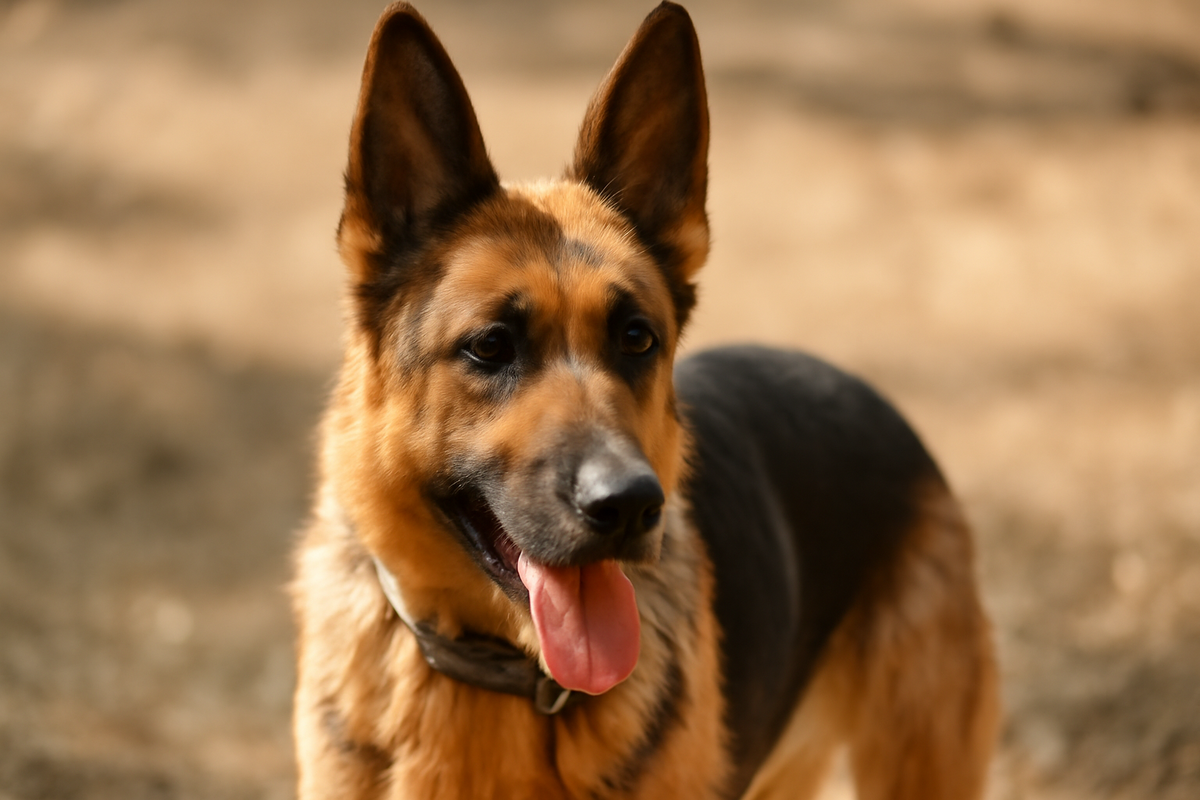
Lila likes to sit just at the edge of the shade—close enough to feel safe, far enough to keep watch. The afternoon sun pools like honey across the concrete of the rescue’s small yard, and she settles into a patch of light, ears alert, nose lifted to read the air. Somewhere beyond the chain-link fence, a car door slams, a child laughs, a crow argues with the sky. Lila listens to all of it, weighing every sound, every shift of breeze, as if the future might be carried to her on the scent of someone new. Someone who will finally say, “Come on, girl. Let’s go home.”
The Dog Who Waits by the Gate
The caretakers say she knows the rhythm of the day better than the clock on the office wall. When the sun begins to slide behind the building and the long shadows stretch toward the kennels, that’s when Lila’s energy changes. She moves to the front of her run, sits by the gate, and stares down the narrow walkway where volunteers appear, one by one, to walk the dogs.
Sometimes, when a car pulls into the gravel lot, her head snaps up, entire body leaning toward the sound. A door opens, human voices spill out, and Lila stands—tall, lean, all muscle and intensity—eyes fixed on the opening in the fence as if a missing piece might finally click into place there. People come through. Some glance her way and smile; some don’t quite meet those amber eyes that seem to ask a question she’s learned not to voice too loudly.
Lila is a German Shepherd, the kind that makes strangers pause. Her coat is a classic sweep of black along the back, fading into warm tan on her legs and chest. In some lights, her fur looks almost copper where the sun kisses it; in others, her dark saddle gives her an air of solemn authority. You can see the intelligence in her face before you ever meet her—brows that seem to lift with curiosity, eyes that follow movement with quick, precise focus.
But it’s not just her beauty that stops people; it’s the contradiction she carries. When you first approach her kennel, she may bark—a deep, sharp sound that echoes off cement and metal, making her look bigger, more imposing. Step closer, though, speak softly, let your presence settle, and you see something else surface. The bark trails off. Her ears soften just a touch. Her tail ticks once, twice, uncertain but hopeful. Lila has learned that new people can mean new beginnings. She hasn’t yet given up on the idea that one of them might be hers.
Lila’s Story, Told in Paw Prints and Paw-Scuffed Floors
Every rescue dog carries a story that doesn’t always come with words. Some of Lila’s past is a jumble of scattered details—found wandering, underweight, wary but not broken. She arrived with a collar that didn’t quite fit and no microchip, a dog-shaped question mark in need of someone patient enough to help her rewrite the ending.
She was younger then, still filling out the long lines of her frame, still learning that food would arrive each day, that water bowls could be full, that human hands could mean comfort instead of confusion. The shelter staff saw the sharp outline of ribs soften, then disappear beneath healthy muscle. They watched as the brittle, hypervigilant look in her eyes unknotted—gradually, like a tightly wound spring left too long under tension.
What emerged was a dog who desperately wanted to belong, but wasn’t always sure how. German Shepherds are like that: wired for work, for partnership, for purpose. Left without a job, they invent one—guarding, herding the family from room to room, patrolling yards and windows, reading the world for signs only they can see. For Lila, whose life had been made of uncertainty, her new self-appointed job became simple and absolute: observe everything, trust slowly, protect fiercely once trust is given.
Ask the volunteers who walk her regularly, and they’ll tell you how far she’s come. “When she first arrived,” one of them says, “she’d stiffen anytime someone moved too quickly. Now? Once she recognizes you, she leans into your leg like it’s the safest place on earth.” Another laughs, remembering how Lila discovered tennis balls. “You should have seen her face the first time she realized she could chase it and bring it back and we’d throw it again. Like she’d unlocked a secret level of life.”
A Glimpse into Lila’s Day-to-Day World
Most days follow a steady rhythm: morning feeding, kennel cleaning, short walks, quiet stretches when the sun is high and the breeze slows things down. In the hum of that routine, Lila has developed her own small rituals. She circles her bed exactly twice before lying down. She checks the corner where treats sometimes appear. She watches the hallway, ears twitching with every footstep.
When she’s led out to the play yard, something shifts. Her stride lengthens. Her tail lifts in a wide, flag-like arc. You can almost hear the click as work-mode gives way to play-mode. She’ll track the path of a tossed ball with laser precision, paws throwing up tiny clouds of dust as she pivots, body stretched into the pure geometry of motion. That’s when the shepherd in her shines brightest—not as a guard, but as an athlete, a partner in motion, a thinking creature who is perfectly aware of every move she makes.
And then, of course, there are the quiet moments: the slow exhale when she settles beside a trusted human, the way she’ll rest her head just barely against a leg or arm, as if asking, “Is this allowed? Can I stay here?” Those who have granted her that permission know the answer: once she claims you as her person, she will stay with the singular loyalty that this breed is famous for.
Who Lila Is, Behind Those Amber Eyes
To imagine Lila in a home is to imagine layers of her unfolding. On the surface, she is many things at once: alert, agile, sensitive, and smart enough to outthink you if you’re not paying attention. But beneath that, there’s a quieter core made of devotion and a deep need to feel that she belongs to someone, and someone belongs to her.
In the language of rescue descriptions, she would be labeled “highly intelligent,” “loyal,” “active,” “best in an experienced home.” Yet these words don’t quite capture what it’s like to sit on the floor beside her and feel her presence settle next to you—a living, breathing question that asks, “Will you be my person?”
Lila is the kind of dog who will memorize your routines. If you’re an early riser, she’ll learn the sound of the alarm and meet you at the bedroom door, ears sleepy-soft, tail softly wagging, ready to walk into the quiet morning with you. Coffee steam curling in the kitchen, kettle whistling, the pale blue of dawn outside the window—there she’ll be, nails clicking lightly on the floor, inhaling the cool air of a new day as if to say, “We’re both here. Let’s start.”
Give her a job, and she’ll take it seriously. That job might be as simple as walking you around the neighborhood, scanning the sidewalks and hedges with a calm, steady awareness. It might be learning new cues—sit, stay, down, heel—and then more advanced tasks, because this is a dog who thrives when her brain is engaged. Puzzle toys, scent games, obedience training, agility, or even just learning the names of her toys—these are the kinds of things that help Lila feel settled and proud.
At home, she will likely be the shadow that follows you room to room, checking in, then curling up where she can keep you in her line of sight. That’s part of her shepherd nature too: she doesn’t want to disappear into the background of your life; she wants to stand beside you in it.
Lila at a Glance: Key Details
For those who like to see a snapshot of who she is, here’s a simple overview of Lila’s needs and personality:
| Name | Lila |
| Breed | German Shepherd (rescue) |
| Age | Adult (prime working/companion age) |
| Size | Large, athletic build |
| Energy Level | High—needs daily exercise and mental enrichment |
| Temperament | Loyal, sensitive, alert, bonds deeply with her people |
| Ideal Home | Experienced, patient, active; adults or older, dog-savvy kids |
| Training | Food-motivated; responds well to positive reinforcement |
What Lila Needs from Her Future Human
Bringing home a dog like Lila isn’t about filling an empty space with something soft and warm and grateful. It’s about stepping into a partnership. She doesn’t just want a house; she wants a role, a language, a shared life. The people who will thrive with her are the ones who understand that.
First and foremost, Lila needs time—time to settle, to understand the new rules, to relax into the knowledge that this place, these people, are not going to vanish. The first days might be a gentle blur of exploration and uncertainty. She may pace more than you expect. She may cling more than you expect. Or she may retreat to a quiet corner to watch you from a safe distance, measuring your moves.
This is where patience becomes an act of love. Instead of pushing, you invite. Instead of assuming, you observe. You let her come to you when she’s ready, adjusting the pace so that trust builds like a steady tide, not like a crashing wave.
Consistent structure will be her compass. Regular feeding times, set walk schedules, clear boundaries about which furniture is for dogs and which is not—these small, simple rules become a language she can understand. German Shepherds, bred for centuries to work closely with humans, flourish when that language is clear and kind.
She’ll also need movement: brisk walks, purposeful hikes, time to trot alongside you as you discover your shared routes. Some days, that might mean a fast-paced loop through the neighborhood where she practices loose-leash walking and ignoring distractions. Other days, it might be a trip to a quiet trail where pine needles soften your steps and the air smells of earth and leaves and distant water. Out there, with the leash slack between you and the sky widening overhead, you’ll see just how natural it feels to move together.
The Right Match, Not Just Any Match
Lila isn’t the dog for everyone—and that’s okay. She’s probably not the best fit for a home that’s rarely still, chaotic with constant visitors, doors slamming, people coming and going without pause. She’s not the dog to leave alone in a yard for hours, expected to entertain herself. Her mind is too busy; her heart is too tuned to the presence of her people.
Instead, she’s for the person who has been waiting, perhaps quietly, for a dog who means something. The one who has read about German Shepherds and understands their sharp minds, their sensitivity, their deep connections. The one who imagines training sessions as shared conversations, not obedience drills. The one who wants a dog to walk through life with, not just around the block.
The Urgency of Now
Rescue time moves differently than regular time. Days turn into weeks; weeks into months. New dogs arrive with the urgency of medical needs, of space limitations, of shelters overflowing beyond capacity. And dogs like Lila—stable, lovely, waiting—sometimes get quietly pushed toward the back of the metaphorical line.
She isn’t the youngest puppy anymore, tumbling over her own paws in a frenzy of chaotic charm. She isn’t the tiny lap dog people think will fit easily into their lives. She’s big. She’s noticeable. She requires a commitment that’s as real as any vow.
But there is also an urgency that has nothing to do with kennel space or adoption statistics. It’s the urgency of a life being lived in holding pattern. Each day she spends waiting is a day she could be learning the smell of her own yard, the sound of her person’s step on the path, the pattern of shadows across the living room floor at sunset.
Imagine her first night home. The quiet thump of her paws as she explores each room, nose pressed to corners where dust and history reside. The way she circles her new bed—maybe an old blanket, maybe something bought just for her—then lies down with the kind of sigh that comes from somewhere deep. That moment, that exhale, is a line being drawn: before and after. Shelter and home.
Imagine her realizing that the car ride didn’t end at another kennel, but at a doorstep that opens with the same key every time. Imagine the first time she hears your voice call her name in a forest, or across a field, or just from the next room—and she knows, without question, that name is hers, and you are hers, and this is the life she gets to keep.
How You Can Step into Lila’s Story
Maybe you’re the person Lila is waiting for. Or maybe you simply feel the tug of her story and wonder what part you can play, even if you’re not ready or able to adopt. There are more ways to be part of her journey than you might think.
If adoption is on your mind, the next step is simple, even if the feelings behind it are not. Reach out to the rescue. Ask about meeting her. Tell them about your life—your schedule, your experience with dogs, your home. Good rescues don’t just push dogs out the door; they help write good matches. Be honest about what you can offer; be open about what you hope for.
When you meet her, let the moment unfold. Don’t rush toward grand expectations. Watch how she moves, how she sniffs your hand, how close she chooses to sit. Talk to her in your normal voice. Ask the staff what she’s like on walks, how she behaves with other dogs, what calms her. You’re not just choosing her; she’s quietly choosing you too.
If adopting isn’t currently possible, you can still carry her story forward. Share it with someone who might be searching for a dog like her. Support the rescue that’s keeping her safe—your kindness makes room for dogs like Lila to wait a little longer for the right home instead of just the first available one.
In the end, the story of a rescue dog isn’t really about rescue at all. It’s about connection. About the way one life brushes up against another and both are changed, quietly but unmistakably. Somewhere, as you read this, Lila is probably lying on a kennel bed, nose tucked toward her paws, ears twitching at distant sounds. She doesn’t know your name yet. But any day now, you could walk through that gate and change the shape of both your worlds.
And when you do, there will come a night—weeks or months down the line—when you’ll feel the solid weight of her head resting against your knee as you sit in your own home. The TV murmurs in the background. A lamp glows soft in the corner. Outside, the wind brushes past your windows, carrying with it the echo of all the places she might have gone but didn’t, because she made it here instead. To you.
On that night, as her breathing evens out and her body relaxes fully for perhaps the first time in her life, you’ll realize something simple and profound: yes, you adopted Lila. But somewhere along the way, Lila quietly adopted you right back.
Frequently Asked Questions About Adopting Lila
Is Lila good with other dogs?
Lila’s comfort with other dogs can depend on the individual dog and the setting. Like many German Shepherds, she prefers calm, respectful introductions rather than chaotic greetings. The rescue can arrange a meet-and-greet with any resident dog to see how they get along before adoption.
Can Lila live with children?
Lila would likely do best with older, dog-savvy children who understand how to respect her space and energy level. She may find very young, unpredictable children overwhelming. The rescue can help evaluate whether your family dynamic is a good fit for her.
How much exercise does Lila need?
As an active German Shepherd, Lila will thrive with at least one to two hours of combined physical and mental exercise each day. That can include walks, training sessions, puzzle toys, and playtime. She is not a “quick walk around the block” kind of dog—she’s a partner for real daily activity.
Does Lila have any special training needs?
Lila responds best to positive reinforcement training—treats, praise, and consistency. Ongoing training will help her feel secure and give her the mental challenge she craves. A basic obedience class or working with a force-free trainer would be an excellent way to build your bond.
What kind of home is best for Lila?
The ideal home for Lila is one with people who are experienced with shepherds or similar working breeds, who value structure, and who can give her daily exercise and attention. A securely fenced yard is helpful but not strictly required if you’re committed to regular, purposeful walks and outings.
Will Lila need time to adjust to her new home?
Yes. Like any rescue dog, Lila will need a decompression period—time to learn the layout, routines, and expectations of her new life. Expect the first few weeks to be an adjustment phase where you focus on calm, consistency, and building trust rather than perfection.
How can I start the process of adopting Lila?
To begin, contact the rescue that’s currently caring for her and ask about their adoption process. They may ask you to complete an application, schedule a meet-and-greet, and possibly a home check. From there, you and the rescue can decide together whether you and Lila are the right match.

Hello, I’m Mathew, and I write articles about useful Home Tricks: simple solutions, saving time and useful for every day.




