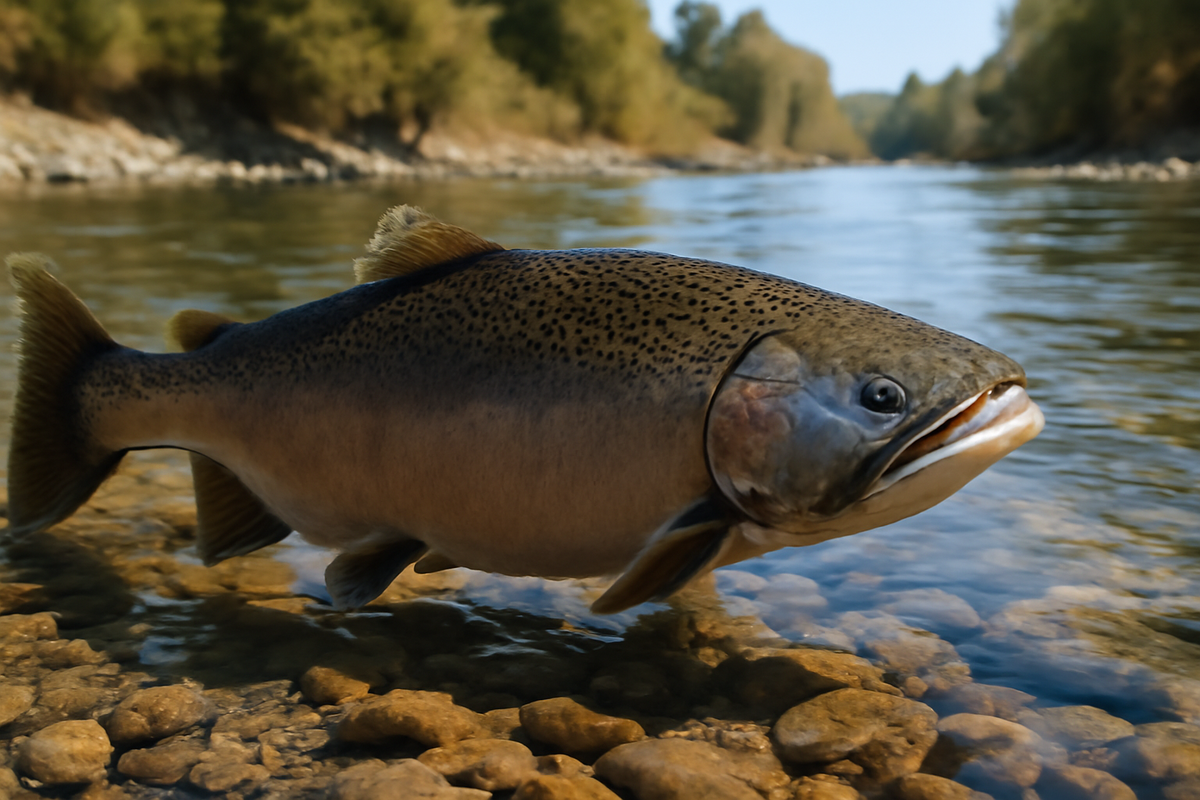
The fish does not know it is carrying a century on its back. It only knows the tug of the current, the cold bite of snowmelt on its flanks, and a pull that feels older than memory—older than dams, older than highways, older than every bridge that now throws its shadow on the water. The Chinook salmon is coming home, guided by a river that, for nearly a hundred years, did not exist as a river at all.
The River That Forgot Its Own Name
Imagine a river that once roared so loudly you had to shout to hear each other along its banks. In spring, the snowmelt would pound through the canyon, churning up foam and tumbling boulders, chipping new secrets into the granite. Salmon by the tens of thousands would surge upstream—sleek, silver bullets punching through whitewater, following a scent-path imprinted in their bodies since they were the size of a child’s finger.
In California, these were the legendary Chinook salmon rivers. They fed Indigenous communities, grizzlies, eagles, the forest itself. Their bodies—their eventual deaths—brought ocean nutrients hundreds of miles inland, fertilizing trees that never saw the sea. Each fish was a small, pulsing thread in a tapestry that tied mountain snow to coastal fog.
Then the walls went up.
Concrete dams sealed off entire watersheds, built in the name of progress. They powered cities, irrigated orchards, and created lakes where there had been canyons. Behind the dams, the old spawning beds fell silent under still, cold reservoirs. Salmon runs winked out, one by one, until their names survived only in local stories and yellowing photos. The river forgot that it was supposed to run free. The salmon, cut off from their ancestral routes, forgot too.
Almost.
The First Cracks in the Wall
The story of this one Chinook salmon—the one nosing its way up a long-lost California river nearly a century after the last wild run—does not begin in the water. It begins in dusty meetings, in rolled-out maps, in arguments that stretched for decades. It begins in the quiet persistence of people who refused to let the idea of a living river die.
Biologists stood under humming fluorescent lights pointing to old survey records and grainy black-and-white images. In them, men in wool caps stood beside wooden racks of salmon, the fish slung in rows, thick as firewood. Indigenous leaders told of a time when the river itself was a pantry, a sacred artery of life that pulsed with every run. Their elders remembered the taste of smoked fish, the way the whole village would move to the water’s edge, how children would fall asleep to the slap-slap of bodies on the surface.
For years, these stories were just that—stories, weighed down by a shrug: But the dam is there. The river is gone. What can we do?
Eventually, a different question began to surface: What if the river wasn’t gone forever?
Engineers sketched plans that did not assume concrete had to be permanent. Ecologists ran numbers and saw surprising resilience just beneath the surface. Activists and tribes took their cause to courtrooms and council halls. Bit by painstaking bit, the unthinkable became negotiable. The river, still pressing its weight against the dam’s cold wall, became an argument, a promise, a possibility.
The Day the River Exhaled
When the demolition finally began, it was less like an explosion and more like a slow unwinding. Crews chipped and cut through concrete, staged the releases, and let decades of captured water slip downstream in careful, measured breaths. People lined the banks to watch.
At first, the newly freed river looked raw and awkward, like a limb that had fallen asleep and was only now beginning to tingle back to life. Muddy plumes fanned out downstream, curling around boulders that had not seen the sun in generations. Fragments of old trees, long entombed in the reservoir’s silence, swirled past like ghosts. Gravel bars reassembled themselves in the current’s new language; side channels blinked open; forgotten springs seeped into daylight.
Along the banks, willows and alders began to root where the water once lapped against a sharp, artificial shoreline. Songbirds rediscovered perches that no longer hung over flat, still water but over a muscular, moving flow. The river was remembering how to be a river.
And somewhere, far out in the cold Pacific, a young Chinook salmon felt something shift.
A Nose Full of History
Scientists will tell you the navigation of a salmon is chemistry and magnetism: a map written in the Earth’s magnetic field, a memory of scents layered from gravel and snowmelt and moss. But the way this single fish turns toward a river that hasn’t run free in nearly a hundred years feels like something closer to myth.
It started life in saltwater, adrift in currents that do not care about history. Food was plentiful there—krill, smaller fish, a glittering chaos of life. The Chinook grew sleek and powerful in the ocean’s cold engine, trading the risks of predators and storms for the rewards of open water. If you had watched it then—just one silver streak among thousands—you would have seen nothing to mark it as different.
But inside, like a seed held in darkness, a pattern was ripening.
One spring, the call came. Not a voice, not a thought, but a shift, as if a compass needle deep in the salmon’s skull had clicked into alignment. The great turning of the body began. Fat stores built up. Muscles braced. The urge was clear and total: Go home.
Only—what does home mean to a fish whose ancestral river has been a still reservoir longer than any salmon lifespan? Chinook live only a few years. No living ancestor had ever made this trip. And yet, as if decoding a message passed down in the quiet of eggs, the fish began to angle toward the coast, then closer, then into the mouth of the great estuary that gathers so many of California’s rivers into one mingled breath.
The water tasted different here. More silt, more tannin, more of the mountain’s voice mixed with the ocean’s roar. Among that chorus, one note—faint, almost faded by time—threaded out like a memory. It was the scent of a river that had been buried beneath a reservoir, now, at last, flowing free again.
The Chinook turned toward it.
Upstream Through a Changed World
This is where the story narrows, like a river approaching its first rapid. From here on, the fish moves mostly unseen. But we can imagine its path.
On the outskirts of sprawling cities, the salmon slips beneath bridges clogged with rush-hour traffic, the muffled growl of engines vibrating through its lateral line. Sunlight fractures through the gaps in the concrete overhead, strobing across its back. It skirts the shadows of harbor seals patrolling near the river mouth, dodges a sea lion’s lunging shape. Each time, the salmon spends precious energy in a panicked burst, then settles back into the grinding rhythm of migration.
The water temperature shifts as it leaves the tide’s last subtle tug. The taste of salt grows thin, replaced by cold, tannin-stained snowmelt and the faint, iron tang of mountain stone. The Chinook’s body begins to change. Its chrome-bright ocean armor darkens, taking on a bronze, almost bruised hue. Males, especially, develop hooked jaws and thicker displays of muscle. It is becoming a creature of fresh water again, a temporary wildness designed for a single purpose: to fight upstream, to spawn, and to die.
Along the banks, the human world crowds closer. Backyard fences, orchards, fields of irrigated crops, the occasional rusted-out car half-buried in gravel. The river’s corridor—once broad as a floodplain, with multiple braids and seasonal marshes—has been squeezed into a single, deeper channel. But for the salmon, there is only the next bend, the way the current tugs at its tail, the chemical fingerprint of “home” growing stronger with every mile.
Where the Dam Used to Be
Up ahead, the river narrows between scarred walls of rock. This, for nearly a century, was the end of the line: the blunt, impenetrable face of the dam. The water had pooled still and deep here, its voice reduced to a quiet, exhausted lapping at the concrete. Migrating salmon, if they made it this far, would have found nothing but a blank, vertical silence.
Now, the silence has been broken.
What the Chinook finds instead is turbulence. The restoration engineers did not simply blow a hole in the dam and walk away; they carved the river’s course through the old reservoir bed, creating a staircase of riffles and pools designed to mimic what might once have been here. Boulders have been repositioned like punctuation marks, guiding the current and giving shade and rest stops for fish. Native plants have been plugged into the raw banks, their roots tasked with holding the new shape of the river as flood and drought test its resilience.
For the Chinook, this is less about design and more about instinct. It senses faster water, more oxygen. It leaps small cascades where the river breaks over rock. The climb is brutal on its already-tiring body. Each jump is a gamble—miss, and it risks being slammed into stone, scales scraped raw, precious energy wasted.
Still, it climbs.
Above the former dam site, the river is slimmer, cooler, and strangely young. So much sediment was trapped behind the wall that the exposed channels are like newly skinned earth—raw, bright, unweathered. Gravel has been trucked in and spread over stretches of riverbed to rebuild the cobbled, oxygenated nests that salmon prefer for spawning. This is a manufactured wild, a stitched-together memory of what once was.
The fish does not care. Its whole body is screaming now with a single command: Here. Here. Here.
The First Red in a Hundred Years
Somewhere along a shallow riffle, where water chatters over hand-sized stones, the Chinook rests in the shadow of a submerged log. Its fins flutter slowly, keeping it balanced in the current like a kite on an invisible string. The scent is unmistakable. The ingredients of this place—this exact blend of rock, soil, water, and leaf—match an internal template that has waited, dormant, for generations.
This is it. The end of the journey.
Nearby, maybe one or two other salmon have made it this far—refugees of the ocean, wanderers who decoded the same faint call. Together, they begin a ritual so old it predates every act that tried to erase it.
The female Chinook turns on her side and beats her tail into the gravel, over and over, sending up small clouds of sand and silt. Slowly, she carves out a shallow depression—a redd, a cradle for the next generation. The effort gouges away at her. Scales peel off. Her color deepens in blotches. She is burning the last of herself to make a place for others.
When the redd is ready, she releases a spill of orange, translucent eggs into the flowing water. The male, hovering close, flicks his fins and releases milt, the milky cloud that will thread life into those waiting beads. The river folds them all into itself, pulling them gently down among the clean gravel, hiding them from view.
Eggs in a river that has not held a native Chinook redd in nearly a hundred years.
Above them, the adult fish hang in the current for a few more days, ragged but fierce. Then, one by one, their bodies fail. They tumble sideways, then drift downstream, flesh already beginning to soften. In death, they become what salmon have always been: a final gift.
Insects will feast on them. Otters and bears, maybe, if those links in the chain reattach themselves in time. Even the trees along the bank—those young willows and alders—will draw ocean-born nitrogen up through their roots, weaving faraway currents into their leaves.
But under the gravel, the story is not over. It is just starting again.
How a Single Fish Changes a Landscape
It might be tempting to treat this as a tidy parable: humans build dam, salmon disappear; humans remove dam, salmon return; nature heals. The reality is rougher, slower, more complicated. Yet there is no denying that the presence of this single Chinook—and the few that follow—marks a turning point.
For scientists, this fish is a data point that borders on miracle. Radio tags and sonar arrays pinged with excitement as its passage was recorded. Genetic samples taken from a shed scale or a sloughed fin cell will be analyzed in labs, cross-referenced with historic collections, compared to remnant populations in other basins. The question at the center of all this: Who are you? Are you descended from a forgotten strain? A wanderer from a nearby river? A hybrid of hatchery lineages making their way back into the wild story?
For Indigenous communities whose ancestors once greeted these runs with ceremony, the returning Chinook is something far beyond data. It is a relative, a long-absent family member finally finding the way home. On the day the first fish was confirmed above the old dam site, some people wept. Others sang. Elders spoke of promises kept—not just by the engineers and policymakers, but by the salmon itself, which persisted in its duty to return as long as the river gave it even the slimmest chance.
For the river, the fish is a spark. Salmon are engineers in their own right. Their digging reshapes gravel beds, improves oxygen flow, and creates microhabitats for insects and other fish. Their carcasses feed entire food webs. A single fish, multiplied over years and generations, can nudge a river back toward the dynamic complexity that sustained it for millennia.
For the rest of us, perhaps sitting miles away scrolling through a story about a fish we will never see in person, this Chinook offers something quieter but no less vital: a reorientation of what is possible.
A Future Written in Water
Standing on the bank of this newly freed California river, the air smells raw—wet stone, algae just beginning to bloom, a faint sweetness from wildflowers pushing up through disturbed soil. The water’s voice is gathering confidence. You can hear it. More importantly, the fish can.
In the coming years, restoration crews will keep working. They will stabilize banks, plant more native vegetation, adjust the placement of boulders and logs to fine-tune the current. Biologists will fan out along the channel in waders and rafts, counting redds, scooping up fry in gentle nets, checking water temperature and dissolved oxygen levels.
There will be setbacks. A drought year might shrink the river to a thin, warm ribbon, stressing young salmon to the edge of survival. A heavy storm might rip out carefully placed structures, rearranging the riverbed like a child scattering toys. Invasive species may slip into the new system, competing for space and food. Climate change will keep pushing at every margin—hotter summers, less reliable snowpack, more violent swings between wet and dry.
And still, each spring, somewhere out in the dark blue blur of the Pacific, Chinook will feel that old compass twitch. If the river holds, if we let it keep learning what it once knew by heart, more fish will nose into its mouth, test its currents, and commit their bodies to the uphill climb.
In a world where so many stories about the environment end with loss, with another species slipping into the long quiet of extinction, this one offers a different arc. Not a fairy tale, not an erasure of harm, but a muscular, hard-earned glimpse of repair.
The first Chinook salmon to return to its native California river in nearly a century is not a happy ending. It is a beginning—a wet, fin-flicking, gravel-sifting sentence at the start of a new chapter we are writing together with stone, water, and bone.
Key Moments in the Chinook’s Return
Here is a simple snapshot of how this restoration journey unfolds, from concrete wall to living river:
| Stage | What Happened | Why It Matters |
|---|---|---|
| Dam Removal Planning | Communities, tribes, scientists, and agencies negotiated for years to study impacts and design a safe removal. | Built the legal, social, and technical foundation for bringing the river back. |
| Controlled Demolition | Concrete was removed in phases, allowing sediment and water to move downstream in manageable pulses. | Protected downstream habitat while freeing the river’s flow. |
| Habitat Reconstruction | Engineers and ecologists reshaped channels, added gravel, and planted native vegetation. | Recreated spawning beds and shelter critical for salmon survival. |
| First Salmon Detected | Monitoring equipment and field crews documented Chinook above the former dam site. | Confirmed that salmon can and will recolonize restored habitat. |
| Spawning and Redds | Fish created nests in the new gravel and laid eggs for the first time in nearly a century. | Marks the true return of the life cycle, not just a passing visit. |
FAQ: The Return of Chinook Salmon to a Restored California River
How do salmon find their way back to a river that was blocked for so long?
Salmon use a combination of the Earth’s magnetic field for long-distance navigation and an extraordinary sense of smell to recognize the unique chemical “scent” of their home watershed. Even though no living salmon had migrated this exact route in decades, the river’s water chemistry—now that it flows again—matches the imprint encoded when this lineage first evolved. Some fish also stray from nearby rivers, exploring new or restored habitat, which helps recolonize places once cut off.
Were these returning Chinook from a hatchery or wild populations?
In many restoration projects, the first returning fish are a mix. Some may be descendants of hatchery-raised salmon released in connected watersheds; others may be wild fish straying from neighboring rivers. Genetic testing helps scientists untangle these origins. Over time, if the habitat is healthy and fish can complete their life cycle naturally, the population can become increasingly self-sustaining and wild.
Does removing a dam harm the environment in other ways?
Dam removal can temporarily disturb ecosystems—releasing stored sediment, altering water quality, and reshaping channels. That is why modern projects are planned carefully and phased over time. Although there are short-term impacts, the long-term benefits are significant: restored fish passage, revived sediment transport, better water temperatures, and renewed floodplain function. Most rivers rebound surprisingly quickly once allowed to flow freely again.
How long will it take for salmon runs to truly recover?
Recovery is not instant. Chinook salmon typically take three to five years to complete a full life cycle. Ecologists often say it can take multiple salmon generations—10, 20, even 30 years—to see the full effects of restoration. The first returning fish are a hopeful signal, but stable, abundant runs depend on consistent flows, healthy habitat from the mountains to the sea, and management that adapts to climate change and population pressures.
What can ordinary people do to support salmon and river restoration?
You do not need to be a biologist or an engineer to make a difference. Supporting local watershed groups, participating in river cleanups, conserving water at home, and paying attention to how we vote on water and land-use policies all help. Simply learning the names of your local rivers, understanding where your water comes from, and sharing stories like this one can shift how communities value living, connected waterways.

Hello, I’m Mathew, and I write articles about useful Home Tricks: simple solutions, saving time and useful for every day.