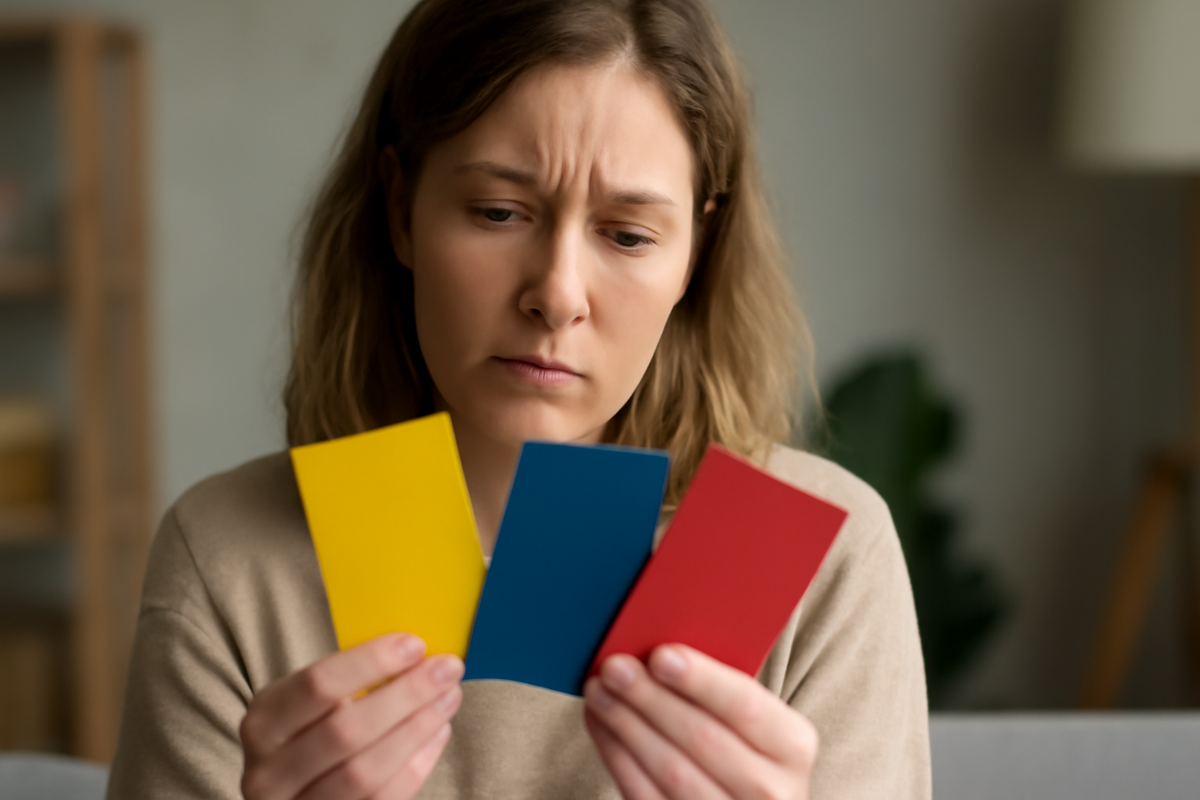
The room was white in that careful, curated way that makes you feel as if your thoughts might echo. Outside, the city hummed; inside, the only sound was the faint tick of a clock and the rustle of a psychologist’s notebook. On the low table between us lay a simple fan of color cards—just rectangles of pigment, really. Harmless. Ordinary. But as I watched people choose their favorites over several afternoons in that office, it began to feel like something else was happening. People didn’t just pick a color; they reached for a feeling, a shield, a story they weren’t ready to say out loud.
The Quiet Language of Color
We like to imagine our color preferences are innocent, almost whimsical. “I’ve always loved blue,” someone might shrug, as if this love sprang out of nowhere, unbothered by history, unshaped by fear. Yet psychologists have long suspected that our favorite colors do more than decorate our wardrobes and living rooms. They often mirror the moods we crave, the insecurities we’re disguising, and the pieces of ourselves we worry might crack if someone looks too closely.
Color psychology is not mind-reading, and it’s certainly not destiny. But there is a growing body of clinical observation and research suggesting that some color preferences, when strong and persistent, cluster around particular emotional needs—especially when self-confidence is fragile. You can think of these favorite hues as emotional bandages: not wrong, not bad, but revealing. They tell us where we feel tender.
Among the many colors in the spectrum, three turn up again and again in conversations about hidden insecurity: intense black, hyper-controlled white, and loud, attention-hungry red. Loving these colors does not automatically mean you’re insecure. Still, when someone clings to them, insists on them, wraps their identity in them, psychologists start to wonder: What hurt are you hiding? What are you protecting underneath all that pigment?
Black: The Armor of the Overwhelmed
In that white-walled office, black was often chosen quickly, almost instinctively. “Black,” one young man said, with a finality that sounded less like preference and more like surrender. He was dressed almost entirely in it: black hoodie, black jeans, black sneakers. When asked why, he shrugged. “It just feels…safe.”
That word—safe—shows up a lot among those who cling to black as their default. To psychologists, black is the color of emotional armor. It is boundary, barrier, and silence, all at once. For people whose self-confidence feels fragile, black can function as a shield between the tender self and a world that feels too bright, too demanding, too intrusive.
Some researchers describe black as a “withdrawal color.” It absorbs light rather than reflecting it, taking in everything but giving nothing back. In emotional terms, that can translate to a desire not to be read too easily. If you’ve ever watched someone step into a room filled with color and feel instantly exposed, then soften the moment they slip on a black coat, you’ve seen this defense in motion. The color becomes a kind of cave—a place to retreat, regroup, and remain unreadable.
People with shaky self-worth sometimes gravitate toward black because it lets them hide their uncertainties without having to explain them. Instead of saying, “I’m not sure who I am,” they can say, “I like things simple.” Instead of “I’m scared you’ll judge me,” they say, “I just hate bright colors.” Behind that simplicity often lurks a fear of visibility: the belief that if others truly see them, they’ll find something lacking.
Of course, many choose black for aesthetics, professionalism, or cultural identity. But psychologists notice patterns. When black dominates not just a wardrobe, but a life—bedroom, phone, car, artwork—and when that dominance is tinted with a defensive tone (“Colors are stupid,” “I can’t stand cheerful people,” “Everything else looks childish”), it may reveal a deeper story: a person protecting tender self-esteem under layers of deliberate obscurity.
White: The Perfectionist’s Fragile Shield
If black is the color of hiding, white is often the color of erasing. It’s the blank page before a single word, the pristine room before anyone dares to sit on the sofa. When people talk about their love of white, they often mention words like “clean,” “pure,” “fresh,” or “perfect.” They describe white spaces as calming because “nothing is out of place.”
For some, that’s all it is: a love of simplicity and light. But for others, especially those wrestling with hidden self-doubt, white becomes less about simplicity and more about control. White doesn’t just brighten a space; it removes evidence of chaos. It’s the color of what has not yet gone wrong.
Psychologists often notice that people who are deeply, almost anxiously attached to white—white clothes that can’t risk a stain, white rooms terrified of clutter, white decor that must remain untouched—sometimes carry a quiet fear of contamination, not just physical, but emotional. Flaws, mistakes, conflicts, messy feelings: all of these feel like stains on the self. If your sense of worth is fragile, the idea of being “messy” can feel almost unbearable.
Perfectionism loves white. In therapy, clients who idealize white sometimes speak of wanting to “start over,” “wipe the slate clean,” or “keep things under control.” They might struggle with criticism, even gentle feedback, as if every smudge reveals something permanently wrong with them. Their lives may look organized, polished, impressively managed, but just beneath that glossy surface lies a fear that if one thing falls out of place, everything will fall apart—and everyone will see how not-enough they really feel.
White can become a color of avoidance. Instead of grappling with complex emotions or unresolved history, a person might pour their energy into curating a spotless home, a flawless social media feed, an immaculate personal image. When a psychologist sees white used this way—relentlessly, rigidly—it can signal an underlying insecurity: I must look perfect, or I’ll be revealed as unworthy.
Red: The Spotlight for a Shaken Ego
Then there is red: loud, immediate, almost impossible to ignore. It is the color of stop signs and sirens, of theater curtains and first roses. When someone loves red, they rarely say it with a whisper. “Red, always,” one woman told me, her nails a glossy crimson, her lipstick the exact shade of a ripe cherry. “If I walk into a room and no one notices, I feel…wrong.”
Red is the color of visibility. It pulls the eye, quickens the pulse, and demands an answer to a quiet question: “Do you see me?” For people with a shaky sense of self, red can be a way to borrow importance from the color itself. If deep down you fear you are easy to overlook, then surrounding yourself with red can feel like building your own spotlight.
Psychologists associate strong red preferences, especially when coupled with constant performance—loud laughter, bold outfits, dramatic stories—with a particular kind of insecurity. This is not shyness that hides in the corner; it’s insecurity that tries to outrun its own doubt by staying center stage. The outside message is “Look at me,” but the inside whisper is “If you stop looking, do I still matter?”
People drawn fiercely to red often describe craving excitement and intensity. They fear being boring, average, ignorable. Their confidence may appear high from a distance—after all, it takes courage to wear that much color—but inside, their sense of worth may be deeply tethered to attention, applause, and constant engagement. Without these, they may feel strangely hollow, unsure who they are when no one is watching.
Again, context matters. Loving a red scarf or a pop of crimson in art does not make anyone insecure. But when red saturates everything—the car, the clothes, the phone, the lips—and when that saturation pairs with anxiety about being overlooked, psychologists begin to see a pattern: an ego that feels fragile unless it is lit up in neon.
How These Colors Whisper About Self-Confidence
Black, white, and red couldn’t be more different visually: one absorbs, one reflects, one explodes. Yet when strongly preferred, they often cluster around a similar emotional core: a self that doesn’t quite trust its own worth.
To put it another way:
| Color Preference (When Extreme) | Hidden Insecurity Often Linked | Emotional Function of the Color |
|---|---|---|
| Black | Fear of being seen and judged; worry that inner flaws will be exposed | Acts as armor, creating distance and privacy; hides emotional vulnerability |
| White | Perfectionism; fear of making mistakes or appearing “messy” or imperfect | Symbolizes purity and control; erases visible “flaws” and chaos |
| Red | Fear of being ignored or insignificant; worth tied to attention | Draws focus; amplifies presence; creates a sense of importance and excitement |
These links are tendencies, not rules. Personality, culture, personal history, and context all shape how color functions in a person’s life. A painter might adore red for its energy with no hint of insecurity. A minimalist might prefer white simply because clutter is overwhelming. A designer in all-black might just love the aesthetic.
But in a therapeutic setting—where people talk about their secret fears and most private doubts—colors often become shorthand. “Everything in my life is black” can quietly mean “I feel safest when I’m hidden.” “I only feel okay in all-white spaces” may translate as “If anything gets messy, I won’t know who I am.” “I can’t stand it if I don’t stand out” can be red’s confession: “Without attention, I’m not sure I exist.”
Reading Your Palette Without Judging It
If you’re beginning to mentally scan your closet or living room, you’re not alone. It’s tempting to audit every color choice and hunt for diagnosis. But that’s not the point. Colors are clues, not verdicts. They are part of a story, not the entire plot.
A more helpful question than “What’s wrong with me?” is “What do I use this color to feel?” Sit with that for a moment:
- When you slide into your favorite black outfit, do you feel powerful or safely invisible?
- When you step into a white-saturated room, do you relax, or tense up at the thought of something “ruining” it?
- When you wear red, do you feel more yourself, or more like a performance you have to keep up?
Psychologists rarely isolate color as a single diagnostic tool. Instead, they listen to the emotional language around it. What words do you use? Safe, perfect, noticed, protected, clean, exciting. Beneath each word is a need: for safety, acceptance, significance, belonging. If your self-confidence is fragile, colors may become a subtle way of handling those needs without having to name them.
Exploring this doesn’t mean abandoning your favorite shades. It means getting curious about them. If black has been your armor, maybe you can experiment with adding a softer color in one small place and notice what feelings surface. If white has been your shield of perfection, maybe you can let one corner of your world get a little bit messy and see if your worth truly changes. If red has been your spotlight, perhaps you can try quiet colors in private moments and meet the version of you that does not need applause to feel real.
From Hidden Insecurity to Conscious Choice
There’s a moment that sometimes happens in therapy when a client looks down at their clothes and laughs—softly, a little caught off guard. “I just realized,” they say, tugging at a black sleeve or glancing at immaculate white sneakers or admiring a streak of red lipstick in the mirror, “I think I’ve been wearing how I feel.”
That realization isn’t an accusation; it’s an opening. Colors that once quietly protected us can become conscious tools instead of unconscious reflexes. You can still love black, but now you know when you’re using it to hide and when you’re using it to feel grounded. You can still surround yourself with white, but you might also invite a little chaos and learn that your worth survives the stain. You can still wear red and enjoy the thrill of being seen, while also cultivating an inner voice that says, calmly, firmly, “I matter even when it’s quiet.”
Fragile self-confidence does not stay fragile forever if we are willing to see where it hides. Sometimes it hides in our words, sometimes in our choices, and sometimes, quite simply, in the colors we pull toward ourselves like blankets. The work is not to strip those blankets away, but to understand why we chose them—and to remember we are more than anything we wear, paint, or prefer.
Next time you open your closet or scroll through photos of your living room, pause. Notice which colors have been doing silent emotional labor for you. Ask them what they’ve been protecting. You might find that in the quiet conversation between your eyes and your favorite shades, there is a small, honest truth waiting to be seen: your insecurities are not failures. They are just tender places that learned to speak in color long before you had the words.
FAQs
Does liking black, white, or red mean I’m definitely insecure?
No. Color preferences are influenced by many factors: culture, fashion, work, environment, and personal taste. Psychologists only see these colors as potential clues when the preference is extreme, rigid, and paired with emotional patterns like perfectionism, fear of judgment, or a hunger for attention.
Can my favorite color change as my self-confidence changes?
Yes. Many people notice their color preferences shift over the years. As you feel safer, more accepted, or more at peace with yourself, you may find yourself drawn to new colors—or using your old favorites in more flexible ways.
Are some colors always “good” for mental health?
No single color is universally good or bad. Soft blues and greens are often experienced as calming, warm tones as energizing, and so on, but the impact of a color depends heavily on personal associations and context. What feels soothing to one person might feel dull or sad to another.
Should I change my environment if I think my color choices reflect insecurity?
Only if you want to, and gently. Instead of a drastic overhaul, try small experiments: a new accent color, a different outfit, a less controlled corner of your home. Notice how you feel. The goal is awareness and choice, not forcing yourself into colors that don’t feel like you.
Can exploring my color preferences really help my self-confidence?
Yes, as part of a broader process. Reflecting on why you choose certain colors can reveal deeper needs—for safety, acceptance, order, or visibility. Understanding and honoring those needs, perhaps with the support of a therapist, can gradually strengthen self-confidence from the inside out.

Hello, I’m Mathew, and I write articles about useful Home Tricks: simple solutions, saving time and useful for every day.