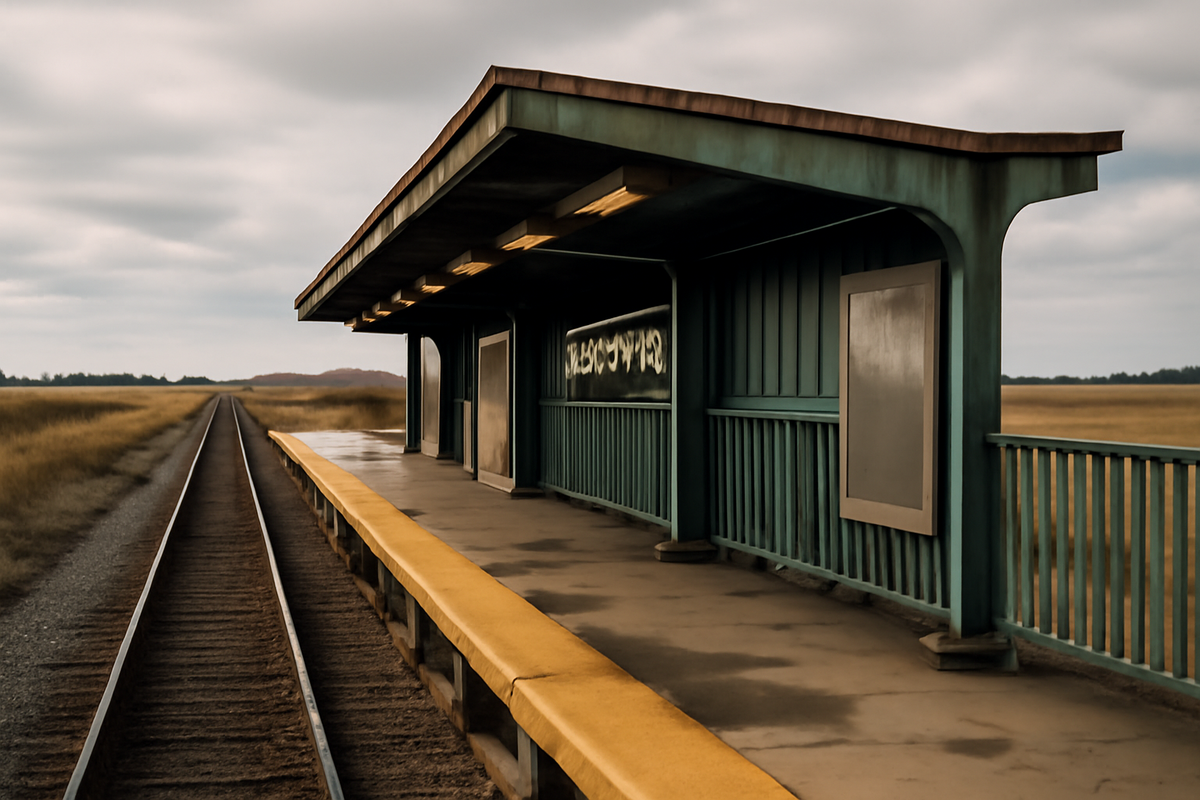
The platform is so quiet you can hear the fluorescent lights hum. A candy wrapper skitters along the yellow safety line, pushed by a breeze from a train that never comes. Above, a sign glows stubbornly: “Next train: 14 minutes.” No one is there to read it. This is a subway station built for a crowd that never arrived, a concrete monument to optimism — or hubris — left waiting in the middle of nowhere.
The Day the Future Opened Its Doors
Back in 2008, these platforms weren’t empty at all. They were full of speeches, ribbon-cuttings, camera flashes — and a very specific kind of hope. City officials stood at podiums and talked about “visionary infrastructure” and “anticipatory planning.” The air smelled like wet paint and new steel, and everyone agreed: building subway stations before the neighborhoods existed was bold, even brilliant.
The idea was seductively simple. If you put transit first, development would follow. Build a line out through empty industrial fields and half-zoned farmland, and people would come — families, shops, offices, bakeries with the smell of sourdough spilling out onto sidewalks that didn’t exist yet. It was the urban-planning version of the old movie line: “If you build it, they will come.”
Between 2006 and 2009, city after city joined the trend. Transit agencies, flush with pre-crisis funding and armed with glossy forecast reports, drew lines deep into the outskirts, planting stations like seeds. They talked about transit-oriented development, walkable communities, carbon reduction. Renderings showed tree-lined streets and cafés near glassy station entrances. It was, in many ways, a hopeful time in public infrastructure.
The numbers looked convincing on paper. Travel demand models showed future ridership curves climbing steeply upward. Housing forecasts predicted sky-high demand and relentless sprawl. Developers, in theory, would swarm around the new hubs, snatching up cheap land and building mixed-use neighborhoods. Long before the first family rolled a stroller onto the platform, planners imagined morning crowds so thick they’d need extra trains.
Then came 2008’s financial crisis — and with it, a long, quiet echo through all that concrete.
The Lonely Stations at the Edge of the Map
Visit one of these stations today, in 2025, and your first impression is not failure. It’s silence. Birds have claimed some of the metal rafters. Grass creeps up through the edges of the park-and-ride lots that were supposed to be temporary, placeholders until apartments and offices wrapped themselves around the station.
On paper, the basic elements look right. There is a wide staircase, an elevator, ticket machines beneath overhangs. There may even be a piece of public art — a sculpture, a mural, a gesture toward culture. But step back fifty meters and the station sits in a landscape that feels unfinished: warehouses, empty lots, maybe a single speculative building squinting hopefully at the horizon.
In some cities, bus routes barely bother to detour into these desert stops. The schedules are thin, the transfer options poor. A rider who actually uses the station, perhaps a warehouse worker or a night-shift nurse, might be the only person on the platform when the train sighs to a stop. The automatic doors open with theatrical precision for an audience of one.
Even more painful than the silence is the contrast with what was promised. Those old renderings haven’t aged well. Where there were supposed to be leafy boulevards, there is often a wide road hostile to pedestrians — six lanes, fast traffic, no shade. Where planners imagined ground-floor cafés spilling onto plazas, there are chain-link fences and “For Lease” signs faded by the sun. The station, a heavy investment of public money, stands as the only object that truly arrived on time.
Not every “middle of nowhere” station is a ghost. A few have scraped together enough riders to survive, feeding into distant employment centers. But for most, reality has fallen far short of the dreams of 2008. The strategy, once hailed as visionary, is now being quietly, and sometimes angrily, questioned. What went wrong?
How the Forecasts Got It So Wrong
Part of the answer lives inside the subtle language of the models that shaped those decisions. Ridership forecasts are careful creatures, built from demographics, land-use assumptions, and economic predictions. In the early 2000s, most models assumed a world that would more or less keep expanding the way it had: steady job growth, more commuting, more outward development.
Then reality rewrote the script. The 2008 crash stalled construction and froze credit. Subdivisions planned near future stations were put on hold or canceled entirely. Developers, suddenly cautious, retreated toward safer bets in already-established neighborhoods. Entire tracts of land that had been zoned for mixed-use dreams remained scrubby fields dotted with weeds and discarded construction signs.
At the same time, urban preferences began to shift in ways the models underestimated. Many younger households chose smaller, central apartments over far-flung suburbs. Remote work and flexible schedules, slowly at first and then rapidly accelerated by the pandemic years after 2020, changed the daily pulse of commuting. The whole logic of building out far and early rested on five-day-a-week rush-hour demand that has eroded into something less predictable and more diffuse.
There was also a quieter miscalculation: an overconfidence that transit alone could summon urban life. In the glossy slideshows, the presence of a subway station seemed to guarantee vibrant density. But in practice, zoning codes remained conservative in many of these “future hubs.” Height limits, parking minimums, and lengthy approval processes meant that even interested developers faced layers of friction. The train arrived right on time — the city never truly invited the buildings to follow.
The result is stark when you put the promise next to the outcome. The gap between forecasted ridership numbers and actual passengers is not just a rounding error; in some places, it is a chasm. Transit agencies now quietly circulate internal memos asking how to justify running frequent, expensive service to almost-empty endpoints when core lines, closer to the center, groan under actual crowding.
| Station Type | Forecast Ridership (Daily) | Actual Ridership (2024) | Development Within 800m |
|---|---|---|---|
| Urban infill station | 18,000 | 20,500 | Mature mixed-use, high density |
| Suburban retrofit station | 11,000 | 9,700 | Partial redevelopment, big-box & apartments |
| “Middle of nowhere” 2008 station | 15,000 | 3,200 | Sparse, warehouses & vacant land |
The lesson is not that predictive tools are useless, but that they were used to justify a story that was only half true. Infrastructure can shape growth, but it does not, by itself, override economics, policy, and shifting human desire.
The Hidden Costs of Being Too Early
For riders, the failure feels like wasted opportunity: a train they rarely use, a station they pass on maps but never see in person. For transit agencies, it’s something harsher and more practical: a financial drag that doesn’t go away.
Every station has a kind of heartbeat cost — cleaning, lighting, security, maintenance, staff, inspections. Track must be kept in safe condition whether it carries full trains or just a handful of passengers. Elevators break and must be repaired, cameras must be replaced, escalators must be inspected. When ridership is strong, these costs blend into the lifeblood of a system. When a station stands nearly empty, each passenger is effectively wrapped in a very expensive blanket of service.
The early-build strategy also locked up capital that might have gone elsewhere. In those same years, aging stations in busier parts of the network waited for accessibility upgrades or platform repairs. Crowded central segments could have used additional capacity or more frequent trains. Instead, tens or hundreds of millions were poured into concrete shells on the periphery, in trust that the future would reimburse the gamble.
There is a social cost too, less visible but no less real. An empty station can make transit itself seem like a bad investment in the public imagination. Critics point to quiet platforms and say, “Look, no one rides these things,” ignoring that many inner-city stops are overflowing. But optics matter. A station in the middle of nowhere feels like proof — however selective — that governments can’t be trusted to spend wisely.
And then there’s the emotional cost tucked inside the professionals who worked on these projects. Talk to a planner or engineer who helped design one of these stations, and you may hear a mix of pride and regret. The detailing might be beautiful — careful sightlines, generous canopies, good materials — but the context never appeared. It’s like designing a theater and discovering that only a handful of people ever buy tickets.
Why the “Build It and They Will Come” Story Broke Down
Underneath all the spreadsheets and site plans, the early station strategy depended on a particular faith: that transportation leads and land use follows, almost automatically. The 2025 view is more nuanced, and harsher.
Infrastructure can absolutely shape the city, but only in conversation with at least three other forces: strong supportive policy, coordinated investment, and time. In many of the 2008 stations, one or more of these partners never showed up.
Policy lagged. Transit-oriented development requires more than a buzzword; it demands zoning that allows — and encourages — height, mixed uses, and minimal parking. Yet many station areas remained locked in low-rise, car-centric regulations. A developer asking, “What can I build here?” heard a quiet answer: “Not much that will make you money soon.”
Investment scattered. Instead of a deliberate, orchestrated effort to bring jobs, housing, and amenities to these new hubs, public and private capital followed old patterns. Retail followed cars. Offices clung to highway interchanges. Greenfield housing popped up where land assembly was easiest, not where the train already waited.
Most of all, the story underestimated time. City-building is slow, and infrastructure timelines are long. The gap between opening day and neighborhood maturity can easily stretch 20 or 30 years. But the 2008 strategy was sold to the public in shorter horizons — full platforms in five or ten years, booming districts within a political term or two. When those deadlines passed, the stations turned, unfairly but inevitably, into symbols of broken promises.
There is also a simpler truth: people don’t move their lives based solely on the presence of a station. They follow schools, jobs, social networks, affordability, and a hundred small conveniences. A subway stop surrounded by empty lots may be technically “well-connected,” but it doesn’t feel like home. The walk from platform to front door is as much emotional as it is physical, and concrete alone can’t complete that journey.
The 2025 Reboot: What We Do Differently Now
By 2025, the mood has shifted dramatically. Planners and transit agencies are less enchanted with the romance of building far-ahead-of-demand and more focused on tactical, grounded approaches. The failed strategy of 2008 hasn’t killed vision — but it has sharpened it.
New rail projects now tend to favor corridors where people already are, or where at least multiple pieces are lined up: zoning changes in place, public land assembled for housing, commitments from major employers, updated bus networks to feed the line. Instead of making a solitary bet on a lone station, agencies talk about “whole-ecosystem planning.” A station without jobs, homes, and services is increasingly seen as a half-finished project, no matter how polished the platform.
In some cities, those lonely 2008 stations are being retrofitted into more coherent futures. Surface parking lots are being converted into affordable housing. Old zoning maps are being redrawn to allow mid-rise apartments and small retail. Incentives are offered to bring clinics, co-working spaces, even small universities to the area. The train that once served almost no one is now reimagined as a spine for a late-blooming district.
Importantly, agencies are becoming more honest in public about uncertainty. Instead of presenting glossy certainty, they talk in scenarios. “If we build the station and change the zoning and attract X jobs, we expect this range of ridership. If those things don’t happen, the outcome looks different.” That transparency can be uncomfortable, but it’s a step away from the overconfident optimism that left so many platforms empty.
There’s a growing appetite, too, for lighter, more flexible moves. Rather than leapfrogging far into undeveloped land with expensive heavy-rail stations, cities experiment with bus rapid transit, tramways, or even demand-responsive shuttles as interim tools. Hard infrastructure is still crucial, but it’s being phased more cautiously, layered with policy and market signals instead of hurled hopefully into blank space.
And in the background, those quiet 2008 stations continue to glow in the dark, uneasy reminders that public works live longer than political cycles. Every time a planner walks through one, they are walking through a case study — a story etched in steel and stone about what happens when vision outruns reality by just a little too far.
Listening to the Silence
Walk again onto that empty platform. The paint is no longer new; there are fine cracks in the concrete where the seasons have pushed against the edges. A lone commuter checks their phone under the station clock. The train arrives on time, doors sigh open, and they step inside. The car pulls away, leaving the station quiet once more.
The failure of the 2008 “middle of nowhere” station strategy is not a failure of believing in public transit. It is a failure of believing that tracks alone could dictate the shape of the city. We are learning, slowly, that subways and streets and zoning and markets and human preference are all threads in the same fabric. Pull one without tending the others, and the pattern doesn’t hold.
In 2025, the lesson feels sharper because we need transit more than ever — for climate, equity, and sheer practicality. The answer is not to stop building, but to build more wisely: closer to where lives are already unfolding, and more deliberately tied to the policies and investments that make neighborhoods real.
One day, perhaps, those quiet stations will finally be busy. Children will run for trains beneath shade trees that aren’t there yet. Shop doors will jingle open in the morning rush. The silence will be replaced by a comfortable murmur of everyday life. If that happens, it will not be because we believed that steel alone could conjure a city, but because we finally learned to line up all the pieces at once.
Frequently Asked Questions
Why were so many subway stations built “in the middle of nowhere” around 2008?
They were built as part of an “anticipatory planning” strategy. Planners and politicians believed that constructing transit first would attract development later. Forecasts predicted strong population growth, expanding suburbs, and high ridership if lines extended out ahead of demand.
What changed between 2008 and 2025 that made the strategy fail?
The 2008 financial crisis stalled development, credit tightened, and many planned neighborhoods never materialized. Later, remote work, shifting housing preferences toward central areas, and slow zoning reforms meant that the expected dense communities around these stations never fully formed.
Are all early-built suburban or peripheral stations failures?
No. Some stations have eventually attracted enough riders, especially where cities paired transit with supportive zoning, public investment, and good bus connections. The biggest failures tend to be where stations were built without coordinated land-use changes or realistic timelines.
Why not just close the underused stations?
Closing stations is politically and operationally difficult. Infrastructure is already paid for, and shutting a station can strand existing users, however few. Agencies also hope that with policy changes and gradual growth, ridership might improve over time, making closure short-sighted.
What are cities doing differently now when planning new lines?
Many are focusing on corridors with existing demand, tying transit investments to firm zoning reforms, housing and job commitments, and better bus integration. They’re also phasing expansions more cautiously and being more transparent about uncertainty in ridership forecasts.

Hello, I’m Mathew, and I write articles about useful Home Tricks: simple solutions, saving time and useful for every day.