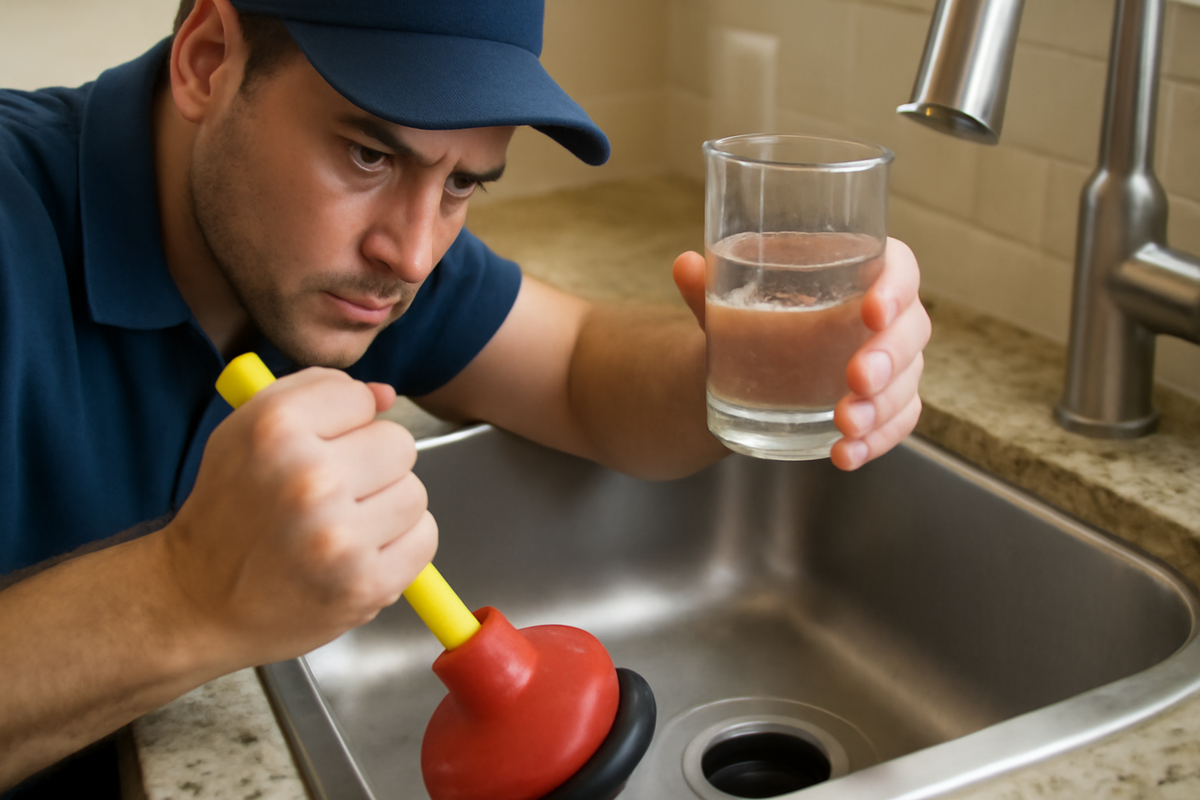
The first thing you notice is the sound. Not the angry glug-glug of a dying drain, but the quiet, suspicious stillness that tells you something is wrong. The water in the sink hesitates, then gathers itself in a small pond, swirling lazily instead of disappearing with that satisfying whoosh. You reach for the cupboard below, prepared for the familiar rattling of plastic bottles—harsh cleaners, vinegar, baking soda, whatever last month’s how-to article suggested. But today, there’s another option sitting on the edge of the counter: a simple, half-full glass of water.
You wouldn’t think a glass of water could teach you anything about plumbing. Yet, according to one patient old plumber with weathered hands and a sense of humor dry as drywall dust, that half-glass might be the quiet hero your drains have been waiting for—no vinegar, no baking soda, and definitely no chemical cocktail with skull-and-crossbones warnings on the label.
The day the plumber put down the vinegar
The story starts in a small, sunlit kitchen that smelled faintly of coffee and wet leaves tracked in from the yard. The sink was backing up again. Not dramatically, just enough to be irritating. Enough for the homeowner to apologize six times before the plumber even opened his toolbox.
“I’ve tried everything,” they said. “Vinegar, baking soda, that foamy stuff in the neon bottle. I even saw a video where someone poured cola down the drain.”
The plumber gave the drain a slow, considering look—the way a seasoned hiker sizes up a muddy trail. Then he did something unexpected. He reached, not for a wrench, not for a bottle, but for a drinking glass on the counter. He filled it halfway with cold water from the tap. Just half. No more.
“Most of the time,” he said, swirling the water gently, “your drain’s not totally clogged. It’s just… tired. Coated. Sluggish. You don’t always need fireworks to wake it up. Sometimes you just need the right nudge.”
He called it the “half-glass trick.” It sounded more like a bar game than a plumbing method. But the way he explained it made the whole thing feel oddly elegant—like nature, gravity, and a bit of kitchen mindfulness all teaming up to do the work usually assigned to stinging chemicals and fizzing powders.
What’s really happening inside your drain
Most of us think of a clogged drain as a plug—some solid, evil lump of hair or grease sitting in the pipe like a cork in a bottle. The truth is less dramatic and a lot more… sticky. Over time, your drain walls slowly gather a thin film of soap scum, grease, oils, toothpaste, bits of food, and whatever else your sink sees daily. That film thickens, narrows the pathway, and makes it easier for new debris to hang around instead of flowing away.
Vinegar and baking soda work by reacting with each other and sometimes softening that gunk, but they’re not magic. Harsh chemical cleaners, on the other hand, are like sending a battering ram down your drain. They can work, absolutely—but they can also be brutal on older pipes, septic systems, and waterways downstream of your home.
The plumber’s half-glass trick works with the natural behavior of water and the shape of your drain instead of trying to scorch everything in sight. It doesn’t promise to obliterate a dense, years-old clog. What it does is keep those “almost clogs” from becoming full-blown disasters—and it does it quietly.
Inside the gently curved, often overlooked S-shaped trap beneath your sink, water is always resting. That U- or P-trap holds a small reservoir that blocks sewer gases from coming up. But it also slows things down just enough for heavier debris and sticky residue to linger. Over time, that cozy resting pool becomes more like a sediment pond. The half-glass trick uses timing, temperature, and a bit of momentum to loosen that sediment and send it on its way.
The half-glass trick, step by step
There’s no label to read, no warning text in tiny letters. Just a sequence, a rhythm. The plumber didn’t write it down; he recited it like a recipe passed between generations:
1. Start with a clean, half-glass of cold water
Fill a regular drinking glass halfway with cold tap water. Not warm, not hot—cold. The temperature difference matters. Cold water is denser; it carries weight and moves a little more decisively than warm water. Half a glass is enough to move quickly but not so much that it splashes or overwhelms the system.
2. Let a thin stream of warm water run
Turn on your tap and let a small, steady thread of warm water flow down the drain—not blasting, not trickling. You’re not trying to fill the sink. You’re creating a narrow, gentle river that glides down along the sides of the pipes, softening the film and warming the metal or plastic slightly. Give it about 20–30 seconds.
3. Then: the drop, not the dump
Now comes the part that feels almost ceremonial. Hold the glass directly over the drain. Don’t pour the water in from the side of the sink; bring the glass to the center above the opening. Then tilt it firmly and pour the half-glass in one continuous motion.
The cold, slightly heavier water dives through the center column of the warm flow. It doesn’t spread out gently—it punches a narrow path downward, a mini water piston. As it barrels through the trap, it nudges settled particles, jolts tiny pockets of grime, and briefly shifts the pressure in that U-bend just enough to dislodge the loosened layer.
4. Keep the warm water running a little longer
Let the warm water continue flowing for another 20–40 seconds. This eases the disturbed grime further down the line, spreading it out so it doesn’t immediately settle again in a new clump. Think of it as escorting the trouble out of your home’s plumbing system, not just knocking it loose and leaving it stranded.
5. Repeat, don’t overdo
For a slow-but-still-moving drain, you might repeat the half-glass pour two or three times during one session. For regular maintenance, once or twice a week is enough. If your sink is fully backed up, water doesn’t move at all, or it’s coming back up when you run another fixture, this trick is too gentle for that situation—you’ll need a plunger, a drain snake, or a professional.
Why a half-glass? The quiet science behind it
That modest amount of water is not random. A full glass is heavier and moves slower; it spreads out too widely, losing its ability to form that focused downward push. A splash or dribble doesn’t have enough momentum to reach and nudge the settled water in the trap.
The sweet spot—a half-glass poured in a single, steady tilt—creates a small, high-speed column of water. It behaves almost like a gentle plunger stroke from the inside, but without the violent up-and-down motion or the risk of pushing a clog deeper into a tight corner.
The contrast between the warm water already flowing in the pipe and the sudden rush of cooler, denser water also helps disturb layering. Warm water tends to rise slightly within the pipe; the colder water undercuts it and bulldozes a path. What you get is a quiet stirring inside the pipe, a reshuffling of the sediment that makes it easier to carry away.
This isn’t chemistry; it’s physics. No fizzing, no foaming. Just the choreography of temperature, gravity, and speed.
How the half-glass trick compares to popular methods
We live in a world that loves quick fixes, especially ones that foam dramatically and make us feel like something intense is happening. But intense isn’t always better—especially when your pipes, your lungs, and downstream ecosystems are paying the price. Here’s how the plumber’s humble glass stacks up against the usual suspects:
| Method | What It Does Best | Drawbacks |
|---|---|---|
| Half-glass water trick | Gentle maintenance, preventing build-up in sinks and bathroom drains. | Won’t clear fully blocked pipes or heavy grease clogs. |
| Vinegar & baking soda | Loosens light organic grime; deodorizes drains. | Reaction is short-lived and not very powerful on deeper or older buildup. |
| Chemical drain cleaners | Can burn through tough clogs quickly. | Harsh on pipes, dangerous to handle, and harmful to septic systems and waterways. |
| Plunger | Moves semi-solid blockages; good for toilets, some sinks and tubs. | Messy, can push clogs deeper if used incorrectly. |
| Drain snake / auger | Physically breaks up stubborn, localized clogs. | Takes more time and effort; risk of pipe damage if forced. |
The half-glass trick doesn’t pretend to replace all of these tools. It’s more like flossing compared to a root canal. Regular, low-effort maintenance that spares you the need for drama later.
Where this trick shines—and where it doesn’t
Walk through your home in your imagination, listening for the places where water lingers too long: that bathroom sink where toothpaste gathers at the edges, the kitchen drain where dishwater leaves a faint ring, the laundry sink that sees the worst of muddy jeans. These are prime candidates for the half-glass habit.
In the kitchen, where grease is king, this trick works best when paired with a bit of mindfulness. Wiping oily pans with a paper towel before washing, using a sink strainer, and running hot water after especially heavy dishwashing all help. The half-glass method then becomes the finishing touch—a subtle sweep that keeps the slender neck of your plumbing from narrowing day by day.
In bathroom sinks and showers, it’s particularly effective against that combination of hair, soap film, and shaving residue. It won’t magic away a dense knot of hair caught on the drain crossbar, but it can slow the growth of that sticky collar of grime that forms just out of sight.
It’s less effective in drains that are already in serious trouble. If the water doesn’t drain at all, if you hear gurgling from other fixtures when one is running, or if you smell sewage, these are clear signs that the gentle route has been bypassed by a bigger problem. That’s when you step away from the glass and reach for real tools—or dial someone who carries them for a living.
Turning a plumber’s trick into a quiet household ritual
There’s something quietly satisfying about knowing your home’s little systems are humming along because of habits, not emergencies. The plumber who shared the half-glass trick didn’t present it as a hack or a secret formula. It was more like a suggestion: pay attention early; act gently; repeat consistently.
Imagine building it into your week—after you’ve finished the dinner dishes, or while brushing your teeth at night. Half a glass, a warm trickle, a moment of focus on the simple mechanics of water and gravity doing precisely what they’re meant to do. It turns maintenance into a practice instead of a frantic sprint when things already smell wrong and sound worse.
There’s another benefit, too, softer and less obvious. When you rely less on harsh bottled solutions, you handle fewer corrosive chemicals, breathe fewer caustic fumes, and send fewer aggressive ingredients into the shared veins of your city or town—the sewers and streams that tie your sink to everything downstream.
A half-glass of water will not save the world. But it might save you a call, a bill, and a headache. And it introduces a different way of thinking about home care: not as combat, but as cooperation—between you, your pipes, and the side of physics that’s been patiently on your team all along.
FAQs about the plumber’s half-glass drain trick
Does this trick really work on its own?
Yes—for mild, early-stage buildup and as regular maintenance. It helps keep drains clear that are still flowing but starting to slow. It’s not a cure-all for fully blocked pipes or severe grease clogs.
How often should I do the half-glass trick?
Once or twice a week per frequently used sink is a good starting point. In busy kitchens, you might use it every few days; in a guest bathroom, only once in a while.
Can I use hot water instead of warm?
Moderately warm water works best. Extremely hot water can melt and smear grease further down the line, where it may cool and solidify again. Warm water softens and carries debris without that risk.
Will this work in a bathtub or shower drain?
Yes, it can help slow buildup in tubs and showers, especially from soap scum and hair residue. Just be sure the drain is already moving; if standing water lingers for minutes, you likely need to physically remove hair or use a drain snake first.
Is this safe for old pipes or septic systems?
It is very gentle on both. You’re only using tap water at different temperatures, with no corrosive chemicals. For older plumbing and septic systems, this method is far friendlier than chemical drain cleaners.
Can I combine this with vinegar and baking soda?
You can, but it’s usually unnecessary for regular maintenance. If you do use vinegar and baking soda occasionally, you can follow up later with the half-glass method to help move loosened residue along.
What if my drain is completely clogged?
If water won’t go down at all or backs up into the sink or tub, skip this trick and try a plunger or drain snake. If the clog persists, or if multiple fixtures are affected, it’s time to call a professional plumber.
Why not just pour a whole bucket of water instead?
Large volumes often move more slowly and can overwhelm traps, splashing back or forcing debris into tight corners. The half-glass size creates a quick, focused column of water that disturbs sediment without brute force.
Does the shape of my sink drain matter?
Most standard bathroom and kitchen sinks with a typical P-trap or S-trap benefit from this trick. Extremely shallow or unusual specialty drains may behave differently, but the basic physics still apply as long as water can form a column down the center.
How will I know if it’s helping?
You’ll notice that water drains more briskly and doesn’t pause or swirl as much in the basin. Over weeks, you may also find you need fewer drastic interventions—no emergency plunging, no last‑minute bottle runs for harsh cleaners. That quiet absence of drama is often the first sign it’s doing its job.

Hello, I’m Mathew, and I write articles about useful Home Tricks: simple solutions, saving time and useful for every day.