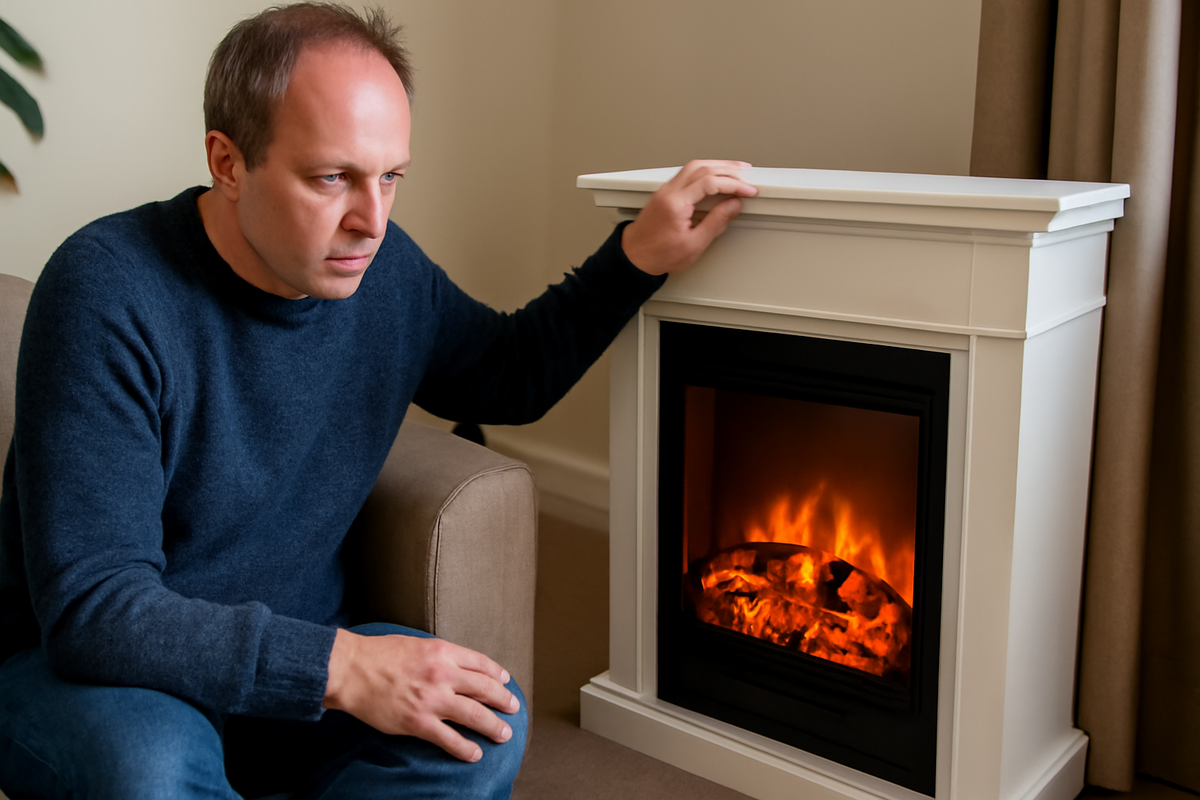
The box sat in the middle of my living room like a small, unassuming animal. Plain cardboard, Lidl logo on the side, and a bold label announcing its contents: an electric fireplace, £139. Outside, the sky was the colour of a dull spoon, and the kind of November cold that gets into your hands and stays there had begun to creep under the doors. It felt like the perfect day to see if a budget fireplace from a supermarket could really compete with crackling logs and old-fashioned flame.
The Day the Fireplace Arrived
It started as one of those impulse decisions we pretend are carefully considered. You know the sort. You’re wandering through Lidl, half-thinking about dinner and half-thinking about how much you dislike your current living room, and then there it is: a neat, black-framed electric fireplace glowing seductively in the middle aisle. £139. Faux embers. Remote control. Two heat settings. The promise of “realistic flame effect.”
I stood in front of the display longer than I’ll admit. Real fires and I have history. I grew up with the kind of house where winter meant chopping wood, sweeping out ash, and warming your back so close to the hearth that your jumper almost smoked. Real fire, real heat, real mess. These days I live in a small, well-insulated flat where building regulations and my landlord both frown at chimneys, flues, and anything that might drip soot onto the carpet. A fireplace, in the traditional sense, was off the table.
So this, I told myself, might be a compromise: the look of a fire, the simplicity of a plug socket, and a price that didn’t require a second mortgage. Besides, I wanted to know how good a cheap electric fireplace could really be. Was it going to feel like an awkward wall-mounted television pretending to be fire? Would it sound like a hairdryer? Would it look, frankly, a bit sad?
Two days later, the box was in my living room. The light had slipped away early, the room was slightly chilly, and the window reflected a flat, grey version of the world. I cut the tape and folded back the cardboard flaps. Somewhere deep inside the packaging, something clinked gently, like glass against metal. I remember thinking: This is either going to be brilliant, or deeply embarrassing.
Unboxing a Fake Fire (That Didn’t Feel Fake)
The first surprise was the weight. I’d expected something plasticky and light, but this thing had presence. It wasn’t heavy enough to be a burden, but it carried itself with the kind of reassuring sturdiness you associate with real appliances, not novelty gadgets. I slid it out of the polystyrene and took a good look.
The frame was matte black, simple, and unpretentious. No gold trim, no shiny chrome; just clean lines and a large glass front. Behind the glass, a sculpted “log bed” lay waiting, the shapes of split logs and glowing embers frozen in silence. Up close, could you tell it wasn’t real wood? Of course. But from a step or two back, there was something about the depth and texture that felt surprisingly convincing.
I found a spot against the main wall, beneath a print of a foggy pine forest, and plugged it in. The cord was long enough to be practical but not long enough to snake awkwardly around the room. My living room isn’t especially big—maybe 4 by 5 metres—but like most British houses, it has that peculiar talent for catching draughts. The idea of having a new heat source, however artificial, felt almost decadent.
The control panel was tucked neatly under the frame, out of sight. There was also a small remote; light, functional, and just intuitive enough that I didn’t need the manual to figure it out. I pressed the power button.
First, darkness. A low click. Then, slowly, the fake embers woke up.
The Flames That Fooled the Room
The first thing you notice is the glow. It spills out softly, amber and orange, then deepens into an almost coal-red at the centre of the “logs.” The flames themselves are projected behind them, restless shapes of light that tiptoe upwards and then drift sideways, as if teased by an invisible breeze. They move just enough to feel random, but not so much that your eyes catch the pattern.
I turned the overhead light off. The room transformed. Shadows gathered in the corners and the walls picked up a gentle, flickering warmth. My bookshelf, suddenly bathed in a golden wash, looked like something from a winter catalogue. My scepticism loosened a little.
“It actually looks… real,” my friend Anna said from the sofa when she came over later that evening. She leaned forward, eyes narrowed, the way you’d inspect a magic trick when you were almost certain you knew how it was done.
“Stand here,” I said, waving her to my usual seat. It’s the one opposite the new fireplace—the spot where you’re forced to look straight at it.
She stood, folded her arms, and stared. We both waited for the illusion to break: a strange flicker, an obvious loop, anything. The flames just kept dancing in that slow, hypnotic, unscripted way. The log bed glowed deeper, as if a fresh gust of air had just hit a real fire.
“Ok,” she said, finally. “That’s… weirdly good.”
The second surprise was how quiet it was with the heat off. Just the faintest whisper of a fan somewhere deep in the machine, barely audible under the house’s ordinary noises—refrigerator hum, distant traffic, the occasional creak of floorboards. As an ambient light feature alone, it was more convincing than any digital fireplace I’d seen on a television screen.
Turning Up the Heat
Of course, looks are one thing. Warmth is another. No one gathers around a purely decorative heater in February. If this was going to earn a place in my home, it needed to do more than pretend to burn wood.
The Lidl fireplace offers two heat settings: 1000W and 2000W. The manual, to its credit, is refreshingly clear, with none of that baffling, over-translated jargon you brace for with budget appliances. The idea is simple: you choose the gentle background warmth of 1kW or the full, room-lifting blast of 2kW.
I started small. The air in the room that evening had the sharpness of just-opened windows, though none were open. I hit the first heat setting on the remote. A very soft hum rose from within the unit, like a distant extractor fan. A few seconds later, warm air curled around my ankles.
It didn’t rush at me. It crept in quietly, steadily, like a tide coming in on a calm bay. Five minutes passed. The chill that had lingered at ground level began to soften. Ten minutes later, I felt it in my hands. The room no longer had that cold edge you unconsciously brace against.
Curious, I nudged it up to the higher setting. The fan picked up a little more speed; still not loud, but present now, like white noise. The output, though, was unmistakable. Heat rolled outwards from the front vent in a wider arc. It was the kind of warmth that makes you want to stretch out your legs and refuse to move for the rest of the night.
Over the course of that week, I tried it in a variety of moods and weathers. Early morning, with frost caught in the corners of the window; mid-afternoon on a day the sky never really turned bright; deep evening, when the world outside was just darkness and the occasional scuff of tyres on wet tarmac. Each time, I set the fireplace to 2000W for 15–20 minutes to take the chill off the room, then let it tick over for another half-hour at 1000W, or even just with the flames on and heat off, for the atmosphere.
In a room of about 20 square metres, it made a noticeable difference. It wasn’t instant, like stepping in front of a powerful fan heater, but it was more even and less aggressive. No burners glaring in one direction. Just a slow diffusion of warmth that eventually reached the corners. It didn’t replace the central heating altogether, but it allowed me to turn the thermostat down a notch and stay genuinely comfortable.
Numbers, Noise, and Little Details
Because curiosity and spreadsheets go hand in hand in my house, I also wanted to know how this thing stacked up in practical terms. I kept a quick record of how long I used it and at what setting. Then I compared that to the cost of running a standard 2kW heater.
| Mode | Power Use | Typical Use Per Evening | What It Felt Like |
|---|---|---|---|
| Flame Only | Low (no heating element) | 2–4 hours | Cosy ambience, no change in temperature |
| Heat Level 1 | 1000W | 30–60 minutes | Gentle background warmth, ideal for mild chill |
| Heat Level 2 | 2000W | 15–30 minutes | Quickly takes the edge off a cold room |
Noise-wise, the fireplace stayed surprisingly modest. With only the flame effect on, you’d be hard-pressed to hear it over the normal sounds of the house. With heat on level one, the fan is a soft shushing that fades into the background after a minute. Level two is more audible, but still miles away from the roaring, metallic bluster of some portable heaters I’ve used. Think “library air conditioner on low,” not “jet engine in a shoebox.”
There were other details I didn’t know I’d care about until I started living with it. The way the glass front never got worryingly hot, just warm. The built-in safety cut-out that kicks in if it gets too toasty or tips over. The fact that I could dim the brightness of the flames just enough to make late-night reading easy on the eyes. None of these things were what sold me in the aisle. But they’re exactly the things that made me keep using it once the novelty wore off.
Guests, Reactions, and a Quiet Shift in the Room
About a week into the test, I hosted a small gathering. Nothing elaborate—just a few friends, some mismatched mugs, and a pot of something hot on the hob. The wind outside pressed flat raindrops against the window, and the neighbourhood seemed to shrink to just the glow from my living room.
I had the electric fireplace on flame-only mode when people started arriving. Everyone noticed it, but not in the way I’d expected. There were no immediate comments about it being “new” or “electric” or “from Lidl.” Instead, people drifted towards it the way we always, instinctively, gather around warmth.
“That’s nice,” someone murmured, dropping onto the floor cushion closest to it.
“Is that a real fire?” another asked, squinting over the rim of a mug. The question hung there for a second, and I recognised it as a kind of compliment.
I told them what it was, how much it had cost. The surprise was visible on faces around the room.
“You’re joking.”
“From Lidl? Really?”
“I thought those things always looked a bit… fake.”
Later, as the night drew on, someone stretched out their legs and sighed: “I could sit here all winter.”
It wasn’t just the illusion of fire at work; it was what it did to the feel of the space. The fireplace shifted the room’s centre of gravity. Conversations gravitated towards that corner. The sofa closest to it became the most coveted spot. Books migrated to the small table beside it. The room, which had always felt a little functional in winter, started to feel intentionally cosy.
I realised, belatedly, that while I’d gone into this experiment asking, “Can a £139 electric fireplace heat the room?” the more interesting question became, “Can it change the way the room feels?” And the answer, for me at least, was emphatically yes.
Living With the Illusion
Over the next couple of weeks, the fireplace slowly stopped feeling like a test subject and started feeling like part of the house. It flicked on automatically most evenings almost without thought. Sometimes I’d just use the flames while working late, a kind of quiet, flickering company that made the hours feel less mechanical. Other times I’d switch the heat on after a wet dog-walk or a long cold commute, standing in front of it in guilty, greedy gratitude.
Of course, there are trade-offs. No electric fireplace, no matter how cleverly designed, will ever give you the smell of woodsmoke or the occasional shower of sparks. There is no ritual of stacking logs, no satisfying thunk of closing a stove door. It will not, in a power cut, save you from cold the way a real wood burner might.
What it does offer instead is a sort of democratic, apartment-friendly warmth: no chimney, no ash, no storage, no sweeping, no splitting, no flue inspections. It gives you beauty without the mess, and heat without the hassle. It asks for nothing but a plug socket and a little corner of the wall.
And for £139, it doesn’t try to pretend it’s something it’s not. It embraces being good-enough magic—convincing enough that your guests second-guess themselves, comforting enough that you forget, after a while, to care whether the flames are powered by gas, oak, or a quiet little filament and a fan.
So, Was It Worth It?
By the end of my trial, the biggest surprise wasn’t that Lidl’s electric fireplace looked good. I had suspected, from the moment I saw it glowing in the aisle, that it might. The real surprise was how thoroughly it confused the boundary between necessity and pleasure.
Technically, no one needs a fake fireplace. You could warm the room with a basic convection heater for less money upfront, and it would do the job. But we don’t live our winters purely in the maths of kilowatt-hours and efficiency charts. We live them in small rituals: where we read, how we unwind, what corner of the house feels like a sanctuary when the rain has been falling for six straight days.
On pure performance, the Lidl fireplace held its own. It heated a mid-sized living room respectably, especially when used in bursts rather than as a 24/7 heater. It ran more quietly than some pricier models I’ve seen. It stayed safe, stable, and intuitive to control. In that sense, “performance” surprised my slightly cynical expectations.
But it also did something less measurable: it gave the room a focal point, a warm heart. The kind that makes friends say, “Let’s sit in there,” and you know instantly what “there” means. The kind that makes grey mornings tolerable and long evenings luxurious instead of long.
When people ask now—because they do—I tell them this: it won’t replace a real fire if you already have one. Nothing will. But if you live in a place where chimneys are a memory, where gas is expensive, where space is tight and landlords are cautious, then yes, a supermarket fireplace for £139 might just surprise you too.
I didn’t expect to keep it after I’d finished testing it. I thought I’d return it or sell it on, chalk it up as an interesting experiment in seasonal impulse buying. Instead, as the days shortened and the air sharpened, I found myself doing something I used to do as a child: coming home, dropping my bag, and walking straight to the fire.
FAQ
Does the Lidl electric fireplace really heat a whole room?
In a typical UK living room of around 15–20 square metres, the 2000W setting does a solid job of taking the chill off within 15–20 minutes. It won’t replace a full central heating system, but it works very well as a supplementary heat source and creates a noticeably warmer, more comfortable space.
How realistic do the flames look in person?
From a couple of metres away, the flame effect is impressively convincing. The embers have depth and warmth, and the flames move in a way that feels organic rather than mechanical. Up close, you can tell it’s an illusion, but it still looks far better than many older or cheaper electric fires.
Is it expensive to run?
Running costs depend on your electricity tariff and how you use it. Flame-only mode uses relatively little power. The 1000W and 2000W settings draw more, like any electric heater, but if you use the higher setting to quickly warm the room and then drop to a lower level or flame-only, it can be a reasonable and targeted way to heat your living space.
Is the fireplace noisy?
On flame-only mode, it’s very quiet. With heat on, you can hear a gentle fan noise, more noticeable on the 2000W setting but still far from intrusive. Most people will find that it quickly fades into the background, especially with conversation, TV, or music in the room.
Is it safe for homes with children or pets?
The front glass becomes warm but not dangerously hot, and the unit is designed with safety features like overheat protection. As with any heater, you should keep soft furnishings, curious fingers, and pet tails a sensible distance away, but it is generally safer and cleaner than an open flame or traditional wood burner.
Can you use the flame effect without the heat?
Yes. The flame effect operates independently, so you can enjoy the cosy ambience all year round without adding any extra warmth. This is particularly nice on mild evenings when you want the look of a fire but not the temperature that usually comes with it.
Do you need professional installation?
No. The model I tested was plug-and-play: you position it, plug it into a standard socket, and it’s ready to go. Just make sure it’s on a stable surface or securely fixed if it’s designed for wall mounting, and follow the spacing and safety guidance in the manual.

Hello, I’m Mathew, and I write articles about useful Home Tricks: simple solutions, saving time and useful for every day.