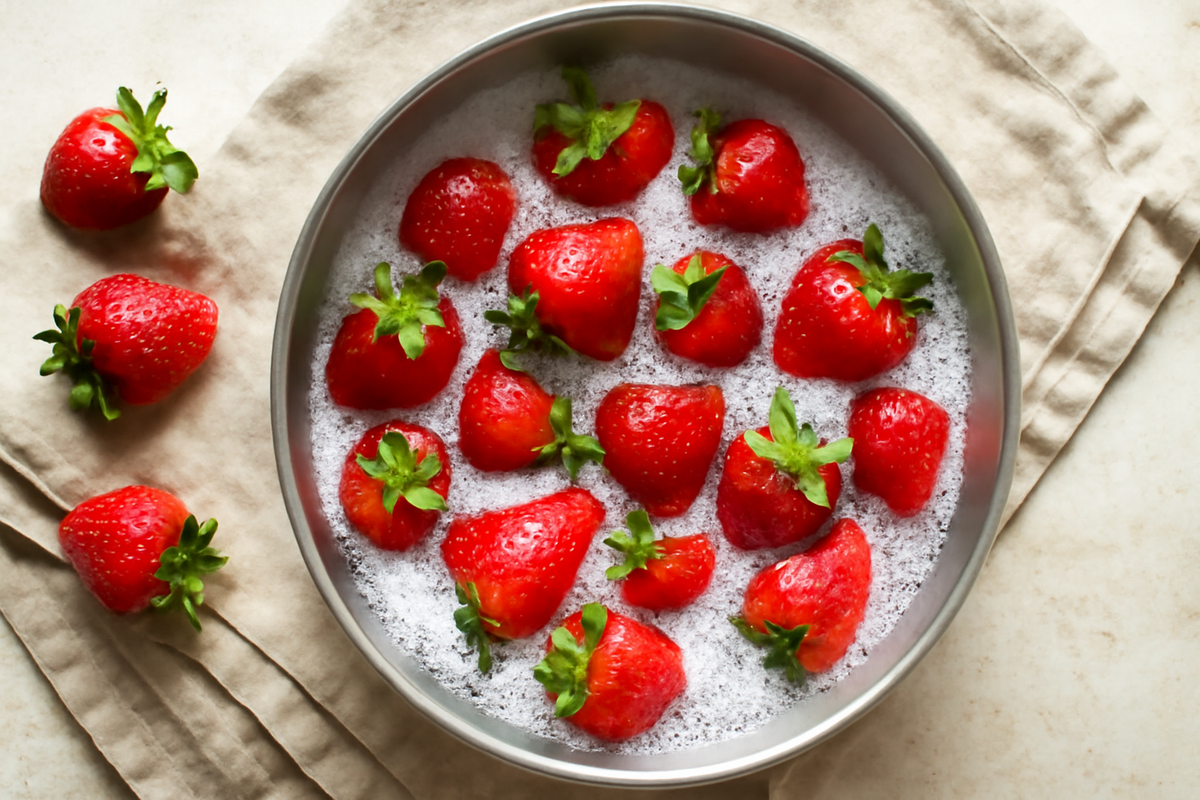
The first berry breaks under your teeth with a tiny sigh, that soft pop of a skin giving way. Sweet, sun-warm, a little wild at the edges. For a second, you taste nothing but June, and then—almost ghostlike—you notice something else. A faint grit. A weird, greenish speck clinging to a seed. The memory of that video you once saw of tiny bugs wriggling in fruit flashes through your mind, and just like that, the romance of the strawberry is gone.
The Myth of the Perfect Strawberry Rinse
Ask ten people how to clean strawberries and you’ll hear ten variations of the same ritual. Someone will swear by vinegar baths. Someone else will insist on soaking them in salt. Others say a simple rinse under running water is enough. And then there’s that friend who insists that if it came from the organic stall at the market, the dirt is “natural” and you can just eat it as is.
But when you start talking to people who actually study what clings to the surface of fruit—the food safety researchers, produce specialists, and agricultural extension folks—you hear a very different story. They’re not big fans of vinegar baths. They’re not impressed by a quick flick under the tap. And, maybe surprisingly, they aren’t interested in turning your kitchen into a chemistry lab either.
Instead, they describe something quieter, more practical, and almost tender. Not a hack. Not a “secret.” Just a way of handling strawberries that respects what they are: fragile forest jewels coated with microscopic stowaways—dust, soil, spores, and yes, sometimes insects—that don’t care if you paid extra for that punnet.
The Trouble With Vinegar, Salt, and Wishful Thinking
Vinegar-water recipes have taken the internet by storm. You’ve probably seen them: soak berries for 10–20 minutes in a vinegar bath, stand back in horror as the water turns cloudy and flecked with debris, then swear to never eat unwashed fruit again. It’s compelling, dramatic—and, experts quietly say, not the best idea.
First, there’s the reality of strawberry skin. Run your fingers gently over one. It’s not smooth like an apple or waxed like a citrus peel. It’s delicate, almost porous, packed with tiny surface folds and seeds. Vinegar doesn’t just dislodge dirt; it seeps into those folds. It can roughen the surface, draw out some of the berries’ own aroma compounds, and leave a faint tang that you may not notice until you’ve eaten half a bowl and wondered why they taste vaguely pickled.
Salt baths are no kinder. Salt is osmotically aggressive—it wants to pull water out of things. Leave strawberries in a salty soak long enough and they start to lose their spring, going from bright and perky to tired and watery. Both vinegar and salt can also accelerate spoilage by damaging the fruit’s outer cells, giving molds and bacteria an easier time getting in once you stash them in the fridge.
On the other side, there’s the “plain water is fine” camp. A fast rinse under the tap does wash away visible dust and a good share of loose microbes. But strawberries grow low to the ground, close to soil, splashing rain, and whatever the wind sends their way. Their textured skin gives debris plenty of places to hide. Running water over them like you’re trying to catch a train is better than nothing, but it’s not what you’d call thorough.
Food scientists land somewhere in between the drama of vinegar and the laziness of a half-hearted rinse. They talk, instead, about three deceptively simple ideas: time, motion, and gentleness.
The True Way: A Gentle, Three-Part Dance
The experts’ preferred method doesn’t lean on sharp acids or mouth-puckering salts. It uses cool clean water, a bit of patience, and your hands. Imagine it less as “disinfecting” and more as a kind of mini river the strawberries can swim through—one where dirt, spores, and tiny insects are coaxed away instead of blasted or pickled off.
1. The Soak That Isn’t Really a Soak
Fill a clean bowl with cool water—not icy, not warm. You don’t want shock; you want comfort. Place your strawberries in the bowl gently. Don’t dump them like rocks. Let them rest there for a minute or two, no more than five. This isn’t a long soak; it’s a pause. Just enough time for dry particles to loosen and float, for tiny air bubbles trapped in the berry’s folds to rise and escape.
In this quiet minute, gravity and water do what they’ve been doing in rivers for a few billion years: they separate the clingy from the clean. Dust, pollen, and dried soil begin to drift off. Some berries may release little chains of bubbles from around their seeds, like sighing out the day’s fieldwork.
2. The Hands-on Swirl
Now comes the part that food scientists emphasize the most: friction. Not the harsh scraping of a vegetable brush—strawberries are far too tender for that—but the soft, repetitive swish of your fingertips.
Slide your hand into the bowl and stir the water in wide circles so the berries roll and tumble over each other. With your fingers, gently turn each strawberry, cupping it, rubbing lightly with the pads of your fingers to reach around the stem, along the seeds, into the tiny creases. You’re not scrubbing; you’re coaxing. Think of brushing sand off a sleeping child, not scouring a pan.
This combination of motion and touch does what vinegar claims to do, but without the chemical roughness. It physically dislodges microorganisms and specks hidden in the berry’s natural architecture. In food safety terms, you’re reducing the “load”—not sterilizing (you can’t, and you don’t need to), but nudging the balance decisively in your favor.
3. The Double-Rinse and the Quiet Dry
When the minute of swirling is done, lift the berries out with your hands or a slotted spoon. Don’t pour the bowl over a colander; that just dumps all the freed dirt right back over them. Instead, move the strawberries into a second bowl or directly into a clean colander.
Now, give them a gentle second rinse under a cool, low-pressure stream of water. Turn the colander slowly with one hand while the other hand helps move berries so each gets its moment under the stream. You’re letting the last loose debris wash away, like the final waves smoothing sand after a storm.
Spread the berries out in a single layer on a clean kitchen towel or a few layers of paper towel. Pat them, one by one, with another towel. Not pressing hard, just enough to remove the surface water. Excess moisture is the enemy of shelf life; it invites mold. Dry strawberries keep their spring, their shine, and their perfume longer.
Only now, when they are clean and dry, should you hull them or cut them—if you’re going to eat them right away. If you plan to store them, keep the green tops on. That little leafy cap acts as nature’s cork, slowing down moisture loss and gradual decay from the inside.
Why This Gentle Ritual Works Better Than Vinegar
This quiet method might sound too simple in an era obsessed with “hacks,” but it lines up almost perfectly with what food safety research actually shows about washing fresh produce.
Microorganisms and dirt cling to fruit surfaces through a mix of tiny forces: surface tension, stickiness from dried plant sap, microscopic pockets where water can’t easily flow. Acids like vinegar can disrupt some of that, but at a cost to flavor and texture. Household disinfectants are unsafe. Specialty fruit washes show no consistent advantage over plain water plus friction.
What changes the game is how long the water is in contact with the surface, and how much gentle movement nudges that surface. The brief “soak” phase lets water slip into crevices. The swirling and finger-rubbing create small variations in pressure that lift debris away. The second rinse washes it all off. This is the mechanical magic: you’re not poisoning anything; you’re physically carrying it away.
And crucially, you’re preserving what makes a strawberry a strawberry: its delicate outer layer, its natural bloom, that faint, almost invisible sheen that keeps its aroma compounds from evaporating too fast.
How This Method Fits Into Real Life
Of course, it’s one thing to talk about careful berry-bathing in theory and another to actually make it part of your weeknight kitchen rhythm. The good news: once you get used to it, the whole process—from filling the bowl to laying the berries on a towel—takes less than five minutes for a standard box.
It also plays surprisingly nicely with how strawberries actually behave once you bring them home. Unwashed, they can sit in the fridge for several days, but there’s always that one hidden soft spot that blooms into a white fuzz before you’ve even opened the box again. Washed and thoroughly dried, then stored correctly, they can be both safer and, sometimes, slightly shorter-lived—but in a good way. You’re saying, “We’re eating these soon,” and then actually doing it.
Here’s a simple comparison to keep the details straight and make the choice that fits your habits:
| Method | What It Does | Pros | Cons |
|---|---|---|---|
| Quick tap rinse | Removes loose surface dirt | Very fast, no tools | Misses hidden debris, less effective on microbes |
| Vinegar or salt soak | Chemically disrupts some microbes, loosens dirt | Dramatic results in the bowl | Affects flavor, can damage texture, may hasten spoilage |
| Gentle bowl wash (expert method) | Combines time, gentle motion, and friction | Highly effective, preserves flavor and texture | Takes a few extra minutes, needs a bit of care |
Once you start using the expert method, you may notice something subtle: you eat strawberries more attentively. You hold each one. You see the tiny variations in shape, the way some smell like jam and others like green leaves. Cleaning becomes less of a chore and more like a small ritual before pleasure.
Storing, Timing, and the Art of Not Ruining a Perfect Berry
Cleansing strawberries properly is only half of the story. The rest is knowing when not to wash them, and how to live with the fact that, like all delicate things, they are temporary.
If you’re not eating them within a day, experts often suggest this: store them unwashed, in a breathable container. Remove any that already have soft spots or mold; one bad berry is like a whispering rumor in a crowd—it spreads more than you think. Line a shallow container with a paper towel, lay the berries in a single layer, and leave the lid slightly ajar or use a loosely covered container so moisture doesn’t build up.
Then, wash them with the gentle bowl method just before you eat. That’s the ideal. But life is rarely ideal, and sometimes you do need your strawberries ready to grab from the fridge—especially if small hands are involved, or mornings are rushed, or you simply know yourself well enough to accept that “I’ll wash them later” really means “they’ll die a slow, fuzzy death in the back of the crisper.”
In that case, it’s better to wash them once, properly, dry them thoroughly, and store them in a shallow, lined container with the lid barely cracked. Will they last quite as long as the unwashed? Probably not. Will they be safer, cleaner, and more likely to actually be eaten at their peak? Almost certainly.
And that’s the deeper point the experts keep circling back to: the “best” method is the one that balances safety, flavor, and reality. The gentle bowl method does this beautifully. It asks for a few more minutes and, in exchange, gives you strawberries that taste like themselves, without the tang of vinegar, without the grit of the field, and without the faint anxiety that you might still be crunching on unseen passengers.
Seeing Strawberries as They Really Are
In the end, this true way to clean strawberries isn’t just about sanitation. It’s about relationship. When you slow down long enough to swirl and touch and turn each berry, you remember something easy to forget in fluorescent grocery aisles: strawberries are not objects; they are small, perishable miracles of weather and soil and time.
They arrived in your kitchen carried by many hands, through fields and trucks and storerooms. Dust settled on them. Rain splashed them. Insects walked across them. Microbes explored their skins. None of this is a moral failing on the part of the fruit. It’s simply what it means to be alive in the world.
Your job, then, before that first bright bite, is not to wage chemical war but to offer a kind of welcome: a bowl of cool water, a gentle swirl, a soft drying. To take what the field offered and make it ready for the table, without stripping away its nature.
Later, when you sink your teeth into a clean, shining strawberry, you’ll taste something more than sweetness. You’ll taste the tiny act of care you put in—the hands-on seconds between the dirt and the dish, between fear and enjoyment, between the myth of “perfectly sanitized” and the honest, well-washed reality.
And maybe, as the juice runs down your fingers, you’ll understand why the experts say: no vinegar, no harsh tricks, no shortcuts. Just water, time, and touch. It turns out the truest way to clean a strawberry is also the most human.
FAQ
Do I really not need vinegar to clean strawberries?
No. Food safety research shows that clean, cool water plus gentle friction (your hands) is highly effective at removing dirt and reducing microbes. Vinegar can alter flavor and damage texture without offering a dramatic safety benefit for home use.
How long should I leave strawberries in the water?
One to five minutes is enough. You’re not aiming for a long soak, just enough time for particles to loosen. Any longer and you risk the berries absorbing too much water and becoming soft.
Should I remove the green tops before washing?
No. Leave the caps on while washing. They help protect the interior from absorbing excess water. Remove the tops only right before eating or using the strawberries.
Can I use a produce wash instead of just water?
Commercial produce washes generally don’t outperform plain water plus friction for berries. They are not harmful when used correctly, but they’re not necessary if you’re washing carefully with the bowl method.
Is it safe to wash strawberries in advance?
Yes, if you dry them thoroughly afterward and store them properly. They may not last quite as long as unwashed berries, but they’ll be clean and ready to eat, which often means they get enjoyed at their best instead of going to waste.
What if my strawberries are organic—do I still need to wash them?
Yes. Organic farming changes how crops are grown, not whether they collect dust, soil, pollen, and microbes. All strawberries, organic or not, should be washed before eating.
Can I use a brush to clean strawberries?
It’s not recommended. Strawberry skins are extremely delicate, and a brush can bruise or tear them. Your fingertips are the best tool: soft, responsive, and gentle enough to preserve the fruit.

Hello, I’m Mathew, and I write articles about useful Home Tricks: simple solutions, saving time and useful for every day.




