The dishwater had gone cold again. A limp gray film shimmered on the surface, smelling faintly of last night’s garlic and this morning’s eggs. You stand at the sink, hands hovering over the greasy skillet, feeling that tiny flicker of dread that always shows up sometime after dinner: the sink situation. The sponge smells suspicious, the dish soap seems to be giving up the fight, and the pan looks like it’s been varnished in bacon memory. You squeeze in more soap, swirl, scrub, rinse—and somehow everything still feels just a little… slimy. A little smelly. A little stressful.
The quiet power hiding in the salt jar
Somewhere behind you, tucked into a cupboard or sitting quietly by the stove, there’s a small jar that holds a secret. It doesn’t look like much—just grains, ordinary and familiar. But if you pick it up, twist the lid, and let it fall like sand into your palm, you can feel its presence in a different way: a faint rasp, a dry crunch, a subtle weight.
Salt has lived in our kitchens longer than dish soap has even existed, and yet, most of us never invite it to the sink. We keep it in the realm of flavor, seasoning soup and brightening tomatoes, never quite realizing that the same tiny crystals that make food sing can also strip a greasy pan of its shame. Dish soap, for all its scents and colors and promises of “triple power degreasing,” is sometimes just one small ally in a larger battle. Salt is the old, quiet friend you forgot to call.
When you bring the two together—salt and dish soap—they make a kind of unassuming magic. Not the kind that foams into extravagant bubbles to impress you, but the kind you feel at the level of texture and smell: a plate that squeaks under your fingers, a pan that smells like nothing at all, a sponge that suddenly feels new again.
The night I accidentally discovered the salt trick
The discovery, for many people, doesn’t arrive through a recipe or a cleaning blog. It comes in a moment of frustration. My own arrived on a weeknight when the kitchen felt like a low-grade disaster zone. The air smelled like fried onions and worry. A heavy cast-iron skillet lounged in the sink, wearing a thick, shiny coat of old oil that seemed personally offended by my attempts to clean it.
I squeezed a generous swirl of dish soap into the pan and turned on the tap. Warm water, a scrub brush, frustrated circular motions. The grease smeared but didn’t surrender. I rinsed, frowned, scrubbed again. Still that stubborn, slippery resistance. I could feel my shoulders creeping higher, that invisible stress of a chore that just won’t end.
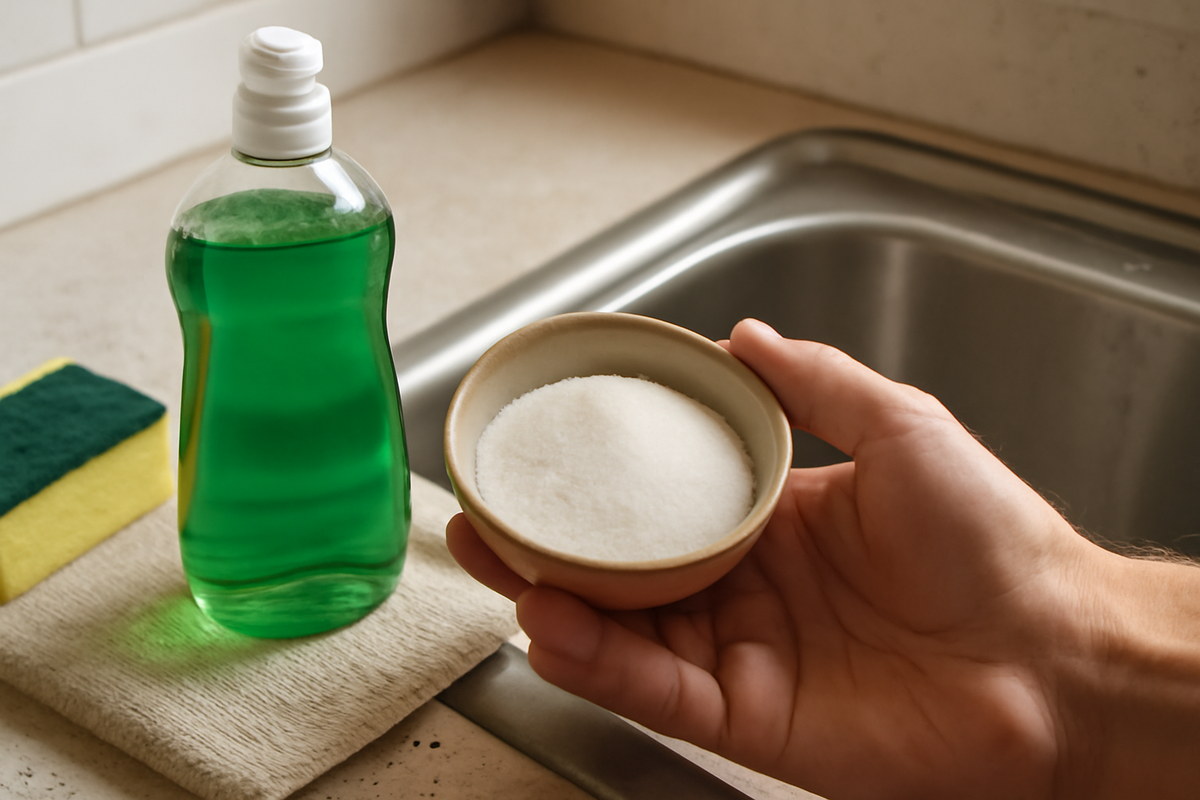
On the counter beside me sat a small bowl of coarse salt. I’d used it for dinner, to finish a salad, and hadn’t yet put it away. My hand moved almost without thinking: a sprinkle into the pan, a little avalanche of crystals meeting the soapy water with a delicate hiss and crunch.
Then, something shifted. The brush met resistance—a soft, sandy friction instead of that infuriating glide over slick oil. The grease loosened, clinging to the salt instead of to the metal. The smell faded as quickly as steam on a cold window. When I rinsed the pan, it felt… different. Clean in a way that needed no second guess. No ghost of oil. No lingering aroma. Just metal and water and the quiet satisfaction of done.
It felt like a trick, like I’d cheated some unwritten rule of kitchen drudgery. But it was just chemistry meeting texture, and a reminder that our kitchens are filled with simple helpers we forget to use.
Why salt in dish soap actually works (in real, physical terms)
Behind the small miracle of that skillet is a straightforward story your hands can feel before your brain explains it. Dish soap already knows how to handle grease: its molecules love to grab onto oil and hold it captive in water. But every grease splatter and baked-on sauce is its own tiny battlefield, and sometimes the surface they cling to makes the job harder.
Enter salt. Not as a harsh scrubber that scratches everything in its path, but as a kind of gritty companion, especially when you choose the right kind and the right moment. When you add salt to dish soap, several things happen at once:
- Gentle abrasion: Those tiny crystals create subtle friction. As you scrub, the salt acts like a hundred tiny fingertips, loosening stuck-on bits without needing heavy pressure.
- Helps break up oils: While salt doesn’t dissolve fat like soap does, it can disrupt the way oil clings to surfaces, especially in combination with heat and detergent. It gives the soap more openings to do its job.
- Odor reduction: Salt can help pull moisture and residue away from porous surfaces like wood or sponge fibers, and with that residue, a lot of the smell travels too.
- Texture feedback: As the salt dissolves or wears down, it gives you a physical cue: you can feel the movement from gritty to smooth as the surface gets cleaner.
The alchemy of it is tangible. You can feel the way a greasy pan goes from slick and evasive to honest and solid under your hand, simply because you invited a little salt into the mix. The kitchen starts to smell less like dishes waiting to be done and more like possibility.
The simple “salt & soap” method you can feel working
You don’t need a formula, but rituals are comforting, so here’s one that fits easily into a weekday night:
- Rinse off loose crumbs or sauce, but don’t stress about the stuck bits.
- Squeeze dish soap directly onto the pan, plate, or cutting board.
- Sprinkle a modest pinch of salt over the soapy area—enough to see a dusting, not a snowdrift.
- Add a splash of warm water, then start scrubbing with a sponge, cloth, or brush.
- Feel for the shift: first slightly gritty, then gradually smoother as grease and food lift away.
- Rinse and run your fingers lightly over the surface. It should feel clean in that unmistakable, almost squeaky way.
That’s it. No extra products, no mysterious sprays in neon bottles, just something you already own, stepping into a new role.
Where salt shines—and where it should step back
Like any good tool, salt has its place. The trick is learning where it quietly excels, and where it’s better to leave it on the shelf. Think of it not as a magic cure-all, but as an upgrade for certain moments.
| Use Case | How Salt Helps | Notes |
|---|---|---|
| Greasy pans & skillets | Adds grip and light abrasion so soap can lift oil faster. | Great for stainless, cast iron (with care), and enamel. |
| Cutting boards with strong odors | Helps scrub out garlic, onion, and fish smells. | Best on wood and plastic; rinse well afterward. |
| Smelly sponges | Salt and soap together help draw out residue and odors. | Use as a refresh; still replace sponges regularly. |
| Cloudy glassware & delicate dishes | Very gentle salt use can help with film. | Use fine salt & soft cloth; avoid heavy pressure. |
| Nonstick pans (caution) | Salt can be too abrasive for some coatings. | If used, go very light—or skip entirely. |
Salt is most comforting in the realm of the stubborn: the sticky caramelized edges of roasted vegetables, the glossy crescent of bacon fat lining a pan, the wooden spoon that smells suspiciously like last week’s curry. It excels anywhere you’d like just a hint more traction, a little extra courage against residue.
And it’s not just about the hardware. It quietly shifts the mood of the task itself. Scrubbing no longer feels like a wrestle with something that refuses to let go; it turns into a conversation with texture, a satisfying give-and-take between grit and smoothness.
Cleaning the things that remember: boards, spoons, and sponges
Some surfaces in the kitchen are storytellers. Wooden spoons remember the colors of sauces they’ve stirred. Cutting boards whisper faintly of garlic and onion long after you’ve washed them. Sponges become soft archives of every meal they’ve touched unless you intervene.
Salt with dish soap gives you a way to quiet those memories when you want a clean slate.
- Cutting boards: Sprinkle salt across the surface, add a line of dish soap, and use your hand, a cloth, or half a lemon as a scrubber. You’ll feel the grain of the wood rise under your fingers, the salt working into the tiny grooves where smells like to hide. Rinse with warm water and let it dry upright. The board feels lighter somehow, less haunted by meals past.
- Wooden spoons and spatulas: Lay them flat, dab on dish soap, and massage in a pinch of fine salt. Focus on the part that regularly meets the pan. Rinse and towel dry. The wood regains a kind of honest neutrality.
- Sponges and scrubbers: When a sponge smells faintly off but isn’t yet destined for the trash, soak it briefly in warm water, then squeeze out most of the liquid. Add dish soap and sprinkle salt directly onto it. Work the salt into a lather, then rinse thoroughly. It won’t resurrect a dead sponge, but it can gently extend the life of one that’s starting to go sideways.
There’s a small emotional relief in this kind of cleaning. It’s not just about hygiene; it’s about feeling like your tools are ready for what comes next, not burdened by what came before.
Stress, control, and the small rituals that anchor us
A kitchen sink can be a barometer for how the day is going. When dishes pile high, it’s never just about plates and pans. It’s about time that slipped away, about tired feet, about that text you still haven’t answered and the email that arrived with an edge of urgency. Standing at the sink can feel like standing at the edge of all of that.
Using salt in your dish soap will not fix your schedule, but it can shift your experience of this one small moment. There is a special kind of ease in feeling something work efficiently under your hands. The pan that used to require ten minutes of angry scrubbing suddenly submits in three. The cutting board stops arguing with your nose. The sponge regains a bit of dignity.
These small wins matter more than we admit. The kitchen is a place of repeated labor—chopping, stirring, wiping, washing. When you discover that a simple, old ingredient can smooth just one of those loops, it feels like someone quietly loosened a knot in your day.
There’s also a deeper psychological comfort in turning to something simple and natural. Salt doesn’t come in a clever bottle or a limited-edition scent. It doesn’t ask you to memorize instructions or wonder if you’re using it “right.” It just pours out of its jar, waits on your palm, and shows up in the water, ready to do the work alongside you.
Creating your own tiny kitchen ritual
You can turn the salt-and-soap pairing into a ritual that lightly bookmarks the end of a meal:
- After cooking something especially greasy or fragrant, leave a little bowl of salt by the sink.
- When you’re ready to wash, pause for just a breath before you start. Notice the weight of the pan, the smell in the air.
- Add your soap, then scatter the salt—it makes a soft, almost musical sound as it hits the surface.
- As you scrub, pay attention to the way the texture shifts, the way the smell recedes, the way the water changes from cloudy to clear.
It’s a tiny, tactile meditation, tucked into something you have to do anyway. A way to let your mind rest in sensation for a moment: warm water, squeaky-clean metal, the quiet of a kitchen transitioning from working space to resting space.
Choosing and using salt wisely
You don’t need anything fancy for this trick. The salt you already have is almost certainly enough. But a few small choices can fine-tune the experience:
- Fine salt vs. coarse salt: Fine salt dissolves faster and offers smoother abrasion—ideal for delicate surfaces like glass or enamel. Coarse salt provides more grip and is lovely on sturdy pans and wood, as long as you aren’t using aggressive force.
- How much to use: Start small. A pinch or two is often enough. You’re enhancing the soap, not burying it. Too much salt can be wasteful and harder to rinse.
- Temperature of water: Warm water helps soften grease, letting the salt and soap work together more easily.
- Surfaces to treat gently: On nonstick pans, glossy plastics, or very delicate glasses, use fine salt with a tender touch—or skip salt entirely if you’re nervous. When in doubt, test a tiny patch first.
What matters less is the “perfect” technique and more that you let yourself experiment. Your kitchen, your tools, your meals—your version of this little trick will probably evolve over time. The important part is knowing it’s there when you need just a bit more help than soap alone seems to offer.
From chore to small satisfaction
There are days when the kitchen feels like a battleground, and days when it feels like a refuge. Either way, the sink is always there: a shallow basin where evidence of daily life piles up. You cook, you eat, you live—and the dishes bear witness.
Bringing salt to the sink doesn’t transform the task into a party. It’s humbler than that. It makes things easier. Faster. More tactilely satisfying. The pan that once filled you with quiet dread becomes just another surface you know how to handle. You start to trust your own small hacks and instincts a bit more. You notice the way the scent in the kitchen softens after you’ve scrubbed a cutting board salted with soap. You feel that shift from sticky to clean in your fingertips and realize your shoulders have dropped a little.
In a world full of complicated solutions and specialized products, there’s something almost comforting—gentle, grounded—in discovering that a scoop of salt and a squeeze of dish soap can quietly change your evenings. A small, old ingredient, stepping into the light of a new job, turning a stubborn mess into something simple and solvable.
Tonight, when you stand at the sink and look down at whatever the day has left behind, you’ll know. You can reach for the bottle of soap and, right beside it, the salt jar. Let the crystals fall, feel the texture change, inhale the cleaner air afterward. Let the grease, the odor, and just a bit of the day’s stress swirl down the drain with the cloudy water.
FAQ
Can I mix salt directly into my dish soap bottle?
It’s better not to. Salt can change the thickness and behavior of the soap over time and may not dissolve evenly. You’ll get more control and better results by adding a pinch of salt only when and where you need it—directly onto the dish or sponge.
Will salt scratch my pans or dishes?
Used gently and in small amounts, salt is usually safe for sturdy surfaces like stainless steel, enamel, and wood. For delicate glassware, nonstick coatings, or glossy plastics, choose fine salt, use a soft cloth, and keep your pressure light. When in doubt, test a small area first.
Does this work with any kind of dish soap?
Yes, most regular liquid dish soaps pair well with salt. The soap handles the grease chemically, while the salt adds physical help through light abrasion and better grip. Whether your soap is scented, unscented, plant-based, or conventional, the basic partnership is the same.
Is using salt in dishwashing eco-friendly?
Salt is a simple, naturally occurring mineral and can sometimes help you use less soap and fewer specialized cleaning products. While it doesn’t replace dish soap, it can make your existing soap more effective and reduce the need for extra degreasers and odor-removers.
Can I use salt and dish soap on cast-iron pans?
Yes, but with care. Use a modest amount of salt and a little soap only when the pan is especially greasy or smelly, and avoid harsh scrubbing that might strip the seasoning. Rinse well, dry thoroughly, and follow up with a thin layer of oil if you notice the surface looking dry.
Will salt really help remove odors from cutting boards?
It can help a lot. Salt, combined with dish soap and gentle scrubbing, works into the tiny grooves of wood and plastic where smells cling. For very strong odors, you can repeat the process or follow with a quick rinse of diluted vinegar—but often, salt and soap alone make a surprising difference.
How often should I use this salt-and-soap method?
Use it when you need it most: after cooking oily meals, cutting strong-smelling ingredients, or when your sponge and boards feel a bit “tired.” For everyday light washing, plain dish soap may be enough. Think of salt as your quiet extra helper, waiting in the wings for the tougher jobs.

Hello, I’m Mathew, and I write articles about useful Home Tricks: simple solutions, saving time and useful for every day.