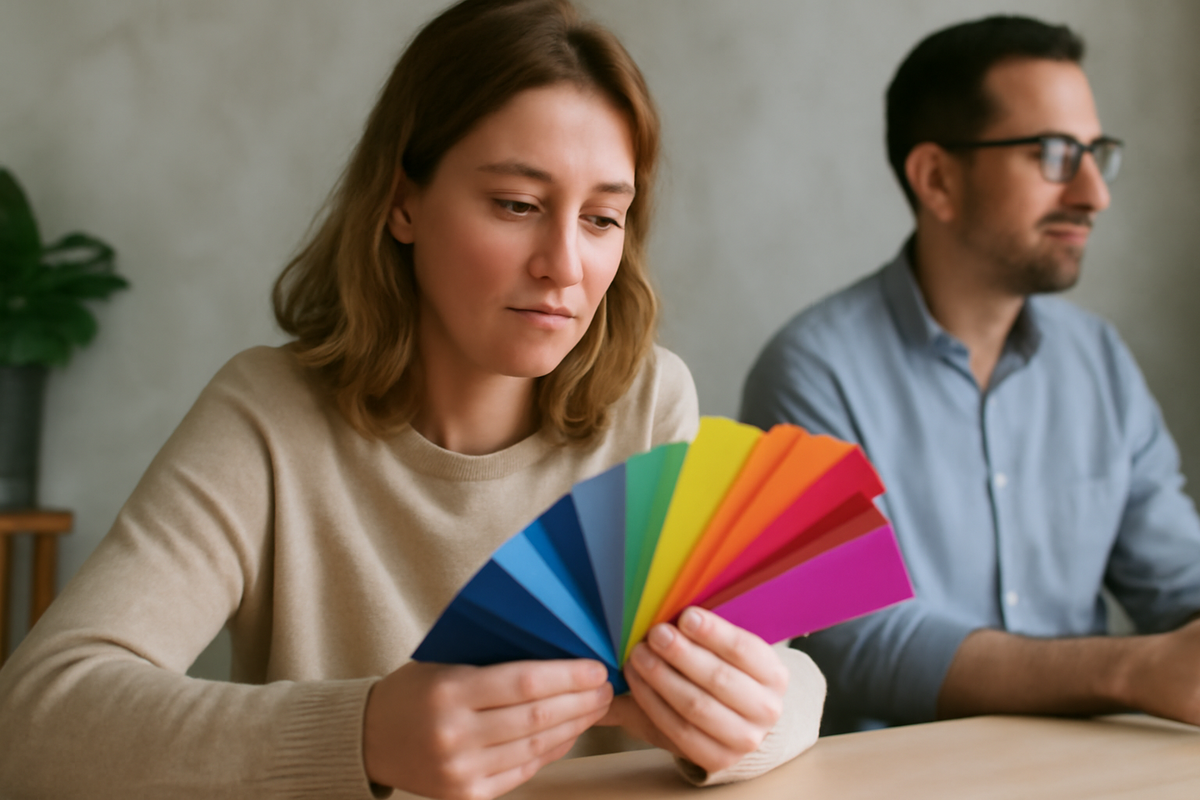
The first thing you notice is the blue. It is everywhere and nowhere at once—stitched into the sky, glimmering off car windows, humming faintly from a stranger’s scarf on the train. You watch a little boy in a supermarket reach past the bright red apples and electric green candies and plant his hand decisively on the bluest box on the shelf, as if he has been waiting his whole short life to choose it. His mother laughs. “Of course you picked blue,” she says. “You always do.”
It makes you wonder: when we say “my favorite color is blue,” what are we really saying? Are we quietly confessing something about who we are—or who we want to be? Or is it just a story we’ve been repeating since kindergarten because someone once asked us, and we thought we needed an answer?
The Strange Intimacy of “What’s Your Favorite Color?”
There’s something disarming about that question. Not “What do you do?” or “Where are you from?” but “What’s your favorite color?” It’s the kind of thing a child might ask on a playground, but adults ask it too—on awkward first dates, in personality quizzes, in late-night conversations when the lights are low and the room feels safe.
Say “black,” and you might get a raised eyebrow. Say “yellow,” and people will smile as if they’ve just learned you keep sunshine in your pocket. Say “green,” and they’ll picture you walking through forests or tending a row of herbs on a windowsill. Colors carry shadows of meaning, unspoken but persistent.
Psychologists have been fascinated by this for decades. Can color really reveal deeper traits—introversion, optimism, impulsiveness, calm? Color psychology sits at this uneasy crossroads where science, culture, marketing, and myth all meet. On one side are studies about how red jerseys might influence sports outcomes, or how blue lighting could help calm nervous patients. On the other side are critics who argue that most of what we believe about color is wishful thinking dressed up as research, tangled in social norms and personal experiences.
Still, the question lingers like a soft echo: when we choose a favorite color, are we just picking something pretty, or choosing a reflection of ourselves?
The Silent Stories Hiding Inside Each Color
Walk into any forest at dusk and notice how the colors shift as the light drains away. Greens deepen into shadow; browns grow velvety and indistinct. What felt bright and clear an hour ago now seems mysterious, layered, alive with stories. Our emotional response to color works a bit like that—subtle, context-dependent, and often invisible until someone asks us to look closely.
Hold your own favorite color in your mind for a moment. Picture it as vividly as you can: a red like fresh raspberries, or a blue like the sea when a storm is still far away. Maybe it’s not even a pure color but something in between—a smoky teal, a dusty rose, a muted olive that only makes sense on a rainy day. It’s rarely just the color itself that matters. It’s the memories braided into it: the bedroom wall you stared at as a teenager, the sweater someone you loved always wore, the first bike you ever owned.
Color psychologists often talk about “associations,” the links our brains form between colors and feelings or concepts. Red is urgency, heat, danger, desire. Blue is stability, trust, distance, calm. Yellow is energy, caution, brightness. Green is growth, balance, renewal. But these are not laws of nature—they’re more like cultural habits, shared stories, and personal imprints.
To make things more tangible, imagine sitting across from someone at a café, steam rising from your cups, and they tell you their favorite color. Without realizing it, you might start building a quiet, private sketch of them in your mind.
| Preferred Color | Common Traits People Expect | How People Often Want to Be Seen |
|---|---|---|
| Blue | Calm, dependable, thoughtful | Trustworthy, stable, emotionally steady |
| Red | Passionate, bold, impulsive | Confident, powerful, not afraid to be seen |
| Green | Balanced, nurturing, grounded | Caring, stable, in tune with nature |
| Yellow | Cheerful, creative, energetic | Optimistic, playful, open to new ideas |
| Purple | Intuitive, imaginative, unique | Deep, artistic, slightly unconventional |
| Black | Mysterious, guarded, strong-willed | Sophisticated, in control, hard to read |
| White | Organized, cautious, idealistic | Clean, clear-minded, morally consistent |
These are impressions, not diagnoses. Yet they seep into our everyday choices: the color of our phone case, our shoes, our living room walls. Sometimes, strangely, we avoid the colors we love the most because they feel too vulnerable, too revealing, like a confession we are not ready to make out loud.
Where Science Meets the Spectrum (and Starts Arguing)
Color psychology as a field is a bit like a prism held up to the sun: beautiful, complicated, and easy to misinterpret if you only look from one angle. There are studies suggesting that color can nudge our emotions and behaviors. People working in blue-tinted rooms, for instance, have sometimes been found to perform better on tasks that require focus, while red can heighten alertness and even boost performance on tasks that need quick, detailed attention. Marketers lean heavily on these findings—painting “buy now” buttons in high-contrast hues, bathing sale signs in red.
But there are also problems. Many of the famous findings in color psychology are hard to replicate consistently. What calms one person may irritate another. A color that signals danger in one culture might symbolize luck or celebration in another. White is purity at a Western wedding and mourning at some Eastern funerals. Red is a stop sign on one street and a joyous festival on another.
When it comes to favorite colors and personality traits, the evidence becomes even foggier. Some studies have found loose correlations—people who prefer blue score slightly higher on traits like agreeableness, for example, while red-lovers sometimes score higher on dominance or extroversion. But “slightly higher” is not destiny. It’s a whisper, not a commandment.
Still, humans love patterns. We want our favorite color to mean something—something flattering, if possible. It’s comforting to believe that loving green makes us balanced or connected to nature, that choosing purple means there is something rarefied and original about us. In this sense, color psychology becomes less about strict science and more about narrative: a story we tell ourselves in shades and tones, filling in the blanks with what we hope is true.
When Color Feels Like Home: The Personal Side of the Palette
Imagine opening your closet right now and running your fingers across the fabric. What color do you touch most? Maybe your hangers swing with near-identical shirts in just-slightly-different blues. Maybe your drawers are a quiet ocean of black and gray, broken by one rebellious red sweater that you almost never wear. Maybe you have a collection of earth tones because they make you feel, inexplicably, like you belong in your own skin.
Our lives are filled with micro-moments of color choice: choosing the mug for morning coffee, the case for our laptop, the shade of the ink we buy. We rarely explain these decisions out loud, yet they add up to something—a kind of visual fingerprint we leave on the spaces we touch.
You might find, if you trace your colors backward, that they lead you to strange and tender places. The soft green of the blanket your grandmother always tucked around you. The burnt orange of a childhood kitchen where the air smelled like cinnamon. The harsh fluorescent yellow of a school bus that took you somewhere you were afraid to go. These experiences linger not as clearly worded memories, but as flashes of feeling attached to hue.
In that sense, your favorite color is less a personality test and more a doorway. It opens into a series of rooms in your past where you felt safe, powerful, curious, or seen. When you say, “I love this color,” you might really be saying, “I love the version of myself that shows up when this color is near.”
This is part of why color psychology is so hard to pin down in neat, measurable units. The same navy blue that makes one person feel secure might remind another of an authority figure they feared. The same bright red that thrills one person could hum with anxiety for someone else. Color is not just light—it’s biography.
Culture, Context, and the Quiet Bias in the Rainbow
Imagine two people standing in front of a vivid red wall. One grew up in a place where red means celebration: lanterns and weddings and lucky envelopes. The other grew up where red was the color of reprimand: the pen teachers used to mark mistakes, the lights on top of police cars. They are looking at the same wall, but what they feel is not the same.
Color meanings are heavily sculpted by culture. In Western advertising, blue is the go-to color for banks and insurance companies—stability, trust, the emotional equivalent of a firm handshake. In other contexts, blue might be associated with mourning or spiritual distance. Green is “eco-friendly” in one place, sacred in another, unlucky somewhere else. Even within the same country, generational differences appear: one person’s “feminine pink” is another person’s “punk pink” or “genderless neon.”
Layered on top of culture is context. A dark room lit only by a red “exit” sign feels different from a summer carnival draped in red flags. A blue ocean beneath a bright sky feels liberating; the same blue painted on the walls of a cramped office might feel sterile or sad. A color is never just itself—it is always in relationship: to light, to space, to purpose, to the other colors around it.
So when someone claims, confidently, that “people who like yellow are extroverts,” or “black means you’re depressed,” they’re skipping over a vast terrain of nuance. Yes, there are patterns. We can’t ignore that. Many people around the world do report similar feelings about certain basic colors. But these patterns are starting points for curiosity, not shortcuts to judgment.
The more we learn about how differently people see and internalize color, the more color psychology itself becomes humble. Its bold claims soften. Instead of huge declarations—“Your favorite color defines you”—we get quieter questions: “What might this color mean to you?” “What part of your story does it belong to?”
Playing With Your Own Palette: What Your Favorite Color Might Be Whispering
Forget, for a moment, what the books and articles say about color. Instead, think about the palette of your days. Which color do you reach for when you’re tired and need comfort? Which one feels like courage when you wear it? Which shade feels too loud, or too honest, to touch often?
It can be interesting to treat your favorite color not as a verdict on your psyche, but as a gentle conversation with yourself. If you love blue, does it feel like a cool distance you’re protecting—or an open sky you trust? If you adore red, does it feel like permission to take up space—or a mask you wear so no one sees your quiet parts? If you gravitate toward muted neutrals, do they soothe your senses—or help you disappear?
You might even notice that your favorite color has changed over time. Maybe you were a “pink person” in childhood, a “black phase” teenager, a “green, always green” adult. Each shift can say something about what you needed at that moment: softness, protection, grounding. We edit our color preferences in the same way we edit our playlists, our wardrobes, even our handwriting—tiny, evolving expressions of how we want to move through the world.
Color psychology, in its gentlest, most honest form, is not about slapping labels on people. It’s about asking better questions. It reminds you to notice the quiet choices: why your room feels wrong until you add a certain color pillow, why you buy the notebook in that specific shade even when you told yourself you have enough already.
Maybe the real power of favorite colors is that they give us a language beyond words. Sometimes it’s easier to say “today I feel gray” than to detail every nuance of our mood. Sometimes wearing yellow is the bravest sentence we can write on our body: I am trying to believe in light again.
Between Science and Story: Why Color Still Divides Opinions
Ask a neuroscientist about favorite colors and they might tell you about cones in the retina, or how the brain processes wavelengths of light. Ask a marketer and they’ll talk about conversions, attention, and brand identity. Ask an artist and you’ll hear about harmony, contrast, the way one color makes another vibrate or vanish. Ask a skeptic and they’ll roll their eyes at pop-psych quizzes that promise to reveal your soul from a single shade.
All of them are right, and all of them are incomplete. Color is physical—electromagnetic radiation bounced and bent into visibility. It is psychological—tied to memory, expectation, and emotion. It is social—taught, reinforced, and sometimes weaponized by culture. And it is personal—a private, often tender connection between what we see and what we feel.
This is why color psychology continues to divide opinions. The temptation to oversimplify is strong. It’s so satisfying to believe that loving purple means you’re mystical or that choosing blue proves you’re sincere. These neat categories feel comforting in a chaotic world. But real people are messier than palettes and richer than spectrums. We are mosaics, not monochromes.
Still, even the harshest critics of color psychology might admit there’s something powerful about the way a single color can change a room, a mood, a memory. Think of hospital walls repainted from cold white to warm peach. Think of protest movements uniting behind a single color on shirts and banners. Think of a tiny child insisting all their clothes be one particular shade, as if that hue is the only thing standing between them and a world too big to understand.
So perhaps the most honest answer to the question “Does your favorite color reveal deeper traits?” is: Sometimes. A little. In ways that are real but rarely simple. Color will not tell your whole story. But it might tell the opening line of a chapter you haven’t fully read yet.
Tonight, when the sun sinks and your room softens into blues and grays, notice what happens to you. Notice which colors linger around your bed, your desk, your reflection in the mirror. Ask yourself, very quietly, not “What does this color say about me?” but “Why does this one feel like home?” You might find that the answer says more about you than any quiz ever could.
FAQ
Does my favorite color really say anything about my personality?
It can offer clues, but it’s not a reliable diagnosis. Your favorite color often reflects personal memories, cultural meanings, and how you want to feel or be seen, rather than fixed, measurable traits. Think of it as a conversation starter with yourself, not a verdict.
Why do my favorite colors change over time?
As your life circumstances, values, and emotional needs shift, the colors that comfort or energize you can change too. A former love for dark, protective colors might give way to lighter, softer tones when you feel safer or more open, and vice versa.
Are some colors scientifically proven to affect mood?
Some studies suggest trends—for example, red can increase alertness while blue can support focus or calm—but results are mixed and heavily influenced by personal and cultural context. Colors can nudge mood, but they don’t control it.
Do different cultures experience color psychology differently?
Yes. Meanings attached to colors vary widely across cultures. White may symbolize purity in one culture and mourning in another; red may signal danger in some contexts and luck or joy in others. Any interpretation of color has to be read through a cultural lens.
How can I use color more intentionally in my daily life?
Start by noticing how different colors actually make you feel in specific spaces. Use calming tones where you rest, energizing ones where you work or create, and accent colors that express how you want to show up in the world. Experiment, pay attention to your reactions, and let your own experience guide you more than rigid rules.

Hello, I’m Mathew, and I write articles about useful Home Tricks: simple solutions, saving time and useful for every day.