The first time I saw a pool noodle in a kitchen, I laughed. It lay there on the counter like something that had escaped a summer afternoon and wandered into the wrong season. Outside, the sky was the color of dishwater—January, grey and restless—and inside, my friend Emma was cutting a bright turquoise noodle into neat little sections beside a pile of wooden spoons and spatulas.
“You’re going to think I’ve lost my mind,” she said, sliding one of the foam pieces into the back of a drawer. “But this thing is about to change your life.”
And it did. Not dramatically, not in a fireworks-and-fanfares way. More like the slow relief of finally finding the light switch in a dark room you’ve been stumbling through for years. A pool noodle, it turns out, is less a toy and more a surprisingly brilliant tool when it comes to taming the hidden chaos of a kitchen.
The moment you realize your kitchen isn’t working
Most kitchens don’t announce their disorganization; they whisper it. You feel it in the quiet frustrations: the drawer that won’t close because a whisk is jammed sideways, the clatter of lids every time you reach for a single pot, the measuring spoons that play hide-and-seek at the back of a dusty corner.
There’s that one drawer—everyone has it—where things go to be forgotten. Loose batteries, rubber bands, dried-out markers, a mystery key, three soy sauce packets, and one bent paperclip. You slide it open, feel vaguely annoyed, push it shut. Another day, maybe.
We tell ourselves the kitchen is small, that we need more cabinets, more shelves, more expensive organizers. But often what we really need is to make better use of the spaces we already have, especially the awkward ones: the deep drawers where everything tips forward, the under-sink cavern where bottles fall over like dominoes, the narrow gaps where crumbs and spatulas both go to disappear.
The magic of the pool noodle is not that it’s fancy or clever or Instagram-pretty. It’s that it’s simple, soft, incredibly cheap, and far more adaptable than it looks. It shapeshifts into exactly what your kitchen needs, one snip at a time.
The surprising charm of a foam tube
Hold a pool noodle in your hands and you’ll notice a few things right away. It’s light. It bends but doesn’t break. It’s firm enough to hold shape yet forgiving enough not to scratch, dent, or clang. It doesn’t rust, warp, or crumble. It takes up space without feeling heavy.
In a kitchen, that combination is gold.
Most of our storage problems are about space and friction. Items slide, roll, bump, rattle. Glass meets metal with a crash. Platters lean precariously; lids tumble; baking trays scatter like cards. The noodle solves these problems one by one by doing something beautifully simple: it fills just enough space, in just the right way, to keep everything else in line.
There’s also something disarming about it. A pool noodle is deeply unserious. It’s associated with cannonballs and shrieks and the slap of water on skin, not with meticulous organization. That lightheartedness makes it easier to experiment. You don’t have to “do it right.” You can slice it, test it, move it, remove it, change your mind. The stakes are low, but the payoff can be high.
So you start with one noodle. Then you pick a problem spot. And somewhere between the scissors and the first test fit, you realize: this is a kind of quiet, playful problem-solving. It’s organization as tinkering, not as perfection.
1. Drawer dividers that actually fit your life
Open your utensil drawer and listen: the soft clink of metal, the sliding shuffle as everything shifts forward each time you close it. It’s like a tiny, daily avalanche. Even if you already use plastic or bamboo organizers, they never seem to fit perfectly. There’s always an odd gap—too narrow for a full-sized section but too big to ignore.
This is where the pool noodle starts to feel like a secret tool. Instead of buying another container, you use the noodle as a custom-fit brace.
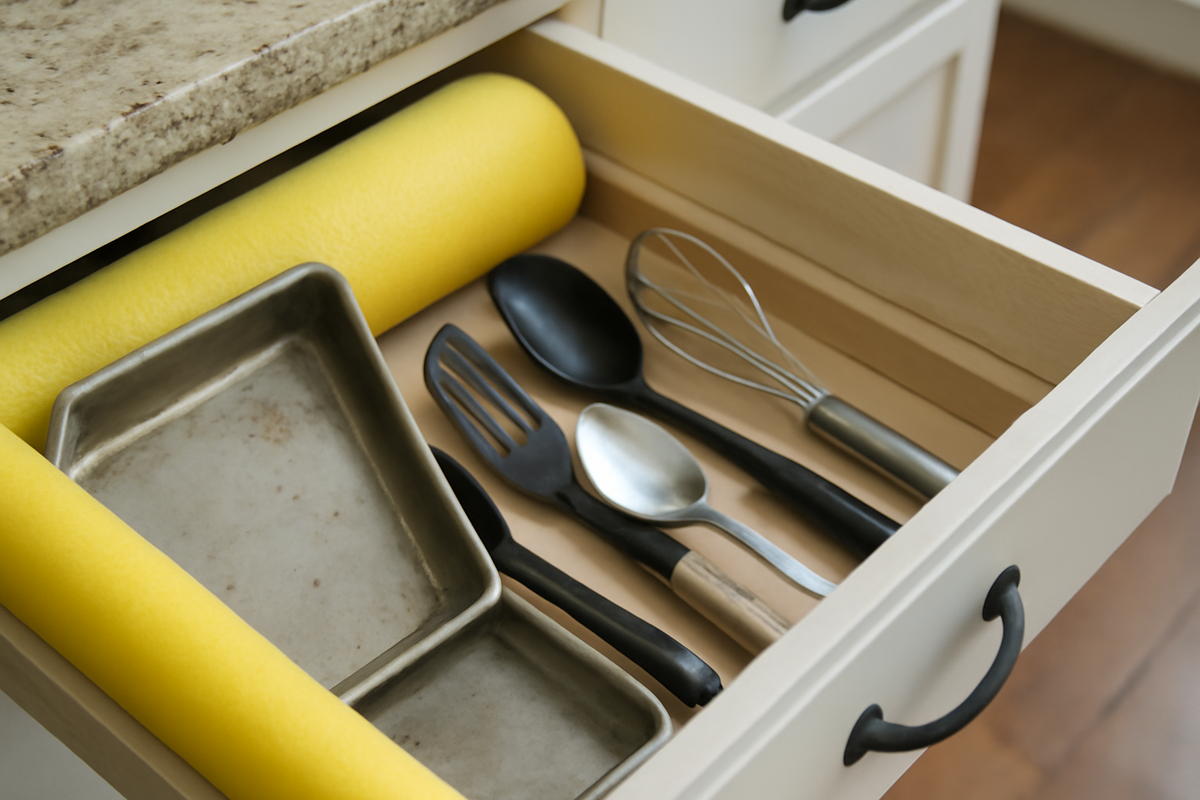
Cut a piece of noodle the exact width of the drawer. Wedge it at the very back, behind your utensil trays, right where things usually slide and tilt. Suddenly, when you close the drawer, the tray doesn’t slam backward or drift. It stays where you put it. The spoons stay in their lane. The forks don’t wander.
Have a narrow gap beside your main tray? Slice a lengthwise strip off the noodle to make a thinner bumper and slide it into that empty space. Now it becomes a gentle wall, keeping stray chopsticks, straws, skewers, and reusable bag clips corralled instead of scattered.
Better yet, you can layer the trick: a full round piece at the back, a half-moon along one side, maybe a slender wedge as a spacer between two organizers you already own. Every cut is custom. The drawer conforms to your habits instead of forcing you to adapt to it.
2. The under-sink oasis you never thought possible
The cabinet under the sink is where hope goes to die. It’s always a bit damp, a bit dark, and a bit chaotic, with cleaning bottles knocking over like bowling pins whenever you reach for the one you actually want. Plus there’s that looming S-shaped pipe, stealing headroom and forcing everything to huddle around it in an awkward circle.
A pool noodle, sliced open lengthwise, becomes a kind of soft exoskeleton for all that plumbing. Slip it over the pipe and suddenly there’s protection from bangs and scrapes. No more clanging buckets or bruised knuckles as you blindly shove a spray bottle toward the back.
Now cut a few shorter sections and line them along the sides or back of the cabinet as bumpers. Tuck them behind rows of bottles or cleaners to keep them standing. If you like to store rolls of trash bags upright, use noodle rings—slices about two inches thick—as flexible little corrals that hug the roll and keep it from tipping.
The cabinet transforms from “I don’t want to open that” to “I know exactly where that is.” And the best part is that it only took a few minutes and a tool you usually associate with pool games, not a complete overhaul or pricey custom inserts.
3. Vertical storage without the clatter
There’s a quiet bravery in deciding to store things vertically. Baking sheets, cutting boards, platters: they all look so satisfyingly tidy when they stand shoulder to shoulder. But getting to that point often means metal racks, sharp clinks, and too much visual noise. Or, if you skip the racks altogether, they slump and slip into an unsteady lean.
Here again, the humble foam cylinder comes to the rescue as a stabilizer and silence-maker.
Imagine a deep drawer where you store cutting boards and trays upright. Cut a pool noodle into long strips and lay them along the front and back of the drawer. Each strip becomes a gentle spine, a padded barrier the boards can lean against without knocking. If you want individual “slots,” you can create them by adding small notches along the noodle, creating scalloped rests where each board can nestle lightly.
In a cabinet, you can run a noodle strip along the bottom back edge, so that when boards lean, their base doesn’t slide out from under them. Add another piece along one side as a buffer: a vertical cushion that keeps them from shifting every time the cabinet door opens.
The result is that familiar satisfaction: quiet, organized, and surprisingly elegant for something that began life as a pool toy.
4. Cushioning the fragile, the precious, and the loud
Some kitchen items demand gentleness: the wine glasses that tap nervously against each other on a shelf, the serving platters you inherited, the cast-iron lids that thud loudly against the pot. We pad and stack and carefully slide, but the worry is always there—a chip, a crack, a bang that wakes the whole house.
A pool noodle, cut with intention, becomes a soft armor.
Cut thin rings of foam and slip them over the stems of wine glasses before you nestle them close together on a shelf or in a box. Place a long, narrow slice along the back of a cabinet shelf so that anything fragile resting against the wall leans into the noodle instead of bare wood or tile.
Stacking pans? Run a strip of noodle around the rim of the lid that always seems to clang against the pot when you put it away. Or create simple spacers: two or three short pieces laid between stacked platters or baking dishes so glass never meets glass directly. You get the same snug fit but with a whisper-soft buffer in between.
It’s not just about sound, though the softening of the kitchen’s clatter is its own quiet relief. It’s about the way this small, colorful tube grants you permission to treat your everyday objects with a little more care—without adding plastic clutter or complicated systems.
5. Taming cords, gaps, and invisible frustrations
Some of the messiest parts of a kitchen aren’t visible until you look closely: the cords that snake behind appliances, the awkward gap between the stove and the counter where crumbs vanish, the slender sliver between the fridge and the wall where nothing useful fits.
These are the spaces that nibble away at your sense of calm. You don’t always see them, but you know they’re there—the stuck crumb, the unreachable olive oil cap, the plug that never quite reaches the right outlet.
Take a pool noodle and slice it lengthwise. For the gap beside your stove, cut a piece to size and gently wedge it into place like a soft, removable bridge between surfaces. Suddenly, no more lost utensils, no runaway veggies rolling into the abyss. You can remove it easily to wash, unlike rigid metal strips that scratch or bend.
For cords, noodle rings become simple cable organizers. Cut a small slit into a ring and slide the cord through. You can color-code if you like—blue for the mixer, yellow for the kettle—or just enjoy the fact that the cords are no longer a tangled snarl. They loop neatly instead of sprawling.
Have an appliance that rattles gently against a backsplash or wall when it’s in use? A tiny wedge of pool noodle behind it can absorb that vibration. The kitchen feels quieter, more intentional, less on edge—little irritations slipping away, one foam piece at a time.
A tiny tool, a big shift in how you see your space
The beauty of using a pool noodle to organize your kitchen isn’t that you’ll suddenly have a magazine-perfect space. It’s that the space will finally feel like it’s working with you, rather than against you. You cut, test, adjust. You listen for the absence of clatter, notice the way drawers close smoothly, feel the ease of reaching for exactly what you need.
Somewhere in that process, the kitchen changes from a place of low-grade friction to a place of quiet support. It becomes a room that doesn’t just house your tools, but respects the way you move through your day.
What starts with a single noodle and a pair of scissors can expand into a gentle reimagining of your whole kitchen. Not a renovation. Not a spending spree. Just calm, incremental changes—foam bumpers and spacers and silencers that tuck invisibly into corners, behind trays, along shelves.
And maybe that’s what makes this hack feel so refreshing. It’s not about buying more. It’s about noticing more. Noticing the drawer that sticks, the lid that clangs, the glass that feels slightly at risk—and then softening that experience with a tool that’s both playful and practical.
Before long, the pool noodle becomes something else entirely: a reminder that small, almost silly solutions can carry a surprising amount of wisdom. That the path to a more organized, more peaceful kitchen doesn’t have to be rigid or serious. It can be flexible, bright, and delightfully low-tech.
Simple ideas at a glance
Here’s a quick look at how different pieces of a single noodle can quietly reshape your kitchen:
| Pool Noodle Use | Where to Use It | What It Solves |
|---|---|---|
| Full-length bumper | Back of utensil drawers | Stops trays and cutlery from sliding |
| Half-moon strip | Side gaps in drawers or cabinets | Creates custom dividers for odd spaces |
| Short cylinders | Under-sink area, bottle rows | Keeps bottles upright and cushioned |
| Thin rings | Around glass stems, cords, rolls | Protects fragile items and tames tangles |
| Lengthwise slit piece | Over pipes, between stove and counter | Covers harsh edges, blocks gaps, adds safety |
One noodle. A handful of cuts. A kitchen that feels softer, smarter, more tuned to your life.
Somewhere on a high summer day, kids will still whack each other with these foam tubes and splash in bright blue water. But back in your quiet, ordinary kitchen, that same shape will be doing a different kind of work—holding space, easing tension, and proving that sometimes, the most transformative tools are the ones we’ve been overlooking all along.
Frequently Asked Questions
Can I use any type of pool noodle in the kitchen?
Yes. Most standard foam pool noodles work well. Choose one that is firm enough to hold shape but not so dense that it’s hard to cut. Smooth-surface noodles are easier to wipe clean than highly textured ones.
How do I cut a pool noodle safely?
Use a sharp kitchen knife or a sturdy pair of scissors. Work on a stable surface, and cut slowly with steady pressure. For lengthwise cuts, lightly mark a line first, then follow it carefully to keep the piece even.
Is it safe to use pool noodles near food?
As long as the foam doesn’t come into direct contact with food, it’s fine for most households. Use noodles as spacers, bumpers, and dividers around containers, trays, and tools—not as surfaces for serving or storing unwrapped food.
How do I clean the pool noodle pieces?
Wipe them with a damp cloth and mild soap, then let them air-dry completely before putting them back. For heavily used pieces, you can rinse them under warm water, squeeze out excess, and dry thoroughly.
Will the foam break down or crumble over time?
With regular indoor use, most noodles last a long time. If you notice any crumbling, cracks, or strong odors, it’s best to replace that section. Because one noodle yields many pieces, swapping out old ones is simple and inexpensive.
Can I reuse the pieces if I reorganize my kitchen later?
Absolutely. That’s one of the biggest advantages. You can pull out, trim, re-cut, or move pieces as your storage needs change, instead of committing to fixed organizers.
Does this work in very small kitchens?
It works especially well in small kitchens. Pool noodle pieces help you tailor every drawer, cabinet, and gap so that no space is wasted. They give you the function of custom organizers without the cost or bulk.

Hello, I’m Mathew, and I write articles about useful Home Tricks: simple solutions, saving time and useful for every day.